
Key Takeaways
- A quantitative beta-hCG blood test is the most accurate way to confirm pregnancy — it detects hCG as early as 6-8 days after ovulation, several days before a missed period
- At DCDC, the beta-hCG blood test costs AED 149 with same-day results — no fasting or special preparation required
- Home urine pregnancy tests are 97-99% accurate when taken after a missed period, but blood tests detect lower hCG concentrations (as low as 5 mIU/mL vs 20-50 mIU/mL for urine tests)
- Normal hCG levels roughly double every 48-72 hours during the first 8-10 weeks of pregnancy — your doctor may order serial tests to confirm a viable pregnancy
- False negatives are far more common than false positives — testing too early, dilute urine, or certain medications can all cause a misleading negative result
- After a positive result, schedule your first prenatal visit between weeks 6-8 for a dating ultrasound and initial blood panel to establish your pregnancy care plan
Whether you have just missed a period, are experiencing early symptoms, or are actively trying to conceive, getting a reliable pregnancy test in Dubai is one of the first steps toward confirming a pregnancy and beginning prenatal care. While home urine tests offer convenience, a beta-hCG blood test at DCDC provides the earliest, most accurate detection — measuring the exact level of human chorionic gonadotropin in your blood as early as six to eight days after ovulation, well before most home tests can deliver a reliable result.
This guide covers everything you need to know about pregnancy testing in Dubai in 2026: how each test type works, when to take them, what your hCG numbers mean, how much they cost, and what to do after a positive result. Based on current clinical guidelines and reviewed by Dr. Parisa Dini, OB-GYN at Doctors Clinic Diagnostic Center (DCDC) in Dubai Healthcare City.
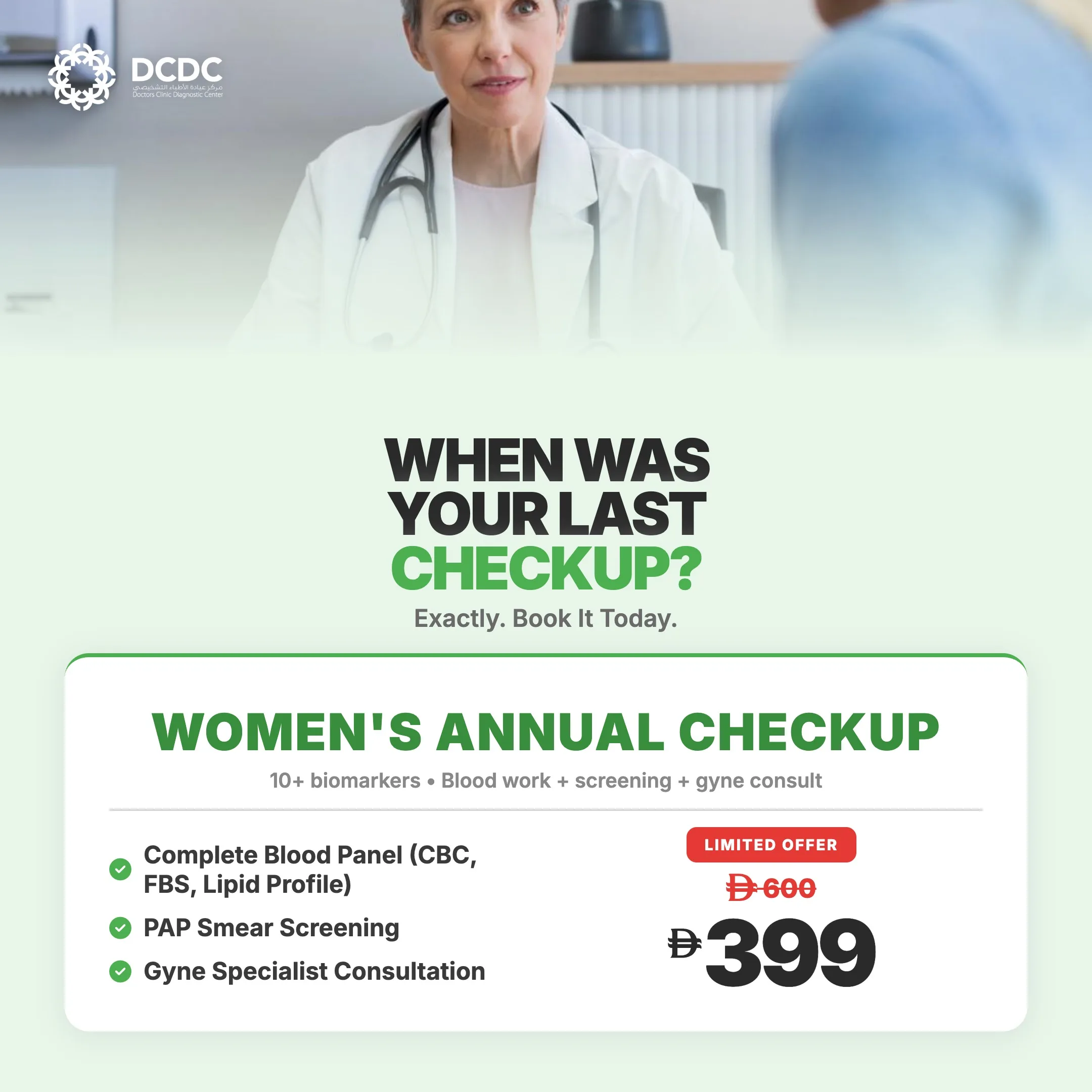
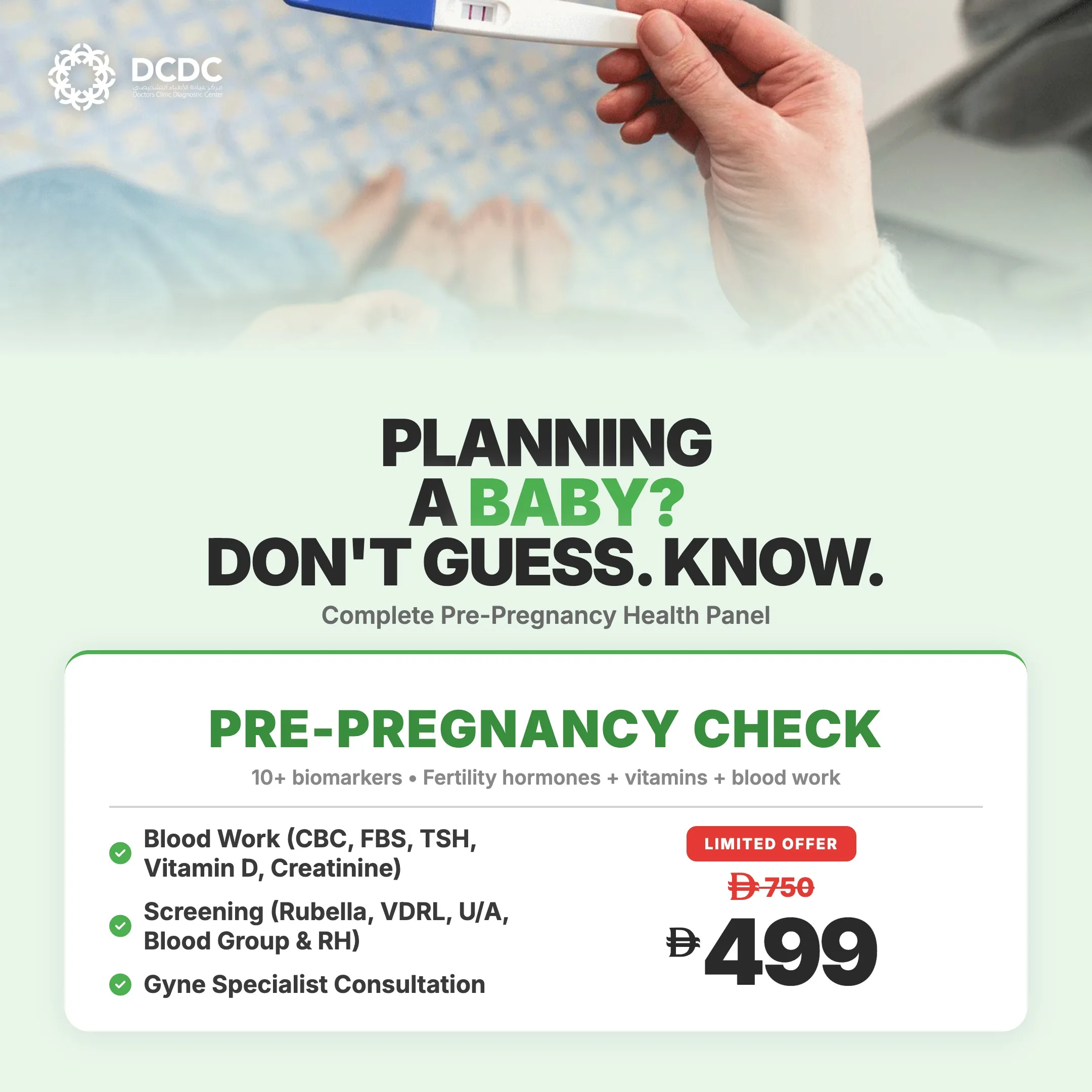
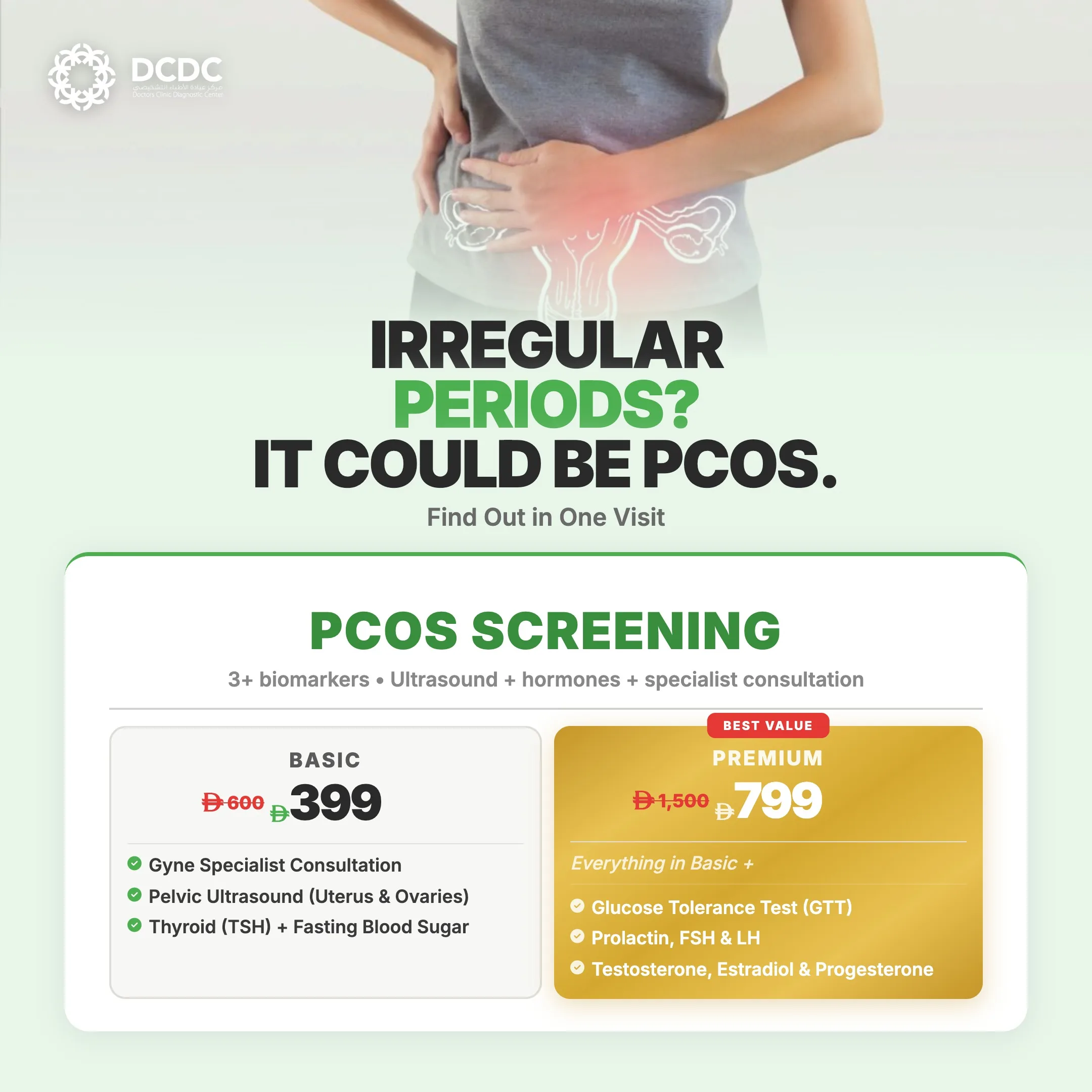
Health Screening Packages
Save with our bundled screening packages — specialist consultation included



What Is a Pregnancy Test and How Does It Work?
All pregnancy tests — whether a home urine strip or a laboratory blood draw — work by detecting human chorionic gonadotropin (hCG), a hormone produced by the placenta shortly after a fertilised egg implants in the uterine wall. Implantation typically occurs 6-12 days after ovulation, and hCG production begins almost immediately afterward.
In early pregnancy, hCG levels rise rapidly. The hormone enters the bloodstream first and then filters into the urine, which is why blood tests can detect pregnancy earlier than urine-based tests. According to the American College of Obstetricians and Gynecologists (ACOG), hCG can be detected in blood as early as 6-8 days post-ovulation, while most urine tests require higher concentrations that are not reached until around the time of a missed period — roughly 14 days after ovulation.
The sensitivity of a pregnancy test refers to the minimum hCG concentration it can detect, measured in milli-international units per millilitre (mIU/mL). Laboratory blood tests can detect hCG at concentrations as low as 5 mIU/mL, whereas most over-the-counter urine tests have a threshold of 20-50 mIU/mL. This difference in sensitivity is the primary reason blood tests confirm pregnancy days earlier than home tests.
Types of Pregnancy Tests Available in Dubai
Home Urine Pregnancy Tests
Home pregnancy tests are widely available at pharmacies throughout Dubai, including major chains such as Aster Pharmacy, Life Pharmacy, and BinSina. They use antibodies on a test strip that react with hCG in your urine, producing a visible line, plus sign, or digital reading. Most brands sold in the UAE — including Clearblue, First Response, and local equivalents — have a sensitivity of 20-25 mIU/mL, meaning they can reliably detect pregnancy from the first day of a missed period.
- Standard tests — detect hCG at 25 mIU/mL; reliable from the day of your expected period
- Early detection tests — detect hCG at 10-15 mIU/mL; may detect pregnancy up to 5-6 days before a missed period, though accuracy is lower at that stage
- Digital tests — display "Pregnant" or "Not Pregnant" (some estimate weeks since conception); same sensitivity as standard tests but easier to read
Home tests are best taken with first morning urine, when hCG is most concentrated. Drinking large amounts of water before testing can dilute urine and produce a false negative, particularly in very early pregnancy.
Qualitative Blood Pregnancy Test
A qualitative blood test simply reports a yes or no answer — pregnant or not pregnant. It detects the presence of hCG above a threshold (typically 5 mIU/mL) but does not measure the exact amount. This test is sometimes used in emergency departments or when a quick clinical confirmation is needed.
Quantitative Beta-hCG Blood Test
The quantitative beta-hCG test — the type offered at DCDC — measures the exact concentration of hCG in your blood, reported as a number in mIU/mL. This is the most informative pregnancy test because it not only confirms pregnancy but also provides clinical data that your doctor uses to:
- Estimate gestational age in very early pregnancy (before ultrasound dating is possible)
- Monitor whether hCG is rising at a healthy rate (roughly doubling every 48-72 hours in early weeks)
- Identify potential complications such as ectopic pregnancy, threatened miscarriage, or molar pregnancy when levels do not follow expected patterns
- Track hCG decline after a pregnancy loss or treatment to ensure levels return to baseline
Your doctor may order serial beta-hCG tests — two or more tests spaced 48-72 hours apart — to evaluate the trend. A single hCG value is less meaningful than the pattern of rise or fall over time.
Blood Pregnancy Test vs Home Urine Test
Choosing between a home urine test and a blood test depends on your situation, timing, and what information you need. Here is a side-by-side comparison:
| Feature | Home Urine Test | Blood Test (Beta-hCG) |
|---|---|---|
| Detection threshold | 20-50 mIU/mL | 5 mIU/mL |
| Earliest detection | 1-2 days before missed period | 6-8 days after ovulation |
| Accuracy after missed period | 97-99% | Over 99% |
| Result type | Positive / Negative | Exact hCG number (mIU/mL) |
| Results available | 2-5 minutes | Same day (at DCDC) |
| Cost in Dubai | AED 15-60 (pharmacy) | AED 149 (DCDC) |
| Fasting required | No | No |
| Can estimate gestational age | No | Yes (with reference ranges) |
| Can detect ectopic risk | No | Yes (via serial testing) |
| Where to get it | Any pharmacy | Clinic or lab |
For women who have been trying to conceive, have a history of ectopic pregnancy or miscarriage, or are experiencing symptoms like spotting or cramping, a quantitative blood test provides critical information that a home test cannot. For women who simply want an initial confirmation after a missed period, a home urine test is a reasonable first step — with a follow-up blood test to confirm and begin prenatal care. You can read more about what blood tests are ordered during pregnancy in our pregnancy blood test guide.
Understanding Beta-hCG Levels by Week
After a positive test, one of the first questions patients ask is whether their hCG level is normal. Beta-hCG levels vary enormously between individuals, so the rate of rise matters more than a single number. The table below shows approximate ranges published by the American Pregnancy Association and widely referenced in clinical practice:
| Weeks Since Last Menstrual Period | Typical hCG Range (mIU/mL) |
|---|---|
| 3 weeks (1 week after ovulation) | 5-50 |
| 4 weeks | 5-426 |
| 5 weeks | 18-7,340 |
| 6 weeks | 1,080-56,500 |
| 7-8 weeks | 7,650-229,000 |
| 9-12 weeks | 25,700-288,000 |
| 13-16 weeks | 13,300-254,000 |
| 17-24 weeks | 4,060-165,400 |
| 25-40 weeks | 3,640-117,000 |
Several important points about interpreting hCG levels:
- Wide normal ranges — at 6 weeks, hCG can be anywhere from 1,080 to 56,500 mIU/mL and still represent a perfectly healthy pregnancy. A single value that falls within range is reassuring but not diagnostic on its own
- Doubling time — in early pregnancy (below approximately 6,000 mIU/mL), hCG should roughly double every 48-72 hours. As levels rise above 6,000 mIU/mL, the doubling rate slows, and levels eventually plateau and begin to decline after the first trimester
- Slow rise or declining levels — hCG that rises more slowly than expected, plateaus too early, or decreases in the first trimester may indicate an ectopic pregnancy, non-viable pregnancy, or impending miscarriage. Your doctor will correlate hCG trends with ultrasound findings before reaching conclusions
- Very high levels — unusually elevated hCG may occur with twin or multiple pregnancies, molar pregnancy, or certain chromosomal conditions. An ultrasound is needed to determine the cause
- hCG after pregnancy loss — levels should decline to below 5 mIU/mL after a miscarriage or treatment. Serial testing confirms complete resolution
When to Take a Pregnancy Test
Timing significantly affects accuracy. Testing too early — before enough hCG has accumulated — is the most common reason for a false negative result.
Optimal Timing for Each Test Type
- Blood test (beta-hCG) — can detect pregnancy as early as 6-8 days after ovulation, or about 1 week before your expected period. For the most reliable single result, test on or after the day of your expected period
- Home urine test (standard) — wait until the first day of your missed period for 97-99% accuracy. Testing earlier reduces reliability significantly — at 4 days before a missed period, sensitivity drops to roughly 50-60%
- Home urine test (early detection) — may detect pregnancy up to 5-6 days before a missed period, but accuracy at that point is only about 60-75%. Confirm with a follow-up test if the first result is negative
Early Symptoms That Prompt Testing
Common reasons women in Dubai visit DCDC for a pregnancy test include:
- Missed or late period (the most reliable early indicator)
- Breast tenderness or swelling
- Nausea or vomiting (morning sickness, which can occur at any time of day)
- Unusual fatigue or drowsiness
- Frequent urination
- Light spotting or cramping (which may indicate implantation)
- Positive home test requiring clinical confirmation
- Irregular cycles making it difficult to identify a missed period
How Accurate Are Pregnancy Tests?
When used correctly and at the right time, modern pregnancy tests are highly accurate. However, no test is perfect, and understanding the limitations helps you interpret your result with confidence.
Blood Test Accuracy
Quantitative beta-hCG blood tests are over 99% accurate when performed at an appropriate time. False results are extremely rare with laboratory blood testing and are almost always related to very unusual medical conditions (such as heterophilic antibodies that interfere with the assay) rather than test error.
Home Urine Test Accuracy
According to a systematic review published in the Journal of Clinical Medicine, home pregnancy tests achieve 97-99% accuracy when taken on or after the day of a missed period. However, real-world accuracy is lower because many women test before this point. Studies show that when tested 1-3 days before a missed period, sensitivity ranges from 46% to 89% depending on the brand and hCG threshold.
Causes of False Negative Results
- Testing too early — the most common cause; hCG has not reached detectable levels yet
- Dilute urine — drinking excessive fluids before testing reduces hCG concentration
- Late implantation — in some pregnancies, the embryo implants later than average, delaying hCG production
- Ectopic pregnancy — may produce hCG at slower rates than normal intrauterine pregnancy
- Expired or improperly stored test — heat and humidity in Dubai can degrade test reagents if stored outside recommended conditions
Causes of False Positive Results
False positives are uncommon but can occur due to:
- Chemical pregnancy — a very early pregnancy loss where hCG was produced briefly; technically the test was correct, but the pregnancy did not continue
- Fertility medications containing hCG — injections such as Ovidrel or Pregnyl can cause a positive test for up to 10-14 days after administration
- Recent miscarriage or abortion — residual hCG may persist in the body for several weeks
- Evaporation line — reading a home test result after the specified time window (usually 5-10 minutes) can cause a faint evaporation line that is mistaken for a positive
What to Expect at DCDC
Getting a pregnancy test at Doctors Clinic Diagnostic Center in Dubai Healthcare City is straightforward, with no appointment required for a walk-in blood draw. Here is what the process looks like:
- Arrival and registration — check in at reception in Building 64, Block A, Al Razi Medical Complex. Free dedicated parking is available on site. The clinic is open Saturday to Thursday from 8 AM to 10 PM and Friday from 9 AM to 9 PM, making it easy to visit before or after work
- Blood draw — a phlebotomist collects a small blood sample from your arm. The draw takes under five minutes, no fasting is required, and there are no dietary restrictions beforehand
- Same-day results — your quantitative beta-hCG results are available the same day and accessible through the DCDC patient portal. For urgent cases, results can be expedited
- Consultation (if needed) — if your test is positive, you can book a follow-up consultation with Dr. Parisa Dini or another OB-GYN at DCDC to begin prenatal care immediately. If your result is negative but you still suspect pregnancy, your doctor may recommend a repeat test in 48-72 hours
- Insurance — DCDC works with 20+ insurance partners including Daman, AXA, Bupa, MetLife, and Cigna with direct billing, so there is no need to pay out of pocket and claim later
Prefer to test from home? DCDC offers home blood collection — a nurse visits your location, collects the sample, and your results are delivered through the patient portal. Home collection adds AED 199 per visit on top of the test price.
Pregnancy Test Cost in Dubai (2026)
Cost is a practical consideration, particularly for women who may need serial testing. Here is a breakdown of pregnancy test costs in Dubai:
| Test Type | DCDC Price (AED) | Typical Dubai Range (AED) |
|---|---|---|
| Home urine test (pharmacy) | 15-60 | 15-60 |
| Beta-hCG blood test (quantitative) | 149 | 100-300 |
| Beta-hCG with home collection | 348 (149 + 199 collection) | 350-500 |
| Serial beta-hCG (2 tests over 48-72 hours) | 298 (2 × 149) | 200-600 |
At DCDC, the beta-hCG blood test is AED 149 — a fixed, transparent price with no hidden consultation fees for the blood draw itself. If you opt for home sample collection, a single visit fee of AED 199 covers the nurse visit regardless of how many tests are collected in the same draw. Multiple tests collected in one home visit incur only one collection fee.
Many insurance plans in Dubai cover pregnancy-related blood work, including beta-hCG, as part of maternity benefits. DCDC handles pre-authorisation directly with your insurer, so you can check your coverage at the time of your visit without needing to call your insurance company separately.
Weeks 4-5: Confirm and Begin Prenatal Vitamins
Weeks 6-8: First Prenatal Visit
- A dating ultrasound to confirm the pregnancy is intrauterine, check for a heartbeat (usually visible from week 6-7), and estimate your due date
- A comprehensive blood panel — CBC, blood type and Rh factor, rubella immunity, hepatitis B, HIV screening, thyroid function, and vitamin D levels
- Review of your medical history, current medications, and any risk factors
- Discussion of prenatal screening options, including NIPT (non-invasive prenatal testing) available from week 10
Weeks 11-14: First Trimester Screening
Related Services at DCDC
Expert care and advanced diagnostics at Dubai Healthcare City
Frequently Asked Questions
Next Steps After a Positive Pregnancy Test
A positive pregnancy test — whether from a home kit or a blood draw — is the beginning of a process, not the end. Here is a recommended timeline for the first weeks:
If you tested positive with a home kit, confirm with a quantitative blood test to establish your baseline hCG level. Begin taking a prenatal vitamin with at least 400 mcg of folic acid (the WHO and ACOG both recommend starting folic acid supplementation ideally before conception and continuing through the first trimester to reduce the risk of neural tube defects). Stop alcohol, smoking, and any non-essential medications — consult your doctor about which prescriptions are safe to continue.
Schedule your first prenatal appointment with an OB-GYN. At DCDC, this visit typically includes:
Between weeks 11 and 14, your doctor will offer first-trimester screening, which may include a nuchal translucency (NT) ultrasound and blood markers (PAPP-A and free beta-hCG) to assess the risk of chromosomal conditions such as Down syndrome. The anomaly scan is performed later, typically between weeks 18 and 22, for a detailed anatomical survey of the baby.
Sources & References
This article was reviewed by our medical team and references the following sources:
Medical content on this site is reviewed by DHA-licensed physicians. See our editorial policy for more information.

Written by
Dr. Parisa Dini
Obstetrics and Gynecology
MD, Obstetrics and Gynecology
Dr. Parisa Dini is an Obstetrician and Gynecologist at Doctors Clinic Diagnostic Center (DCDC) in Dubai Healthcare City.
Related Articles
Pregnancy Blood Test Dubai: Cost & Guide (2026)

NIPT Test Dubai: Cost, Accuracy & Timing (2026)
Anomaly Scan Dubai: Cost, Timing & Results (2026)

HSG Test Dubai: Price, Procedure & Insurance (2026)

Fertility Tests Dubai: Couple's Checklist (2026)
More in Women's Health

Ovarian Cancer Warning Signs Dubai (2026)
Read MoreEmsella vs Incontinence Surgery Dubai (2026)
Read More
Double Marker Test Dubai: Timing, Results & Price (2026)
Read More
Emsella Side Effects & Safety Dubai (2026)
Read More
FSH & LH Test Dubai: Day 3 Levels, Ratio & Price
Read MoreNIPT Test Dubai: Cost, Accuracy & Timing (2026)
Read More© 2026 Doctors Clinic Diagnostic Center (DCDC), Dubai Healthcare City. Originally published at https://doctorsclinicdubai.ae/blog/pregnancy-test-dubai-types-accuracy. All rights reserved. Unauthorized reproduction is prohibited.