

Book Your Appointment
Verified Patient Reviews of DCDC Diagnostic Center in Dubai
Verified reviews and real patient stories from Dubai Healthcare City
Arumima & kabita ps were excellent in handimg the special kid for blood test Thank you
Tej G.
I had a great experience at this diagnostic center. Everything was handled smoothly from start to finish. The booking and reception process was efficient, and Ms. Jochele made the transaction quick and seamless. Special thanks to Ms. Anu for the blood test—she was very gentle, and the injection was almost painless. The clinic is clean, well-organized, and has a pleasant environment. Overall, the service was excellent. Thank you to the entire team for your professionalism and care!
Emily F.
I had an wonderful day at Doctors Clinic Diagnostic Centre in Dubai. Doctor Shahoo Mazhari, the cardiologist, she was very professional and kind. This world needs a helpful people like you. The Lab Anu Ashok, very gentle and made me comfortable during my bloody test. The Filipinos receptionist, thanks for being friendly... I'm very thankful for everyone 🙏 Highly recommended DCDC ❤️🌎
Antari F.






Pregnancy Blood Test (Beta-HCG) in Dubai: Early and Accurate Detection
Quantitative beta-HCG blood testing for early pregnancy confirmation, ectopic monitoring, and viability assessment
A pregnancy blood test in Dubai measuring beta human chorionic gonadotropin (beta-HCG) is the most sensitive and accurate method of confirming pregnancy and monitoring its early development. Beta-HCG is a hormone produced exclusively by the trophoblast cells of a developing placenta, detectable in the blood from as early as 8 to 10 days after fertilisation, several days before a missed period and significantly earlier than a urine pregnancy test. At DCDC in Dubai Healthcare City, we offer an early pregnancy blood test with both qualitative and quantitative HCG blood tests, providing not merely a yes or no result but a precise numerical value that your doctor uses to assess pregnancy viability, progression, and potential complications.
The critical distinction between a qualitative and quantitative beta-HCG test lies in clinical utility. A qualitative test indicates simply whether HCG is present or absent above a detection threshold. A quantitative test measures the exact concentration in milli-international units per millilitre (mIU/mL), which carries far greater diagnostic value. In a normal intrauterine pregnancy, beta-HCG levels approximately double every 48 to 72 hours during the first trimester, a predictable pattern known as the beta-HCG doubling time. Serial quantitative measurements allow your doctor to confirm appropriate rise, detect abnormal patterns suggesting ectopic pregnancy or miscarriage, and guide clinical decisions about ultrasound timing and intervention.
Ectopic pregnancy, in which the fertilised egg implants outside the uterus, most commonly in the fallopian tube, is a potentially life-threatening emergency that affects approximately 1 to 2 percent of all pregnancies. In ectopic pregnancy, beta-HCG levels typically rise but at a subnormal rate, failing to double appropriately over 48 hours. This abnormal doubling pattern, identified through serial quantitative measurements, is one of the earliest clinical clues that prompts urgent investigation. Molar pregnancy, a rare gestational abnormality caused by abnormal fertilisation, characteristically produces markedly elevated beta-HCG levels — often tens or hundreds of thousands of mIU/mL — disproportionate to gestational age.
- Earliest DetectionDetects pregnancy from 8-10 days post-conception, before missed period
- Quantitative PrecisionExact HCG level for doubling time calculation and viability monitoring
- Same-Day ResultsExpert radiologist interpretation delivered within 24 hours at our Dubai Healthcare City facility.
- Ectopic MonitoringSerial testing protocol to detect abnormal implantation patterns early

Dr. Hadi Komshi
Specialist Internal Medicine·Laboratory & Diagnostics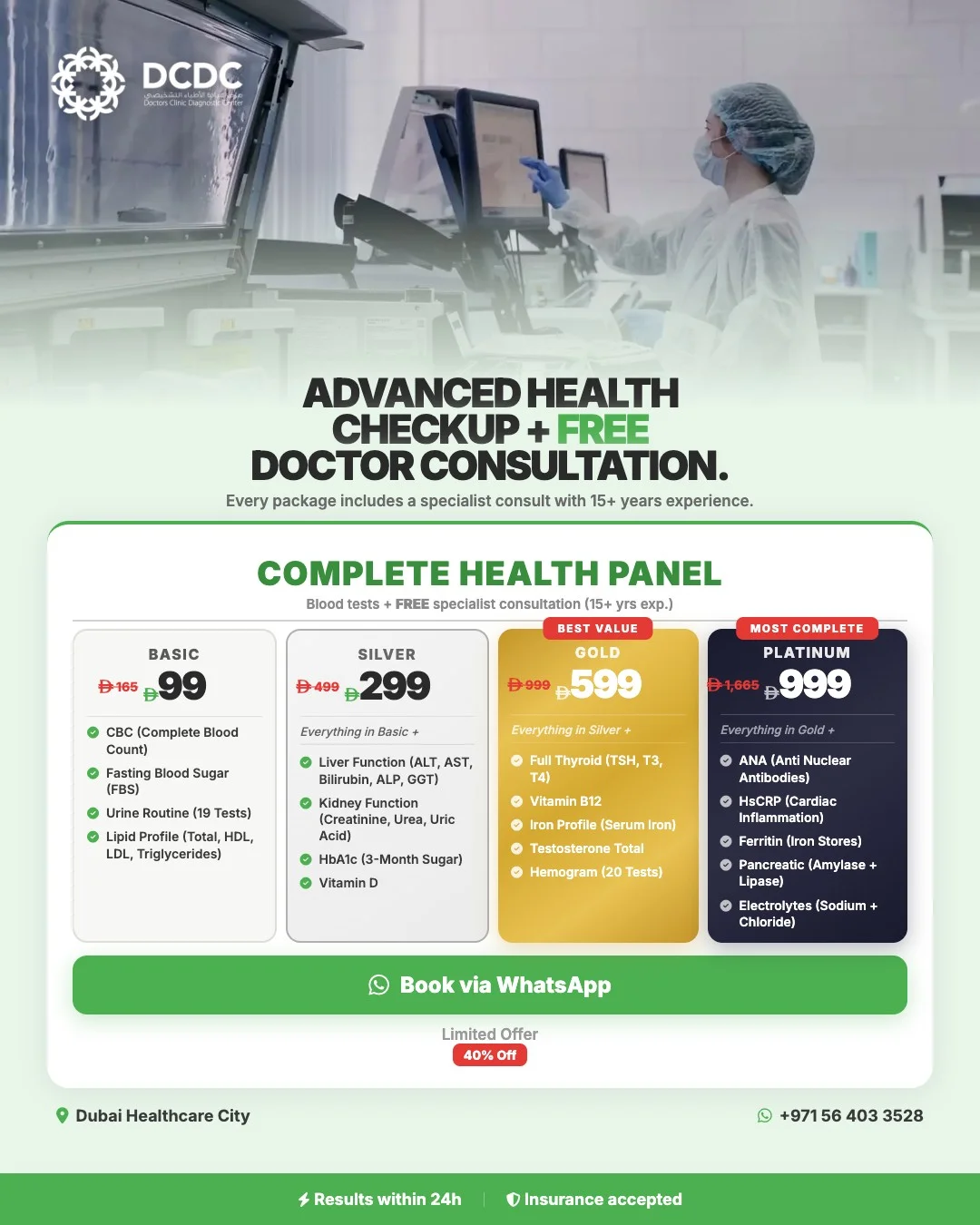
Complete Health Panel
Advanced health checkup with FREE specialist consultation. 4 tiers from basic blood work to full-body screening with 40+ biomarkers.
10–40+ tests included
What's Included
Who is this for?
Anyone wanting a comprehensive baseline health check with specialist consultation
Explore Our Services
Comprehensive pregnancy blood test (beta-hcg) services at DCDC Dubai Healthcare City.
Quantitative Beta-HCG Test
Precise serum HCG measurement for pregnancy monitoring and viability assessment.
Serial Beta-HCG Monitoring
Repeat quantitative testing at 48-hour intervals to confirm appropriate doubling time.
Early Pregnancy Scan
Transvaginal ultrasound from 6 weeks to confirm intrauterine location and viability.
NIPT Screening
Non-invasive prenatal testing for chromosomal conditions from 10 weeks.
Blood Tests
Comprehensive antenatal blood panel including blood group, rubella, and iron studies.
All services performed by DHA-licensed specialists
Who Should Get Pregnancy Blood Test (Beta-HCG)?
Quantitative beta-HCG blood testing is recommended for anyone requiring accurate pregnancy confirmation, early viability monitoring, or investigation of pregnancy complications. It is the most sensitive pregnancy test available, appropriate from the earliest days after potential conception.
Women seeking the earliest possible pregnancy confirmation before missed period
Most CommonWomen with a positive urine pregnancy test requiring quantitative confirmation
Most CommonPatients undergoing IVF or other assisted reproduction requiring precise HCG monitoring
Women with abdominal or pelvic pain in early pregnancy requiring ectopic exclusion
Women with unexplained bleeding in the first trimester
Women with a history of ectopic pregnancy requiring vigilant early monitoring
Women with a history of recurrent miscarriage needing serial viability tracking
Investigation of markedly elevated HCG suggesting molar pregnancy
Post-treatment monitoring of gestational trophoblastic disease for recurrence
Women on fertility medications requiring HCG trigger shot confirmation
Delayed or irregular periods with uncertain pregnancy status
Post-miscarriage monitoring to confirm return of HCG to non-pregnant levels
Why Choose DCDC for Pregnancy Blood Testing?
DCDC offers quantitative beta-HCG testing with same-day results and direct obstetric referral for early pregnancy monitoring.

Quantitative Beta-HCG Precision
Our MOHAP-accredited laboratory provides precise quantitative beta-HCG measurement in mIU/mL, essential for doubling time calculation and viability assessment.
Same-Day Pregnancy Results
Beta-HCG results are typically available the same day of collection, critical for time-sensitive decisions in early pregnancy and ectopic monitoring.
Serial Monitoring Coordination
We support serial beta-HCG testing at 48-hour intervals with trending analysis, coordinated with our obstetrics team for ultrasound correlation when needed.
Insurance Direct Billing
We accept direct billing with 20+ major insurers including Daman, AXA, MetLife, and Bupa. Walk-ins welcome with no appointment needed.
Your Comfortable Visit
A simple, step-by-step Pregnancy scan process designed for comfort, speed, and accuracy.
Walk In or Book
No appointment needed. Test available any time of day without fasting.
Registration
Insurance verification and referral check in under 5 minutes.
Blood Draw
Quick and comfortable sample collection by experienced phlebotomist.
Laboratory Analysis
Immediate processing on high-sensitivity immunoassay platform.
Results
Same-day results with clinical interpretation and next-step guidance.
Pregnancy Blood Test Cost in Dubai
Many insurance plans cover beta-HCG testing with a physician referral. Direct billing available with 20+ insurers. Contact us: +971 54 219 5008
- Pregnancy blood test (beta-HCG): from AED 149.
- No fasting required; test at any time of day.
- Same-day results for most beta-HCG tests.
- Insurance verification in minutes
- No hidden fees
- Fast response on WhatsApp
Your Pregnancy Blood Test Experience
Quick, confidential, and handled with care and sensitivity.
Before
During
After
Insurance & Location
MOHAP License: Fully licensed diagnostic center in Dubai Healthcare City








- 20+ insurance providers in Dubaiincluding Daman, AXA, ADNIC, and others
- Pre-authorization supportand direct billing (where applicable)
- Coverage verificationbefore your appointment at our Dubai Healthcare City clinic
- Transparent pricingwith no hidden fees for pregnancy blood test (beta-hcg) services
Visit Us in Dubai Healthcare City
Doctors Clinic Diagnostic Center
Building 64, Block A, Al Razi Medical Complex, Dubai Healthcare City, Dubai, UAE
Near Oud Metha Road · Easy access from Bur Dubai, Downtown Dubai, Business Bay · Free dedicated parking available
Working Hours
Mon-Thu, Sat: 8AM - 10:30PM | Sun: 8:30AM - 10:30PM | Fri: 9AM - 10PM
How Insurance Works at DCDC
Check Coverage
Verify your plan covers Pregnancy Blood Test (Beta-HCG)
Get a Referral
Some insurers require a GP referral — we can guide you
Pre-Authorization
We handle pre-auth directly with your insurer
Direct Billing
No upfront payment — we bill your insurer directly
Co-Pay Only
You only pay any applicable co-pay at the clinic
Dr. Hadi Komshi
Specialist Internal Medicine
MD, Specialist Internal Medicine
Dr. Hadi Komshi is a DHA-licensed Internal Medicine Specialist with extensive experience in managing both acute and chronic medical conditions. With years of clinical practice across inpatient, outpatient, emergency, ICU, and CCU settings, he is known for his accurate diagnoses, comprehensive approach, and dedication to patient-centered care. He has previously led a Hemodialysis Unit and is skilled in interpreting imaging studies and specialized diagnostic tests, ensuring safe, effective, and evidence-based treatment for his patients.
- Acute & chronic disease management
- Diabetes, thyroid disorders & metabolic conditions
- Hypertension & cardiovascular risk assessment
Persian · Arabic · English
Understanding Beta-HCG and Early Pregnancy Monitoring
Human chorionic gonadotropin (HCG) is a glycoprotein hormone composed of alpha and beta subunits. The beta subunit is unique to HCG and is the target measured in pregnancy blood tests, as it does not cross-react with other pituitary hormones such as LH, FSH, and TSH that share the same alpha subunit. After fertilisation, HCG is produced first by the fertilised egg itself and then increasingly by the trophoblast cells that form the early placenta. Its primary role in early pregnancy is to signal the corpus luteum in the ovary to continue producing progesterone, maintaining the uterine lining and preventing menstruation until the placenta matures enough to produce progesterone independently at around 8 to 10 weeks.
Serial quantitative beta-HCG measurement is the most valuable clinical tool in early pregnancy surveillance. The established pattern of doubling every 48 to 72 hours serves as a benchmark against which actual measurements are compared to identify normal versus abnormal progression. When combined with transvaginal ultrasound, which can visualise the gestational sac from approximately 4.5 to 5 weeks and the embryonic heartbeat from 5.5 to 6 weeks, serial HCG provides a comprehensive picture of early pregnancy health. Understanding that HCG reference ranges overlap broadly between normal and abnormal pregnancies underscores why trend analysis over serial measurements is always more informative than any single value in isolation.
Pregnancy Conditions Monitored Through Beta-HCG Testing
Normal Intrauterine Pregnancy
Confirmed by appropriately rising beta-HCG with at least 53% increase every 48 hours, combined with intrauterine gestational sac on ultrasound above the discriminatory zone threshold.
Ectopic Pregnancy
Abnormal implantation outside the uterus causing subnormal HCG rise, a potentially life-threatening emergency requiring urgent intervention to prevent tubal rupture and haemorrhage.
Threatened Miscarriage
First-trimester bleeding with a live intrauterine pregnancy, monitored by serial HCG to distinguish from inevitable miscarriage; slow-rising or plateauing HCG with no heartbeat indicates poor prognosis.
Missed Miscarriage
Non-viable pregnancy retained in the uterus without expulsion, detected by declining or plateauing HCG levels combined with absent cardiac activity on ultrasound.
Molar Pregnancy (Hydatidiform Mole)
Abnormal conception producing markedly elevated HCG disproportionate to gestational age, requiring surgical evacuation and serial HCG monitoring to exclude gestational trophoblastic neoplasia.
Gestational Trophoblastic Disease
Persistent or rising HCG after molar pregnancy evacuation indicating trophoblastic neoplasia; HCG is the definitive tumour marker guiding chemotherapy dosing and response assessment.
IVF Pregnancy Monitoring
Serial beta-HCG from 9-14 days post-transfer confirms implantation, with subsequent measurements tracking doubling time to detect multiple implantation or early pregnancy complications.
Post-Miscarriage Resolution
Serial HCG to non-pregnant levels confirms complete resolution of pregnancy tissue; failure to normalise suggests incomplete miscarriage or retained trophoblastic tissue requiring further management.
Related Services
Explore other diagnostic and consultation services available at our Dubai Healthcare City clinic.
Frequently Asked Questions
Common questions about Pregnancy Blood Test (Beta-HCG) in Dubai.
A blood beta-HCG test is significantly more sensitive than a urine pregnancy test. Blood tests can detect HCG levels as low as 5 mIU/mL, enabling detection 8 to 10 days after fertilisation, before a missed period. Urine tests typically have a detection threshold of 20 to 50 mIU/mL and require waiting until around the time of the missed period. Additionally, a quantitative blood test provides an exact HCG concentration rather than a simple positive or negative, enabling your doctor to assess pregnancy progression and detect complications through doubling time analysis.
In a normal intrauterine pregnancy, beta-HCG concentrations double approximately every 48 to 72 hours during the first 8 to 10 weeks of pregnancy. This predictable rise confirms that the trophoblast is implanting successfully and the pregnancy is progressing normally. A slower rise, typically defined as less than 53 percent increase over 48 hours, may indicate an ectopic pregnancy, threatened miscarriage, or other complication requiring further investigation. Levels that plateau or decline after a period of rise suggest a failing pregnancy. Serial measurements at 48-hour intervals are the standard protocol for monitoring.
Beta-HCG levels vary enormously in normal pregnancy. A first positive blood test might register anywhere from 10 to 500 mIU/mL depending on the precise stage after conception. At 4 weeks gestation, levels typically range from 10 to 750 mIU/mL. By 5 weeks, 200 to 7,200 mIU/mL is typical. Peak levels occur around 8 to 10 weeks, ranging from 25,700 to 288,000 mIU/mL, after which levels gradually decline. Importantly, a single level means little without clinical context. What matters is the trend over serial measurements relative to gestational age.
An ectopic pregnancy is suspected when beta-HCG fails to rise appropriately over serial 48-hour measurements. In a normal intrauterine pregnancy, HCG rises by at least 53 to 66 percent every 48 hours. In ectopic pregnancy, the rise is typically blunted, plateauing or rising more slowly, though some ectopic pregnancies can initially mimic normal doubling. When the discriminatory zone threshold (typically 1,500 to 3,500 mIU/mL depending on the laboratory) is exceeded without an intrauterine pregnancy visible on transvaginal ultrasound, ectopic pregnancy is strongly suspected. This combination of serial beta-HCG and ultrasound is the standard diagnostic approach.
A hydatidiform mole is an abnormal conception where an egg fertilised incorrectly produces a growth of placental tissue without a viable embryo. Molar pregnancies characteristically produce markedly elevated beta-HCG levels, often exceeding 100,000 mIU/mL and sometimes reaching several hundred thousand, disproportionately high for the gestational age. After surgical removal (suction curettage), serial beta-HCG monitoring is essential to confirm levels decline to undetectable, as persistent or rising levels indicate gestational trophoblastic neoplasia requiring further treatment.
Yes, though this is uncommon. Rare non-pregnancy causes of elevated beta-HCG include certain tumours that produce HCG ectopically, including testicular germ cell tumours, choriocarcinoma, certain lung, stomach, or liver cancers, and pituitary HCG in perimenopausal women. Phantom HCG, caused by heterophile antibodies interfering with the assay, can produce false positives. If the clinical picture does not fit pregnancy, further investigation including urine HCG, serial monitoring, and imaging is warranted to exclude non-obstetric causes.
After a complete miscarriage, beta-HCG levels decline and typically return to non-pregnant levels (below 5 mIU/mL) within 4 to 6 weeks, though the exact timeline depends on the peak level before the loss. Higher peak levels take longer to normalise. Serial monitoring to confirmed zero is standard practice after miscarriage to ensure complete resolution. Levels that plateau or rise again suggest incomplete miscarriage or, rarely, gestational trophoblastic disease, both requiring further evaluation and management.
Twin and higher-order multiple pregnancies do produce higher beta-HCG levels than singleton pregnancies at equivalent gestational ages, as each placenta contributes to total HCG production. However, a single elevated HCG value cannot reliably predict twins; the ranges for singleton and twin pregnancies overlap significantly. Ultrasound at 6 to 7 weeks is the definitive method for determining the number of embryos and gestational sacs. High HCG does not independently indicate a healthier pregnancy, as conditions such as molar pregnancy or Down syndrome are also associated with markedly elevated levels.
Key Facts
- Modality
- Pregnancy Blood Test (Beta-HCG)
- Primary Indication
- Pregnancy confirmation, ectopic pregnancy monitoring, early pregnancy viability, and molar pregnancy detection
- Duration
- 5-10 minutes for sample collection
- Preparation
- No fasting required; test can be performed at any time of day
- Report Time
- Same-day results for most beta-HCG tests
- Location
- Dubai Healthcare City
- Insurance
- Most major insurance accepted (Daman, AXA, Bupa, etc.)
Medical Review & Oversight
All services are provided under the supervision of licensed medical professionals in our MOHAP-accredited facility.