Key Takeaways
- Shin splints (medial tibial stress syndrome) are caused by repetitive stress on the tibia and surrounding muscles, most commonly from running, jumping, or a sudden increase in training load
- The hallmark symptom is a dull, aching pain along the inner shin that worsens with activity and eases with rest — distinguishing it from the sharp, localised pain of a stress fracture
- Most cases of shin splints respond well to relative rest, load management, and structured physiotherapy without the need for imaging or invasive treatment
- Persistent or worsening shin pain should be assessed clinically, since untreated shin splints can progress toward a tibial stress fracture if training continues unchanged
- On-site X-ray and MRI at DCDC in Dubai Healthcare City allow same-day differentiation between shin splints and a stress fracture, which changes the treatment plan significantly
- Typical recovery takes 2-8 weeks with appropriate rest and rehabilitation, though return-to-running timelines vary based on severity and training history
- Physiotherapy at DCDC, including manual therapy, therapeutic exercise, and gait assessment, is available from AED 250 per session with direct billing to over 20 insurance providers
Shin splints — medically known as medial tibial stress syndrome — are one of the most common overuse injuries among runners, footballers, and fitness enthusiasts training on Dubai's hot pavements, treadmills, and padel courts. The condition causes a dull, aching pain along the inner edge of the shin bone that typically builds gradually with repetitive impact and can sideline even experienced athletes for weeks if ignored. Our Physiotherapy service at DCDC Dubai Healthcare City offers structured, evidence-based rehabilitation for shin splints, with same-day access to on-site imaging if a more serious injury needs to be ruled out.
This guide explains what shin splints are, how they differ from a stress fracture, the exercises and treatments that speed up recovery, and what a realistic timeline looks like for returning to running or sport. It also covers how diagnosis and treatment work at DCDC, from your first physiotherapy assessment through to a full return-to-activity plan.


What Are Shin Splints (Medial Tibial Stress Syndrome)?
Shin splints, or medial tibial stress syndrome (MTSS), refer to pain along the inner (medial) border of the tibia — the large shin bone — caused by repetitive stress on the bone, surrounding periosteum (the connective tissue covering the bone), and the muscles that attach to it. The condition sits on a spectrum of bone-stress injuries: at the mild end, it involves inflammation of the periosteum and overworked muscle-tendon units; at the more advanced end, if training continues unchanged, the same repetitive loading can progress toward a tibial stress fracture.
MTSS is extremely common, accounting for an estimated 13-20% of all running-related injuries and up to 35% of lower-leg injuries in military recruits and athletes undergoing sudden increases in training volume. It affects recreational and competitive runners alike, along with dancers, footballers, and anyone whose sport involves repeated impact through the lower leg — a profile that fits a large share of Dubai's active, outdoor-training population, particularly during the cooler months when running mileage tends to spike.
The pain typically presents along a 5-10cm stretch of the middle-to-lower third of the tibia, on the inner side of the shin. Unlike a fracture, the pain of shin splints is usually diffuse rather than pinpoint, and it tends to ease once the triggering activity stops — at least in the early stages, before the condition becomes chronic.
Common Causes of Shin Splints in Dubai
Shin splints develop when the repetitive load placed on the tibia and surrounding soft tissue exceeds the bone and muscle's capacity to adapt and repair between sessions. In Dubai, several factors specific to the local training environment contribute to this imbalance.
- Sudden increase in training load: A common pattern in Dubai is a burst of enthusiasm once the weather cools in October-March, with runners rapidly increasing distance or frequency after months of reduced outdoor activity during summer.
- Running surface: Consistent training on hard pavement along the Dubai Marina, Kite Beach, or Jumeirah promenade increases impact loading compared to softer trail or track surfaces.
- Worn or unsuitable footwear: Shoes that have exceeded their lifespan (typically 500-800km) or lack adequate cushioning and support fail to absorb impact forces adequately.
- Biomechanical factors: Overpronation (excessive inward rolling of the foot), tight calf muscles, weak hip and core stabilisers, and leg-length discrepancies all alter how load is distributed through the tibia.
- Low bone density or nutritional deficiencies: Vitamin D deficiency is common in populations who spend significant time indoors or avoid direct sun exposure during Dubai's hot months, and it is a recognised risk factor for bone-stress injuries.
- Treadmill and indoor training patterns: Many Dubai residents shift almost entirely to treadmill or gym-based cardio in summer, then transition abruptly back to outdoor running, which can shock under-conditioned tissue.
Shin Splints vs Stress Fracture: Key Differences
One of the most important distinctions in managing shin pain is telling shin splints apart from a tibial stress fracture, since the two conditions require different management approaches and recovery timelines. Both fall along the same spectrum of bone-stress injury, but a stress fracture represents an actual crack in the bone and requires stricter load reduction to heal safely.
| Feature | Shin Splints (MTSS) | Tibial Stress Fracture |
|---|---|---|
| Pain location | Diffuse, along 5-10cm of the inner shin | Focal, pinpoint tenderness at a single spot |
| Pain pattern | Worsens with activity, eases with rest, especially early on | Persists even at rest; may cause night pain |
| Onset | Gradual, over days to weeks | Gradual but progresses to constant pain if training continues |
| Hop test | Usually tolerable, mild discomfort | Often reproduces sharp, localised pain |
| Imaging findings | Often normal X-ray; MRI may show periosteal oedema | X-ray may be normal early; MRI/bone scan shows fracture line or bone marrow oedema |
| Typical recovery | 2-8 weeks with load management and physiotherapy | 6-12+ weeks with a stricter, often non-weight-bearing initial phase |
Key clinical differences between shin splints and a tibial stress fracture
Because the two conditions can feel similar in the early stages, self-diagnosis is unreliable. Anyone with shin pain that is worsening, localised to a single point, or present at rest and at night should be assessed clinically before continuing to train, since running through an undiagnosed stress fracture significantly increases the risk of a complete bone fracture. For a related lower-leg overuse condition, see our guide on Plantar Fasciitis: Physiotherapy Treatment Guide, since plantar fasciitis and shin splints often occur together in runners with similar biomechanical risk factors.
Symptoms and Warning Signs
Shin splints typically develop gradually rather than from a single traumatic event. Recognising the early symptoms allows treatment to begin before the condition worsens or overlaps with a stress fracture.
- Dull, aching pain along the inner border of the shin, usually in the lower two-thirds of the tibia
- Pain that appears at the start of exercise, sometimes eases during activity, then returns afterward or the following day
- Mild swelling along the affected area of the shin in some cases
- Tenderness when pressing along a broad stretch of the tibia, rather than one specific point
- Pain that progressively worsens with continued training, eventually persisting even during walking or at rest — a warning sign that requires assessment
- Stiffness in the calf muscles or reduced ankle flexibility accompanying the shin pain
How Shin Splints Are Diagnosed
Diagnosis of shin splints begins with a detailed clinical history, including training load, recent changes in footwear or surface, and the exact pattern of pain. A physical examination assesses tenderness along the tibia, calf and ankle flexibility, foot arch type, and running or gait mechanics where relevant.
In most straightforward cases, shin splints can be diagnosed clinically without imaging. However, imaging becomes important when pain is severe, localised to a single point, not improving with initial rest, or when there is concern about ruling out a stress fracture. At DCDC, on-site X-ray is available to assess bone integrity, and MRI can detect the early periosteal changes of MTSS as well as bone marrow oedema associated with a developing stress fracture — often before a fracture line would be visible on a standard X-ray. Having imaging available in the same building as your physiotherapy assessment means a same-day diagnosis is possible, avoiding the delay and disruption of referral to an external imaging centre.
Physiotherapy Treatment for Shin Splints
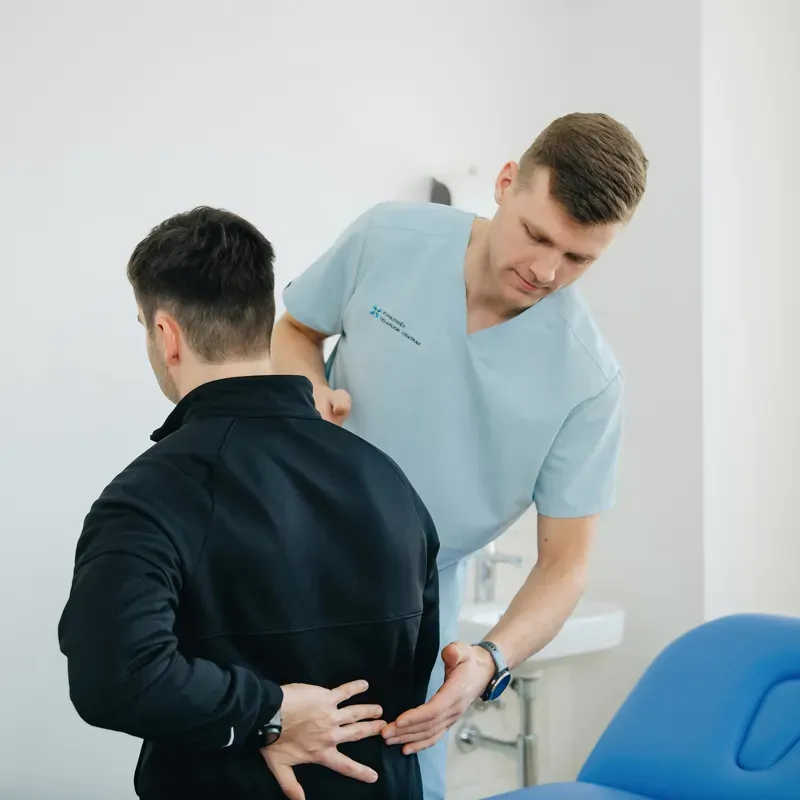
Physiotherapy is the cornerstone of shin splints treatment. The primary goal in the initial phase is to reduce the aggravating load while keeping the tissue active enough to maintain conditioning, followed by a structured, progressive return to full training. A physiotherapy plan for shin splints typically combines manual therapy, targeted strengthening, and gait or biomechanical assessment.
Dr. Hadi Komshi, DPT and Sports Rehabilitation specialist at DCDC, explains: "The mistake I see most often with shin splints is patients either stopping all activity and losing conditioning, or pushing through the pain until it becomes a stress fracture. Neither is the right answer. Effective treatment is about finding the right level of relative rest — cross-training with low-impact activity while we address the calf tightness, hip weakness, or footwear issue that's actually driving the overload on the shin. Once the tissue has settled, we rebuild load gradually and objectively, rather than just telling someone to 'wait until it doesn't hurt.'"
- Manual therapy: Soft tissue release and mobilisation of the calf muscles, tibialis posterior, and ankle joint to reduce tension contributing to abnormal tibial loading
- Electrotherapy and ultrasound modalities: Used to help manage pain and inflammation in the acute phase alongside active rehabilitation
- Therapeutic exercise: Progressive strengthening of the calf, tibialis anterior, hip abductors, and core to correct the biomechanical deficits that overload the shin
- Gait and running form assessment: Identifying overstriding, cadence issues, or overpronation that increase tibial stress during running
- Load management guidance: A structured plan for cross-training (swimming, cycling, elliptical) that maintains cardiovascular fitness without aggravating the shin
- Dry needling: Sometimes used to address trigger points in the calf and tibialis posterior muscles contributing to tightness and altered mechanics
Best Exercises for Shin Splint Recovery
Specific exercises target the muscular imbalances and weaknesses most commonly associated with shin splints. These should generally be introduced under professional guidance, since doing them incorrectly — or too aggressively, too soon — can aggravate symptoms rather than resolve them.
- Calf raises (double and single leg): Build strength and endurance in the gastrocnemius and soleus, which absorb significant shock during running
- Tibialis anterior strengthening (toe raises, resistance band dorsiflexion): Directly targets the muscle most closely linked to anterior and medial shin overload
- Calf and soleus stretching: Improves ankle dorsiflexion range, reducing compensatory strain through the shin during push-off
- Hip abductor and glute strengthening (clamshells, side-lying leg raises, single-leg bridges): Improves pelvic and lower-limb control, reducing excessive tibial rotation and overpronation
- Single-leg balance and proprioception drills: Enhance neuromuscular control of the lower leg during dynamic movement
- Low-impact cross-training (swimming, cycling, aqua jogging): Maintains cardiovascular fitness while allowing bone and soft tissue recovery time
Shin Splints Treatment Cost in Dubai
The cost of treating shin splints in Dubai depends on whether imaging is required and how many physiotherapy sessions are needed for full recovery. The table below outlines indicative cash-pay pricing at DCDC; patients with insurance coverage often pay significantly less out of pocket through our direct billing arrangements.
| Service | Estimated Cost (Cash) | Insurance Coverage | Notes |
|---|---|---|---|
| Physiotherapy assessment and treatment | From AED 250 per session | Covered subject to plan limits | 45-60 minute sessions; includes manual therapy and exercise prescription |
| Digital X-ray (tibia/shin) | AED 150-300 | Covered by most plans | Used to rule out stress fracture or bony abnormality |
| MRI (lower leg) | AED 900-1,500 | Covered for clinical indication | Detects periosteal changes and early stress fracture; same-day scan available |
| Physiotherapy session pack (course of treatment) | Varies — ask about package pricing | Covered subject to plan limits | Most patients need 4-8 sessions over several weeks |
| Follow-up orthopedic or sports rehabilitation review | From AED 250 | Covered by most plans | Recommended if symptoms persist beyond 3-4 weeks |
Estimated shin splints treatment costs at DCDC Dubai (2026) — all prices are indicative; confirm with the clinic at time of booking
DCDC is MOHAP-licensed (License No. NIMY7VY5-240925) and holds direct billing agreements with over 20 insurance providers in the UAE, including Daman, AXA, Bupa, MetLife, and Cigna. We recommend confirming your specific plan's coverage for physiotherapy and imaging before your appointment so there are no surprises regarding out-of-pocket cost.
Dealing with Persistent Shin Pain? Get an Expert Assessment
Our physiotherapy team at DCDC Dubai Healthcare City provides thorough assessment, gait analysis, and a structured recovery plan for shin splints, with same-day X-ray and MRI available on-site if a stress fracture needs to be ruled out. Physiotherapy sessions from AED 250, with direct billing to Daman, AXA, Bupa, MetLife, Cigna, and 15+ other insurers.
Recovery Timeline: How Long Do Shin Splints Take to Heal?
Recovery time for shin splints varies depending on severity, how early treatment begins, and adherence to the load-management plan. The following provides a general framework, though individual timelines can vary considerably.
| Timeframe | Typical Milestones |
|---|---|
| Week 1-2 | Relative rest from aggravating activity, pain and inflammation management, begin gentle stretching and low-impact cross-training |
| Week 2-4 | Progressive strengthening of calf, tibialis anterior, and hip stabilisers; pain-free walking and low-impact cardio |
| Week 4-6 | Gradual reintroduction of jogging using a structured run-walk progression; ongoing strength work |
| Week 6-8 | Return to regular running distance and intensity if pain-free and strength benchmarks are met; gait review recommended before returning to competitive training |
| Beyond 8 weeks | Persistent symptoms at this stage warrant reassessment and imaging to rule out a developing stress fracture |
General shin splints recovery timeline with rehabilitation milestones
Returning to running too quickly, or increasing training load faster than the tissue can adapt, is the most common reason for recurrence. A structured, criteria-based return to sport — rather than a fixed calendar date — gives the best chance of a lasting recovery. For athletes managing a broader range of overuse injuries, our guide on Sports Injury Recovery Dubai: PRP & Rehab covers additional rehabilitation principles that apply across many running-related conditions.
What to Expect at DCDC for Shin Splints Treatment
DCDC is a one-stop diagnostic and treatment centre in Dubai Healthcare City, rated 4.8/5 on Google from over 1,000 verified patient reviews with a 98% patient satisfaction rate. Here is what a typical visit for shin pain looks like from arrival to treatment plan.
- Arrival and check-in: Free dedicated on-site parking is available at Al Razi Medical Complex, Building 64, Block A. Reception verifies your insurance details for direct billing where applicable.
- Physiotherapy assessment: Dr. Hadi Komshi or a member of the physiotherapy team takes a detailed history of your training, footwear, and pain pattern, followed by a physical examination of the shin, calf, ankle, and hip mechanics.
- On-site imaging (if indicated): If clinical findings suggest a possible stress fracture or if symptoms are not typical of straightforward shin splints, digital X-ray and MRI are available in the same building for same-day diagnosis, avoiding the need for a separate referral.
- Treatment plan: A personalised plan is created combining manual therapy, targeted exercise, load-management advice, and — where appropriate — electrotherapy or ultrasound modalities for pain relief in the initial phase.
- Session structure: Each physiotherapy session runs 45-60 minutes. Patients are asked to wear comfortable, loose-fitting clothing and to bring any existing imaging reports to their first appointment.
- Progress reviews: Follow-up sessions track pain levels, strength benchmarks, and readiness for a graded return to running or sport.
DCDC operates from Building 64, Block A, Al Razi Medical Complex, Dubai Healthcare City, with hours Saturday to Thursday 8AM-10PM and Friday 9AM-9PM — making appointments accessible before or after work for most of Dubai's active population. If shin pain has been accompanied by knee discomfort from altered running mechanics, our guide on Runner's Knee: Physio Treatment & Recovery may also be relevant, since the two conditions frequently overlap in distance runners.
Prevention Tips: How to Avoid Shin Splints
Because shin splints are almost always the result of a training load exceeding tissue tolerance, prevention centres on managing that balance carefully, especially for runners in Dubai transitioning between indoor and outdoor training as the seasons change.
- Follow the 10% rule: Avoid increasing weekly running distance or intensity by more than approximately 10% at a time, particularly when returning to outdoor training after a break.
- Replace running shoes regularly: Worn-out footwear loses cushioning and support; replace shoes every 500-800km or when tread wear is visible.
- Vary training surfaces: Mixing softer surfaces with pavement running reduces cumulative impact loading on the tibia.
- Maintain calf and hip strength: Ongoing strength training for the calves, tibialis anterior, and hip stabilisers builds resilience against repetitive loading.
- Address biomechanical issues early: A gait assessment can identify overpronation or overstriding before they become a chronic issue, and orthotics or footwear changes can be recommended if needed.
- Ensure adequate recovery and nutrition: Adequate sleep, calcium and vitamin D intake, and rest days between hard training sessions all support bone health and tissue repair.
If shin pain develops alongside foot arch discomfort or heel pain, it is worth reviewing our guide on Knee Pain Causes & When to Worry Dubai, since compensatory changes in gait to protect a sore shin can sometimes shift stress upward to the knee.
When to See a Doctor for Shin Pain
While most shin splints respond well to conservative management, certain warning signs indicate the need for a prompt clinical assessment rather than continued self-treatment.
- Pain that is sharply localised to one specific spot on the shin rather than spread across a broader area
- Pain that persists at rest or wakes you at night
- Pain that continues to worsen despite 1-2 weeks of rest and reduced activity
- Visible swelling, redness, or warmth over the shin, which could indicate a different underlying issue
- Shin pain accompanied by numbness, tingling, or significant weakness in the foot or ankle
- Recurrent shin splints despite following a structured rehabilitation and prevention programme
Any of these signs warrant a physiotherapy or orthopedic assessment with imaging where appropriate, since distinguishing shin splints from a stress fracture early prevents a much longer recovery down the line.
Book Your Shin Splints Assessment at DCDC
Rated 4.8/5 from 1,000+ verified Google reviews. MOHAP-licensed (License No. NIMY7VY5-240925). On-site X-ray, MRI, and ultrasound for same-day diagnosis, alongside physiotherapy from AED 250 per session. Book a physiotherapy appointment at DCDC Dubai Healthcare City and get back to running with confidence.
Related Services at DCDC
Expert care and advanced diagnostics at Dubai Healthcare City
Frequently Asked Questions
Getting Back to Running Without Recurring Shin Pain
Shin splints are one of the most common — and most preventable — overuse injuries among Dubai's running and fitness community, but they are also frequently mismanaged, either through continuing to train through pain or resting completely without addressing the underlying cause. The evidence consistently points to a middle path: relative rest, structured strengthening, and a gradual, criteria-based return to activity.
At DCDC Dubai Healthcare City, our physiotherapy team's approach centres on identifying and correcting the specific factors driving your shin overload, backed by same-day X-ray and MRI access when a stress fracture needs to be ruled out. Whether you are training for your first 10km along the Dubai Marina or managing recurrent shin pain from years of running, a structured assessment gives you a clear, evidence-based path back to full activity.
Sources & References
This article was reviewed by our medical team and references the following sources:
- British Journal of Sports Medicine — Medial Tibial Stress Syndrome: A Critical Review
- NHS — Shin Splints
- Mayo Clinic — Shin Splints: Symptoms and Causes
- Cleveland Clinic — Shin Splints
- American College of Sports Medicine (ACSM) — Management of Bone Stress Injuries in Runners
- PubMed — Medial Tibial Stress Syndrome: Diagnosis, Treatment and Outcome Assessment (Systematic Review)
- Physio-Pedia — Medial Tibial Stress Syndrome
Medical content on this site is reviewed by DHA-licensed physicians. See our editorial policy for more information.

Written by
Dr. Hadi Komshi
Sports Rehabilitation
DPT, Sports Rehabilitation
Dr. Hadi Komshi is a Sports Rehabilitation specialist at Doctors Clinic Diagnostic Center (DCDC) in Dubai Healthcare City.
Related Articles

Plantar Fasciitis: Physiotherapy Treatment Guide
Runner's Knee: Physio Treatment & Recovery
Ankle Sprain Dubai: Treatment & Recovery
Sports Injury Recovery Dubai: PRP & Rehab

Golfer's Elbow vs Tennis Elbow Dubai
More in Physiotherapy
Emsella vs Kegels Dubai: Which Works Better? (2026)
Read MoreGolfer's Elbow vs Tennis Elbow Dubai (2026)
Read MorePhysiotherapy Dubai: Types, Cost & Guide (2026)
Read More
Vestibular Rehab Dubai: Treatment for Vertigo (2026)
Read MorePhysiotherapy Packages Dubai: Save 20%+ (2026)
Read More
Shoulder Pain Dubai: 7 Causes & When to Worry (2026)
Read More© 2026 Doctors Clinic Diagnostic Center (DCDC), Dubai Healthcare City. Originally published at https://doctorsclinicdubai.ae/blog/shin-splints-treatment-recovery-dubai. All rights reserved. Unauthorized reproduction is prohibited.