Key Takeaways
- Tennis elbow (lateral epicondylitis) affects the outer elbow tendons; golfer's elbow (medial epicondylitis) affects the inner elbow tendons — the location of pain is the fastest way to tell them apart.
- Tennis elbow is roughly 7 to 10 times more common than golfer's elbow, and fewer than 5% of tennis elbow cases are actually caused by playing tennis.
- Golfer's elbow is more likely to cause tingling or numbness into the ring and little fingers because the ulnar nerve runs directly behind the medial epicondyle.
- Both conditions are degenerative tendon changes (tendinosis) rather than true inflammation, which is why NSAIDs alone rarely provide lasting relief.
- Up to 80-90% of both tennis elbow and golfer's elbow cases resolve with conservative treatment — rest, physiotherapy, and activity modification — within 6 to 12 months, without surgery.
- DCDC offers on-site X-ray and MRI for same-day elbow injury grading, physiotherapy consultations from AED 300, and PRP therapy for chronic, treatment-resistant cases.
- Corticosteroid injections can relieve pain in the short term but studies show worse long-term outcomes compared to physiotherapy alone, so they are used selectively.
- A structured eccentric-loading physiotherapy programme remains the single most evidence-backed treatment for both conditions, regardless of which side of the elbow is affected.
Elbow pain that flares up after gripping a racquet, a golf club, a dumbbell, or even a keyboard can point to one of two very similar-sounding but distinct conditions: golfer's elbow and tennis elbow. Despite their sporting names, both conditions are far more commonly caused by work and daily repetitive movement than by the sports they are named after, and getting the diagnosis right matters because the treatment approach, recovery timeline, and self-care advice differ in important ways. At DCDC in Dubai Healthcare City, our sports rehabilitation at DCDC team sees both conditions daily and uses a structured clinical and imaging pathway to confirm exactly which tendon is affected before building a treatment plan.
This guide compares golfer's elbow and tennis elbow side by side — location, causes, symptoms, risk factors, diagnosis, treatment, prevention, and cost in Dubai — so you can understand which condition you may be dealing with and what recovery realistically looks like. Whether you play padel three times a week, sit at a keyboard eight hours a day, or have never picked up a golf club in your life, this comparison covers what you need to know before your appointment.

Golfer's Elbow vs Tennis Elbow: The Key Difference at a Glance
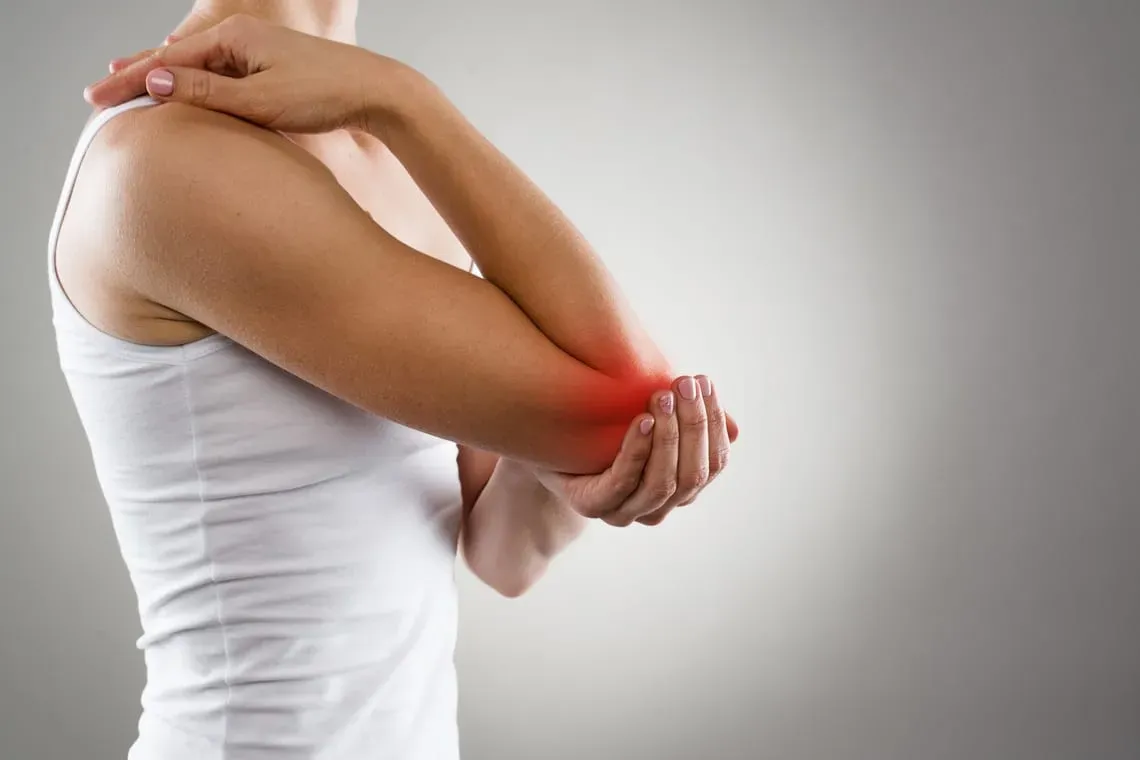
The single most useful fact to remember is where the pain is. Tennis elbow, medically called lateral epicondylitis, causes pain on the outside (lateral side) of the elbow, at the bony bump where the forearm extensor tendons attach. Golfer's elbow, medically called medial epicondylitis, causes pain on the inside (medial side) of the elbow, where the forearm flexor and pronator tendons attach. According to the Cleveland Clinic, both conditions are overuse injuries of the tendon rather than the muscle or joint itself, and both are classified as forms of epicondylitis or, more accurately in chronic cases, epicondylosis (degenerative tendinosis rather than active inflammation).
- Tennis elbow (lateral epicondylitis): outer elbow pain, affects the extensor carpi radialis brevis (ECRB) tendon, worsens with gripping and wrist extension (e.g. lifting a cup, shaking hands, using a screwdriver).
- Golfer's elbow (medial epicondylitis): inner elbow pain, affects the common flexor tendon and pronator teres, worsens with wrist flexion and forearm rotation (e.g. swinging a golf club, throwing, using a hammer).
- Prevalence: tennis elbow is roughly 7-10 times more common than golfer's elbow in the general population, according to orthopaedic epidemiology data cited by multiple U.S. orthopaedic centres.
- Nerve involvement: golfer's elbow more frequently produces tingling or numbness into the ring and little fingers because the ulnar nerve runs directly behind the medial epicondyle.
What Is Tennis Elbow (Lateral Epicondylitis)?
Tennis elbow develops when the tendon that attaches the extensor carpi radialis brevis muscle to the lateral epicondyle (the bony prominence on the outer elbow) becomes overloaded through repeated wrist extension and gripping movements. Over time, microscopic tears accumulate faster than the tendon can repair itself, leading to a disorganised, thickened tendon structure that researchers describe as angiofibroblastic tendinosis rather than classic inflammation. This is an important distinction because it explains why anti-inflammatory medication alone often fails to resolve the condition — the tendon needs a structured loading programme to remodel, not just symptom suppression.
According to the Cleveland Clinic, tennis elbow affects an estimated 1-3% of adults at some point, with the highest incidence occurring between ages 35 and 55. Despite the name, only about 5% of people diagnosed with tennis elbow actually developed it from playing tennis. The vast majority of cases arise from occupational repetitive strain — plumbers, painters, carpenters, butchers, and increasingly office workers who spend hours typing and using a computer mouse.
Common Causes of Tennis Elbow
- Racquet sports with poor backhand technique or an over-tight grip, including tennis, padel, squash, and badminton.
- Repetitive computer mouse use, particularly with poor wrist positioning or an unsupported forearm.
- Manual trades involving repetitive gripping and wrist extension: plumbing, painting, carpentry, and hairdressing.
- Weightlifting movements that load the wrist extensors under strain, such as heavy dumbbell rows or bicep curls with poor form.
- Sudden increases in activity intensity or duration without adequate conditioning — a very common trigger among weekend athletes in Dubai.
What Is Golfer's Elbow (Medial Epicondylitis)?
Golfer's elbow develops at the opposite side of the joint. It involves degeneration of the common flexor-pronator tendon, which attaches the wrist flexor and forearm pronator muscles to the medial epicondyle on the inner side of the elbow. According to Mayo Clinic, golfer's elbow is caused by damage to the muscles and tendons that control wrist and finger movement, typically from repeated flexing, gripping, swinging, or throwing motions. As with tennis elbow, the underlying tissue change is degenerative tendinosis rather than acute inflammation, which is why chronic cases do not respond well to rest or medication alone.
Golfer's elbow is significantly less common than tennis elbow — StatPearls describes it as roughly one-seventh to one-tenth as prevalent in population-based studies. Despite its name, most people who develop golfer's elbow have never swung a golf club; it is equally common among throwing athletes, weightlifters, carpenters, and manual labourers who repeatedly flex the wrist and rotate the forearm. Because the ulnar nerve runs in a groove directly behind the medial epicondyle, golfer's elbow carries a higher chance of associated nerve symptoms — tingling, numbness, or weakness affecting the ring and little fingers — compared to tennis elbow.
Common Causes of Golfer's Elbow
- Golf swings with excessive wrist flexion at ball contact, particularly with an incorrect grip or swing plane.
- Throwing sports, including baseball pitching, javelin, and cricket bowling, which load the medial elbow through the acceleration phase.
- Weightlifting exercises that emphasise wrist flexion and forearm pronation, such as heavy bicep curls, hammer curls, and forearm-focused grip training.
- Manual occupations requiring repetitive hammering, screwing, or carrying heavy loads with a bent wrist.
- Poor conditioning combined with a sudden jump in training volume, a pattern our physiotherapists see frequently among Dubai's growing padel and golf communities.
If your pain sits on the outer elbow rather than the inner side, our dedicated guide to tennis elbow physiotherapy treatment covers the eccentric-loading protocols and bracing options in more depth.
Side-by-Side Comparison: Golfer's Elbow vs Tennis Elbow
| Feature | Tennis Elbow | Golfer's Elbow |
|---|---|---|
| Medical name | Lateral epicondylitis | Medial epicondylitis |
| Pain location | Outer (lateral) elbow | Inner (medial) elbow |
| Tendon affected | Extensor carpi radialis brevis (ECRB) and other wrist extensors | Common flexor tendon and pronator teres |
| Aggravating movement | Wrist extension, gripping, lifting palm-down | Wrist flexion, forearm pronation, gripping palm-up |
| Prevalence | Affects ~1-3% of adults; the more common condition | ~7-10x less common than tennis elbow |
| Peak age range | 35-55 years | 40-60 years |
| Nerve involvement | Uncommon | More frequent — ulnar nerve runs behind the medial epicondyle |
| Typical sports link | Tennis, padel, squash, badminton backhand | Golf swing, throwing sports, weightlifting |
| Most common real-world cause | Occupational/computer use, not sport (only ~5% from tennis) | Occupational/manual labour, not always golf |
| Self-resolution rate | 80-90% within 6-12 months with conservative care | 80-90% within 6-12 months with conservative care |
Head-to-head clinical comparison of golfer's elbow and tennis elbow.
Symptoms Comparison: How to Tell Them Apart
Both conditions share a similar pattern of gradual-onset aching pain that worsens with use and eases with rest, but the specific movements that trigger pain differ because opposite tendon groups are involved. Recognising these patterns can help you describe your symptoms accurately when you see a physiotherapist or orthopaedic doctor.
Tennis Elbow Symptoms
- Aching or burning pain centred on the bony bump on the outside of the elbow, sometimes radiating down the forearm.
- Pain and weakness when gripping objects, shaking hands, opening a jar, or lifting a cup with the palm facing down.
- Tenderness directly over the lateral epicondyle when pressed.
- Pain reproduced by resisted wrist extension (the wrist bending backward against resistance) — a test physiotherapists call Cozen's test.
- Stiffness in the morning or after periods of rest, improving somewhat with gentle movement.
Golfer's Elbow Symptoms
- Aching pain centred on the bony bump on the inside of the elbow, which may spread into the forearm.
- Pain and weakness when flexing the wrist, making a fist, or rotating the forearm palm-up (as in shaking hands or turning a key).
- Tenderness directly over the medial epicondyle when pressed.
- Pain reproduced by resisted wrist flexion and forearm pronation against resistance.
- Tingling or numbness in the ring and little fingers in a meaningful minority of cases, reflecting the ulnar nerve's proximity to the medial elbow.
Causes and Risk Factors for Each Condition
Both conditions share the same fundamental mechanism — repetitive tendon overload that outpaces the body's ability to repair — but the specific risk factors differ by activity and biomechanics.
Risk Factors for Tennis Elbow
- Age 35-55, with incidence declining after age 60.
- Occupations involving repetitive wrist extension: painting, plumbing, carpentry, cooking, and prolonged computer mouse use.
- Poor backhand technique in racquet sports, especially using excessive wrist action instead of shoulder rotation.
- An oversized or undersized racquet grip, or racquet strings that are too tightly tensioned.
- Smoking, which is associated with slower tendon healing in multiple studies.
Risk Factors for Golfer's Elbow
- Age 40-60, similar to tennis elbow but occurring slightly later on average.
- Occupations involving repetitive gripping, hammering, and carrying: construction, plumbing, and assembly-line work.
- Golf swing faults, particularly excessive wrist snap ('casting') through impact.
- Throwing sports with high forearm pronation demands, such as baseball, cricket, and javelin.
- Weightlifting with heavy grip-dominant exercises performed without adequate forearm conditioning.
Recovering athletes across a range of sports benefit from a structured, criteria-based return to activity rather than a fixed timeline. Our overview of sports injury recovery in Dubai explains how physiotherapists use progressive loading milestones to decide when it is safe to return to golf, tennis, padel, or the gym.
Which Do You Have? A Self-Assessment Guide
While only a clinical examination can confirm a diagnosis, the following self-assessment can help you decide which condition is more likely before your appointment. None of these tests should be forced through significant pain, and this guide is not a substitute for professional evaluation.
Signs Pointing to Tennis Elbow
- Pain is on the outer (thumb side) point of the elbow.
- Pain worsens when you try to lift something with your palm facing downward, such as picking up a kettle.
- Pain increases when you bend your wrist backward against resistance.
- You play a racquet sport, use a computer mouse extensively, or perform manual trade work.
Signs Pointing to Golfer's Elbow
- Pain is on the inner (pinky side) point of the elbow.
- Pain worsens when you make a fist or turn a doorknob with your palm facing upward.
- Pain increases when you bend your wrist forward against resistance.
- You experience tingling or numbness in your ring and little fingers.
- You golf, throw, hammer, or lift weights with a grip-heavy technique.
If your symptoms do not clearly fall into one pattern, or if you notice weakness, significant swelling, or numbness that spreads beyond the fingers, book a clinical assessment rather than guessing. Some patients — particularly racquet-sport and golf players who train both sides of the body intensively — develop mild irritation on both sides of the elbow simultaneously, which requires a tailored assessment to sort out which tendon needs the most attention.
Diagnosis: How DCDC Confirms Which Condition You Have
In the majority of cases, golfer's elbow and tennis elbow are diagnosed clinically — through a detailed history and a hands-on physical examination that reproduces your pain with specific resisted movements. However, imaging plays an important role when symptoms are severe, longstanding, unusual, or not responding to initial treatment, and it helps rule out other causes of elbow pain such as ligament injury, arthritis, referred cervical spine pain, or a stress fracture.
At DCDC, our elbow assessment pathway includes on-site X-ray to rule out bony abnormalities and calcific tendinosis, and on-site MRI for rapid injury grading when the clinical picture is unclear or symptoms have persisted beyond the expected recovery window. MRI is particularly useful for grading the degree of tendon tearing (partial versus full-thickness) and for assessing ulnar collateral ligament integrity in athletes with medial elbow pain, since ligament injury can mimic or coexist with golfer's elbow. Musculoskeletal ultrasound is also available and offers the advantage of dynamic, real-time assessment of the tendon during movement.
Treatment Comparison: Similarities and Differences
The good news is that the evidence-based treatment pathway for golfer's elbow and tennis elbow is very similar, following a stepwise, conservative-first approach recommended by orthopaedic and sports medicine guidelines. The main differences lie in which muscle group is targeted during strengthening and which nerve needs monitoring during rehabilitation.
| Treatment Stage | Tennis Elbow Approach | Golfer's Elbow Approach |
|---|---|---|
| Acute phase (0-2 weeks) | Relative rest, ice, activity modification, avoid gripping with wrist extended | Relative rest, ice, activity modification, avoid gripping with wrist flexed |
| Bracing/support | Counterforce forearm strap below the elbow to offload the extensor tendon | Counterforce forearm strap below the elbow to offload the flexor tendon |
| Physiotherapy focus | Eccentric wrist extensor strengthening (e.g. Tyler Twist protocol) | Eccentric wrist flexor and pronator strengthening |
| Nerve monitoring | Rarely required | Monitored closely for ulnar nerve irritation during rehab |
| Shockwave therapy (ESWT) | Used for chronic cases beyond 6 weeks of conservative care | Used for chronic cases beyond 6 weeks of conservative care |
| Corticosteroid injection | Short-term relief; used selectively due to worse long-term outcomes in studies | Short-term relief; used selectively, with extra care near the ulnar nerve |
| PRP therapy | Considered for chronic, treatment-resistant cases (typically 3+ months) | Considered for chronic, treatment-resistant cases (typically 3+ months) |
| Surgery | Reserved for the small minority (under 10%) who fail 6-12 months of conservative treatment | Reserved for the small minority who fail conservative treatment, with extra attention to protecting the ulnar nerve |
Stepwise treatment comparison for tennis elbow and golfer's elbow.
A structured, progressive loading programme — not rest alone — is what actually remodels the degenerated tendon tissue. Passive treatments like ice, NSAIDs, and bracing manage symptoms in the short term, but the tendon needs graded mechanical loading (isometric, then eccentric, then concentric strengthening) to rebuild collagen alignment and regain tensile strength. This is true whether the injury is on the inner or outer elbow, which is why our physiotherapy team designs a tendon-specific loading plan rather than a generic exercise sheet.
Racquet-sport players in Dubai's active padel and tennis community frequently present with both lateral elbow overload and other upper-limb strain patterns. Our detailed guide to padel injuries treatment covers grip modification, string tension, and racquet weight adjustments that reduce repeat strain on the elbow tendons.
Prevention Strategies for Golfers, Tennis and Padel Players
Preventing Tennis Elbow
- Have a coach check your backhand technique — leading with the elbow rather than rotating from the shoulder overloads the extensor tendon.
- Choose the correct racquet grip size and consider a slightly lower string tension to reduce vibration transmitted to the elbow.
- Set up ergonomic computer workstations with wrist support and take micro-breaks every 30-45 minutes during long typing sessions.
- Warm up the forearm extensors with light resistance band work before racquet sports or manual labour.
- Progress training volume gradually — the classic '10% rule' of increasing load no more than 10% per week applies well to elbow tendons.
Preventing Golfer's Elbow
- Work with a golf professional on swing mechanics — reducing excessive wrist 'casting' through impact significantly lowers medial elbow load.
- Strengthen the forearm flexors and rotator cuff off-season so the tendon can tolerate in-season demands.
- Use properly fitted golf grips — grips that are too thin force excessive hand-gripping force.
- Avoid hitting from bare ground or deep rough repeatedly during practice, which transmits high impact forces through the wrists.
- For throwing athletes and weightlifters, build gradual tolerance to pronation-heavy exercises rather than jumping straight into maximal loads.
Not Sure Which Condition You Have?
Book a sports rehabilitation assessment at DCDC in Dubai Healthcare City. Our physiotherapy and orthopaedic team will examine your elbow, confirm the diagnosis, and start you on a tendon-specific treatment plan. View sports rehabilitation services or WhatsApp us to book.
Cost Comparison: Elbow Tendonitis Treatment in Dubai
Because the treatment pathway for both conditions is nearly identical, costs in Dubai are broadly comparable whether you are dealing with golfer's elbow or tennis elbow. Pricing depends mainly on the stage of treatment (initial assessment, physiotherapy course, or advanced regenerative therapy for chronic cases) rather than which side of the elbow is affected.
| Service | Typical Cost in Dubai | DCDC Price |
|---|---|---|
| Physiotherapy consultation and assessment | AED 250-450 | From AED 300 |
| Orthopaedic consultation | AED 300-500 | From AED 300 |
| Follow-up physiotherapy session | AED 250-500 | From AED 250 |
| Elbow X-ray | AED 150-350 | From AED 150 |
| Elbow ultrasound (tendon assessment) | AED 300-600 | From AED 300 |
| Elbow MRI | AED 900-1,500 | From AED 900 |
| Corticosteroid injection | AED 400-900 | From AED 400 |
| PRP therapy session | AED 1,500-3,000 | From AED 1,500 |
Estimated elbow tendonitis treatment costs in Dubai (2026). A typical rehabilitation programme involves 6-10 physiotherapy sessions over 6-10 weeks; PRP is added only for chronic, treatment-resistant cases.
DCDC offers direct billing with over 20 insurance providers, so many patients pay little to nothing out of pocket for physiotherapy and diagnostic imaging once coverage is verified. Our reception team can check your policy's outpatient physiotherapy allowance before your first visit, and self-pay patients can book directly without a referral.
What to Expect at DCDC: Your Elbow Pain Assessment Journey
Knowing what happens at your appointment makes the process far less stressful. Here is what a typical elbow pain visit looks like at Doctors Clinic Diagnostic Center in Dubai Healthcare City.
- Arrival and parking: DCDC is located in Dubai Healthcare City with free on-site parking, making it convenient whether you are coming straight from the golf course, the padel court, or the office.
- Clinical history and exam: A physiotherapist or orthopaedic specialist takes a detailed history of your activity, occupation, and pain pattern, then performs hands-on resisted movement tests to localise the affected tendon.
- On-site imaging when needed: If the clinical picture is unclear, symptoms are longstanding, or a ligament or nerve issue is suspected, on-site X-ray and MRI allow rapid injury grading, often on the same day, avoiding the delay of referring you elsewhere.
- Diagnosis and explanation: You receive a clear explanation of which tendon is affected, how severe the tissue changes are, and what the realistic recovery timeline looks like based on your specific case.
- Personalised treatment plan: A tendon-specific loading programme is built around your goals, whether that is returning to competitive padel, playing pain-free golf, or simply typing without discomfort at work.
- Advanced options for chronic cases: For patients who have not responded to 6-12 weeks of physiotherapy, PRP therapy is available on-site to accelerate tendon healing without surgery.
DCDC is a MOHAP-licensed facility rated 4.8/5 on Google from more than 1,000 patient reviews, with 98% patient satisfaction across our rehabilitation services. Whether you need a single consultation or a full multi-week rehabilitation programme, our team coordinates imaging, physiotherapy, and specialist follow-up under one roof so you are not shuttled between different clinics across Dubai.
A Sports Rehabilitation Specialist's Perspective

Sports Rehabilitation
Dr. Hadi Komshi is a Sports Rehabilitation Specialist at Doctors Clinic Diagnostic Center (DCDC) in Dubai Healthcare City.
"In my clinical experience treating elbow tendonitis in Dubai's active sporting population, the biggest mistake patients make is resting completely and waiting for the pain to disappear on its own," says Dr. Hadi Komshi, DPT. "Whether it's golfer's elbow from a golf swing fault or tennis elbow from hours at a keyboard, the tendon needs progressive, tendon-specific loading to actually remodel — not just avoidance. As a Doctors of Physical Therapy with a focus on sports rehabilitation, I find that patients who start a structured eccentric-strengthening programme early, rather than waiting months, return to their sport or work faster and with a much lower risk of the condition becoming chronic."
Final Thoughts: Choosing the Right Path Forward
Golfer's elbow and tennis elbow are two sides of the same coin — literally, given that one affects the inner elbow and the other the outer elbow — but they share a common underlying cause: repetitive tendon overload that outpaces the body's healing capacity. Correctly identifying which condition you have matters less for changing the overall treatment philosophy (both respond to structured, progressive loading) and more for making sure the right muscle group is targeted and any nerve symptoms are appropriately monitored.
If you are dealing with persistent elbow pain in Dubai, whether from padel, golf, the gym, or simply your daily work routine, an accurate diagnosis from a qualified sports rehabilitation team is the fastest route to lasting recovery rather than months of guesswork.
Book Your Elbow Assessment at DCDC Dubai Healthcare City
Doctors Clinic Diagnostic Center offers physiotherapy consultations from AED 300, on-site X-ray and MRI for same-day injury grading, and PRP therapy for chronic tendon cases. Free parking, MOHAP-licensed facility, direct billing with 20+ insurance providers. Book your assessment or contact us on WhatsApp.
Related Services at DCDC
Expert care and advanced diagnostics at Dubai Healthcare City
Frequently Asked Questions
Key Points to Remember
Golfer's elbow and tennis elbow are opposite-sided tendon injuries — inner elbow versus outer elbow — but they share the same underlying cause of repetitive tendon overload and respond to the same stepwise, conservative-first treatment philosophy.
Fewer than 5% of tennis elbow cases and a similarly small share of golfer's elbow cases are actually caused by the sports they are named after; occupational and daily repetitive strain account for most cases seen in Dubai clinics.
At DCDC in Dubai Healthcare City, physiotherapy consultations start from AED 300, with on-site X-ray and MRI available for same-day injury grading and PRP therapy offered for chronic, treatment-resistant tendon cases — all under one roof with free parking and direct billing with 20+ insurers.
Sources & References
This article was reviewed by our medical team and references the following sources:
- Cleveland Clinic — Tennis Elbow (Lateral Epicondylitis)
- Cleveland Clinic — Golfer's Elbow (Medial Epicondylitis)
- Mayo Clinic — Golfer's Elbow (Medial Epicondylitis): Symptoms and Causes
- InformedHealth.org (NCBI Bookshelf) — Overview: Tennis Elbow and Golfer's Elbow
- StatPearls (NCBI Bookshelf) — Medial Epicondylitis (Golfer's Elbow)
- NHS — Tennis Elbow
Medical content on this site is reviewed by DHA-licensed physicians. See our editorial policy for more information.

Written by
Dr. Hadi Komshi
Sports Rehabilitation
DPT, Sports Rehabilitation
Dr. Hadi Komshi is a Sports Rehabilitation Specialist at Doctors Clinic Diagnostic Center (DCDC) in Dubai Healthcare City.
Related Articles

Tennis Elbow: Why Rest Alone Won't Fix It
Sports Injury Recovery Dubai: PRP & Rehab
Padel Injuries Dubai: Prevention & Recovery
PRP Hair Treatment Dubai: Cost & Results
More in Physiotherapy
Emsella vs Kegels Dubai: Which Works Better? (2026)
Read MoreShin Splints Dubai: Treatment & Recovery (2026)
Read MorePhysiotherapy Dubai: Types, Cost & Guide (2026)
Read More
Vestibular Rehab Dubai: Treatment for Vertigo (2026)
Read MorePhysiotherapy Packages Dubai: Save 20%+ (2026)
Read More
Shoulder Pain Dubai: 7 Causes & When to Worry (2026)
Read More© 2026 Doctors Clinic Diagnostic Center (DCDC), Dubai Healthcare City. Originally published at https://doctorsclinicdubai.ae/blog/golfers-elbow-vs-tennis-elbow-dubai. All rights reserved. Unauthorized reproduction is prohibited.