Key Takeaways
- There are 5 main types of hearing tests: pure tone audiometry (hearing thresholds, from AED 200), speech audiometry (word recognition), tympanometry (middle ear function, from AED 150), otoacoustic emissions (inner ear hair cells, from AED 300), and ABR/BERA (auditory nerve, from AED 500)
- Three types of hearing loss exist: conductive (outer/middle ear problem, often treatable), sensorineural (inner ear damage, typically permanent, managed with hearing aids), and mixed (combination of both)
- An audiogram plots hearing thresholds from 0 dB (softest sounds) to 100+ dB across frequencies from 250 Hz to 8,000 Hz. Normal hearing is 0-20 dB. Mild loss is 21-40 dB, moderate 41-55 dB, severe 71-90 dB, and profound greater than 90 dB
- Warning signs requiring a hearing test: frequently asking people to repeat themselves, turning up TV volume, difficulty hearing in noisy environments, tinnitus, feeling that people are mumbling, sudden hearing loss (medical emergency within 72 hours)
- Adults under 50 should test every 10 years, adults 50+ every 3 years, high-noise workers annually, and anyone with tinnitus immediately. Children should be screened at birth, ages 4, 5, 6, 8, and 10
- Hearing aids range from AED 3,000-15,000+ per ear in Dubai, with modern options including Bluetooth connectivity, rechargeable batteries, and AI-driven adaptation. Basic insurance rarely covers hearing aids; comprehensive plans may offer partial coverage
Have you noticed yourself asking "what?" more often, turning up the TV volume while others complain it is too loud, struggling to follow conversations in restaurants, or hearing a persistent ringing in your ears? These are not just signs of ageing — they are signals that your hearing needs professional assessment. A hearing test (audiometry test) is painless, takes under an hour, and can detect problems at their earliest and most treatable stage. This guide explains every type of hearing test available in Dubai, what each one costs, how to read your audiogram results, the three types of hearing loss and their treatments, when you need to be tested at every age, and the hearing aid options available if hearing loss is detected.
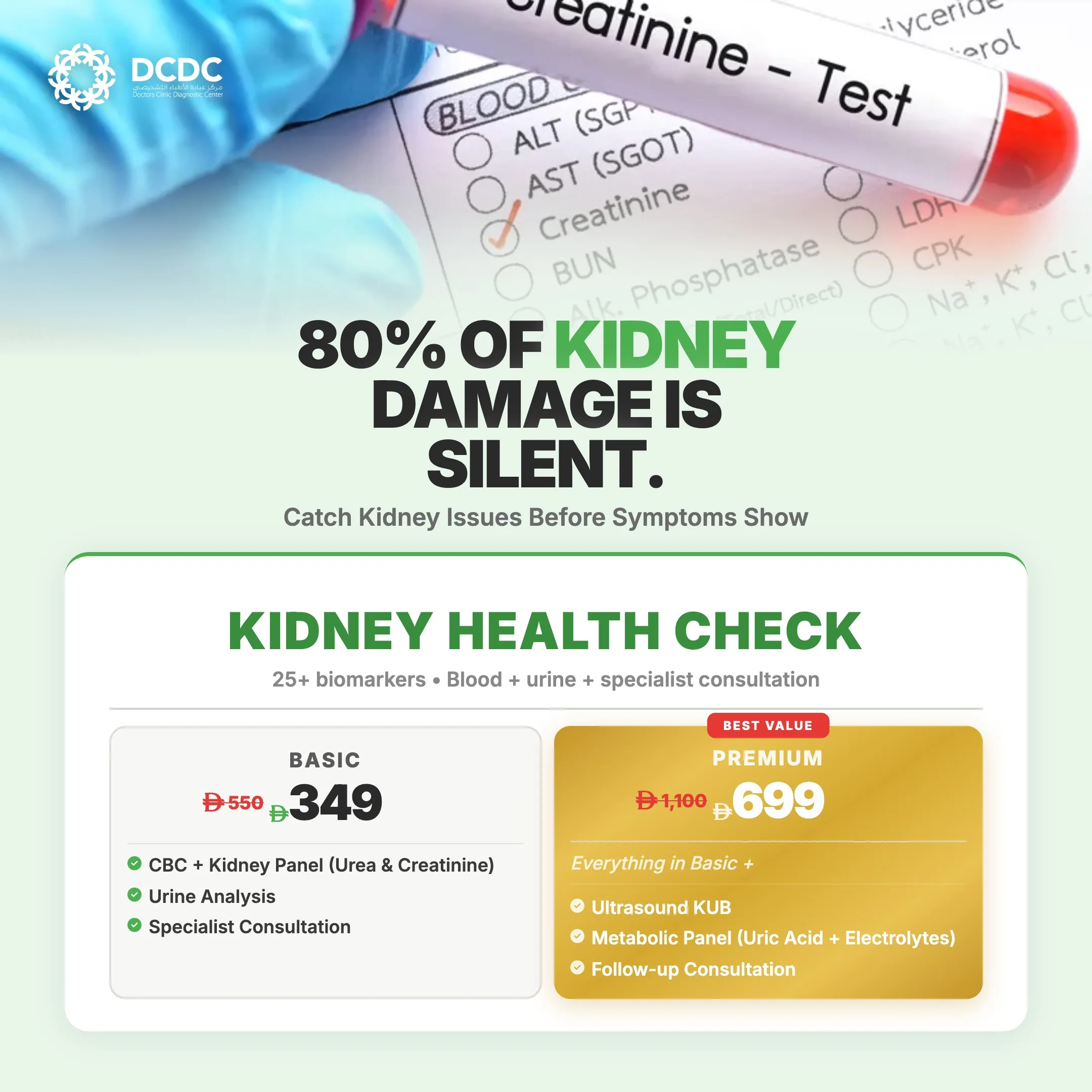
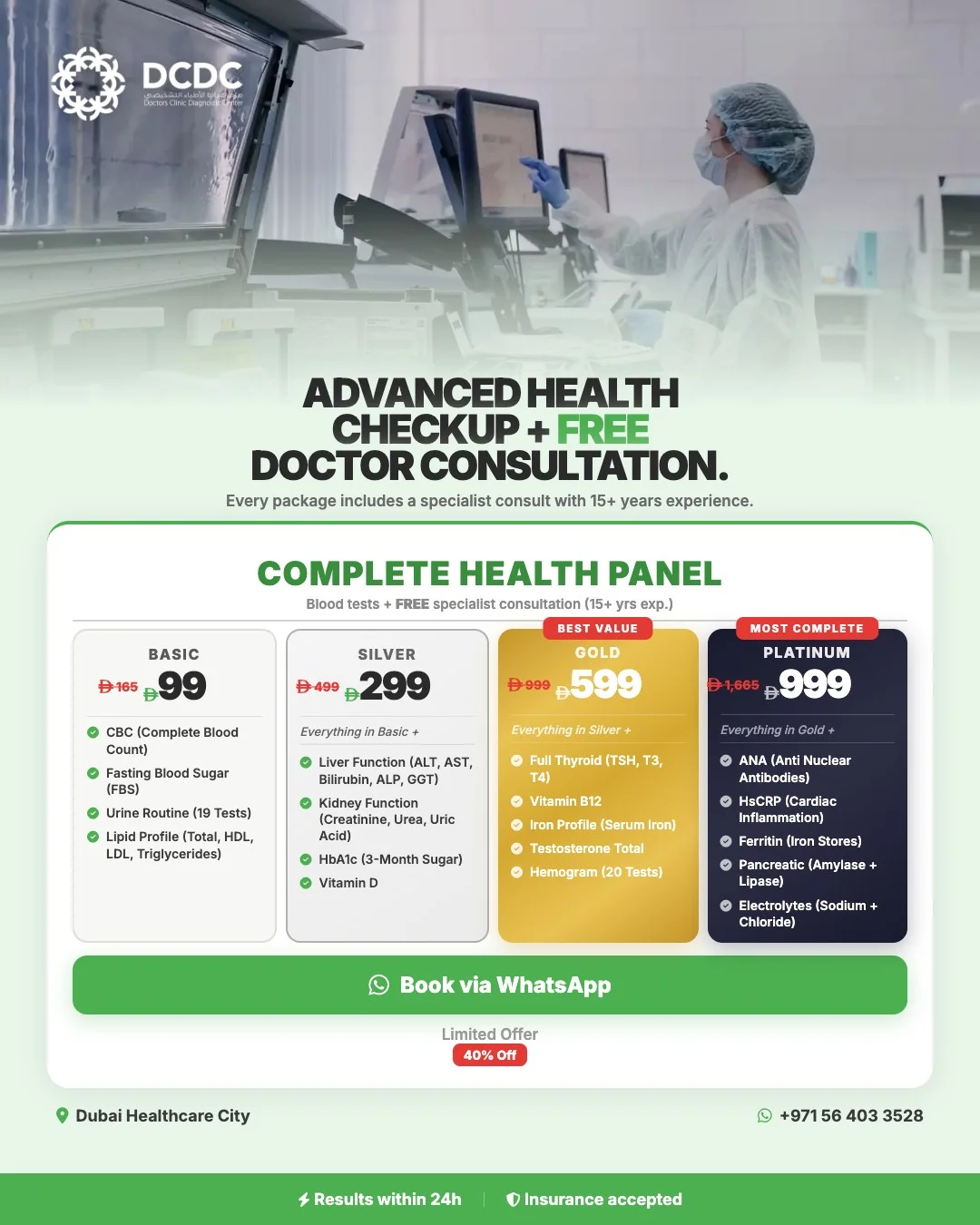
Health Screening Packages
Save with our bundled screening packages — specialist consultation included




Types of Hearing Tests: Complete Guide
Modern audiology offers several complementary tests, each assessing a different part of the hearing system. Your ENT specialist or audiologist determines which combination is appropriate based on your symptoms, age, and clinical question. Understanding what each test measures helps you know what to expect during your assessment.
| Test | What It Measures | How It Works | Duration | Cost (AED) | Patient Cooperation Needed? |
|---|---|---|---|---|---|
| Pure Tone Audiometry (PTA) | Softest sounds you can hear at each frequency (250-8,000 Hz) | Headphones in sound booth. Press button when you hear a tone. | 15-20 min | From 200 | Yes |
| Speech Audiometry | How well you understand spoken words at different volumes | Repeat words played through headphones at various volumes | 10-15 min | Usually included with PTA | Yes |
| Tympanometry | Middle ear function: eardrum movement, ossicle chain, Eustachian tube | Soft probe in ear canal changes air pressure while playing a tone | 2-5 min per ear | From 150 | Minimal (sit still) |
| Otoacoustic Emissions (OAE) | Inner ear outer hair cell function | Miniature microphone in ear canal detects sounds produced by cochlear hair cells | 5-10 min | From 300 | No (objective test) |
| ABR/BERA | Auditory nerve and brainstem pathway integrity | Electrodes on scalp record brain's electrical response to sounds | 30-60 min | From 500 | No (can sleep through it) |
Five types of hearing tests with purpose, method, duration, and cost. A comprehensive assessment typically combines PTA, speech audiometry, and tympanometry (30-45 minutes, from AED 350-500).
1. Pure Tone Audiometry (PTA)
Pure tone audiometry is the standard hearing test. You sit in a sound-treated booth wearing headphones, and tones of different frequencies (pitch) and intensities (volume) are played. You press a button or raise your hand each time you hear a tone, even if it is very faint. The test measures two pathways:
- Air conduction: Sounds delivered through headphones test the entire hearing pathway (outer ear, middle ear, inner ear, auditory nerve)
- Bone conduction: A vibrating device placed behind the ear on the mastoid bone bypasses the outer and middle ear, testing inner ear function directly
- The air-bone gap: If bone conduction is normal but air conduction is reduced, the problem is in the outer or middle ear (conductive loss). If both are reduced equally, the problem is in the inner ear (sensorineural loss)
2. Speech Audiometry
Speech audiometry measures how well you understand words, not just detect tones. Two people with identical audiograms can have very different speech understanding abilities, making this test clinically important.
- Speech Reception Threshold (SRT): The softest level at which you correctly repeat 50% of two-syllable words. Should correlate with your pure tone average.
- Word Recognition Score (WRS): A list of single-syllable words played at comfortable volume. The percentage you correctly repeat. Below 80% indicates poor speech discrimination affecting daily communication.
- Speech in Noise (SIN): Tests your ability to understand speech with background noise — the most common complaint in early hearing loss.
3. Tympanometry (Impedance Audiometry)
Tympanometry assesses middle ear function: the eardrum and the tiny ossicle bones. A soft probe changes air pressure in the ear canal while playing a low tone. The test produces a tympanogram graph with characteristic patterns:
- Type A (normal): Sharp peak at atmospheric pressure — normal eardrum and middle ear
- Type B (flat): No peak — suggests middle ear fluid (effusion) or eardrum perforation
- Type C (shifted): Peak at negative pressure — Eustachian tube dysfunction
- Type As (shallow peak): Ossicular fixation (e.g., otosclerosis)
- Type Ad (deep peak): Flaccid eardrum or ossicular chain discontinuity
- Especially important in children: Tympanometry is the most reliable way to detect glue ear (otitis media with effusion), the most common cause of hearing loss in children
4. Otoacoustic Emissions (OAE)
OAE testing detects tiny sounds produced by the outer hair cells of the cochlea in response to sound stimulation. If hair cells are healthy, emissions are present. If damaged, they are absent. This is the primary test for newborn hearing screening because it requires no patient cooperation and gives a pass/fail result within minutes.
5. Auditory Brainstem Response (ABR/BERA)
ABR (Brainstem Evoked Response Audiometry) measures electrical activity in the auditory nerve and brainstem. Electrodes on the scalp record the brain's response to clicks or tones. No cooperation needed — infants can sleep through it. Key uses: confirming newborn screening results, testing infants and young children, diagnosing auditory neuropathy, and ruling out acoustic neuroma.
Hearing Test Cost in Dubai: Complete Pricing Guide
| Test/Package | What It Includes | Duration | Cost (AED) |
|---|---|---|---|
| Basic Pure Tone Audiometry | Air conduction thresholds at standard frequencies | 15 min | From 200 |
| Pure Tone + Bone Conduction | Air and bone conduction thresholds (identifies hearing loss type) | 20 min | From 250 |
| Tympanometry (both ears) | Middle ear function assessment | 5 min | From 150 |
| Comprehensive Audiometry Package | PTA + speech audiometry + tympanometry | 30-45 min | From 350-500 |
| Otoacoustic Emissions (OAE) | Inner ear hair cell function screening | 10 min | From 300 |
| ABR/BERA Test | Auditory nerve and brainstem assessment | 30-60 min | From 500 |
| Newborn Hearing Screening (OAE) | Pass/fail hearing screen for newborns | 10 min | From 200 |
| ENT Consultation + Audiometry | Full ENT assessment with comprehensive hearing test | 45-60 min | From 500 |
Hearing test costs in Dubai (2026 pricing). Most insurance plans cover hearing tests when ordered by a doctor for clinical indications.
Most Dubai health insurance plans cover hearing tests when ordered by a doctor for clinical indications (hearing difficulty, tinnitus, ear pain, recurrent infections, developmental concerns in children). At DCDC, direct billing is available with 20+ insurance providers.
How to Read Your Audiogram
An audiogram is the graph produced by pure tone audiometry. Understanding how to read it helps you participate in discussions about your hearing health with your audiologist or ENT specialist.
Audiogram Axes and Symbols
- Horizontal axis (top): Frequency in Hertz (Hz) — from low pitch (250 Hz) on the left to high pitch (8,000 Hz) on the right. Human speech primarily occupies 500-4,000 Hz.
- Vertical axis (side): Intensity in decibels (dB) — from soft sounds at the top (0-20 dB) to loud sounds at the bottom (100+ dB). Note: the scale is inverted, so lower marks on the graph mean worse hearing.
- Symbols: O (red) = right ear air conduction. X (blue) = left ear air conduction. [ and ] brackets = bone conduction right and left.
- Reading the result: A mark at 60 dB means you need sounds to be 60 dB loud before you can hear them at that frequency. Normal hearing is 0-20 dB at all frequencies.
Hearing Loss Classification
| Hearing Level (dB) | Classification | Impact on Daily Life | Typical Management |
|---|---|---|---|
| 0-20 dB | Normal hearing | No difficulty in any situation | No intervention needed |
| 21-40 dB | Mild hearing loss | Difficulty with soft speech, whispers, noisy environments | Monitoring, possible hearing aid for communication difficulty |
| 41-55 dB | Moderate hearing loss | Cannot follow normal conversation without effort | Hearing aids recommended |
| 56-70 dB | Moderately severe | Cannot hear normal conversation without amplification | Hearing aids essential |
| 71-90 dB | Severe hearing loss | Only very loud sounds heard unaided | Powerful hearing aids or cochlear implant considered |
| >90 dB | Profound hearing loss | Cannot hear most sounds unaided | Cochlear implant candidate |
Hearing loss classification by severity. These categories guide treatment decisions: mild loss may need monitoring only, while severe-to-profound loss typically requires hearing aids or cochlear implants.
Common Audiogram Patterns
- High-frequency sloping loss: Normal hearing in low frequencies, dropping in high frequencies (2,000-8,000 Hz). The most common pattern — typical of age-related hearing loss (presbycusis) and noise-induced damage.
- Noise notch: A characteristic dip at 4,000 Hz with recovery at 8,000 Hz. Classic signature of noise-induced hearing loss.
- Flat loss: Equal reduction across all frequencies. May suggest middle ear fluid, otosclerosis, or certain inner ear conditions.
- Low-frequency loss: Worse hearing in low frequencies (250-500 Hz). Characteristic of Meniere's disease in early stages.
- Cookie-bite pattern: Hearing is better at high and low frequencies with a dip in the middle. Often genetic in origin.
Three Types of Hearing Loss
Understanding the type of hearing loss is crucial because it determines treatment. The audiogram, together with tympanometry, distinguishes between the three main types.
1. Conductive Hearing Loss
Conductive hearing loss occurs when sound cannot efficiently travel through the outer ear canal, eardrum, or middle ear bones to reach the inner ear. The inner ear itself is functioning normally.
- Common causes: Earwax impaction, middle ear fluid (glue ear), ear infections (otitis media), eardrum perforation, otosclerosis, cholesteatoma, congenital ear canal abnormalities
- On the audiogram: Air conduction reduced, bone conduction normal — creating an air-bone gap
- Treatment: Often medically or surgically treatable: wax removal, antibiotics, grommets for persistent fluid, surgery for otosclerosis or perforation repair
- Prognosis: Good — many causes are fully reversible. Hearing can return to normal after successful treatment.
2. Sensorineural Hearing Loss (SNHL)
Sensorineural hearing loss results from damage to the inner ear (cochlea) hair cells or the auditory nerve. This is the most common type of permanent hearing loss, accounting for approximately 90 percent of all hearing loss in adults.
- Common causes: Ageing (presbycusis), noise exposure, genetic factors, viral infections, ototoxic medications (aminoglycosides, cisplatin), Meniere's disease, acoustic neuroma
- On the audiogram: Both air and bone conduction equally reduced — no air-bone gap
- Treatment: Usually not medically reversible. Managed with hearing aids (mild-moderate), cochlear implants (severe-profound). Sudden SNHL is a medical emergency — steroid treatment within 72 hours can improve outcomes
- Prognosis: Typically permanent but manageable. Early hearing aid fitting prevents auditory deprivation and reduces cognitive decline risk
3. Mixed Hearing Loss
Mixed hearing loss combines conductive and sensorineural components — both an air-bone gap (conductive) and reduced bone conduction (sensorineural). Example: a patient with age-related hearing loss who develops an ear infection has mixed loss. Treatment addresses both components: medical/surgical for the conductive part, hearing aids for the sensorineural part.
When Do You Need a Hearing Test?
Warning Signs of Hearing Loss
- Frequently asking people to repeat themselves — especially in conversations with women or children (higher-pitched voices, and high-frequency loss is most common)
- Turning up the TV/phone volume louder than others need — a family member often notices before you do
- Difficulty hearing in noisy environments — restaurants, malls, group conversations become challenging. Often the earliest complaint
- Tinnitus — ringing, buzzing, hissing, whooshing in one or both ears. Frequently the first sign of hearing damage
- Feeling that people are mumbling — you hear that someone is speaking but cannot make out words clearly
- Needing to see the speaker's face — unconsciously relying on lip reading
- Missing doorbells, phone rings, or alarms — especially high-pitched sounds
- Ear pain, pressure, or fullness — may indicate fluid, infection, or Eustachian tube dysfunction
- Sudden hearing loss — loss developing over hours to days is a medical emergency requiring urgent ENT assessment within 72 hours
Recommended Hearing Screening by Age
| Age Group | Recommended Frequency | Key Risk Factors |
|---|---|---|
| Newborns | Before hospital discharge (within 1 month) | Family history, NICU stay >5 days, congenital infections, craniofacial abnormalities |
| Children (4-10 years) | Ages 4, 5, 6, 8, and 10 | Speech delay, learning difficulties, recurrent ear infections, behavioural concerns |
| Teenagers (12-18) | At least once, or if using headphones regularly at high volume | Personal audio device use, concert attendance, noise exposure |
| Adults under 50 | Every 10 years, or sooner if symptoms/noise exposure | Occupational noise, recreational noise, medications, family history |
| Adults 50+ | Every 3 years | Age-related changes, cumulative noise exposure, medication history |
| High-noise workers | Annually | Construction, aviation, manufacturing, music industry, military |
| Anyone with tinnitus | Immediately for baseline assessment | Tinnitus may be the first sign of underlying hearing loss |
Recommended hearing screening schedule by age group. The average person waits 7-10 years from first noticing hearing difficulty to getting tested, during which untreated loss accelerates cognitive decline.
Tinnitus: When Your Ears Ring
Tinnitus — the perception of sound without an external source — affects approximately 15% of adults worldwide. It is commonly described as ringing, buzzing, hissing, whooshing, clicking, or pulsing sounds. A hearing test is essential because tinnitus is often the first sign of hearing loss the patient has not consciously noticed.
- Hearing loss: The most common cause. Damaged hair cells cause the brain to generate phantom sounds. A hearing test often reveals underlying loss.
- Noise exposure: Concerts, headphones at high volume, construction noise
- Earwax impaction: Treatable cause — removal often resolves tinnitus
- Meniere's disease: Tinnitus with fluctuating hearing loss, ear fullness, and vertigo
- Medications: High-dose aspirin, aminoglycosides, loop diuretics, certain chemotherapy drugs
- TMJ disorders: Jaw joint problems can produce or worsen tinnitus
- Pulsatile tinnitus: Whooshing synchronised with heartbeat — may indicate a vascular cause requiring imaging
Tinnitus management: Treat the underlying cause (wax removal, infection treatment, hearing aids which often reduce tinnitus), sound therapy (white noise generators), cognitive behavioural therapy (most effective for tinnitus distress), tinnitus retraining therapy, and avoiding aggravating factors (caffeine, loud noise, stress).
Hearing Aid Options and Costs in Dubai
Modern hearing aids are small, discreet, and technologically advanced. They are recommended for permanent sensorineural hearing loss that cannot be corrected medically.
| Hearing Aid Type | Visibility | Best For | Features | Cost Per Ear (AED) |
|---|---|---|---|---|
| Behind-the-Ear (BTE) | Visible behind ear | All degrees of hearing loss, children | Durable, powerful, easy to handle, longest battery life | From 3,000 |
| Receiver-in-Canal (RIC) | Small unit behind ear, thin wire to canal | Mild to severe loss | Natural sound quality, comfortable, rechargeable options, Bluetooth | From 4,000 |
| In-the-Ear (ITE) | Fills outer ear bowl | Mild to moderately severe loss | Custom-fit, larger controls, longer battery than CIC | From 5,000 |
| Completely-in-Canal (CIC) | Nearly invisible inside ear canal | Mild to moderate loss | Cosmetically appealing, minimal wind noise, no Bluetooth typically | From 6,000 |
| Premium AI-Enabled | Varies by style (BTE/RIC) | Active lifestyle, complex listening environments | AI scene adaptation, Bluetooth streaming, rechargeable, fall detection, health monitoring | From 10,000-15,000+ |
Hearing aid types and costs in Dubai (2026). Prices are per ear. Most patients need two hearing aids for balanced hearing. Some comprehensive insurance plans provide partial coverage.
Key hearing aid features in 2026 include Bluetooth connectivity for streaming phone calls, music, and TV directly to the hearing aid; rechargeable lithium-ion batteries (full day on a single charge); directional microphones for better speech understanding in noise; tinnitus masking programs; and AI-driven environment adaptation that automatically adjusts settings based on whether you are in a quiet room, restaurant, or outdoor environment.
Adjustment period: It takes 2-4 weeks for your brain to adapt to amplified sound. Regular follow-up appointments for fine-tuning are essential. Hearing aids do not restore perfect hearing but significantly improve communication ability and quality of life.
What to Expect at DCDC: Your Hearing Assessment
At Doctors Clinic Diagnostic Center in Dubai Healthcare City, hearing assessments are available as part of our ENT services. Here is your patient journey:
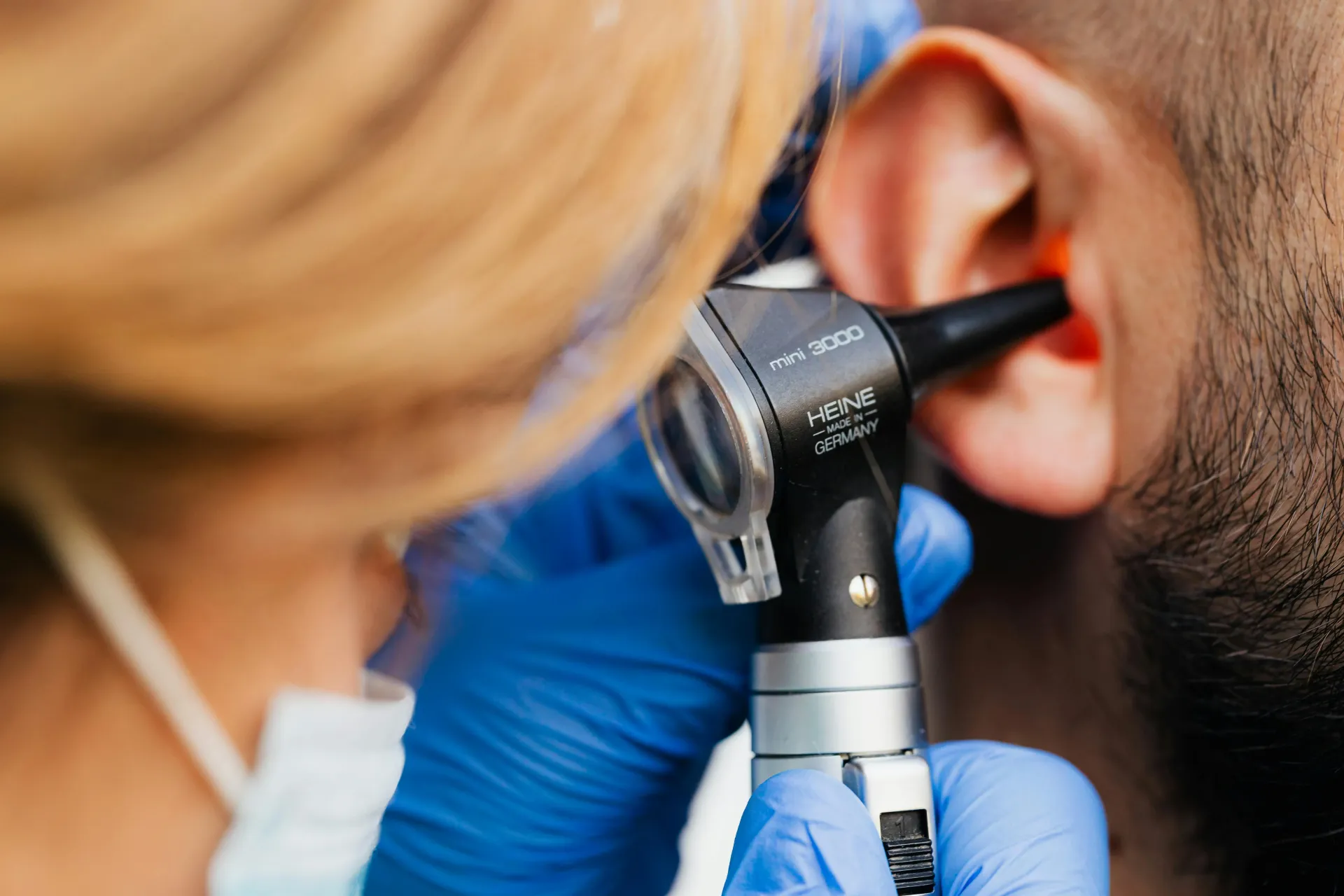
- ENT consultation: Your ENT specialist reviews your symptoms, medical history, noise exposure, and examines your ears with an otoscope to check for wax, infection, eardrum perforation, or other visible abnormalities.
- Audiometric testing: Based on clinical findings, appropriate tests are selected: pure tone audiometry, speech audiometry, tympanometry, and/or OAE.
- Same-day results: Results are reviewed immediately with you. The audiogram is explained, hearing loss type and severity are discussed, and a management plan is provided.
- Treatment or referral: Depending on findings: earwax removal (immediate relief), medication for infections, referral for hearing aid fitting, or specialist referral for surgical conditions. For children, speech therapy referral if hearing loss has affected language development.
DCDC holds a 4.8/5 Google rating from over 1,000 patient reviews. Direct billing is available with 20+ insurance providers including Daman, AXA, Bupa, MetLife, and Cigna. MOHAP Licensed (No. NIMY7VY5-240925).
Book a Hearing Test at DCDC
Comprehensive hearing assessments including pure tone audiometry, speech testing, and tympanometry. Same-day results with immediate ENT specialist review at DCDC Dubai Healthcare City.
Hearing test from AED 200 — most insurance accepted. Walk-in or appointment.
Hearing Tests for Children
Children's hearing assessments differ from adult testing because young children cannot follow standard audiometry instructions. Age-appropriate techniques are used:
- 0-6 months: OAE and ABR — objective tests requiring no cooperation
- 6 months to 2 years: Visual reinforcement audiometry (VRA) — child turns toward sound, rewarded with animated toy
- 2-5 years: Conditioned play audiometry (CPA) — child drops a block in a box each time they hear a sound
- 5+ years: Standard pure tone audiometry (button press or hand raise)
If your child has speech delay, does not respond to sounds appropriately, has recurrent ear infections, or shows learning difficulties, a hearing test should be one of the first investigations. Undetected hearing loss in children significantly impacts speech, language, social, and academic development.
Newborn Hearing Screening
Hearing loss is one of the most common congenital conditions, affecting approximately 1-3 per 1,000 newborns. Early detection is critical because the first 3 years are a crucial period for speech and language development.
- Universal screening: All newborns should be screened before hospital discharge, ideally within the first month
- Tests used: OAE — quick, non-invasive, pass/fail. If baby fails OAE, ABR testing confirms
- The 1-3-6 rule: Screen by 1 month, diagnose by 3 months, begin intervention by 6 months
- Risk factors: Family history, NICU stay >5 days, in-utero infections (CMV, rubella), craniofacial abnormalities
- A fail does not mean hearing loss: Many initial fails are due to ear canal fluid or ambient noise. Further testing determines the outcome.
Noise Exposure in Dubai: Protecting Your Hearing
Dubai's vibrant lifestyle presents unique noise exposure risks. Noise-induced hearing loss is the most preventable form of permanent hearing damage.
- Construction noise: 90-120 dB from pile driving, demolition, and heavy machinery near residential areas
- Personal audio devices: Earbuds at 95-110 dB — the WHO estimates 1.1 billion young people are at risk
- Nightlife: Clubs and events commonly reach 100-115 dB, causing damage within minutes
- Traffic: Sheikh Zayed Road produces sustained 80-85 dB for nearby residents
- Water sports: Jet skiing and speedboats without ear protection
Prevention strategies: Follow the 60/60 rule (maximum 60% headphone volume for 60 minutes). Use earplugs at concerts and construction sites. Take 16+ hour ear breaks after loud noise. Use noise-cancelling headphones so you do not need to increase volume in noisy environments. Get a baseline audiogram before age 50 or if you have noise exposure.
Occupational Hearing Tests in Dubai
UAE labour law requires employers to provide hearing protection and regular monitoring for workers exposed to noise above 85 dB. Industries requiring monitoring include construction, manufacturing, aviation, oil and gas, entertainment, and military. A baseline audiogram should be performed within 6 months of starting high-noise employment, with annual monitoring compared against baseline. A standard threshold shift (STS) of 10 dB or more at 2,000-4,000 Hz triggers action: additional protection, reduced exposure, and medical evaluation.
Insurance Coverage for Hearing Tests and Hearing Aids
Most Dubai health insurance plans cover hearing tests when ordered by a doctor for clinical indications. Hearing aids are less commonly covered: basic plans typically do not include them, while comprehensive plans may provide partial coverage up to a fixed annual limit (often AED 3,000-5,000). Cochlear implants may be covered under specific criteria. Always check with your insurer before purchasing hearing aids.
Occupational hearing tests are typically the employer's responsibility under UAE labour law, not charged to the employee's personal insurance.
Preventing Hearing Loss: Evidence-Based Strategies
- Use ear protection: Custom-fit or foam earplugs at concerts, construction sites, and with power tools. Musicians' earplugs reduce volume without distorting sound.
- Follow the 60/60 rule: Maximum 60% headphone volume for maximum 60 minutes at a time.
- Take ear breaks: 16+ hours of quiet after loud noise exposure for recovery.
- Distance from speakers: At events, stand away from speakers. Intensity decreases with distance.
- Monitor children's headphone use: Volume-limiting headphones (capped at 85 dB) are recommended for children.
- Get a baseline hearing test: Before age 50 or if you have noise exposure, so future tests can detect change early.
- Manage cardiovascular health: Good blood flow to the inner ear supports hearing. Exercise, manage blood pressure, and control diabetes.
Concerned About Your Hearing? Get Tested Today
Comprehensive hearing assessments from AED 200 with immediate results and ENT specialist review. Walk-in or appointment at DCDC Dubai Healthcare City. Most insurance accepted with direct billing.
Sat-Thu 8 AM-10 PM, Fri 9 AM-9 PM. Free parking. MOHAP Licensed.
Related Services at DCDC
Expert care and advanced diagnostics at Dubai Healthcare City
Frequently Asked Questions
Final Thoughts
Hearing is fundamental to communication, safety, cognitive health, and quality of life — yet the average person waits 7-10 years from first noticing hearing difficulty to getting tested. During this delay, untreated hearing loss accelerates cognitive decline and increases social isolation. Modern hearing tests are quick (30-45 minutes for a comprehensive assessment), completely painless, affordable (from AED 200), and provide an immediate picture of your hearing health.
Whether your concern is difficulty hearing conversations, persistent tinnitus, your child's speech development, occupational noise exposure, or simply wanting a baseline audiogram before age 50, there is a test designed for your specific question. Five types of hearing tests assess different parts of the hearing system, and your ENT specialist selects the right combination based on your symptoms.
At Doctors Clinic Diagnostic Center in Dubai Healthcare City, we offer comprehensive audiological testing alongside ENT specialist consultation. Same-day hearing tests are available, results are reviewed immediately, and a clear management plan is provided — from earwax removal to hearing aid referral or specialist investigation. Contact us by phone, WhatsApp, or walk in to schedule your hearing assessment.
Sources & References
This article was reviewed by our medical team and references the following sources:
- World Health Organization — World Report on Hearing (2021)
- American Academy of Audiology — Clinical Practice Guidelines on Audiologic Assessment
- National Institute on Deafness and Other Communication Disorders (NIDCD) — Hearing Loss Statistics
- British Society of Audiology — Recommended Procedures for Pure Tone Audiometry
- The Lancet Commission on Hearing Loss — Hearing Loss: A Growing Global Health Concern
- Dubai Health Authority — Occupational Health and Safety Standards
- Mayo Clinic — Hearing Tests: Types and What to Expect
Medical content on this site is reviewed by DHA-licensed physicians. See our editorial policy for more information.

Written by
Dr. Hadeel Elnur
General Practitioner
MD General Practice
Dr. Hadeel Elnur is a General Practitioner at DCDC Dubai Healthcare City with expertise in primary care, preventive medicine, and ear health assessments.
Related Articles
ENT Doctor Dubai: When to See a Specialist (2026)
Ear Infection Treatment Dubai: Causes & Cost
Ear Wax Removal Cost Dubai: From AED 200
Hearing Loss Causes & Treatment Dubai (2026)
Sleep Apnea & Snoring Dubai: Treatment & Cost
More in General Health
Epilepsy Treatment Dubai: Symptoms & Care (2026)
Read More
Food Allergy vs Food Intolerance Dubai (2026)
Read More
Pneumonia vs Flu Dubai: Key Differences (2026)
Read More
Swollen Lymph Nodes Dubai: When to Worry (2026)
Read MoreFlu vs Cold Dubai: How to Tell the Difference (2026)
Read More
Sleep Study Cost Dubai: Tests & Pricing (2026)
Read More© 2026 Doctors Clinic Diagnostic Center (DCDC), Dubai Healthcare City. Originally published at https://doctorsclinicdubai.ae/blog/hearing-test-dubai-guide. All rights reserved. Unauthorized reproduction is prohibited.