
Key Takeaways
- Difficulty swallowing (dysphagia) is a symptom, not a diagnosis. It is commonly divided into oropharyngeal dysphagia (trouble starting a swallow, with coughing or choking) and oesophageal dysphagia (food sticking after it has been swallowed), and the type guides which tests are needed.
- A lump in the throat that does not interfere with eating (globus sensation) is very common and usually harmless. Trouble actually getting food or liquid down is different and should always be assessed.
- Seek emergency care if you cannot swallow saliva, are drooling, have breathing difficulty, or have food stuck that will not move. See a doctor promptly for swallowing trouble that is progressive, painful, or accompanied by weight loss, hoarseness, a neck lump or vomiting blood.
- Diagnosis usually combines a clinical examination with flexible nasal endoscopy, and where needed upper GI endoscopy, barium swallow, manometry or neck imaging. Most causes are treatable once identified.
- At DCDC in Dubai Healthcare City, ENT, gastroenterology and radiology work under one roof, so the whole swallowing work-up can often be coordinated in one place. ENT consultation starts from AED 300 and GP consultation from AED 249.
Roughly 1 in 25 adults develops a swallowing problem in any given year, and the figure rises sharply with age. Whether it feels like food sticking in your chest, coughing when you drink, or a lump in your throat that never quite clears, swallowing difficulty deserves a proper explanation rather than weeks of waiting. An ENT consultation at DCDC can identify the cause, rule out serious conditions and set up the right tests the same week, often the same day.
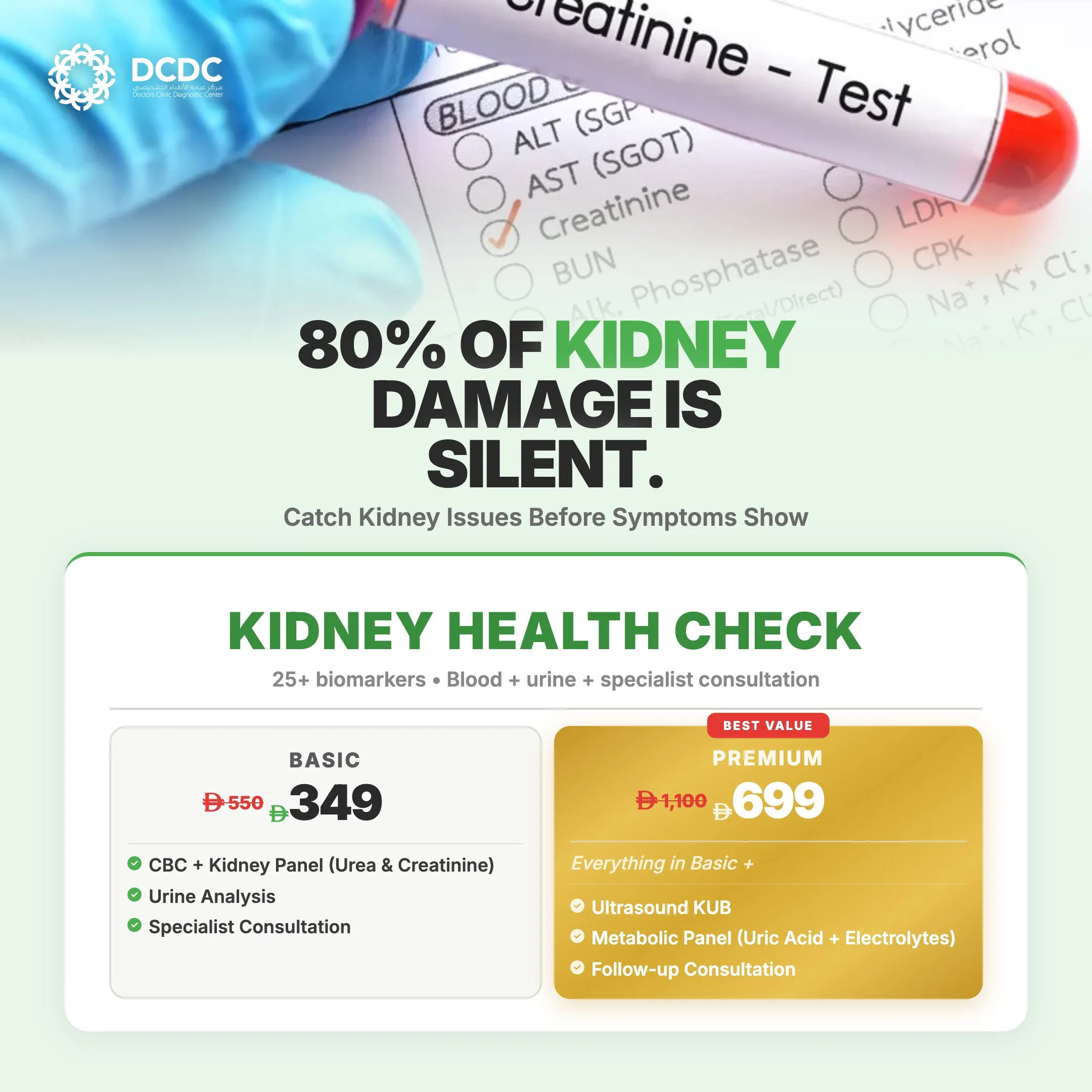
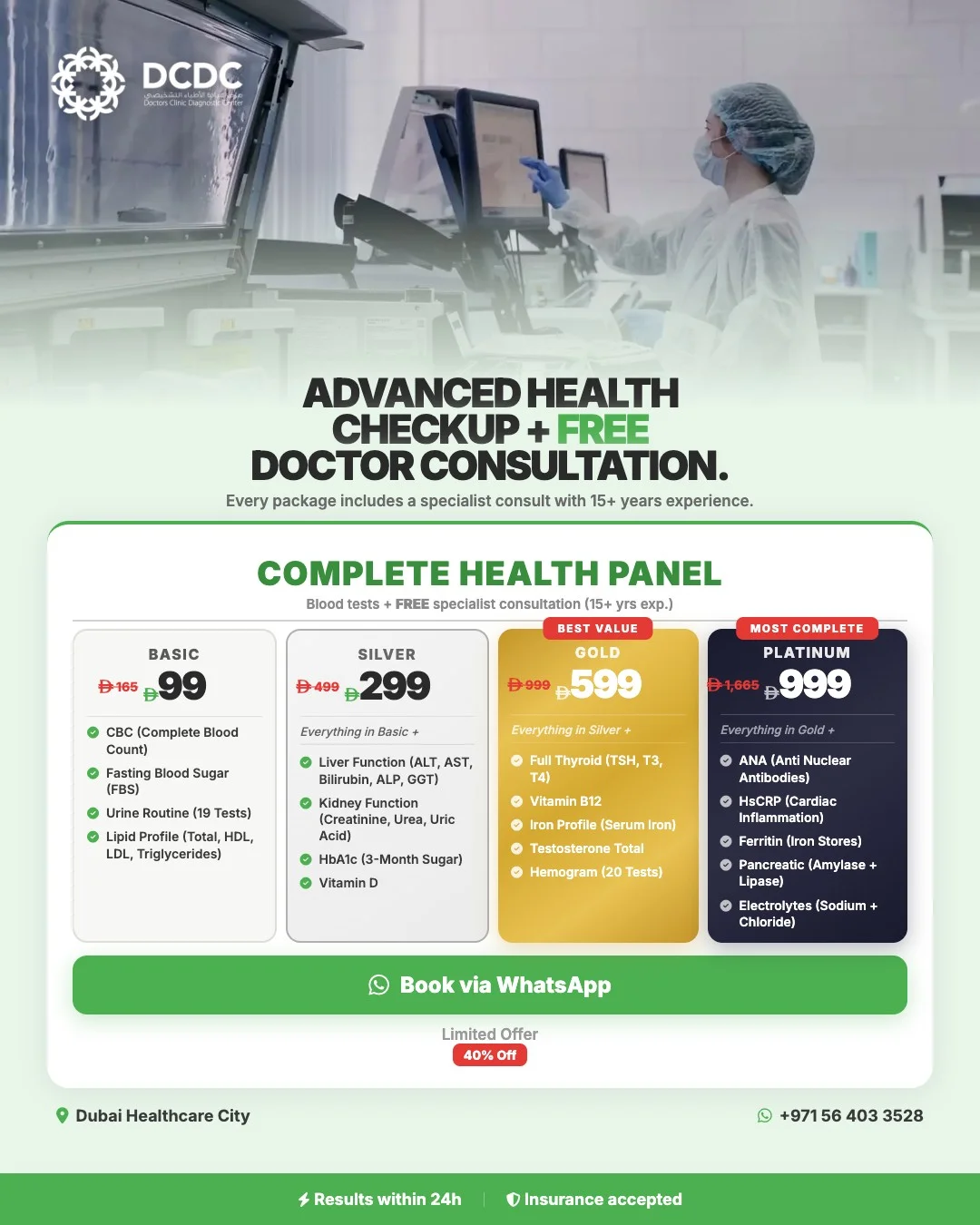
Health Screening Packages
Save with our bundled screening packages — specialist consultation included



Dysphagia is the medical term for difficulty moving food, liquid or saliva from the mouth to the stomach. It can mean the swallow is slow, painful, incomplete, or that food or fluid goes the wrong way and triggers coughing. It is different from odynophagia (pain on swallowing, often from infection or inflammation) and from globus sensation, the feeling of a lump or tightness in the throat that is present between swallows and often eases when you eat.
This distinction matters. Dysphagia is an objective problem with the swallowing mechanism and usually needs investigation. Globus is a sensation with no physical blockage and is usually benign, although a doctor should confirm that nothing else is going on. This guide explains the main causes, the red flags, how swallowing problems are tested, what treatment involves, and what to expect when you are assessed in Dubai.
Common Causes of Swallowing Difficulty
Swallowing involves more than 30 muscles and several nerves working in a precise sequence across the mouth, throat and oesophagus. A problem at any stage can cause symptoms, which is why doctors first ask where the food seems to stick and what is hard to swallow. Causes fall into three broad groups.
Oropharyngeal Dysphagia (Mouth and Throat)
Oropharyngeal dysphagia is difficulty starting the swallow or moving food from the mouth into the oesophagus. People describe coughing or choking when they eat or drink, food or liquid coming back through the nose, a wet or gurgly voice after swallowing, or repeated chest infections. It is mostly caused by problems with nerves and muscles rather than a physical blockage.
- Stroke: one of the most frequent causes; swallowing problems occur in a large proportion of people in the early days after a stroke
- Neurological conditions: Parkinson's disease, multiple sclerosis, motor neurone disease, myasthenia gravis and dementia can weaken or slow the swallow reflex
- Muscle disorders: inflammatory myopathies and age-related loss of muscle strength
- Structural problems: a pharyngeal pouch (Zenker's diverticulum), cricopharyngeal bar, or tumours of the tongue, throat or larynx
- Throat infections and inflammation: severe tonsillitis, peritonsillar abscess and epiglottitis can make swallowing painful or physically difficult; see our guides to tonsillitis treatment in Dubai and sore throat causes and treatment
- After radiotherapy or surgery to the head and neck, which can cause scarring, dryness and weakness
- Medication effects: drugs that cause dry mouth or sedation can worsen swallowing
Oesophageal Dysphagia (Food Passage)
Oesophageal dysphagia is the sensation of food sticking or slowing down after you have swallowed, usually felt behind the breastbone or in the lower neck. Where you feel it is not always where the problem is, so imaging or endoscopy is used to locate it. A key question is whether you struggle with solids only or with solids and liquids, because this separates a narrowing (solids first) from a motility disorder (both from the start).
- Gastro-oesophageal reflux disease (GERD): long-term acid exposure inflames the oesophagus and can cause a peptic stricture, a narrowing that traps food. Read more in our guide to acid reflux and GERD in Dubai
- Eosinophilic oesophagitis: an allergic-type inflammation that typically causes food impaction, especially with meat or bread, and is often seen in younger adults with allergies
- Oesophageal rings and webs: thin bands of tissue that narrow the passage, causing intermittent trouble with solids
- Achalasia and other motility disorders: the oesophageal muscle fails to push food down or the lower sphincter fails to relax, causing difficulty with both solids and liquids, regurgitation and weight loss
- Tumours: oesophageal or stomach-top cancer typically causes dysphagia that is progressive over weeks to months, first with solids then with liquids
- External pressure: an enlarged thyroid (goitre), enlarged lymph nodes or other masses in the neck or chest can compress the swallowing passage; thyroid causes are covered in our thyroid treatment and cost guide
- Pill oesophagitis: tablets that lodge in the oesophagus (certain antibiotics, anti-inflammatories, potassium and bisphosphonates) and injure the lining
Globus Sensation (Lump in the Throat Feeling)
Globus is the persistent feeling of a lump, tightness or something stuck in the throat when nothing is there. It is common, with surveys suggesting that a large share of otherwise healthy people experience it at some point. A typical clue is that the sensation is often easier when eating or drinking and more noticeable when you swallow saliva on its own. True dysphagia is the opposite: it gets worse when you eat.
Contributors include:
- Reflux, including laryngopharyngeal reflux: small amounts of stomach contents irritating the throat, even without heartburn
- Anxiety, stress and muscle tension: tension in the throat and neck muscles, or tightness of the upper oesophageal sphincter, often worse during stressful periods
- Post-nasal drip and allergies: mucus and throat clearing irritate the tissues
- Dry air and dehydration: a particular issue in Dubai, where constant air conditioning, low indoor humidity and long periods outdoors in the heat dry the throat lining
- Spicy and acidic foods: common in Dubai's food scene and a frequent reflux trigger
- Thyroid or neck conditions: less often, a nodule or enlarged thyroid
Globus is a diagnosis made after other conditions are excluded. If you also have true difficulty swallowing, pain on swallowing, weight loss, hoarseness or a neck lump, it should not be assumed to be globus.
Oropharyngeal vs Oesophageal Dysphagia at a Glance
| Feature | Oropharyngeal dysphagia | Oesophageal dysphagia |
|---|---|---|
| Where it happens | Mouth and throat, at the start of the swallow | Oesophagus, after food has gone down |
| Typical symptoms | Coughing or choking while eating, nasal regurgitation, wet voice, drooling, repeated chest infections | Food sticking behind the breastbone, regurgitation, chest discomfort, heartburn, weight loss |
| Timing | Within a second or two of swallowing | Several seconds after swallowing |
| Common causes | Stroke, Parkinson's disease, muscle weakness, pharyngeal pouch, head and neck tumours | GERD and strictures, eosinophilic oesophagitis, rings, achalasia, oesophageal cancer, external compression |
| Typical first tests | Clinical swallow assessment, flexible nasal endoscopy, videofluoroscopy | Upper GI endoscopy, barium swallow, manometry |
| Usual specialist | ENT, speech and language therapist, neurologist | Gastroenterologist, ENT, surgeon |
Overlap is common, and a single patient can have both. That is one reason a combined ENT and gastroenterology assessment is so useful.
When Is Difficulty Swallowing an Emergency?
Most swallowing problems are not emergencies, but some situations need immediate care. Go to the nearest emergency department or call 998 (Dubai Ambulance) if you have:
- Inability to swallow even saliva, or constant drooling
- Difficulty breathing, noisy breathing (stridor) or a feeling that the airway is closing
- Food stuck in the throat or chest that will not pass, especially with chest pain or inability to swallow liquids
- Sudden swallowing difficulty with facial droop, slurred speech or limb weakness (possible stroke)
- Severe throat pain with fever, a muffled voice and trouble opening the mouth (possible abscess)
- Vomiting blood or passing black stools
- Swelling of the lips, tongue or face after a food, drink or medication (possible anaphylaxis)
See a doctor within days, not months, if swallowing difficulty is getting steadily worse, lasts more than two to three weeks, or comes with unintended weight loss, hoarseness lasting more than three weeks, a lump in the neck, painful swallowing, repeated chest infections or avoiding foods because of the problem. Smokers and heavy drinkers, and anyone over 50 with new symptoms, should be assessed sooner. For guidance on choosing the right specialist, see our guide to seeing an ENT doctor in Dubai.
How Is Dysphagia Diagnosed?
Doctors work out the cause by combining your history with a physical examination and targeted tests. The aim is to answer three questions: where is the problem, is there a structural cause such as a narrowing or tumour, and is the swallow mechanism itself failing?
Clinical Examination
Your doctor will ask when the problem began, whether it affects solids, liquids or both, whether it is constant or intermittent, and whether you have heartburn, cough, weight loss, voice change or regurgitation. They will review your medications, examine the mouth, throat and neck (including the thyroid and lymph nodes), and check how you swallow a small amount of water. Careful history alone often points towards the right diagnosis.
Endoscopy
Two types are used. Flexible nasal endoscopy is an outpatient ENT test in which a thin camera passes through the nose to view the throat, voice box and the upper swallowing pathway. It takes a few minutes with local anaesthetic spray. Upper GI endoscopy (gastroscopy) passes a camera through the mouth into the oesophagus and stomach, usually with sedation. It can find inflammation, strictures, rings, eosinophilic oesophagitis and tumours, and allows biopsies or stretching of a narrowing during the same procedure. Endoscopy is the main test when oesophageal dysphagia is suspected.
Barium Swallow
In a barium swallow (or videofluoroscopic swallow study), you drink or eat a contrast material while X-ray images are taken. It shows how food moves through the throat and oesophagus, and can reveal narrowing, pouches, motility problems or aspiration, where food enters the airway. Modified versions with different food textures help speech and language therapists advise on safe diets.
Manometry
Oesophageal manometry measures the pressure and coordination of the oesophageal muscle and sphincters using a thin sensor passed through the nose. It is used when endoscopy and barium tests do not explain the symptoms, or when a motility disorder such as achalasia is suspected. It is typically arranged at a specialist centre after initial assessment.
Imaging (CT and Ultrasound)
Ultrasound of the neck is a quick, radiation-free way to assess the thyroid, neck lymph nodes and masses that could press on the swallowing passage. CT or MRI is used when a tumour, deep neck infection or compression from structures in the chest is suspected, or to stage a known abnormality. Thyroid and neck ultrasound is available on site at DCDC.
| Test | What it shows | Typically used when |
|---|---|---|
| Flexible nasal endoscopy | Throat, voice box, vocal cord movement, pooling of saliva | Oropharyngeal symptoms, hoarseness, globus, throat lump |
| Upper GI endoscopy | Oesophagus and stomach lining; biopsies possible | Food sticking, reflux, suspected stricture, eosinophilic oesophagitis or tumour |
| Barium swallow / videofluoroscopy | Movement of food, pouches, narrowing, aspiration | Coughing with meals, pouch or motility concerns |
| Manometry | Oesophageal pressure and muscle coordination | Unexplained dysphagia, suspected achalasia |
| Neck ultrasound | Thyroid, lymph nodes, neck masses | Neck lump, goitre, external compression |
| CT / MRI | Detailed view of tumours, deep infections, chest structures | Suspected mass, staging, complex cases |
Treatment Options for Swallowing Difficulty
Treatment depends entirely on the cause, which is why identifying it is the first step. Options include:
- Treating reflux: acid-reducing medication (proton pump inhibitors for a defined course), weight management, avoiding late meals, and reducing triggers such as spicy food, caffeine and alcohol. Reflux-related strictures may need dilation
- Endoscopic dilation: stretching a narrowed oesophagus with a balloon or dilator, often giving rapid relief for strictures and rings
- Eosinophilic oesophagitis: swallowed topical steroids, acid suppression or dietary elimination, guided by biopsies
- Swallowing therapy: speech and language therapists teach exercises, safe swallowing techniques, head positions and texture modification (for example thickened fluids) for neurological or muscle-related dysphagia
- Infections: antibiotics or drainage for bacterial tonsillitis or abscess, as well as pain relief
- Treating achalasia: pneumatic dilation, botulinum toxin, or surgical or endoscopic myotomy
- Surgery: for pharyngeal pouches, thyroid enlargement causing compression, or tumours, often with oncology input
- Globus: reassurance after a normal examination, reflux treatment where relevant, throat-relaxing exercises, hydration, reduced throat clearing, and stress management or cognitive behavioural therapy where anxiety contributes
- Nutrition support: dietitian advice, texture-modified diets or, in severe cases, tube feeding while the cause is treated
Treating swallowing problems early is important. Untreated dysphagia can lead to weight loss, dehydration and aspiration pneumonia, and conditions such as strictures and tumours are easier to treat when found sooner.
What to Expect at DCDC
Doctors Clinic Diagnostic Center is in Building 64, Block A, Al Razi Medical Complex, Dubai Healthcare City, open Saturday to Thursday 8 AM to 10 PM and Friday 9 AM to 9 PM. Same-day appointments are frequently available, and parking is free and on site.
- Step 1, ENT assessment: Dr. Yousra Mohamed (MBBS, Arab Board ORL, MRCS) takes a detailed history and examines your mouth, throat and neck. An ENT consultation starts from AED 300. If you prefer to begin with a general check, a GP consultation starts from AED 249
- Step 2, throat visualisation: where appropriate, the upper throat is examined to look for inflammation, pooling of saliva, or structural problems
- Step 3, on-site imaging: thyroid and neck ultrasound can be done at the clinic if a neck lump, goitre or compression is suspected, with results reviewed in the same visit
- Step 4, gastroenterology input: if the picture suggests reflux, an oesophageal narrowing or a motility disorder, our gastroenterology team can arrange upper GI endoscopy or further tests
- Step 5, coordinated plan: you leave with a clear explanation, treatment, any referrals needed (for example swallowing therapy or advanced testing) and a follow-up plan
Having ENT, gastroenterology, general medicine and radiology under one roof means fewer separate appointments and less repetition of your history. DCDC works with more than 20 insurance partners with direct billing, and the front desk can confirm your coverage before you attend.
Self-Care Tips While Waiting for Your Appointment
These measures do not replace assessment but can make eating safer and more comfortable in the meantime:
- Eat slowly, take small bites and chew thoroughly. Sit fully upright for meals and for 30 minutes afterwards
- Choose softer, moist foods and add sauces or gravy; avoid dry bread, tough meat and rice that is hard to manage if these catch
- Alternate solids with sips of water, and avoid talking or being distracted while eating
- Reduce reflux triggers: spicy food, fried and fatty meals, caffeine, alcohol, smoking and large late-night dinners. Wait at least three hours before lying down
- Stay hydrated, especially outdoors in summer, and use a humidifier or avoid direct AC airflow at night if your throat feels dry
- Avoid repeatedly clearing your throat, which irritates the lining and can worsen the lump sensation
- Practise slow breathing or relaxation if stress seems to tighten your throat
- Stop taking any tablet that seems to catch in the throat only after checking with a doctor or pharmacist, and take pills upright with a full glass of water
- Keep a short diary of which foods cause trouble, as it helps your doctor
- Do not self-treat with repeated acid medication for months without review, and seek help urgently if any red flag appears
Struggling to Swallow? Get Answers at DCDC
Book an ENT consultation with Dr. Yousra Mohamed at DCDC Dubai Healthcare City. On-site ultrasound and gastroenterology support, same-day appointments frequently available, free parking and direct insurance billing.
ENT consultation from AED 300 | GP consultation from AED 249
Related Services at DCDC
Expert care and advanced diagnostics at Dubai Healthcare City
Frequently Asked Questions
Final Thoughts
Swallowing difficulty has many possible causes, from a dry irritated throat and reflux to strokes, narrowings and rarely tumours. The reassuring part is that most causes are treatable once found, and that the pattern of your symptoms, whether food sticks in the throat, in the chest, or only feels like a lump, gives your doctor strong clues about where to look.
The key is not to wait. Emergency symptoms such as being unable to swallow saliva or breathe need hospital care immediately, while progressive trouble, pain, weight loss, hoarseness or a neck lump should be seen within days. Even a harmless-feeling lump in the throat is worth a quick examination to confirm that nothing more serious is behind it.
If you are in Dubai, DCDC offers ENT assessment, on-site ultrasound and gastroenterology support in Dubai Healthcare City. Book an ENT consultation, or call or message us on WhatsApp, and we will help you find the cause and a clear plan.
Sources & References
This article references the following sources:
- Mayo Clinic: Dysphagia - Symptoms and Causes
- NHS: Swallowing Problems (Dysphagia)
- Cleveland Clinic: Globus Sensation
- StatPearls (NCBI Bookshelf): Dysphagia
- PubMed: Globus pharyngeus research
This information is educational and does not replace individual medical advice. See our editorial policy for more information.

Written by
Dr. Yousra Mohamed
ENT Specialist
MBBS, Arab Board (ORL), MRCS
Dr. Yousra Mohamed is an ENT Specialist at Doctors Clinic Diagnostic Center (DCDC) in Dubai Healthcare City.
Related Articles

Sore Throat Dubai: Causes & Treatment

Acid Reflux Dubai: GERD Symptoms & Care
Tonsillitis Treatment Dubai: Symptoms & Care

Thyroid Treatment Cost Dubai: From AED 299
ENT Doctor Dubai: Complete Guide
More in General Health
Hoarseness in Dubai: Causes & When to Worry (2026)
Read More
Year-End Insurance Checkup Dubai: Guide (2026)
Read MoreWeak Immune System Signs Dubai: When to Test (2026)
Read MoreStrep Throat Treatment Dubai: Signs (2026)
Read More
Flu vs COVID Symptoms Dubai: Key Signs (2026)
Read More
CBC Test Price Dubai: AED 149, Normal Ranges & Results
Read More© 2026 Doctors Clinic Diagnostic Center (DCDC), Dubai Healthcare City. Originally published at https://doctorsclinicdubai.ae/blog/swallowing-difficulty-causes-dubai. All rights reserved. Unauthorized reproduction is prohibited.