Key Takeaways
- A paternity test compares DNA at 16-24+ STR (Short Tandem Repeat) markers between a child and an alleged father, delivering a probability of paternity of 99.99% or higher when the man is the biological father, and 100% exclusion when he is not
- Dubai offers two distinct types of paternity testing — legal (court-admissible, chain-of-custody) from AED 1,800, and peace-of-mind (informational only) from AED 800 — and choosing the wrong one can invalidate your result for official use
- Sample collection is simple and painless: a buccal cheek swab or a standard venous blood draw, completed in under 5 minutes by trained DCDC staff, with no needles required for the peace-of-mind option
- The UAE's Federal Decree-Law No. 41 of 2024 (Personal Status Law, Article 87) made DNA testing a standalone legal method for proving or disputing lineage in UAE courts, without requiring supplementary evidence
- Only accredited, chain-of-custody DNA tests — with photo ID verification and witnessed collection — are admissible in UAE courts, for birth certificate amendments, inheritance disputes, or immigration cases
- Results are typically ready within 3-5 business days at DCDC, with expedited 24-48 hour processing available for urgent legal or immigration deadlines
- Genetic data is classified as sensitive personal information under the UAE's Federal Decree-Law No. 45 of 2021 (Personal Data Protection Law), meaning your results are handled under strict consent and confidentiality safeguards
- DCDC's General Practitioners, led by Dr. Hadeel Elnur, coordinate the full pathway — from sample collection and lab liaison to guidance on notarization — so you are not left navigating the process alone
If you are searching for a paternity test in Dubai, you likely fall into one of two groups: you need a legally recognized result for a court case, birth certificate, or visa application, or you simply want a private, accurate answer for your own peace of mind. Both are available in Dubai, and both start with the same basic science — comparing DNA markers between a child and an alleged father — but the process, documentation, and cost differ significantly depending on which one you need. At DCDC in Dubai Healthcare City, sample collection for paternity testing is handled through our Blood Tests service, with same-day appointments and a MOHAP-licensed laboratory environment that meets the standards required for both informational and legal testing pathways. This guide walks through exactly how a paternity test works, what it costs, how long it takes, and what the UAE's 2024 legal reforms mean for anyone considering one.
Paternity testing has become far more accessible in the UAE in recent years, both technologically and legally. Advances in STR DNA profiling mean results are now more accurate than ever — 99.99% or higher — while the UAE's updated Personal Status Law has simplified how DNA evidence is used in family and inheritance disputes. Still, the process can feel unfamiliar and sensitive territory to navigate alone. Below, we break down the test types, the science behind the accuracy numbers, the legal framework in the UAE, realistic pricing, and exactly what to expect when you visit DCDC for sample collection.
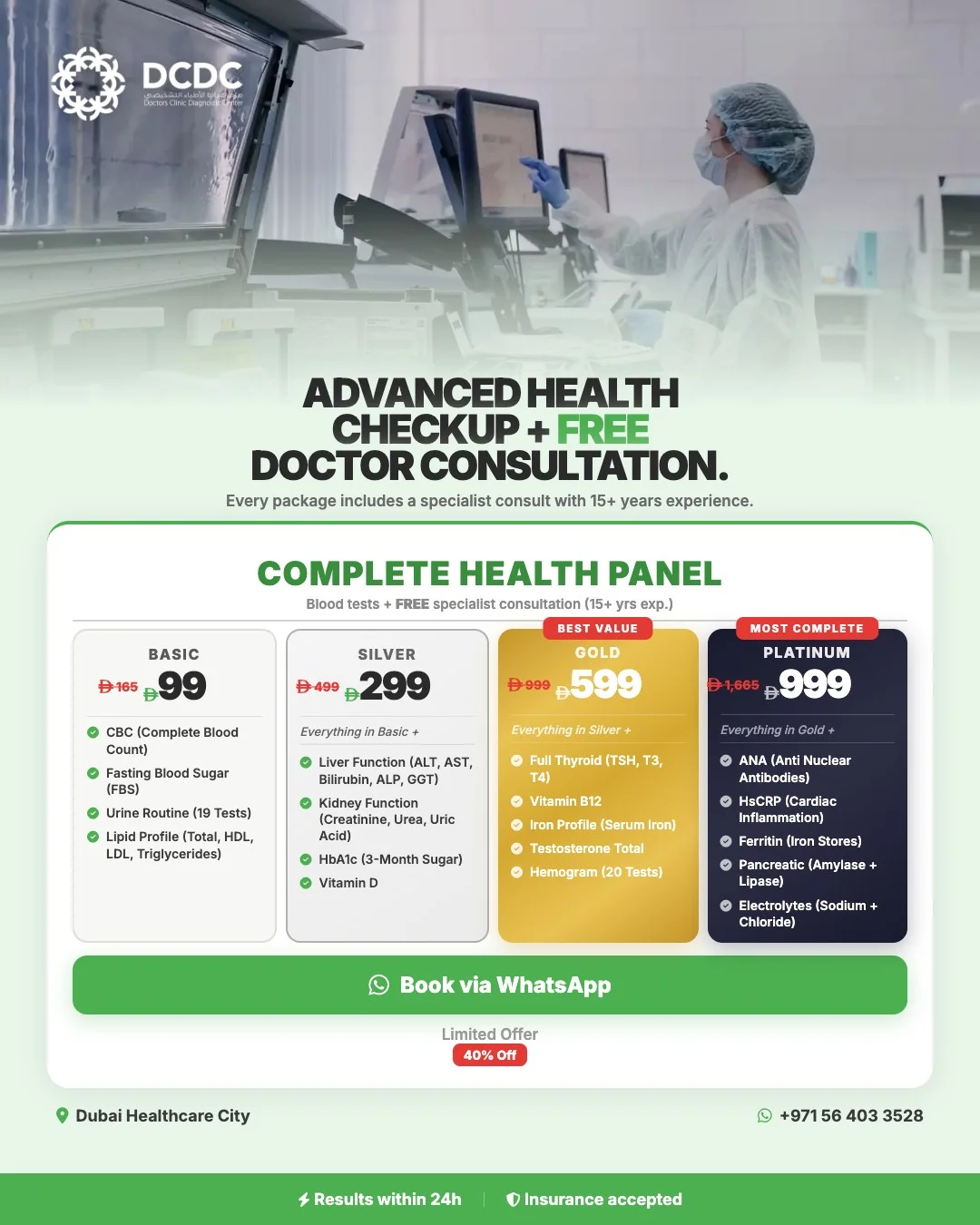
Health Screening Packages
Save with our bundled screening packages — specialist consultation included





What Is a Paternity Test?
A paternity test is a laboratory analysis that compares specific segments of DNA — called STR (Short Tandem Repeat) markers — between a child and an alleged father to determine the statistical likelihood that they are biologically related. Every person inherits one copy of each STR marker from their mother and one from their father. By comparing the child's paternal markers against the alleged father's DNA profile across 16 to 24 or more locations on the genome, a laboratory can calculate a Combined Paternity Index (CPI) and convert it into a probability of paternity.
Unlike blood-type comparisons used decades ago, which could only exclude a man as the father with limited certainty, modern STR-based DNA testing can both include and exclude paternity with extremely high statistical confidence. This is the same underlying technology used in forensic identification, immigration verification, and inheritance disputes worldwide, and it is now widely available in Dubai through accredited private laboratories and hospital-affiliated diagnostic centers.
Types of Paternity Tests in Dubai: Legal vs Peace-of-Mind
Before booking a paternity test in Dubai, the single most important decision is choosing between a legal (court-admissible) test and a peace-of-mind (informational) test. The underlying DNA science is identical — both use the same STR analysis and deliver the same level of scientific accuracy — but the collection procedure and downstream usability are completely different.
Legal (Court-Admissible) Paternity Testing
- Requires photo ID verification (Emirates ID or passport) for every participant tested
- Sample collection must be witnessed by an independent, trained collector — never self-collected
- Samples are sealed in tamper-evident packaging with a documented chain of custody from collection to laboratory analysis
- Required for court proceedings, child custody or maintenance disputes, birth certificate amendments, inheritance claims, and most immigration or visa applications
- Typically costs more than informational testing because of the added documentation, verification, and accredited handling requirements
Peace-of-Mind (Informational) Paternity Testing
- Uses the same DNA analysis and STR markers, delivering identical scientific accuracy
- No chain-of-custody documentation, meaning results are not admissible in UAE courts or for official government use
- Collection is more relaxed — while DCDC still performs professional sample collection on site, formal identity verification is not mandatory
- A more affordable and faster option for people who simply want a private, personal answer without any legal or administrative purpose
It is essential to decide which category you need before your appointment. A peace-of-mind test cannot later be "upgraded" to legal status retroactively — if you anticipate needing the result for court, a government application, or a birth certificate correction, you must request the legal chain-of-custody pathway from the outset.
How DNA Sample Collection Works (Step by Step)
One of the most common questions patients ask is whether a paternity test requires a needle. In most cases, it does not. The standard method for paternity testing worldwide, including at DCDC, is a buccal swab — a soft, sterile brush gently rubbed against the inside of the cheek to collect epithelial cells that contain ample DNA for analysis. This is painless, takes under a minute per participant, and is suitable for people of any age, including newborns.
- Step 1 — Identity verification (legal tests only): Each participant presents a valid Emirates ID or passport, and a photograph is taken to accompany the chain-of-custody documentation
- Step 2 — Consent: All participants (or legal guardians, for minors) sign a consent form authorizing collection, testing, and — for legal tests — release of results to the requesting authority
- Step 3 — Sample collection: A trained DCDC staff member collects a buccal swab from each participant using a sterile brush. In some cases — particularly combined workups or when a laboratory prefers a larger DNA yield — a standard venous blood draw is used instead
- Step 4 — Sealing and labeling: Each sample is labeled, sealed, and — for legal tests — packaged with tamper-evident seals that preserve the chain of custody
- Step 5 — Laboratory analysis: Samples are processed by an accredited genetics laboratory using STR profiling across 16-24+ markers to generate a Combined Paternity Index and probability of paternity
- Step 6 — Results delivery: Results are issued as a signed laboratory report, delivered securely and, for legal tests, formatted for submission to UAE courts or relevant authorities
For participants who prefer or require a blood-based sample — or for patients undergoing a broader diagnostic workup alongside their paternity test — the collection follows the same standard venous draw used for routine laboratory work. If you want more detail on how blood collection is performed and how to prepare for it, our complete blood test guide for Dubai covers preparation, fasting requirements, and what happens to your sample after collection.
Paternity Test Accuracy: Understanding the 99.99% Statistic
Paternity test accuracy is often quoted as "99.99%," but it is worth understanding exactly what that number means. When a man tested is the biological father of the child, the Combined Paternity Index calculated from 16-24+ STR markers typically produces a probability of paternity of 99.99% or higher — the residual uncertainty exists purely as a statistical formality, not because the test is unreliable. When a man is not the biological father, the test achieves 100% exclusion, because a mismatch at even two or three markers is sufficient to rule out biological paternity with certainty.
This near-total accuracy is possible because STR markers are highly variable between unrelated individuals but follow predictable inheritance patterns between biological parents and children. Testing more markers — DCDC's laboratory partners typically analyze more than the historical minimum of 13 — further increases statistical confidence, particularly in cases involving closely related alleged fathers, such as brothers, which require additional markers to distinguish reliably.
Accuracy depends heavily on sample quality and correct identification of participants, which is precisely why legal tests require witnessed, chain-of-custody collection. A contaminated sample, a mislabeled swab, or a self-collected home kit sent through the post introduces risks that a professionally supervised collection at an accredited facility eliminates.
Who Can Request a Paternity Test in the UAE?
In the UAE, a paternity test can be requested by several different parties, depending on the purpose of the test and whether it is being pursued privately or through the courts.
- Mothers seeking to confirm or establish the biological father of their child, whether for personal certainty, child support, or birth certificate documentation
- Alleged fathers who wish to confirm biological paternity before formal acknowledgment, custody arrangements, or inheritance planning
- Legal guardians acting on behalf of a minor child, with appropriate documentation of guardianship
- Adults testing their own paternity for personal reasons, including adoption record clarification or family history questions
- UAE courts, which may order DNA testing directly in disputed paternity, custody, inheritance, or — in rare cases — situations involving mixed-up newborns in hospitals
- Immigration and visa authorities, which may require accredited DNA evidence to confirm a biological relationship as part of a sponsorship or residency application
For informational (peace-of-mind) testing, DCDC does not require the consent of every party to proceed, though we always recommend transparency where possible. Legal, court-admissible testing, however, generally requires the consent and physical presence of all tested parties, or a specific court order authorizing the test to proceed.
UAE Legal Framework for Paternity Testing (2024 Personal Status Law)
The legal landscape for DNA and paternity testing in the UAE changed significantly with the introduction of Federal Decree-Law No. 41 of 2024 on the Personal Status Law, which took effect in 2025. Article 87 of the new law established DNA testing as a standalone, unconditioned method for proving or disproving lineage — a meaningful shift from the previous framework, which required supplementary evidence of a prior relationship before DNA testing could even be considered by the courts.
- Standalone DNA evidence: Under the new law, a party can request DNA testing directly, without first having to establish ancillary proof of a relationship — simplifying and speeding up paternity disputes
- Court-ordered testing: UAE courts can order DNA testing in cases of disputed paternity, inheritance disputes, or exceptional circumstances such as mixed-up newborns in hospitals
- Data protection: Genetic data is classified as sensitive personal data under Federal Decree-Law No. 45 of 2021 (Personal Data Protection Law), requiring explicit consent and strict safeguards for collection, processing, and storage
- Chain-of-custody requirement: For a DNA test result to be accepted in UAE courts, for immigration purposes, or for amending official documents like birth certificates, it must follow a verified chain of custody with photo ID verification — informal or home-collected samples are not accepted
- MOHAP oversight: Laboratories performing DNA testing in Dubai operate under the regulatory framework of the UAE Ministry of Health and Prevention (MOHAP), which governs laboratory licensing, quality standards, and data retention requirements
If you need the paternity test result for use outside the UAE — for example, to support an immigration case in another country — additional attestation through the UAE Ministry of Foreign Affairs and the relevant embassy is typically required after the laboratory issues its report. Our team at DCDC can advise on this process as part of your appointment. For a broader look at how DNA and genetic testing intersects with UAE law more generally — including premarital genetic screening requirements and hereditary disease testing — see our comprehensive guide to DNA and genetic testing in Dubai.
Paternity Test Cost in Dubai: Pricing Breakdown (2026)
Paternity test pricing in Dubai varies considerably depending on the type of test, the number of participants, and whether the result needs to be court-admissible. As a general guide, paternity testing in Dubai typically ranges from AED 800 to AED 3,000+ depending on these factors. Below is a detailed breakdown of typical pricing for the most commonly requested test types.
| Paternity Test Type | Price Range (AED) | Turnaround | Court-Admissible |
|---|---|---|---|
| Peace-of-Mind Test (2 participants) | From AED 800 | 3-5 business days | No |
| Additional Participant (peace-of-mind) | From AED 300 | Same as main test | No |
| Legal / Chain-of-Custody Test (2 participants) | From AED 1,800 | 3-5 business days | Yes |
| Additional Participant (legal test) | From AED 500 | Same as main test | Yes |
| Immigration / Visa Documentation Test | From AED 2,000 | 3-5 business days + attestation | Yes |
| Prenatal (Non-Invasive) Paternity Test | From AED 3,000 | 5-7 business days | Case-dependent |
| Expedited / Rush Processing (add-on) | From AED 300 | 24-48 hours | Depends on base test |
Prices are approximate self-pay guidance for Dubai in 2026. Exact pricing depends on the number of participants, chain-of-custody requirements, and any attestation needed for use outside the UAE. Contact DCDC for a current quote based on your specific situation.
A few pricing factors are worth noting. First, legal tests cost more than peace-of-mind tests primarily because of the identity verification, witnessed collection, and documented chain of custody required to make the result admissible — not because the underlying DNA science differs. Second, testing additional participants — for example, when two men both claim paternity, or when grandparents are tested to support an indirect case — adds a per-person fee rather than doubling the base cost. Third, prenatal paternity testing, which analyzes cell-free fetal DNA circulating in the mother's blood, is the most expensive option because it requires specialized extraction and analysis techniques not needed for postnatal testing.
Note that paternity testing is a self-pay service in almost all cases — health insurance in the UAE generally does not cover paternity testing, as it is not considered a medically necessary diagnostic test. DCDC provides transparent, upfront pricing with no hidden fees, so you know the full cost before any sample is collected.
Speak With DCDC About Paternity Testing
Whether you need a legal chain-of-custody test or a private peace-of-mind result, our team can walk you through the right option, the documentation required, and current pricing.
Building 64, Block A, Al Razi Medical Complex, DHCC — Free Parking Available
What to Expect at DCDC: Your Testing Journey
Understanding the patient journey in advance removes much of the uncertainty around paternity testing. Here is what happens, step by step, when you visit DCDC in Dubai Healthcare City.
- Step 1 — Book or walk in: Contact DCDC by phone, WhatsApp, or in person to discuss whether you need a legal or peace-of-mind test. Walk-ins are welcome during operating hours (Saturday-Thursday 8 AM-10 PM, Friday 9 AM-9 PM)
- Step 2 — Initial consultation: A DCDC General Practitioner discusses your situation, confirms which test type is appropriate for your purpose, and explains the documentation you will need to bring
- Step 3 — Arrival and registration: On arrival at Building 64, Block A, Al Razi Medical Complex (free dedicated parking available), our reception team registers all participants and, for legal tests, verifies identification documents
- Step 4 — Consent and sample collection: After consent forms are signed, our trained staff collect a buccal swab (or blood sample, if preferred or clinically indicated) from each participant in a private setting, taking only a few minutes per person
- Step 5 — Chain-of-custody documentation (legal tests): For legal tests, each sample is sealed, labeled, and photographed alongside the participant to preserve an unbroken chain of custody through to laboratory analysis
- Step 6 — Laboratory analysis: Samples are sent to an accredited genetics laboratory for STR profiling and Combined Paternity Index calculation
- Step 7 — Results delivery: Results are typically available within 3-5 business days and are delivered securely. For legal tests, the report is formatted appropriately for submission to the requesting court, government body, or embassy
According to Dr. Hadeel Elnur, "Paternity testing is rarely just a lab request — it usually comes with a lot of emotional weight and, often, legal complexity. My role as the coordinating GP is to make sure patients understand exactly which test they need before we collect a single sample, connect them with the right laboratory pathway, and where necessary, refer them for supporting workups — whether that's a broader genetic panel, a fertility assessment, or documentation support for an immigration case. Getting the process right the first time avoids the cost and delay of having to repeat a test that turns out not to be admissible for its intended purpose."
With a 4.8/5 Google rating from over 1,000 verified reviews and 98% patient satisfaction, DCDC's multilingual staff — fluent in Arabic, English, Farsi, Urdu, and Hindi — ensure that sensitive conversations around paternity testing are handled with clarity and discretion, regardless of your first language.
When Are Paternity Test Results Ready?
Standard paternity test results — whether legal or peace-of-mind — are typically ready within 3-5 business days of sample collection at DCDC. This timeframe reflects the laboratory processing required for STR profiling across multiple markers, statistical calculation of the Combined Paternity Index, and quality review before the report is finalized and issued.
For urgent situations — a pending court date, an immigration deadline, or simply wanting an answer sooner — expedited processing is available in many cases, reducing turnaround to 24-48 hours for an additional fee. It is worth confirming expedited availability at the time of booking, as it depends on laboratory capacity.
Once results are ready, they are delivered securely, and our GP team is available to walk you through what the report means — including the Combined Paternity Index, the calculated probability of paternity, and, for legal tests, guidance on next steps such as submission to court or further attestation. If you would like a general primer on how to read a laboratory report and what the different values represent, our guide to understanding blood test results in Dubai covers how DCDC formats and explains laboratory reports more broadly.
Privacy and Confidentiality: How Your DNA Data Is Protected
Given how sensitive paternity testing can be — both emotionally and legally — confidentiality is a central concern for most patients. In the UAE, genetic data is explicitly classified as sensitive personal data under Federal Decree-Law No. 45 of 2021 (Personal Data Protection Law), which means it is subject to stricter handling requirements than general medical records.
- Explicit consent is required before any DNA sample is collected, tested, or shared with a third party
- Restricted access: Results are shared only with the individuals who requested the test or, for legal tests, the specific court or authority the report is prepared for
- Secure storage: DCDC's laboratory operations follow MOHAP guidelines on data retention and secure storage of genetic samples and results
- No unauthorized disclosure: Results are never shared with employers, insurers, or other parties without explicit written consent from the individuals tested
For peace-of-mind tests in particular, many patients value that the process can remain entirely private between the parties involved, without the results ever being submitted to a government body or third party unless the patient chooses to do so.
Home Paternity Test Kits vs Clinic-Based Testing in Dubai
Home DNA testing kits — where you collect your own cheek swab and mail it to a laboratory — are widely advertised online and may seem like a convenient, private option. However, there are important limitations to understand before choosing this route in Dubai.
- Never legally admissible: Because there is no witnessed collection or verified chain of custody, home kits cannot be used for UAE court proceedings, birth certificate amendments, or immigration cases — no matter how the laboratory markets the result
- Higher risk of sample issues: Self-collected swabs are more prone to contamination, insufficient sample volume, or mislabeling, occasionally resulting in inconclusive results that require re-testing
- Uncertain laboratory accreditation: Not all kits sold online are processed by accredited genetics laboratories, and results can vary in reliability depending on the provider
- No professional guidance: A clinic-based test comes with the ability to consult a GP before, during, and after the process — particularly valuable when results carry emotional or legal significance
For genuine peace of mind — as opposed to formal legal use — a professionally collected sample at an accredited facility like DCDC offers the same convenience as a home kit (a simple, painless cheek swab) while eliminating the risks associated with self-collection and unverified laboratories, at a comparable cost.
When Should You Get a Paternity Test?
There is no single "right" moment to pursue a paternity test — the appropriate timing depends entirely on your circumstances and what the result will be used for.
- Before finalizing a birth certificate where paternity is uncertain or disputed
- During a custody or child support dispute, where a court may require or accept a chain-of-custody test
- Before or during an inheritance claim involving a disputed biological relationship
- As part of a visa, residency, or citizenship application that requires proof of a biological parent-child relationship
- For personal certainty, when questions about biological paternity are affecting a family relationship, regardless of any legal need
- Prenatally, in specific circumstances where a non-invasive test analyzing fetal DNA in maternal blood is appropriate — always discussed with your doctor first given the specialized nature of this test
Whatever the reason, speaking with a GP first — as offered at DCDC — helps clarify which test type you actually need, avoiding the cost and delay of testing under the wrong pathway. For couples navigating related reproductive health questions, our guide to semen analysis in Dubai covers fertility testing that is sometimes requested alongside or instead of paternity testing, depending on the clinical picture.
Why Choose DCDC for Paternity Testing in Dubai?
Paternity testing is a sensitive process, and choosing the right facility affects both the accuracy of your result and how smoothly the experience unfolds. DCDC offers several advantages for patients in Dubai considering a paternity test.
- MOHAP-licensed laboratory environment: Sample collection and handling follow the regulatory standards set by the UAE Ministry of Health and Prevention
- Both legal and peace-of-mind pathways: Our GP team helps you choose — and correctly document — the test type appropriate for your specific need
- On-site, same-day sample collection: Appointments for the initial consultation and sample collection are typically available the same day, without long waits
- Multi-specialty coordination: As a General Practitioner, Dr. Hadeel Elnur can coordinate related workups — genetic counseling referrals, fertility assessments, or broader diagnostic panels — under one roof rather than sending you to multiple facilities
- Multilingual, discreet staff: Fluent in Arabic, English, Farsi, Urdu, and Hindi, our team handles sensitive conversations with the privacy and professionalism the topic deserves
- 4.8/5 Google rating from over 1,000 verified patient reviews, with 98% patient satisfaction and an average wait time of just 15 minutes
- Convenient location: Building 64, Block A, Al Razi Medical Complex, Dubai Healthcare City, with free dedicated parking and extended hours (Saturday-Thursday 8 AM-10 PM, Friday 9 AM-9 PM)
Book a Paternity Testing Consultation at DCDC
Speak with a DCDC General Practitioner to confirm the right test type for your situation, then complete sample collection the same day.
20+ insurance partners for related consultations — self-pay pricing for paternity testing is transparent with no hidden fees
Related Services at DCDC
Expert care and advanced diagnostics at Dubai Healthcare City
Frequently Asked Questions
Final Thoughts
Paternity testing in Dubai is more accessible, more accurate, and legally clearer than it has ever been. Whether you need a court-admissible result under the UAE's updated Personal Status Law or simply want a private, confidential answer, the underlying DNA science — 16-24+ STR markers analyzed to a probability of paternity of 99.99% or higher — is the same. What differs is the documentation and collection process, and getting that choice right from the outset is the single most important decision in the entire process.
At DCDC in Dubai Healthcare City, our General Practitioners, led by Dr. Hadeel Elnur, help patients navigate that choice before a single sample is collected — coordinating the correct testing pathway, related diagnostic workups where needed, and guidance on documentation for legal or immigration use. With a MOHAP-licensed laboratory environment, a 4.8/5 Google rating from over 1,000 reviews, and multilingual staff who understand the sensitivity of these conversations, DCDC provides a discreet, accurate, and well-supported path from your first consultation to your final results. Contact DCDC by phone, WhatsApp, or simply walk in during operating hours to discuss which paternity testing option is right for you.
Sources & References
This article was reviewed by our medical team and references the following sources:
- GOV.UK — Get a DNA Test: Overview
- AABB — Standards for Relationship Testing Laboratories
- MedlinePlus (U.S. National Library of Medicine) — What Are the Uses of Genetic Testing?
- MedlinePlus — How Is Genetic Testing Done?
- UAE Legislation — Federal Decree-Law No. 41 of 2024 on the Personal Status Law
- Mayo Clinic — Genetic Testing
Medical content on this site is reviewed by DHA-licensed physicians. See our editorial policy for more information.

Written by
Dr. Hadeel Elnur
General Practitioner
MD, General Practice
Dr. Hadeel Elnur is a General Practitioner at Doctors Clinic Diagnostic Center (DCDC) in Dubai Healthcare City.
Related Articles
DNA & Genetic Testing Dubai: Types & Cost (2026)
Blood Test Dubai: Types, Cost & Fasting Guide
Blood Test Results Dubai: What's Normal (2026)

Semen Analysis Dubai: Cost & Guide (2026)
More in Laboratory

Fitness Blood Tests Dubai: What to Check (2026)
Read More
HbA1c vs Fasting Blood Sugar Dubai: Guide (2026)
Read More
TB Test Cost Dubai: From AED 100–690 (2026)
Read MoreHIV Test Cost Dubai: Pricing & Guide (2026)
Read MoreBlood Test Results Dubai: What's Normal (2026)
Read More
Stool Test Dubai: Types, Results & Cost (2026)
Read More© 2026 Doctors Clinic Diagnostic Center (DCDC), Dubai Healthcare City. Originally published at https://doctorsclinicdubai.ae/blog/paternity-test-dubai. All rights reserved. Unauthorized reproduction is prohibited.