Key Takeaways
- A painless lump in the neck is the most common thyroid cancer sign, but over 90-95% of thyroid nodules are benign.
- Hoarseness, trouble swallowing or a swollen neck lymph node lasting more than 3-4 weeks should be checked.
- Thyroid cancer is the third most common cancer in the UAE, and about three in four cases occur in women.
- Ultrasound with TI-RADS scoring tells your doctor whether a nodule needs a biopsy or simple monitoring.
- Most thyroid cancers are highly treatable, with five-year survival above 98% for localised papillary and follicular types.
- DCDC offers on-site thyroid ultrasound, a TSH test at AED 149 and a thyroid profile at AED 399, open until 10 PM in Dubai Healthcare City.
Thyroid cancer is one of the fastest-growing cancers worldwide, and in the UAE it ranks as the third most common cancer, affecting women especially often. The good news is that most cases are highly treatable when found early, and a simple thyroid ultrasound can tell you within a day whether a neck lump is worth worrying about. This guide explains the thyroid cancer signs to watch, how to judge a thyroid nodule, and how doctors reach a diagnosis.
Whether you have noticed a lump while looking in the mirror, your voice has been hoarse for weeks, or a relative has been diagnosed, the sections below give you clear, evidence-based answers. We cover cancer types, warning signs, nodule risk, risk factors, diagnosis, treatment and what to expect when you visit DCDC.


Understanding Thyroid Cancer
The thyroid is a butterfly-shaped gland at the base of the front of your neck, just below the Adam's apple. It produces hormones that control metabolism, heart rate, body temperature and energy use. Thyroid cancer develops when cells in the gland grow abnormally and form a malignant tumour. Because the thyroid sits close to the surface of the neck, many cancers are first noticed as a small lump, either by the patient, a partner, or a doctor during a routine exam.
In the UAE, thyroid cancer is far more common than many residents realise. A registry-based study published in 2022 found that it ranks as the third most common cancer in the country, compared with ninth worldwide, and that around three out of four cases occur in women. The highest number of diagnoses was seen in people aged 35 to 39, meaning this is a cancer of working-age adults rather than only the elderly.
The four main types of thyroid cancer
Not all thyroid cancers behave in the same way. The type determines how fast the tumour grows, how it spreads and how it is treated. The great majority are differentiated thyroid cancers (papillary and follicular), which grow slowly and respond very well to treatment.
| Type | Share of cases (approx.) | Behaviour | Outlook |
|---|---|---|---|
| Papillary | About 80-85% | Slow growing; may spread to neck lymph nodes | Excellent; 5-year survival above 98% when localised |
| Follicular | About 10% | Can spread through the bloodstream to lungs or bone | Very good; slightly lower than papillary if spread |
| Medullary | About 2-4% | Arises from C-cells; produces calcitonin; sometimes hereditary (MEN2) | Good when found early; depends on stage |
| Anaplastic | Under 2% | Very aggressive, grows rapidly | Poor; needs urgent specialist care |
Types of thyroid cancer compared
Papillary thyroid cancer is by far the most common and often presents as a single small nodule. Follicular thyroid cancer is less likely to involve lymph nodes but more likely to travel through the blood. Medullary thyroid cancer starts in a different cell population (the calcitonin-producing C-cells) and about one in four cases is inherited. Anaplastic thyroid cancer is rare, usually affects older adults, and causes a fast-growing neck mass that needs urgent evaluation.
The key message: most thyroid cancers are highly treatable, and outcomes depend heavily on early detection. That is why recognising the warning signs and knowing when to ask for a thyroid ultrasound matters.
Warning Signs of Thyroid Cancer
Most early thyroid cancers cause no symptoms at all. Many are found by accident during a physical examination, or on an ultrasound or CT scan done for another reason. When symptoms do appear, they are usually related to a growing mass pressing on nearby structures in the neck. The most important thyroid cancer signs are listed below.
1. A lump or swelling in the neck
A painless lump at the front of the neck is the most common sign. It may be felt when shaving, applying make-up, or wearing a collar or hijab. Some people notice it only when swallowing, because the thyroid moves upward with each swallow. A lump that persists for more than two to four weeks deserves medical assessment.
2. Swollen lymph nodes in the neck
Papillary thyroid cancer often spreads first to lymph nodes on the side of the neck. A firm, enlarged node that does not shrink after a cold or throat infection has settled can be the first and only sign.
3. Voice changes or persistent hoarseness
The nerve that controls the vocal cords runs right behind the thyroid. A tumour pressing on or invading this nerve can cause hoarseness, a rough or breathy voice, or a voice that tires easily. Hoarseness lasting more than three to four weeks, without a cold, should always be investigated.
4. Difficulty swallowing or a sensation of tightness
A growing mass can press on the oesophagus, causing food to feel as if it sticks in the throat, or create a constant feeling of pressure in the neck.
5. Persistent cough or breathing difficulty
A dry cough that is not caused by a cold or allergy can occur when a tumour presses on the windpipe. Shortness of breath, particularly when lying flat, is less common but needs urgent attention.
6. Neck or throat pain
Pain at the front of the neck, sometimes radiating to the ears, can occur. Most thyroid cancers are painless, so pain is less typical, but it should not be ignored when combined with other signs.
| Sign | How common | Urgency |
|---|---|---|
| Painless neck lump | Most common | See a doctor within 2-4 weeks |
| Enlarged neck lymph node | Common | See a doctor within 2-4 weeks |
| Hoarseness over 3-4 weeks | Occasional | Prompt evaluation |
| Difficulty swallowing | Less common | Prompt evaluation |
| Rapidly growing neck mass, breathing trouble | Rare | Seek urgent care the same day |
Thyroid cancer symptoms and recommended action
Importantly, these symptoms have many harmless explanations, including thyroid inflammation, goitre, benign cysts and reflux. But if one or more of them persists, a short, painless scan can give a clear answer. You can also read about non-cancer causes in our guide to thyroid problem symptoms.
Thyroid Nodules: When to Worry
A thyroid nodule is a lump within the thyroid gland. Nodules are extremely common: depending on the method used, up to half of adults have one when the gland is examined by ultrasound. The reassuring fact is that more than 90 to 95 percent of thyroid nodules are benign. Only a small percentage turn out to be cancer. This is the core of the thyroid nodule cancer risk question: the vast majority of lumps are harmless, but a minority need further testing, and ultrasound is the tool that sorts them.
Features that raise suspicion on ultrasound
Radiologists use a standardised system called ACR TI-RADS (Thyroid Imaging Reporting and Data System) to score nodules. Five features are assessed: composition, echogenicity (how dark the nodule appears), shape, margins and bright echogenic foci. Points are added to give a TI-RADS category from TR1 (benign) to TR5 (highly suspicious).
| Ultrasound feature | Reassuring finding | Suspicious finding |
|---|---|---|
| Composition | Cystic or spongiform | Solid |
| Echogenicity | Isoechoic or bright (like normal thyroid) | Hypoechoic or very hypoechoic (darker than surrounding tissue) |
| Shape | Wider than tall | Taller than wide |
| Margins | Smooth, well defined | Irregular, lobulated or spiculated; extension outside the gland |
| Echogenic foci | None or large comet-tail artefacts | Punctate echogenic foci (microcalcifications) |
| Lymph nodes | Normal, with fatty hilum | Rounded, calcified or cystic nodes |
Suspicious ultrasound features used in TI-RADS
When is a biopsy recommended?
Not every nodule needs a needle test. Under ACR TI-RADS and American Thyroid Association (ATA) guidance, a fine-needle aspiration (FNA) is generally considered when:
- A nodule is TR5 (highly suspicious) and measures 1 cm or more, or is smaller with worrying features and follow-up is planned.
- A nodule is TR4 (moderately suspicious) and measures 1.5 cm or more.
- A nodule is TR3 (mildly suspicious) and measures 2.5 cm or more.
- Ultrasound shows suspicious neck lymph nodes, regardless of nodule size.
- There is a strong clinical risk, such as childhood neck radiation or a family history of thyroid cancer.
Smaller or lower-risk nodules are usually monitored with repeat ultrasound over time. Spongiform and purely cystic nodules carry a very low risk of cancer and rarely need biopsy. Our companion article on thyroid nodule causes and treatment explains the follow-up process in more detail.
Signs a nodule needs prompt attention
- Rapid growth over weeks or months
- A hard, fixed nodule that does not move when you swallow
- New hoarseness or swallowing difficulty alongside a nodule
- Enlarged neck lymph nodes
- A nodule in a child, teenager or someone with prior neck radiation
Risk Factors for Thyroid Cancer
Anyone can develop thyroid cancer, but certain factors raise the likelihood. Understanding them helps you and your doctor decide how closely to look.
- Gender: Women are about three times more likely than men to be diagnosed. In the UAE registry data, the female-to-male ratio was even higher among Emirati patients (nearly 5:1). Hormonal factors are thought to play a role, though the exact reason is not fully understood. Men, however, tend to have somewhat higher-risk nodules when they do occur.
- Age: Differentiated thyroid cancer is most often diagnosed between the ages of 30 and 60, with a peak in the 30s in UAE data. Anaplastic cancer typically occurs after age 60.
- Radiation exposure: Radiation to the head and neck in childhood (for example, for acne, tonsil conditions or cancer treatment), or radioactive fallout exposure, significantly increases risk. Routine dental X-rays and standard diagnostic imaging do not carry meaningful thyroid risk.
- Family history: Having a first-degree relative with thyroid cancer increases your own risk, even in the absence of a known genetic syndrome.
- Inherited genetic conditions: Multiple endocrine neoplasia type 2 (MEN2) causes medullary thyroid cancer, often at a young age, and is linked to RET gene mutations. Familial adenomatous polyposis, Cowden syndrome and Carney complex are also associated with thyroid cancer.
- Iodine intake: Iodine deficiency is associated with a higher proportion of follicular thyroid cancer, while very high iodine intake has been linked to papillary cancer in some populations. Balanced intake through normal diet and iodised salt is ideal.
- Obesity and other factors: Higher body mass index has been associated with a modestly increased risk in several studies. A history of benign thyroid disease such as goitre or thyroid nodules is also relevant.
Note that having an underactive or overactive thyroid does not by itself mean you have cancer, and thyroid cancer itself often occurs with perfectly normal hormone levels. If you have several of the risk factors above, ask your doctor about a baseline neck examination and ultrasound.
How Thyroid Cancer Is Diagnosed
Diagnosis follows a stepwise path. Each step answers a specific question, and most people with a thyroid lump finish the process with a benign result.
Step 1: Medical history and neck examination
Your doctor asks about symptoms, radiation exposure and family history, then gently feels the thyroid and neck lymph nodes while you swallow water. A thyroid examination takes only a few minutes.
Step 2: Thyroid ultrasound and TI-RADS scoring
Ultrasound is the most important imaging test. It is painless, uses no radiation and shows nodule size, composition, margins and calcifications, as well as neighbouring lymph nodes. The radiologist assigns a TI-RADS category that guides whether to biopsy or monitor. At DCDC, you can read more about when you need this test in our thyroid ultrasound guide.
Step 3: Fine-needle aspiration (FNA) biopsy
If the ultrasound is suspicious, a very thin needle is guided into the nodule under ultrasound to collect cells. The sample is examined by a pathologist and reported using the Bethesda system (categories I to VI). Results may be benign, indeterminate, suspicious or malignant. For indeterminate results, molecular testing may be added.
Step 4: Blood tests
- TSH, FT3, FT4: Show whether the gland is under- or overactive. Most thyroid cancers do not change these values, but a low TSH may point to a hot nodule, which is almost always benign.
- Thyroglobulin: A tumour marker mostly used after treatment to monitor for recurrence in differentiated thyroid cancer.
- Calcitonin and CEA: Used when medullary thyroid cancer is suspected or in families with MEN2.
- Thyroid antibodies: Help identify autoimmune thyroiditis, a common benign cause of nodularity.
For a plain-language explanation of these markers, see our thyroid test guide.
Step 5: CT, MRI and radioactive iodine scans for staging
Once cancer is confirmed, cross-sectional imaging (CT or MRI) may be used to see whether the tumour has extended beyond the gland or into the chest. Radioactive iodine scans are used after surgery in selected patients. Your treating specialist will advise which tests are needed for your specific situation.
Book Your Thyroid Screening at DCDC
If you have a neck lump, voice change, family history or simply want peace of mind, DCDC offers thyroid ultrasound and blood testing in one visit. Book your thyroid ultrasound or message us on WhatsApp.
What to Expect at DCDC
Doctors Clinic Diagnostic Center (DCDC) in Dubai Healthcare City brings imaging, laboratory and consultation under one roof, so you do not need to travel between clinics for a thyroid assessment. Here is how a typical visit works.
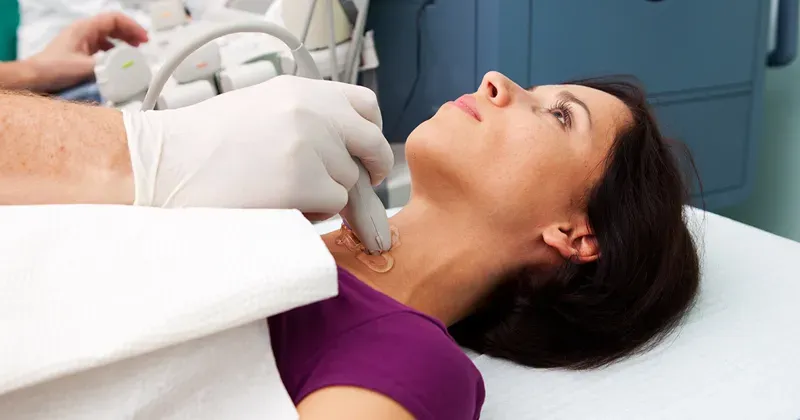
- Step 1, ultrasound appointment: A sonographer performs a high-resolution neck ultrasound lasting around 15 to 20 minutes. You lie on your back with a pillow under your shoulders, and gel is applied to the neck. No preparation or fasting is required, and the scan is painless.
- Step 2, thyroid blood panel: A blood sample is collected at the same visit. Blood results are typically available the same day.
- Step 3, expert reading: Your ultrasound images are interpreted by a subspecialty radiologist, with TI-RADS scoring of any nodules. The ultrasound report is usually ready within 18 to 24 hours.
- Step 4, consultation: A doctor reviews your results with you, explains the findings and arranges follow-up, biopsy or specialist referral if needed.
| Service | Price at DCDC |
|---|---|
| TSH test | AED 149 |
| TSH panel | AED 199 |
| Thyroid profile | AED 399 |
| FT3 test | AED 149 |
| FT4 test | AED 149 |
| Thyroid / endocrinology consultation | From AED 299 |
| GP consultation | From AED 249 |
| Home blood collection | Add AED 199 per visit |
Thyroid-related services and pricing at DCDC
Thyroid ultrasound is available on-site. DCDC works with more than 20 insurance partners, and coverage depends on your plan, so please confirm with our team before booking. We are located in Dubai Healthcare City with free parking, and we are open until 10 PM, which makes it easy to fit an appointment around work.
Thyroid Cancer Survival Rates and Treatment
The outlook for most people with thyroid cancer is among the best of any cancer. In the United States, overall five-year relative survival is around 98 to 99 percent for differentiated thyroid cancer when it is localised, and remains high even when it has spread to nearby lymph nodes. Survival is lower for distant spread, medullary cancer with metastases, and anaplastic cancer, which is why early detection still matters.
| Stage / type | Approximate 5-year survival |
|---|---|
| Papillary, localised | Over 99% |
| Follicular, localised | Over 98% |
| Medullary, localised | Around 98% |
| Medullary, distant spread | Around 40-50% |
| Anaplastic | Under 10%, with newer targeted therapies improving results for some patients |
Approximate survival by type and stage (figures vary between sources)
Treatment options
- Surgery: The main treatment. This may be a lobectomy (removing half of the thyroid) for small low-risk cancers or a total thyroidectomy for larger or higher-risk tumours. Affected lymph nodes may also be removed.
- Radioactive iodine (RAI): Given after total thyroidectomy in selected patients to destroy remaining thyroid cells.
- Thyroid hormone therapy: Levothyroxine replaces natural hormones after surgery and, in some cases, keeps TSH low to reduce recurrence risk.
- Active surveillance: For very small, low-risk papillary cancers, ATA guidance supports careful monitoring with regular ultrasound instead of immediate surgery.
- External beam radiation, targeted drugs and chemotherapy: Reserved for advanced, medullary, radioiodine-resistant or anaplastic disease.
Most patients require lifelong follow-up with blood tests (TSH and thyroglobulin) and periodic neck ultrasound. Recurrence is uncommon but can occur many years later, so continued monitoring is important.
Thyroid Cancer Prevention and Early Detection
There is no guaranteed way to prevent thyroid cancer, because most cases occur without an identifiable cause. However, you can lower avoidable risks and improve the chance of early detection.
Is routine screening recommended for everyone?
Guideline bodies such as the US Preventive Services Task Force recommend against routine ultrasound screening of adults with no symptoms and no risk factors, because it can lead to overdiagnosis, which is finding tiny cancers that may never have caused harm. In contrast, targeted thyroid cancer screening in Dubai is appropriate for people with a lump, symptoms, prior neck radiation, a family history of thyroid cancer or a genetic syndrome. The purpose of this approach is to look closely where the risk is higher, rather than scanning everyone.
How to do a neck self-check
- Stand in front of a mirror and tilt your head slightly back.
- Take a sip of water and swallow while watching the area below your Adam's apple and above the collarbones.
- Look for any bulge or asymmetry, and gently feel both sides of the neck with your fingertips.
- Check the sides of the neck for firm, enlarged lymph nodes.
- Repeat monthly, and note any change in size, voice or swallowing.
When to ask for a thyroid ultrasound
- You feel or see a lump in the neck
- Your voice has been hoarse for more than three to four weeks
- You have a first-degree relative with thyroid cancer
- You had radiation to the head, neck or chest in childhood
- A doctor noticed an enlarged thyroid or nodule during an exam
- You have a known genetic syndrome such as MEN2
For broader prevention, maintain a balanced diet with adequate iodine, avoid unnecessary radiation exposure, and keep up to date with age-appropriate screening. See our guide to cancer screening in Dubai by age for other tests worth considering.
Related Services at DCDC
Expert care and advanced diagnostics at Dubai Healthcare City
Frequently Asked Questions
Final Thoughts
Thyroid cancer often hides quietly, but a painless neck lump, lasting hoarseness, swallowing difficulty or swollen lymph nodes are signals worth acting on. Remember that the vast majority of thyroid nodules are benign, and a short ultrasound can usually settle the question.
If cancer is found, the outlook is generally excellent, especially for papillary and follicular types caught early. Targeted screening is most valuable if you have symptoms, prior neck radiation, a family history or a genetic syndrome.
Do not wait and wonder. Book a thyroid ultrasound at DCDC in Dubai Healthcare City, add a thyroid blood panel, and get clear answers with a subspecialty radiologist report within 18 to 24 hours. This article is for general information and does not replace a personal medical consultation.
Sources & References
This article references the following sources:
- American Thyroid Association - 2015 Management Guidelines for Adult Patients with Thyroid Nodules and Differentiated Thyroid Cancer (PubMed)
- ACR Thyroid Imaging, Reporting and Data System (TI-RADS): White Paper of the ACR TI-RADS Committee (PubMed)
- Thyroid cancer incidence in the United Arab Emirates: a retrospective study on association with age and gender (PMC)
- Mayo Clinic - Thyroid Cancer: Symptoms and Causes
- National Cancer Institute - Thyroid Cancer Treatment (PDQ)
- US Preventive Services Task Force - Screening for Thyroid Cancer: Recommendation Statement
This information is educational and does not replace individual medical advice. See our editorial policy for more information.

Written by
Dr. Hadeel Elnur
General Practitioner
MD, General Practice
Dr. Hadeel Elnur is a General Practitioner at Doctors Clinic Diagnostic Center (DCDC) in Dubai Healthcare City.
Related Articles
Thyroid Nodule Dubai: Causes & Treatment
Thyroid Ultrasound Dubai: When You Need It
Thyroid Test Dubai: TSH, T3 & T4 Guide
Cancer Screening Dubai: Tests & Cost by Age
Thyroid Problems Symptoms Dubai
More in Cancer


© 2026 Doctors Clinic Diagnostic Center (DCDC), Dubai Healthcare City. Originally published at https://doctorsclinicdubai.ae/blog/thyroid-cancer-signs-when-to-worry-dubai. All rights reserved. Unauthorized reproduction is prohibited.