Key Takeaways
- Rosacea is a chronic inflammatory skin condition affecting an estimated 5% of adults worldwide, typically appearing between ages 30 and 50 as persistent facial redness, visible blood vessels, and sometimes acne-like bumps.
- There are four recognised subtypes — erythematotelangiectatic (redness and visible vessels), papulopustular (bumps and pimples), phymatous (skin thickening), and ocular (eye involvement) — and many patients experience overlapping features.
- Dubai's climate is a significant flare-up factor. Extreme summer heat, intense UV exposure, and the sharp temperature swings caused by moving between outdoor heat and heavily air-conditioned interiors are among the most common triggers reported by patients here.
- Rosacea has no cure, but it is highly manageable. Identifying and avoiding personal triggers, combined with topical or oral prescription treatment, controls symptoms in the vast majority of patients.
- At DCDC in Dubai Healthcare City, GP consultations for rosacea start from AED 200 and include a full skin assessment plus same-day blood tests when needed to rule out lupus, other autoimmune conditions, or allergic causes of facial redness.
- Rosacea is frequently confused with acne, eczema, sunburn, and lupus-related rashes. An accurate diagnosis matters because treatments that help acne, such as harsh exfoliants or certain topical retinoids, can worsen rosacea.
- Left unmanaged, papulopustular and phymatous rosacea can progress over years, leading to permanent thickening of facial skin (most commonly the nose). Early, consistent treatment reduces this risk substantially.
If your cheeks flush easily, your face stays red long after a hot day or a spicy meal, or you have noticed small bumps and visible blood vessels that will not fade, you may be dealing with rosacea rather than simple sensitivity or sunburn. Rosacea is a common, chronic skin condition that is often misdiagnosed as acne or an allergic reaction, and Dubai's climate — with its extreme summer heat, intense sun, and constant shifts between outdoor warmth and air-conditioned interiors — makes it a particularly frequent concern for residents. At DCDC in Dubai Healthcare City, our general consultation service provides a thorough assessment to confirm the diagnosis, identify your personal triggers, and rule out other conditions that can mimic rosacea, before building a treatment plan suited to your skin and lifestyle. This guide explains what rosacea is, its four subtypes, the triggers that matter most in Dubai, and the full range of treatment options available.
Rosacea tends to be underdiagnosed because its early signs — occasional flushing, mild redness — are easy to dismiss as normal skin sensitivity. Understanding the pattern of your symptoms is the first step toward getting it properly managed.
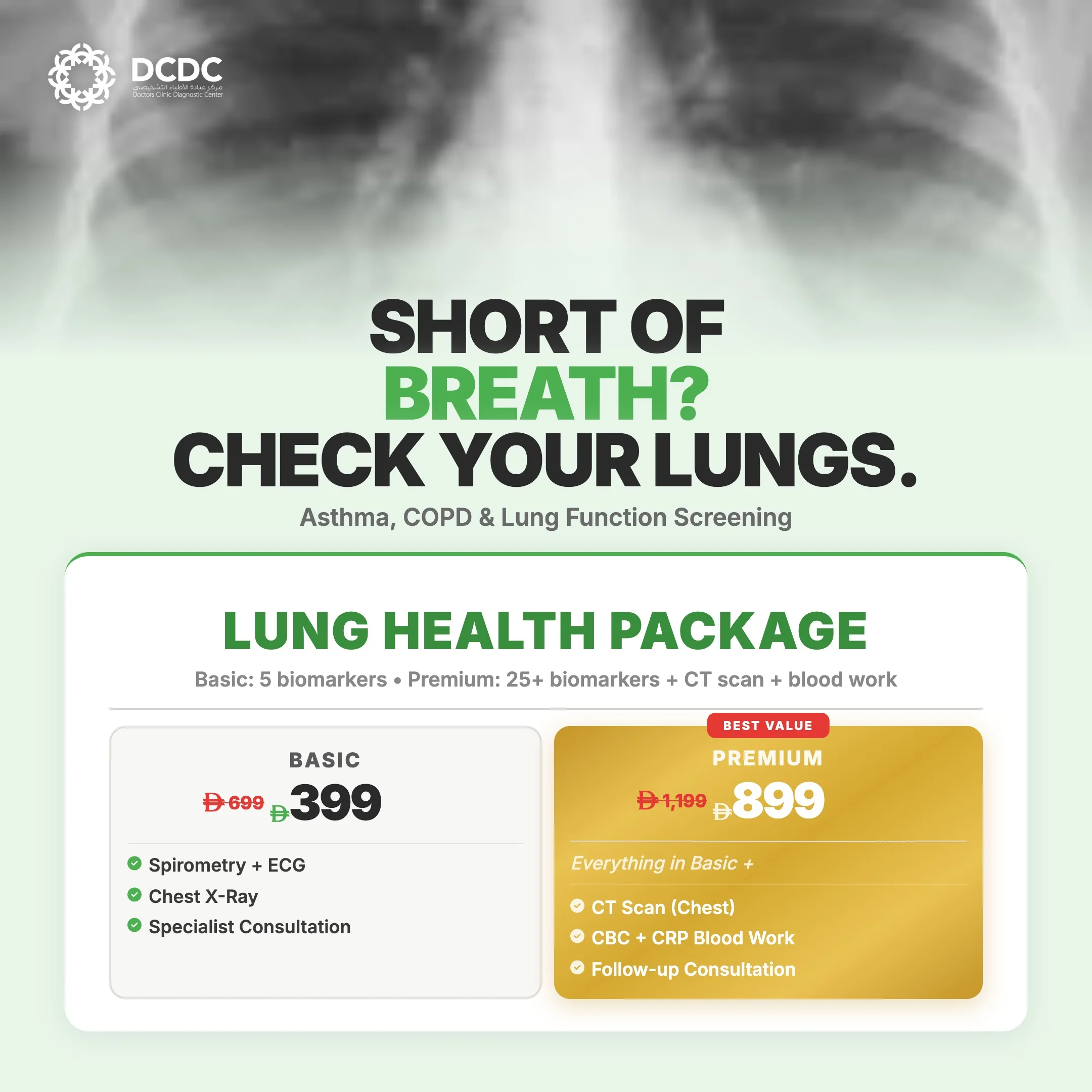
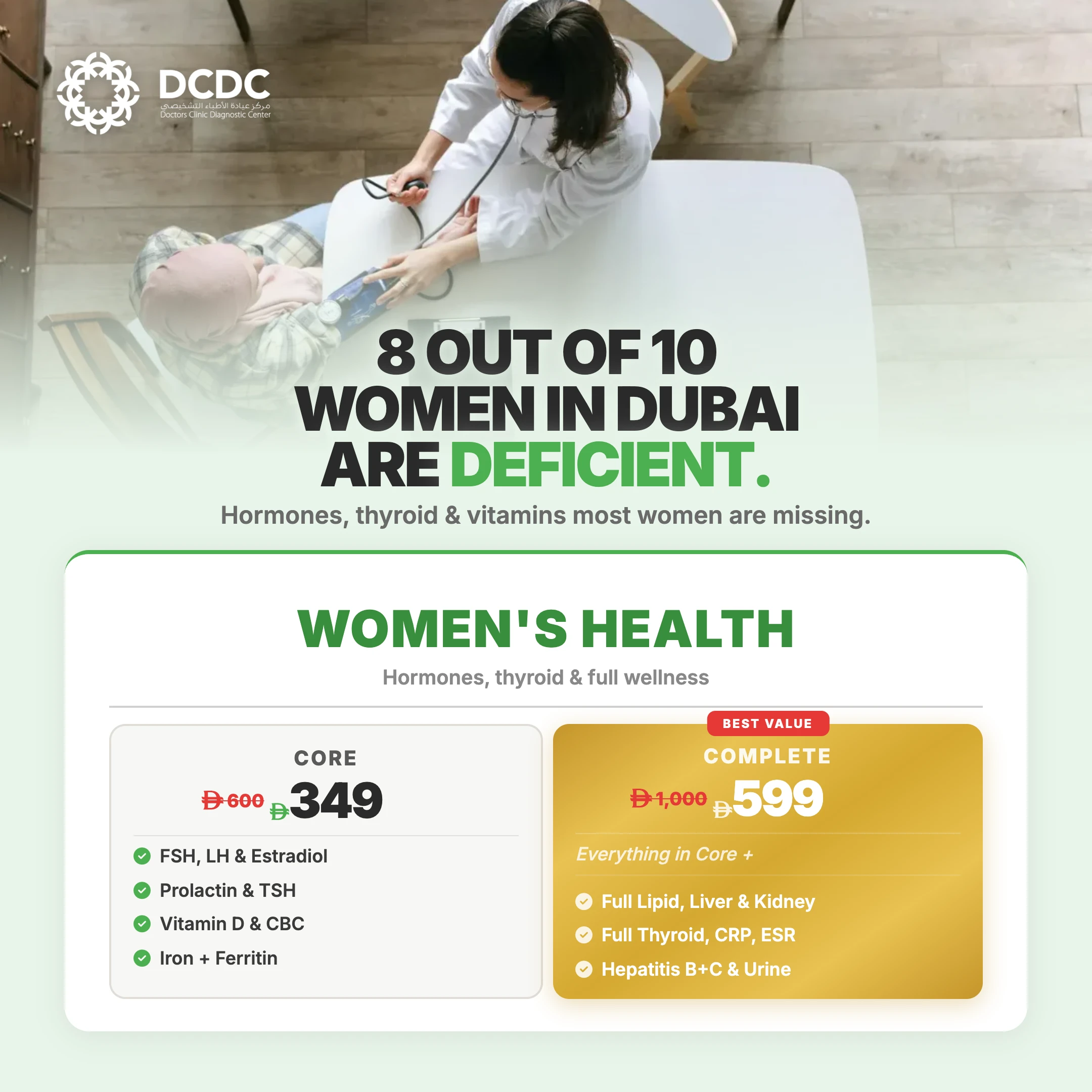
Health Screening Packages
Save with our bundled screening packages — specialist consultation included
What Is Rosacea?
Rosacea is a chronic inflammatory condition that primarily affects the central face — the cheeks, nose, chin, and forehead. It typically begins with intermittent flushing or redness that comes and goes, then can progress to persistent redness, visible small blood vessels (telangiectasia), and inflammatory bumps that resemble acne. Unlike acne, rosacea does not usually involve blackheads, and unlike a simple sunburn or heat rash, the redness of rosacea tends to be recurring and long-lasting rather than a one-off reaction.
According to the National Rosacea Society and dermatology literature, rosacea affects an estimated 5% of the global adult population, though prevalence estimates vary by study population and diagnostic criteria. It most commonly develops between the ages of 30 and 50, and while it can affect anyone, it is reported more frequently in people with fair skin, though it is increasingly recognised and diagnosed in people with medium and darker skin tones as well, where the redness may appear more as a dusky or brownish discolouration rather than bright pink.
The exact cause of rosacea is not fully understood, but current research points to a combination of factors: abnormal inflammatory and immune responses in the skin, blood vessel dysfunction that makes vessels dilate too easily, the presence of a skin mite called Demodex folliculorum in higher-than-normal numbers, and possibly genetic predisposition. Rosacea is not caused by poor hygiene and is not contagious.
The Four Subtypes of Rosacea
Dermatology guidelines classify rosacea into four subtypes based on the dominant features present. Many patients have a combination of subtypes, and rosacea can evolve from one pattern to another over time if untreated.
Erythematotelangiectatic Rosacea (ETR)
The most common presentation. Characterised by persistent facial redness, frequent flushing episodes, and visible thin blood vessels (telangiectasia) on the cheeks and nose. Skin often feels sensitive, may sting or burn with certain products, and can appear rough or dry despite feeling oily in places.
Papulopustular Rosacea
Sometimes called 'acne rosacea' because it produces red bumps and pus-filled pimples on a background of facial redness. This is the subtype most often confused with adult acne. Unlike acne, papulopustular rosacea does not typically present with blackheads or whiteheads, and it is usually accompanied by visible flushing and sensitivity that acne does not cause.
Phymatous Rosacea
The least common but most visually significant subtype. Chronic inflammation causes thickening of the skin, most often on the nose (a pattern known as rhinophyma), resulting in a bulbous, enlarged appearance with prominent pores. It develops gradually over years, is more common in men, and typically follows long-standing untreated erythematotelangiectatic or papulopustular rosacea. Early treatment significantly reduces the risk of progressing to this stage.
Ocular Rosacea
Affects the eyes and eyelids in an estimated 50% of rosacea patients at some point, and can occur even in people with mild or no visible facial redness. Symptoms include dry, gritty, or burning eyes, redness of the eyelid margins, styes, and light sensitivity. Left untreated, ocular rosacea can affect the cornea and, in rare severe cases, threaten vision, which is why eye symptoms should always be reported to a doctor.
Rosacea Symptoms: What to Look Out For
Recognising the early pattern of rosacea symptoms helps you get an accurate diagnosis sooner rather than spending months trialling acne products that will not help and may worsen sensitivity.
- Facial flushing: Sudden, temporary redness that comes on quickly, often triggered by heat, spicy food, alcohol, or emotional stress, and typically fades within minutes to hours in early rosacea.
- Persistent redness: Background redness on the cheeks, nose, chin, or forehead that does not fully resolve between flushing episodes, similar in colour to a mild sunburn that never quite fades.
- Visible blood vessels: Small, thread-like red or purple lines (telangiectasia) visible on the surface of the skin, usually on the nose and cheeks.
- Bumps and pimples: Small red, solid bumps or pus-filled pimples, without the blackheads typically seen in acne.
- Skin sensitivity: Stinging, burning, or tightness, particularly after applying skincare products, sunscreen, or makeup. Many rosacea patients describe their skin as reacting to products that never bothered them before.
- Dry, rough patches: Areas of the face that feel rough or scaly despite the presence of redness and occasional oiliness elsewhere.
- Skin thickening: Gradual enlargement and thickening of the nose or, less commonly, other facial areas, in longer-standing untreated cases.
- Eye symptoms: Dryness, grittiness, redness of the eyelids, or recurrent styes, which can occur alongside or even before facial skin symptoms.
What Causes Rosacea Flare-Ups? Common Triggers
Rosacea itself is a chronic underlying condition, but individual flare-ups are usually set off by identifiable triggers. Triggers vary from person to person, and keeping a symptom diary that notes flushing episodes alongside recent food, weather, and activity is one of the most useful tools for managing the condition long-term. Dr. Hadeel Elnur explains: "Most of my rosacea patients in Dubai are surprised by how much the climate itself contributes to their flare-ups. It is rarely just one trigger — it is usually a combination of heat, sun exposure, and the constant shift between outdoor temperatures and air-conditioned spaces that keeps the skin in a reactive state."
| Trigger Category | Common Examples | Why It Matters in Dubai |
|---|---|---|
| Heat and sun exposure | Direct sunlight, hot weather, saunas, hot showers | Summer temperatures regularly exceed 40°C, and UV intensity is high year-round, making sun protection essential for rosacea control |
| Temperature swings | Moving between air-conditioned interiors and outdoor heat | Dubai residents move between extremes multiple times daily — homes, cars, malls, and offices are often kept much cooler than outdoor air |
| Spicy and hot foods | Chilli, curries, hot beverages, hot soups | Spicy cuisine is a significant part of food culture in Dubai's diverse dining scene, and capsaicin is a well-documented flushing trigger |
| Alcohol | Red wine in particular, but any alcohol can trigger flushing | Alcohol dilates blood vessels and is a widely reported trigger among rosacea patients |
| Emotional stress | Work pressure, anxiety, sudden emotional reactions | Fast-paced professional lifestyles common among Dubai residents can contribute to stress-driven flushing |
| Skincare products | Alcohol-based toners, harsh exfoliants, fragranced products, certain sunscreens | Heavy sunscreen use is necessary in Dubai's UV environment, so choosing rosacea-friendly, fragrance-free formulas matters |
| Exercise and humidity | Intense workouts, humid outdoor conditions | Outdoor exercise during Dubai's hot, humid months can trigger prolonged flushing episodes |
| Certain medications | Topical steroids, some blood pressure medications, niacin supplements | Should always be reviewed with your doctor rather than stopped independently |
Common rosacea triggers and their relevance to Dubai's climate and lifestyle
Rosacea vs Acne, Eczema, and Lupus: How to Tell Them Apart
Because rosacea shares features with several other common skin conditions, self-diagnosis is unreliable and can lead to using the wrong products for months. Understanding the differences can help you describe your symptoms accurately to a doctor, though a clinical examination is always needed to confirm the diagnosis. If you are unsure whether your breakouts are acne or rosacea, our acne treatment guide covers the distinguishing features of true acne in more detail.
| Feature | Rosacea | Acne | Eczema | Lupus Rash |
|---|---|---|---|---|
| Typical age of onset | 30-50 years | Teens to mid-20s (can occur later) | Any age, often from childhood | 20-40 years, more common in women |
| Blackheads/whiteheads | Absent | Present, often the first sign | Absent | Absent |
| Flushing pattern | Frequent, triggered flushing episodes | Not typically present | Not typically present | Can occur, often photosensitive |
| Location | Central face: cheeks, nose, chin, forehead | Face, chest, back, shoulders | Face, but also elbows, knees, hands | Classic 'butterfly' pattern across cheeks and nose bridge |
| Texture | Bumps, visible vessels, sensitive skin | Comedones, papules, pustules, cysts | Dry, scaly, intensely itchy patches | Flat or slightly raised, often photosensitive |
| Itch level | Mild stinging/burning, not typically itchy | Occasionally itchy | Very itchy, hallmark symptom | Usually not itchy |
Comparing rosacea with acne, eczema, and lupus-related facial rash
One especially important distinction is with lupus, an autoimmune condition that can produce a butterfly-shaped facial rash resembling rosacea. Lupus rashes are often more photosensitive, may be accompanied by joint pain, fatigue, or fever, and require different diagnostic testing entirely. If your doctor suspects an autoimmune cause behind your facial redness, they may order specific blood tests to investigate further. For patients whose skin symptoms overlap with allergic reactions, our guide to skin allergies and hives explains how allergic skin reactions differ from rosacea.
Not Sure If It's Rosacea?
Book a GP consultation at DCDC from AED 200 for a thorough skin assessment and personalised management plan.
WhatsApp +971 50 970 3884 to book
How Is Rosacea Diagnosed?
There is no single blood test that confirms rosacea. Diagnosis is primarily clinical, meaning your doctor examines your skin, reviews your symptom pattern and trigger history, and rules out other conditions that can look similar. During your consultation, expect to be asked about how long you have had symptoms, what seems to trigger flare-ups, whether you have any eye symptoms, your skincare routine, and any family history of rosacea or related skin conditions.
In some cases, particularly when the presentation is atypical or when an autoimmune condition needs to be excluded, your doctor may order blood tests such as an antinuclear antibody (ANA) test to help rule out lupus, or a complete blood count if infection is suspected. If your symptoms suggest an allergic component rather than classic rosacea, allergy testing may also be recommended to identify specific triggers.
Rosacea Treatment Options
There is currently no cure for rosacea, but a wide range of treatments can control symptoms effectively, often reducing flare-up frequency and severity substantially. Treatment is typically stepped, starting with trigger management and topical therapy before escalating to oral medication or procedural options for persistent cases.
| Treatment Category | Examples | Best For |
|---|---|---|
| Topical treatments | Metronidazole, azelaic acid, ivermectin cream, brimonidine gel | Mild to moderate redness and bumps; first-line therapy for most patients |
| Oral medications | Low-dose doxycycline, other oral antibiotics, isotretinoin in severe resistant cases | Moderate to severe papulopustular rosacea, or cases not responding to topicals alone |
| Laser and light therapy | Pulsed dye laser (PDL), intense pulsed light (IPL) | Persistent visible blood vessels and background redness that topical treatment cannot fully address |
| Lifestyle and trigger management | Sun protection, gentle skincare, trigger diary, temperature moderation | All rosacea patients, as an ongoing foundation alongside medical treatment |
Rosacea treatment options by category
Topical Treatments
- Metronidazole gel or cream (0.75%-1%): An anti-inflammatory and antimicrobial topical widely used as first-line treatment, applied once or twice daily. Improvement typically takes several weeks of consistent use.
- Azelaic acid (15%): Reduces inflammation and bumps, and can also help with residual redness. Well tolerated for sensitive rosacea-prone skin and useful for patients with overlapping pigmentation concerns.
- Ivermectin cream (1%): Targets both inflammation and Demodex mite overgrowth, which is thought to contribute to papulopustular rosacea in many patients.
- Brimonidine gel: A vasoconstrictor that temporarily reduces visible redness by narrowing blood vessels. Effects last several hours and it is used for cosmetic redness reduction rather than treating the underlying inflammation.
Oral Medications
- Low-dose doxycycline: Used at anti-inflammatory rather than antibiotic doses for moderate to severe papulopustular rosacea. Works by reducing inflammation rather than solely targeting bacteria.
- Other oral antibiotics: May be prescribed short-term for more inflamed presentations, always under medical supervision.
- Low-dose isotretinoin: Reserved for severe, treatment-resistant papulopustular or phymatous rosacea, and requires close monitoring similar to its use in severe acne.
Laser and Procedural Treatments
For patients whose main concern is persistent visible blood vessels or background redness that does not respond fully to topical treatment, laser and light-based therapies can make a significant visible difference. Pulsed dye laser and intense pulsed light (IPL) both target the dilated blood vessels beneath the skin, causing them to fade over a course of sessions. These procedures are typically performed by dermatology specialists, and results are usually most effective as an adjunct to ongoing medical management rather than a standalone cure.
Rosacea Treatment Cost in Dubai
Costs for rosacea care in Dubai vary depending on the treatment pathway. The table below reflects realistic current market ranges.
| Service | Cost Range (AED) | Notes |
|---|---|---|
| GP consultation (DCDC) | From AED 200 | Includes skin assessment, trigger review, and initial management plan |
| Dermatologist consultation | AED 400-800 | For complex or treatment-resistant cases referred by your GP |
| Blood tests (ANA, CBC, allergy panel) | From AED 200-600 | Ordered when an autoimmune or allergic cause needs to be excluded |
| Topical prescription treatments | AED 200-500 | Metronidazole, azelaic acid, or ivermectin cream, per course |
| Oral medication course | AED 150-400 per month | Low-dose doxycycline or other oral therapy, typically several months |
| Laser/IPL treatment | AED 500-2,000 per session | Course of 3-5 sessions typically recommended for visible vessels |
Rosacea treatment prices in Dubai (2026 market rates). DCDC GP consultation from AED 200 with insurance direct billing available.
At DCDC, GP consultations for rosacea start from AED 200. DCDC works with over 20 insurance partners offering direct billing, including Daman, AXA, Bupa, MetLife, and Cigna, which can significantly reduce out-of-pocket costs for consultations and any required blood tests.
How to Manage Rosacea Day to Day
Medical treatment works best alongside consistent daily management, particularly given how much Dubai's climate can influence flare-ups. The following steps are the foundation of long-term rosacea control.
- Daily sun protection: Use a broad-spectrum, fragrance-free, physical (mineral) sunscreen with SPF 30-50 every day, reapplying if outdoors. UV exposure is one of the most consistent rosacea triggers, and this step alone significantly reduces flare frequency for many patients in Dubai's sun.
- Gentle skincare only: Choose fragrance-free, alcohol-free cleansers and moisturisers. Avoid physical scrubs, astringent toners, and products containing menthol, witch hazel, or high concentrations of exfoliating acids.
- Moderate temperature transitions where possible: Where practical, avoid extremely hot showers, and allow your skin a moment to adjust when moving between very hot outdoor air and cold air-conditioned interiors.
- Track your personal triggers: Keep a simple diary noting flare-ups alongside food, weather, stress levels, and activities. Personal trigger patterns vary significantly, and this is often the single most useful tool for long-term control.
- Moderate spicy food and alcohol: You do not necessarily need to eliminate them, but noticing and moderating intake around known flare-triggering foods and drinks can meaningfully reduce flushing episodes.
- Stay consistent with prescribed treatment: Topical treatments for rosacea typically take 4-8 weeks of regular use to show visible improvement. Stopping early because results are not immediate is one of the most common reasons treatment appears to 'not work.'
- Protect your eyes if you have ocular symptoms: Use preservative-free artificial tears if advised, keep eyelids clean, and mention any eye dryness, grittiness, or redness to your doctor even if your facial skin looks well controlled.
Ready to Get Your Rosacea Under Control?
DCDC offers GP consultations for rosacea from AED 200, with same-day blood tests when needed. MOHAP-licensed facility in Dubai Healthcare City with a 4.8/5 Google rating.
Call +971 54 219 5008 or WhatsApp to book
What to Expect at DCDC: Your Rosacea Consultation Journey
If you decide to have your skin assessed at DCDC in Dubai Healthcare City, here is what the process typically looks like.
- Step 1 — Arrival and check-in: DCDC is located in Building 64, Block A, Al Razi Medical Complex in DHCC, with free dedicated parking on-site. Walk-ins are welcome, or you can book ahead. Average wait time is around 15 minutes.
- Step 2 — GP consultation: Your consultation with a General Practitioner such as Dr. Hadeel Elnur typically lasts 15-20 minutes. The doctor examines your skin pattern, discusses your flushing history and possible triggers, checks for eye involvement, and reviews your current skincare products and any medications.
- Step 3 — Ruling out other conditions: If the presentation is not clearly typical rosacea, or if features suggestive of an autoimmune or allergic cause are present, your doctor may order same-day blood tests at DCDC's on-site laboratory.
- Step 4 — Personalised management plan: Your GP will discuss your specific triggers, recommend an appropriate topical or oral treatment where indicated, and advise on sun protection and skincare adjustments suited to Dubai's climate.
- Step 5 — Results review and follow-up: When blood tests are ordered, routine results are typically available within 24 hours. Your GP will review findings and adjust your plan accordingly at a follow-up visit.
- Step 6 — Specialist referral if needed: For phymatous changes, treatment-resistant cases, or when laser therapy is being considered, your GP will coordinate a referral to a dermatologist. If eye involvement is significant, referral to an ophthalmologist may be arranged.
DCDC's 98% patient satisfaction rate and 4.8/5 Google rating from over 1,000 verified reviews reflect a consistent, thorough approach to care. The clinic is open Saturday through Thursday from 8 AM to 10 PM and Friday from 9 AM to 9 PM, and the team is multilingual across Arabic, English, Farsi, Urdu, and Hindi, making consultations accessible for Dubai's diverse population.
Rosacea in Dubai's Climate: Why Local Factors Matter
Dubai's environment presents a fairly unique combination of rosacea triggers concentrated in one place. Summer temperatures that regularly exceed 40°C combine with intense, near year-round UV exposure and near-universal reliance on air conditioning indoors, creating a cycle of heat exposure followed by rapid cooling that many rosacea patients find particularly provoking. Add to this a food culture where spicy cuisine is widely enjoyed, and the combination of triggers is more concentrated than in many temperate climates.
This does not mean rosacea is unmanageable in Dubai — quite the opposite. It simply means that trigger management needs to be tailored specifically to this environment rather than relying on generic advice designed for cooler, less sun-intense climates. Patients who adjust their sun protection routine, moderate their exposure to rapid temperature changes, and pace their time outdoors during peak heat hours often see a meaningful reduction in flare frequency even before starting prescription treatment.
Rosacea and Related Skin Conditions
Rosacea does not exist in isolation from other skin concerns, and many patients in Dubai are managing more than one skin condition simultaneously. If your skin is also prone to dryness and itching alongside redness, it is worth reading about eczema treatment in Dubai, since eczema and rosacea can sometimes coexist and require different topical approaches. Similarly, if you notice patches of darker discolouration alongside your redness, particularly after sun exposure, our guide on melasma treatment explains how this separate but related pigmentation condition is diagnosed and managed. For a broader overview of when to see a specialist for any persistent skin concern, our dermatologist guide for Dubai outlines the referral pathway from GP to specialist care.
Common Rosacea Management Mistakes to Avoid
- Treating it as acne: Using harsh acne-focused products such as strong benzoyl peroxide, physical scrubs, or high-strength exfoliating acids can significantly worsen rosacea sensitivity and redness.
- Skipping sunscreen because skin already feels sensitive: This is counterproductive, since UV exposure is one of the most reliable rosacea triggers. A gentle, mineral-based sunscreen is essential, not optional.
- Over-cleansing or scrubbing: Washing the face too frequently or using textured cleansing tools strips the skin barrier further and increases redness and stinging.
- Stopping treatment as soon as symptoms improve: Rosacea is a chronic condition. Stopping topical treatment abruptly once redness improves often leads to rebound flare-ups within weeks.
- Ignoring eye symptoms: Dry, gritty, or red eyes are frequently dismissed as general dryness rather than reported as a possible sign of ocular rosacea, delaying appropriate treatment.
- Trying to identify triggers through memory alone: Without a written trigger diary, it is easy to miss patterns, particularly when multiple mild triggers combine to cause a single flare.
Why Choose DCDC for Rosacea Assessment in Dubai?
- Affordable GP consultations: Rosacea assessments from AED 200, making thorough evaluation accessible before considering specialist referral.
- On-site laboratory: When blood tests are needed to rule out lupus or other causes of facial redness, samples are collected and processed at our MOHAP-licensed on-site lab, with routine results typically available within 24 hours.
- Careful differential diagnosis: Rosacea is frequently confused with acne, eczema, allergic reactions, and lupus. Our GPs take a thorough history and exam before recommending treatment, rather than assuming based on appearance alone.
- Insurance direct billing: Over 20 insurance partners including Daman, AXA, Bupa, MetLife, and Cigna, with many plans covering consultations and diagnostic blood tests.
- Convenient DHCC location: Building 64, Block A, Al Razi Medical Complex, Dubai Healthcare City, with free parking, extended hours (Sat-Thu 8 AM-10 PM, Fri 9 AM-9 PM), and an average wait time of around 15 minutes.
- Coordinated specialist referrals: When phymatous changes, laser therapy, or ocular involvement require specialist input, DCDC coordinates referrals to dermatology or ophthalmology promptly.
- Proven patient satisfaction: A 4.8/5 Google rating from over 1,000 verified reviews and a 98% patient satisfaction rate.
Related Services at DCDC
Expert care and advanced diagnostics at Dubai Healthcare City
Frequently Asked Questions
Final Thoughts
Rosacea is a common, manageable condition that is frequently mistaken for acne, sunburn, or general skin sensitivity, which often delays proper treatment for months or even years. Understanding your subtype, recognising your personal triggers, and following a consistent management plan — combining appropriate topical or oral treatment with daily sun protection and gentle skincare — brings the condition under control for the vast majority of patients, even in a demanding climate like Dubai's.
At DCDC in Dubai Healthcare City, our approach starts with an accurate diagnosis, since rosacea can resemble several other conditions that require entirely different treatment. With affordable GP consultations from AED 200, same-day on-site blood testing when needed, direct billing with over 20 insurance providers, and a convenient DHCC location with free parking and short wait times, getting your rosacea properly assessed and managed is straightforward. Book your consultation today by calling +971 54 219 5008 or send us a WhatsApp message.
Sources & References
This article was reviewed by our medical team and references the following sources:
- American Academy of Dermatology — Rosacea: Overview, Causes, and Treatment
- Mayo Clinic — Rosacea: Symptoms and Causes
- NHS — Rosacea: Overview, Causes, and Treatment
- Cleveland Clinic — Rosacea: Symptoms, Causes and Treatment
- World Health Organization — Skin Diseases
- National Rosacea Society — Understanding Rosacea
Medical content on this site is reviewed by DHA-licensed physicians. See our editorial policy for more information.

Written by
Dr. Hadeel Elnur
General Practitioner
MD, General Practice
Dr. Hadeel Elnur is a General Practitioner at Doctors Clinic Diagnostic Center (DCDC) in Dubai Healthcare City.
Related Articles

Acne Treatment Dubai: Causes & Care (2026)

Eczema Treatment Dubai: Triggers & Care (2026)
Dermatologist Dubai: Skin Specialist Guide (2026)
Melasma Treatment Dubai: Options & Guide (2026)
Skin Allergy Treatment Dubai: Hives Guide (2026)
More in Dermatology
Skin Tag Removal Cost Dubai: From AED 300 (2026)
Read MoreSkin Rash Causes in Dubai: When to See a Doctor (2026)
Read MoreAlopecia Areata Treatment Dubai: Guide (2026)
Read MoreEczema vs Psoriasis Dubai: Key Differences (2026)
Read MoreSkin Allergy Treatment Dubai: Hives Guide (2026)
Read MoreFungal Skin Infections Dubai: Treatment (2026)
Read More© 2026 Doctors Clinic Diagnostic Center (DCDC), Dubai Healthcare City. Originally published at https://doctorsclinicdubai.ae/blog/rosacea-treatment-dubai. All rights reserved. Unauthorized reproduction is prohibited.