
Key Takeaways
- Around one in three women experience some urinary incontinence after childbirth, and pregnancy itself -- not just the delivery -- is a major cause, which is why women who had a caesarean section can leak too
- Emsella is a non-invasive HIFEM (High-Intensity Focused Electromagnetic) chair treatment: you sit fully clothed for about 28 minutes while the device triggers roughly 11,000 supramaximal pelvic floor contractions that cannot be produced voluntarily with Kegels
- Emsella is normally started after your six-week postnatal check, once bleeding (lochia) has stopped and a doctor has examined you and cleared you -- it is never used during pregnancy and is not a substitute for a proper postnatal assessment
- The standard protocol is six sessions over about three weeks (two per week), with most women noticing a change after the second or third session and results continuing to build for weeks afterwards
- Published HIFEM research reports that about 95% of treated women described improved quality of life and roughly two-thirds reduced or stopped using incontinence pads, though most studies are small and often industry-sponsored
- Emsella works best alongside -- not instead of -- pelvic floor muscle training; Cochrane evidence shows supervised pelvic floor exercises meaningfully reduce postnatal urinary incontinence, and combining the two is the approach used at DCDC
- At DCDC in Dubai Healthcare City, the pathway starts with a postnatal consultation with a female gynecologist from AED 299, with pelvic floor physiotherapy from AED 250 per session; Emsella is offered as single sessions and as a six-session course -- contact the clinic for current pricing
If you sneeze, laugh, lift your baby or jog for a bus and leak a little urine, you are experiencing one of the most common and least talked-about consequences of giving birth -- and it is not something you simply have to live with. Emsella after childbirth has become one of the most asked-about non-surgical options for postpartum pelvic floor weakness, because it strengthens the muscles without undressing, needles, downtime or surgery. Our Emsella pelvic floor therapy service at DCDC in Dubai Healthcare City sits inside a full postnatal pathway: a female gynecologist examines you first, rules out other causes such as infection, and only then decides whether the chair is right for you.
This guide walks through why childbirth weakens the pelvic floor, how to recognise the signs that yours needs help, a week-by-week postpartum recovery timeline, exactly when Emsella can safely start, how it compares with postnatal physiotherapy and Kegels, and what the whole process looks like at DCDC.
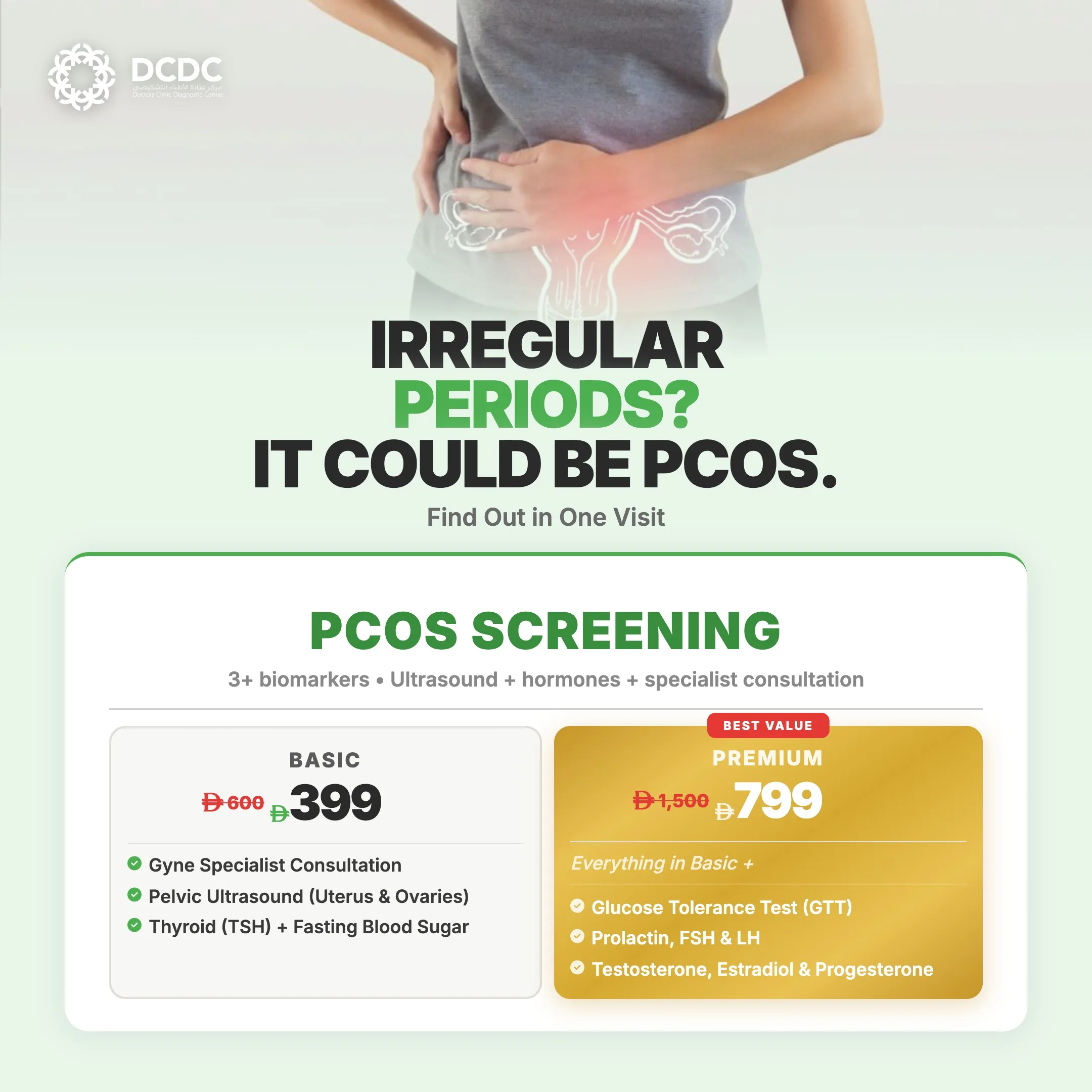
Health Screening Packages
Save with our bundled screening packages — specialist consultation included





Why Childbirth Weakens the Pelvic Floor
The pelvic floor is a hammock of muscle and connective tissue slung between your pubic bone and tailbone. It holds up the bladder, uterus and bowel, it keeps the urethra closed when your abdominal pressure spikes during a cough or a lift, and it contributes to sexual sensation. During pregnancy this hammock carries a load that increases week by week -- a growing uterus, extra fluid volume and a shifting centre of gravity -- for nine months continuously. Relaxin and progesterone soften ligaments to prepare the pelvis for birth, which is biologically useful but also reduces the passive support around the bladder neck.
Vaginal delivery adds a second, more acute injury on top of that chronic loading. The pelvic floor muscles stretch to several times their resting length, and the pudendal nerve that supplies them can be stretched or compressed during the second stage of labour. In some women this produces measurable weakness in the muscle's ability to contract quickly -- exactly the fast, reflexive contraction you need to stay dry when you sneeze. Cleveland Clinic describes the pelvic floor as a group of muscles that can be trained like any other muscle group, which is the encouraging part: weakened muscle is, in most cases, trainable muscle.
Factors That Increase the Risk of Postpartum Pelvic Floor Weakness
- A long second stage of labour -- prolonged pushing increases stretch and nerve traction on the pelvic floor
- Instrumental delivery -- forceps in particular carries a higher rate of pelvic floor injury than a spontaneous vaginal birth
- A large baby -- higher birth weight increases the degree of muscle stretch
- Perineal tearing or episiotomy, especially third- or fourth-degree tears
- Multiple pregnancies -- each additional birth adds cumulative load, and twins add load during pregnancy itself
- Chronic straining -- postpartum constipation, persistent cough, or returning to heavy lifting and high-impact exercise too soon
- Higher BMI and connective tissue laxity, which raise the baseline pressure the pelvic floor has to resist
How Common Is Leaking Urine After Giving Birth?
Postpartum urinary incontinence is far more common than the silence around it suggests. Around one in three women report some degree of urinary leakage after childbirth, and the NHS notes that urinary incontinence in general is very common and frequently under-reported because women assume it is an inevitable part of motherhood. It is not. It is a treatable muscular and neuromuscular problem, and the earlier it is addressed the better the outcome tends to be.
The natural history is genuinely reassuring for many women: symptoms often improve substantially in the first six to twelve weeks as swelling settles, tissue heals and muscle tone begins to return. But a meaningful proportion of women still leak at six months, at a year, and sometimes for decades -- particularly if nothing active was done in the first year. The women who do best are the ones who treat the pelvic floor as something to be actively rehabilitated after birth, in the same way an athlete rehabilitates a strained hamstring, rather than something to wait out.
In Dubai this matters practically. Many mothers here are expatriates without extended family nearby, return to demanding jobs within weeks, and go straight back to gym classes, padel and running in a climate that encourages high fluid intake. All of that raises intra-abdominal pressure and unmasks a weak pelvic floor faster than a slower, more supported recovery would.
Signs Your Pelvic Floor Needs Help: A Postnatal Checklist
Urine leakage is the headline symptom, but pelvic floor weakness announces itself in several ways. If you recognise three or more items on this checklist beyond twelve weeks postpartum, it is worth having a formal assessment rather than continuing to self-manage.
- Stress leakage -- urine escapes when you cough, sneeze, laugh, lift your baby, or jump
- Urgency -- a sudden, hard-to-defer need to pass urine, sometimes with leakage before you reach the toilet
- Frequency -- going to the toilet far more often than before pregnancy, or mapping your day around toilet locations
- Wearing a liner or pad "just in case" when you exercise, travel or leave the house
- A dragging or heavy sensation low in the pelvis, especially at the end of the day or after standing
- A feeling that something is bulging in the vagina -- this needs a gynecological examination, not a chair treatment, as a first step
- Difficulty holding wind or, less commonly, faecal urgency
- Reduced sexual sensation, vaginal laxity, or discomfort during intercourse after birth
- An inability to feel a pelvic floor contraction at all -- if you cannot tell whether you are squeezing correctly, exercises alone are unlikely to work
- Persistent lower back or pelvic girdle pain, which often coexists with a poorly coordinated deep core and pelvic floor
Some of these overlap with other postnatal conditions. Abdominal separation frequently accompanies pelvic floor weakness because the deep core and the pelvic floor work as one pressure system -- our guide to diastasis recti physiotherapy treatment explains how the two are assessed together. Persistent low back or pelvic pain that started in pregnancy is also common, and our article on pregnancy back pain physiotherapy covers when that needs hands-on treatment.
The Postpartum Pelvic Floor Recovery Timeline
Recovery is not a single event at six weeks. The American College of Obstetricians and Gynecologists now frames postpartum care as an ongoing process across the "fourth trimester", recommending contact with a maternity provider within the first three weeks and a comprehensive review by twelve weeks rather than one solitary six-week appointment. Use the timeline below as a realistic map of what to do -- and what not to do -- at each stage.
| Stage | What is happening | What to do | Emsella? |
|---|---|---|---|
| Weeks 0-6 | Bleeding (lochia), tissue healing, perineal or caesarean wound repair, hormonal shifts, broken sleep | Rest and hydrate. Gentle diaphragmatic breathing. Very light, pain-free pelvic floor squeezes once comfortable. Avoid constipation and straining. Do not lift anything heavier than your baby | No -- healing phase, bleeding usually ongoing |
| Week 6 postnatal check | Formal review of healing, bleeding, bladder and bowel function, mood, contraception and scar | Attend the check even if you feel fine. Raise leakage explicitly -- doctors cannot treat what you do not mention. Ask for a pelvic floor assessment | Assessed and, if cleared, may begin from this point |
| Weeks 6-12 | Muscle tone starting to return, energy improving, many women resuming light exercise | Structured pelvic floor muscle training, ideally taught and checked by a physiotherapist. Walking, gentle core work. Progressive return to load | Typical window to start a six-session course once cleared and bleeding has stopped |
| Months 3-6 | The window in which most spontaneous recovery has already happened; persisting symptoms are unlikely to resolve on their own | If you are still leaking, escalate. Combine supervised exercise with a treatment such as HIFEM. Reassess before returning to running or high-impact classes | Very common and appropriate time for a course |
| Months 6-12 | Symptoms present at this stage are considered persistent postnatal incontinence | Full gynecological assessment, urine testing to exclude infection, imaging if indicated, then a combined treatment plan. Maintenance strategy for the long term | Appropriate; often combined with physiotherapy and maintenance sessions |
Postpartum pelvic floor recovery timeline and when Emsella after childbirth typically fits in
When Can You Start Emsella After Childbirth?
The short answer most women are looking for: usually after your six-week postnatal check, once bleeding has completely stopped and a doctor has examined you and confirmed you are healing normally. There is no universal fixed date, because the decision depends on your delivery, your healing and your symptoms rather than on the calendar alone.
The Conditions That Need to Be Met First
- Lochia has stopped. Ongoing postpartum bleeding means the uterus is still involuting and the treatment is deferred
- You have had a postnatal examination. Leakage can be caused or worsened by a urinary tract infection, retained products, a significant prolapse or an obstetric anal sphincter injury -- all of which need identifying before any muscle-stimulation device is used
- Perineal or caesarean wounds have healed without infection or breakdown
- You are not pregnant again. Emsella is contraindicated in pregnancy
- You have been screened for device contraindications -- pacemakers, defibrillators or other implanted electronic devices, metal implants in the pelvis or hip, and certain intrauterine devices
- A urine test has excluded infection, because treating a UTI often resolves urgency and frequency on its own
If you had a complicated delivery -- a third- or fourth-degree tear, a significant postpartum haemorrhage, or a caesarean with wound complications -- expect the start point to be later than six weeks and to be set individually by your gynecologist. Waiting an extra month costs you very little; starting an electromagnetic muscle treatment over an unrecognised infection or an unhealed repair can cost you a great deal.
Not sure if you are ready for Emsella?
Book a postnatal pelvic floor assessment with a female gynecologist at DCDC in Dubai Healthcare City. We examine, test for infection, scan if needed, and only then advise whether Emsella pelvic floor therapy is appropriate for you.
Call or WhatsApp to book -- same-day appointments frequently available, Sat-Thu 8 AM-10 PM
How Emsella Works for Postpartum Women
Emsella uses HIFEM -- High-Intensity Focused Electromagnetic energy -- delivered from a coil built into the seat of a chair. The field passes through clothing and skin and depolarises the motor neurons supplying the pelvic floor, producing what are called supramaximal contractions: contractions stronger and more complete than you can generate voluntarily. You sit fully clothed for roughly 28 minutes, and a single session delivers in the region of 11,000 of these contractions. There are no probes, no undressing and no anaesthesia, and you can drive yourself home and pick up your baby immediately afterwards.
This mechanism addresses the two problems that make postnatal Kegels frustrating. The first is recruitment: after a stretch injury, many women genuinely cannot find or fully activate the muscle, so their home exercises are training almost nothing. The second is volume -- even a diligent mother doing three sets of ten squeezes daily performs about 30 contractions, not 11,000. HIFEM effectively re-introduces the muscle to what a full contraction feels like, which often makes subsequent voluntary training far more productive.
The Standard Protocol
- Six sessions over about three weeks -- typically two sessions per week with a day or more between them
- 28 minutes per session, seated and fully clothed, with intensity increased gradually to your comfort level
- No downtime -- normal activity, childcare, driving and work immediately afterwards
- Most women notice a change after the second or third session, with results continuing to build over the weeks following the course
- Maintenance sessions as advised, particularly for women planning further pregnancies or returning to high-impact sport
What the Evidence Says: Results You Can Reasonably Expect
It is important to separate what has actually been measured from what is claimed in marketing. The most frequently cited HIFEM study is Samuels and colleagues, published in Lasers in Surgery and Medicine in 2019, which followed women with stress, urge and mixed urinary incontinence through six sessions. Approximately 95% of participants reported an improvement in quality of life, and roughly two-thirds of the women reduced or stopped using incontinence pads. A separate randomised, sham-controlled study of high-inductive electromagnetic pelvic floor stimulation found measurable objective improvement in pelvic floor muscle activity compared with sham treatment.
More directly relevant to new mothers, a recent pilot randomised controlled trial specifically examined HIFEM combined with pelvic floor muscle training in mothers living with incontinence, comparing it against sham HIFEM plus the same exercise programme. Both groups improved -- exercise works -- but the combination of HIFEM and pelvic floor muscle training produced a significantly greater reduction in urine leakage. That result reflects how the treatment is best used in practice: as an accelerator layered on top of proper rehabilitation, not as a replacement for it.
The honest caveats are these. Most HIFEM trials are small, several are funded or supported by the device manufacturer, follow-up periods are usually short, and dedicated postpartum-only studies remain limited. Improvement is also not the same as cure -- women with severe leakage, significant prolapse or a sphincter injury may need surgical or specialist input regardless. Any clinic that guarantees you will be dry after six sessions is overselling. For a broader look at all the options, our guide to urinary incontinence treatment in Dubai compares conservative, device-based and surgical routes.
Emsella vs Postnatal Physiotherapy vs Kegels
These three approaches are often presented as competitors. Clinically they are not -- they do different jobs, and the best postnatal outcomes usually come from combining them. Cochrane evidence supports supervised pelvic floor muscle training for preventing and treating urinary incontinence in postnatal women, which is why no responsible clinic will sell you a chair course and send you home without an exercise plan.
| Feature | Emsella (HIFEM) | Postnatal physiotherapy | Home Kegels |
|---|---|---|---|
| What it does | Triggers ~11,000 supramaximal contractions per session, passively | Assesses technique, retrains coordination, addresses core, breathing, posture and scar | Voluntary strengthening you perform yourself |
| Effort required from you | None -- you sit fully clothed | Active participation plus a home programme | Entirely dependent on your consistency |
| Session time and course | About 28 minutes; typically 6 sessions over 3 weeks | Usually 30-45 minutes; often 6-12 sessions over several weeks | A few minutes daily, indefinitely |
| Works if you cannot feel the muscle | Yes -- contraction is induced, not voluntary | Yes -- a physiotherapist can teach and check activation | Often no, which is the commonest reason Kegels fail |
| Addresses prolapse, scar, diastasis, back pain | Not directly | Yes -- this is the main advantage | No |
| Evidence base | Growing, mostly small and often industry-supported studies | Strong -- Cochrane-level evidence for postnatal incontinence | Strong when performed correctly and consistently |
| Best used for | Accelerating recruitment and strength, especially when exercises alone have plateaued | Comprehensive postnatal rehabilitation | Long-term maintenance after either of the above |
Emsella after childbirth compared with postnatal physiotherapy and home pelvic floor exercises
In practice, the sequence that works best is: assessment first, then supervised pelvic floor training, with Emsella added for women who cannot activate the muscle well, who have plateaued, or who simply cannot commit to a daily home programme in the middle of newborn life. Our articles on postnatal recovery physiotherapy and pelvic floor physiotherapy in Dubai explain what a supervised programme actually involves.
C-Section vs Vaginal Birth: Does It Change the Plan?
A common misconception is that a caesarean section protects the pelvic floor completely. It reduces the risk of direct stretch and tearing injury, but it does not remove the effect of nine months of progressive loading, hormonal ligament softening and altered abdominal mechanics. Plenty of women who have never laboured still leak, and they are frequently the most surprised and the slowest to seek help because they assume incontinence only follows vaginal birth.
- After a vaginal birth: the priority is perineal healing, scar mobility if you tore or had an episiotomy, and restoring the fast reflexive contraction. Emsella is usually considered from the six-week check onward once bleeding has stopped
- After a caesarean section: the abdominal wound must be fully healed and free of infection, and the deep core needs attention alongside the pelvic floor. Timing is often similar but is set individually, and some surgeons prefer a longer interval
- After an instrumental delivery or a third- or fourth-degree tear: specialist assessment comes first. Sphincter injury requires a different pathway, and starting a device treatment without that assessment risks missing the real problem
- After multiple births: cumulative loading means the pelvic floor often needs a longer, more structured programme rather than a single six-session course
Breastfeeding and Emsella: What You Need to Know
There is no known contraindication to Emsella while breastfeeding. HIFEM is a focused electromagnetic field applied to the pelvic floor musculature -- it is not a drug, nothing is absorbed systemically, and there is no medication that could pass into breast milk. Practically, women often schedule a session after a feed or after expressing so they are comfortable for the full 28 minutes, and you can feed your baby immediately afterwards. Some mothers bring a partner or helper and sit with the baby nearby, since the treatment requires no undressing and no clinical privacy beyond a normal treatment room.
That said, clinic screening still applies. Breastfeeding lowers circulating oestrogen, which can leave vaginal and urethral tissues drier and more sensitive and can itself contribute to urinary symptoms. That is a reason for a gynecologist to examine you and consider whether topical treatment is needed alongside muscle work -- not a reason to avoid Emsella, but a reason not to treat leakage as a purely mechanical problem. If you notice recurrent burning, urgency or fever, get a urine test before assuming it is pelvic floor weakness; our guide on UTI symptoms and treatment in Dubai covers what to look for.
Safety, Side Effects and Who Should Wait
Emsella is a non-invasive treatment with a good safety record in published studies, where no serious adverse events have been reported. During the session most women describe an unusual but not painful sensation -- a deep tingling and rhythmic pulling as the muscles contract. Afterwards, the commonest experience is a mild muscle fatigue or ache in the pelvic floor for a day or so, exactly as you would expect after an unusually hard workout for any muscle group.
Contraindications Screened Before Treatment
- Pregnancy -- an absolute contraindication
- Pacemakers, implantable defibrillators, neurostimulators or any implanted electronic device
- Metal implants in the pelvis or hip, including plates, screws and joint replacements in the treatment field
- Copper intrauterine devices -- discuss with your doctor; hormonal IUDs are generally acceptable but must be confirmed at screening
- Recent pelvic surgery or unhealed obstetric repair
- Active malignancy in the treatment area
- Bleeding disorders or anticoagulant therapy
- Severe cardiac disorders, uncontrolled epilepsy or fever
Having your period on the day of a session is not a contraindication, though some women find it uncomfortable and prefer to reschedule. Emsella is also not a treatment for prolapse repair, for an obstetric anal sphincter injury, or for incontinence caused by a neurological condition -- in those situations it may play a supporting role, but only after the primary problem has been properly diagnosed and managed.
What Emsella and Postnatal Pelvic Floor Care Cost in Dubai
Most Dubai clinics do not publish Emsella prices online and quote after an assessment, so treat any figure you see as an indication rather than a fixed rate. Internationally, single sessions are commonly quoted in the region of USD 250-500, which converts to a broadly comparable band locally; at Dubai clinics, quoted prices typically fall in the region of AED 800-1,500 per session, with six-session courses generally packaged at a discount in the AED 4,000-8,000 range. Always confirm directly, and always ask whether the quoted figure includes the initial consultation and the review at the end of the course.
| Step in the pathway | At DCDC | Typical Dubai market range |
|---|---|---|
| Postnatal consultation with a female gynecologist (history, examination, urine test) | From AED 299 | AED 300-800 |
| Pelvic floor physiotherapy session | From AED 250 | AED 250-600 per session |
| Emsella single session (28 minutes, fully clothed) | Offered as single sessions -- contact DCDC for current pricing | Roughly AED 800-1,500 |
| Emsella six-session course over about three weeks | Offered as a course package -- contact DCDC for current pricing and package offers | Roughly AED 4,000-8,000 |
| Pelvic ultrasound if clinically indicated | Performed on site at the same visit; quoted at consultation | AED 300-800 |
| Insurance coverage | Consultation and physiotherapy are often covered by insurance; direct billing with 20+ insurers | Device-based pelvic floor treatments are typically self-pay across Dubai |
Postnatal pelvic floor and Emsella pricing in Dubai: DCDC anchors versus market ranges
One practical point on insurance: while Emsella itself is usually not covered, the consultation, the urine testing and often the physiotherapy component frequently are. DCDC handles direct billing with more than 20 insurers including Daman, AXA and Bupa, and the front desk will check your eligibility for the assessable parts of the pathway before you commit to anything.
What to Expect at DCDC
DCDC is a MOHAP-licensed clinic in Building 64, Al Razi Medical Complex, Dubai Healthcare City, with free dedicated on-site parking -- a genuine consideration when you are arriving with a pram and a car seat. Opening hours run Saturday to Thursday from 8 AM to 10 PM and Friday from 9 AM to 9 PM, which makes it realistic to fit two sessions a week around feeding schedules, a partner's working hours or a nanny's availability. Average waiting time is about 15 minutes.
Step 1: Postnatal Consultation with a Female Gynecologist
Your first visit is a proper postnatal assessment, not a sales appointment. A female gynecologist takes a full history of your pregnancy and delivery, asks specifically about leakage triggers, urgency, bowel function, sexual comfort and mood, and examines you. A urine sample is tested on site to exclude infection, and a pelvic ultrasound can be performed in the same building on the same visit if there is any question of prolapse, retained products or a pelvic mass. Consultation starts from AED 299.
Step 2: Suitability Screening for HIFEM
If Emsella is appropriate, you are screened against the contraindication list -- implanted devices, metal implants, IUD type, pregnancy status, healing status of any repair. You will also be shown what the sensation feels like at low intensity so there are no surprises on day one.
Step 3: The Six-Session Course
Sessions are booked twice weekly over roughly three weeks. You arrive dressed as normal, sit on the chair for about 28 minutes, and the intensity is increased progressively as you tolerate it. There is nothing to change into and nothing to recover from -- most mothers book a session and go straight on with their day.
Step 4: Combined Pelvic Floor Physiotherapy
Because the evidence for supervised pelvic floor muscle training is stronger than for any device alone, DCDC's rehabilitation department is built into the plan where appropriate, with physiotherapy from AED 250 per session covering activation technique, breathing and pressure management, deep core retraining, scar work and a graded return to running or gym classes.
Step 5: Review and Long-Term Plan
At the end of the course you are reviewed against the symptoms you reported at baseline -- pad use, leakage episodes, urgency, exercise tolerance. From there the plan is either maintenance, further physiotherapy, or onward referral if the response suggests something the chair cannot fix. DCDC's 4.8/5 Google rating from more than 1,000 verified reviews and 98% patient satisfaction rate reflect this stepwise, no-pressure approach.
According to Dr. Parisa Dini, OB-GYN at DCDC, the most valuable thing a new mother can do is stop treating leakage as a private embarrassment and start treating it as a rehabilitation problem with a timeline. In her clinical experience, the women who improve most are not the ones who chase the newest device but the ones who get examined early, have infection and prolapse excluded, learn to activate the muscle correctly, and then use a tool such as Emsella to accelerate a plan that is already properly set up. Her preference is always assessment first, technology second.
Building a Long-Term Pelvic Floor Routine After Your Course
Muscle gains are use-dependent. Whatever you achieve in six sessions will fade if the pelvic floor goes back to being ignored, particularly if you have another pregnancy. The point of a course is to get you to a level where a sustainable daily habit actually works.
- Keep a daily pelvic floor routine -- a mix of long holds and quick flicks, since the reflexive fast contraction is what keeps you dry when you sneeze
- Exhale on effort -- breathe out as you lift your baby, stand from a chair or push a pram up a ramp, rather than holding your breath and bearing down
- Manage constipation with fibre and adequate fluid; repeated straining undoes pelvic floor work faster than almost anything else
- Return to running gradually -- most guidance suggests waiting until around three months postpartum and only after a pelvic floor assessment, building impact progressively
- Re-assess before your next pregnancy, since starting a subsequent pregnancy with a stronger pelvic floor produces a better outcome afterwards
- Book maintenance sessions if you notice symptoms creeping back after high-impact sport, illness with prolonged coughing, or a period of heavy lifting
Start your postnatal pelvic floor recovery at DCDC
A female gynecologist will assess your pelvic floor, exclude other causes of leakage, and build a plan combining Emsella pelvic floor therapy and physiotherapy where appropriate. Consultation from AED 299, physiotherapy from AED 250, with direct billing across 20+ insurers.
Call or WhatsApp DCDC in Dubai Healthcare City -- free on-site parking, open until 10 PM
Postpartum Pelvic Floor Strengthening Without Surgery: The Bottom Line
For the majority of women, postpartum urinary incontinence is a muscle and nerve problem that responds to non-surgical treatment. Surgery -- a sling procedure or prolapse repair -- is reserved for women with significant anatomical damage or symptoms that persist despite a proper conservative programme, and it is generally deferred until a woman has completed her family. Between doing nothing and having an operation sits a wide, effective middle ground: assessment, supervised pelvic floor training, lifestyle and pressure management, topical oestrogen where appropriate, and device-based treatments such as Emsella.
The single most important variable is not which treatment you pick -- it is how early you act. Symptoms addressed at three months are easier to reverse than symptoms tolerated for three years.
Related Services at DCDC
Expert care and advanced diagnostics at Dubai Healthcare City
Emsella Pelvic Floor Therapy
Non-invasive HIFEM pelvic floor strengthening for postpartum urinary incontinence.
Book AppointmentPost Delivery Support and Care
Structured postnatal reviews covering healing, bladder function, mood and contraception.
Book AppointmentPelvic Health
Assessment and treatment of pelvic floor weakness, prolapse symptoms and incontinence.
Book AppointmentFrequently Asked Questions
Final Thoughts
Leaking urine after giving birth is common, but common is not the same as normal or permanent. The pelvic floor is muscle, and muscle responds to training -- the challenge after childbirth is that many women cannot activate it properly, cannot find the time for a daily programme, or simply were never told that anything could be done. Emsella addresses the first two of those problems directly by inducing thousands of full contractions while you sit fully clothed for less than half an hour.
The most effective plan is also the least glamorous one: get examined, rule out infection and prolapse, learn to contract correctly, then use technology to accelerate what is already a properly structured programme. If you are past your six-week check and still leaking, book a postnatal pelvic floor assessment with a female gynecologist at DCDC in Dubai Healthcare City from AED 299, and let a proper examination -- not guesswork -- decide whether Emsella is right for you.
Sources & References
This article was reviewed by our medical team and references the following sources:
- NHS - Urinary incontinence: overview, causes and treatment
- NHS - Your body after the birth (post-pregnancy recovery)
- ACOG - Optimizing Postpartum Care (the fourth trimester)
- Cochrane Review - Pelvic floor muscle training for prevention and treatment of urinary and faecal incontinence in antenatal and postnatal women
- Samuels JB et al., Lasers in Surgery and Medicine 2019 - Safety and efficacy of a non-invasive HIFEM device for urinary incontinence and quality of life
- PubMed - Effects of HIFEM with pelvic floor muscle training in mothers living with incontinence: a pilot randomized controlled trial
- Assessment of the short-term effects after high-inductive electromagnetic stimulation of pelvic floor muscles: a randomized, sham-controlled study
- NICE Guideline NG210 - Pelvic floor dysfunction: prevention and non-surgical management
- Cleveland Clinic - Pelvic floor muscles: anatomy and function
Medical content on this site is reviewed by DHA-licensed physicians. See our editorial policy for more information.

Written by
Dr. Parisa Dini
Obstetrician & Gynecologist
MD, OB-GYN
Dr. Parisa Dini is an Obstetrician & Gynecologist at Doctors Clinic Diagnostic Center (DCDC) in Dubai Healthcare City, with a focus on PCOS, menopause and preventive women's health.
Related Articles
Emsella vs Kegels Dubai: Which Works Better? (2026)
How Emsella Works: Pelvic Floor Chair Guide Dubai (2026)
Postnatal Recovery Physiotherapy in Dubai
Pelvic Floor Physiotherapy in Dubai

Urinary Incontinence Treatment in Dubai
Diastasis Recti Physiotherapy Treatment
Pregnancy Back Pain Physiotherapy
More in Women's Health

BRCA Test: Who Should Consider Genetic Counselling?
Read More
Breast Cancer Awareness Month: October 2026 Dubai
Read More
Dense Breast Tissue: What Your Mammogram Report Means
Read MoreHow Emsella Works: Pelvic Floor Chair Guide Dubai (2026)
Read MorePelvic Floor Physiotherapy Dubai: Who Needs It (2026)
Read MorePostnatal Recovery: Physiotherapy After Delivery (2026)
Read More© 2026 Doctors Clinic Diagnostic Center (DCDC), Dubai Healthcare City. Originally published at https://doctorsclinicdubai.ae/blog/emsella-after-childbirth-postpartum-dubai. All rights reserved. Unauthorized reproduction is prohibited.