
Key Takeaways
- Location is the first clue: kidney pain is felt higher up, just below the rib cage on one side of the spine, and does not shift with movement -- muscular back pain can occur anywhere along the spine and often changes with position, bending, or lifting
- Kidney pain rarely comes alone -- it is typically accompanied by fever, nausea, vomiting, or urinary changes such as burning, frequency, or blood in the urine, none of which are typical of ordinary mechanical back pain
- Back pain that worsens with movement and eases with rest is almost always musculoskeletal, while kidney pain tends to be a constant, dull ache that does not improve no matter what position you try
- Dubai's extreme summer heat is a major driver of dehydration-related kidney pain -- reduced fluid intake concentrates minerals in the urine, raising the risk of kidney stones, which produce some of the most severe flank pain a person can experience
- Red flag symptoms that need urgent same-day evaluation include fever above 38.5 degrees Celsius with back or side pain, blood in the urine, inability to urinate, or (for back pain) numbness in the groin, leg weakness, or loss of bladder/bowel control
- Accurate diagnosis requires objective testing rather than guesswork -- a focused physical exam, urinalysis, kidney function blood test, and imaging such as renal ultrasound or MRI can distinguish a kidney problem from a spine or muscle problem within a single visit
- At DCDC in Dubai Healthcare City, general consultation, on-site laboratory testing, and same-day imaging (X-ray, ultrasound, CT, and MRI) are available under one roof, so patients typically leave with a diagnosis and treatment plan the same day
- Most cases of both back pain and kidney-related flank pain are manageable without emergency care, but persistent, worsening, or unexplained pain lasting more than a few days should always be assessed by a doctor rather than self-treated
Back pain vs kidney pain -- both can present as a dull or sharp ache somewhere in your lower back, both can be triggered by physical strain or dehydration, and both are extremely common complaints among residents of Dubai. Yet the two conditions have very different causes, require different tests, and carry different levels of urgency. A pulled muscle from a poor night's sleep or a long day at a desk feels nothing like a kidney stone lodged in the ureter, but many patients struggle to tell the two apart until the pain becomes severe. This guide walks through the location, character, and accompanying symptoms that separate back pain from kidney pain, explains when each requires urgent care, and outlines how a general consultation at DCDC in Dubai Healthcare City can pinpoint the cause with same-day testing and imaging. Given Dubai's extreme summer heat and its well-documented link to dehydration-related kidney problems, knowing the difference is especially important for anyone living or working in the UAE.
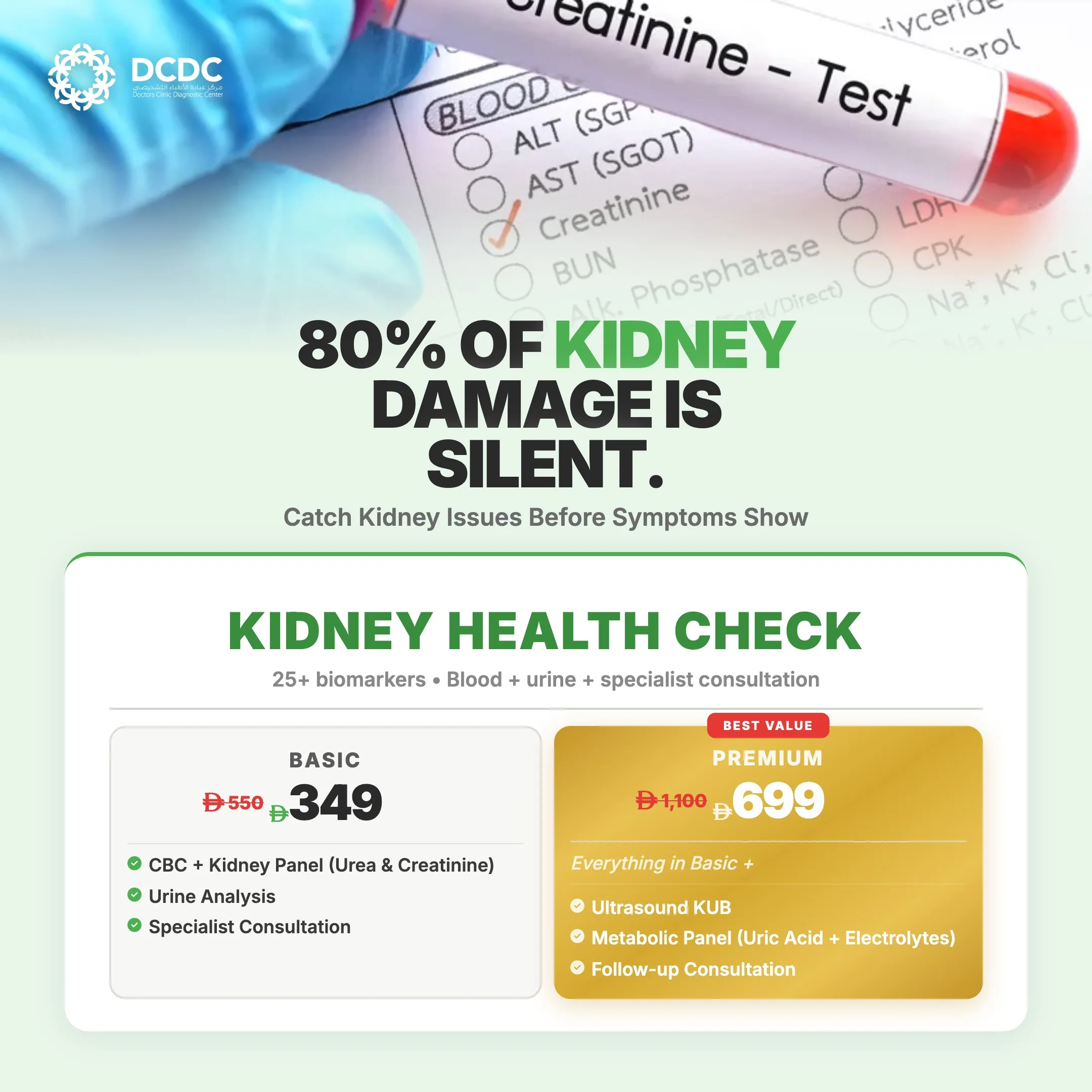
Health Screening Packages
Save with our bundled screening packages — specialist consultation included





Back Pain vs Kidney Pain: Quick Comparison
Before exploring each condition in depth, the table below summarizes the key features that distinguish ordinary back pain from kidney-related pain. Keep this comparison in mind as a first checkpoint, but remember that overlapping presentations do occur -- a doctor's assessment and basic testing remain the only reliable way to confirm a diagnosis.
| Feature | Back Pain (Muscular / Spinal) | Kidney Pain |
|---|---|---|
| Location | Can occur anywhere along the spine, from the neck to the tailbone, usually centered along the midline or one side of the lower back | Higher up, just below the rib cage, to the side of the spine (flank) -- usually one side only |
| Effect of movement | Typically worsens with bending, lifting, twisting, or prolonged sitting; often eases with rest or specific positions | Constant and steady; does not change significantly with posture or movement |
| Pain quality | Dull ache, muscle tightness, stiffness, or sharp pain triggered by specific motions; may include muscle spasm | Deep, dull, boring ache that can escalate into sudden severe colicky waves if a kidney stone is present |
| Radiation pattern | May radiate down one leg (sciatica) if a nerve is compressed by a disc problem | Often radiates forward and down toward the groin or lower abdomen as a stone moves through the ureter |
| Fever | Not typical; suggests an infection or inflammatory condition if present | Common with kidney infection (pyelonephritis) or an infected obstructing stone -- treat as urgent |
| Urinary symptoms | Absent -- muscular or spinal back pain does not affect urination | Common: burning urination, urgency, frequency, cloudy urine, or visible blood in the urine |
| Nausea or vomiting | Uncommon unless pain is extremely severe | Common, especially with kidney stones, due to shared nerve pathways with the gut |
| Common triggers | Poor posture, heavy lifting, sudden twisting, prolonged desk work, weak core muscles, degenerative disc changes | Dehydration, kidney stones, kidney infection, recent UTI that has spread upward |
| Typical duration | Improves within days to a few weeks with rest, movement, and physiotherapy | Varies -- infections respond to antibiotics within days; stones may take one to four weeks to pass |
| First-line diagnostic test | Physical exam and, if needed, X-ray or MRI of the spine | Urinalysis, kidney function blood test, and renal ultrasound or CT |
General comparison of back pain and kidney pain features. Individual presentations vary -- a clinical assessment is the only reliable way to confirm the cause.
What Does Back Pain Feel Like?
Ordinary back pain -- whether it originates in the muscles, ligaments, discs, or joints of the spine -- has a few consistent hallmarks. The pain is mechanical, meaning it changes in intensity depending on your posture, movement, and activity level. Bending forward to pick something up, twisting to reach behind you, sitting for long stretches at a desk, or sleeping in an awkward position can all trigger or worsen the pain. Conversely, lying down in a comfortable position, gentle stretching, or applying heat often brings noticeable relief.
The location of muscular or spinal back pain can be almost anywhere along the length of the spine -- upper back, mid-back, or lower back -- and it is often felt across a broad area rather than in one precise spot. Some patients describe a tight, knotted sensation in the muscles beside the spine, while others describe a sharp, localized pain that appears with a specific movement, such as lifting a heavy bag or turning quickly. When a disc problem irritates a nerve root, pain can radiate down one leg -- a pattern known as sciatica -- sometimes accompanied by tingling, numbness, or weakness in the leg or foot.
Common Causes of Back Pain
Back pain is one of the most common reasons people seek medical care worldwide, and the vast majority of cases stem from mechanical or musculoskeletal causes rather than a serious underlying disease. The most frequent causes include the following.
- Muscle or ligament strain: Sudden awkward movements, improper lifting technique, or overuse can strain the muscles and ligaments supporting the spine, the single most common cause of acute back pain
- Poor posture and prolonged sitting: Long hours at a desk, especially with poor ergonomic setup, place sustained stress on the lower back and surrounding muscles
- Degenerative disc disease: The discs between vertebrae naturally lose hydration and elasticity with age, reducing their ability to cushion the spine and sometimes leading to chronic discomfort
- Herniated or bulging disc: When the soft inner material of a disc pushes through its outer layer, it can press on nearby nerves, causing localized pain and radiating symptoms such as sciatica
- Spinal stenosis or arthritis: Narrowing of the spinal canal or joint degeneration can compress nerves, particularly in older adults, causing pain that worsens with standing or walking
- Weak core muscles and low activity levels: Insufficient core strength places extra load on the spine during everyday movements, a common contributor in sedentary lifestyles
In most cases, back pain from these causes improves within a few days to several weeks with rest, gentle movement, and appropriate treatment. If your pain persists, recurs frequently, or does not respond to conservative measures, our back pain causes guide covers the full range of causes and treatment pathways available in Dubai, including when imaging such as an MRI is recommended.
What Does Kidney Pain Feel Like?
The kidneys sit high in the back of the abdominal cavity, protected beneath the lower ribs on either side of the spine -- not in the lower back where most muscular pain occurs. This anatomical difference is the foundation of nearly every distinguishing feature between the two conditions. Kidney pain, also called renal pain or flank pain, is typically felt as a constant, dull, one-sided ache just below the ribcage, though it can sometimes extend into the upper abdomen or lower back on the affected side.
Unlike mechanical back pain, kidney pain does not change significantly with movement, posture, or position. It tends to stay steady in intensity, regardless of whether you are sitting, standing, or lying down. When a kidney stone is present and begins moving through the ureter, however, the pain can escalate dramatically into sharp, wave-like spasms known as renal colic -- widely described as one of the most intense forms of pain a person can experience, often radiating forward and downward toward the groin as the stone progresses. Kidney pain is also frequently accompanied by systemic or urinary symptoms that simply do not occur with ordinary back pain, including fever, nausea, vomiting, burning during urination, urinary urgency, and visibly discolored or bloody urine.
Common Causes of Kidney Pain
Several distinct kidney conditions can produce flank pain, each with its own pattern of accompanying symptoms and urgency level.
- Kidney stones (nephrolithiasis): Hard mineral deposits that form inside the kidney and cause severe colicky pain as they move through the urinary tract, often accompanied by blood in the urine and nausea
- Kidney infection (pyelonephritis): A bacterial infection that has spread from the bladder up to the kidney, producing steady flank pain, fever, chills, and general malaise -- this requires prompt antibiotic treatment
- Urinary tract infection with upward spread: A lower urinary infection that begins with burning urination and can ascend to the kidneys if left untreated, escalating pain and fever
- Dehydration and concentrated urine: Chronic low fluid intake concentrates minerals in the urine and can contribute to a dull, aching kidney discomfort even before a stone fully forms
- Polycystic kidney disease: A hereditary condition in which fluid-filled cysts enlarge the kidneys over time, sometimes causing chronic dull flank discomfort
- Kidney blockage or obstruction: Structural narrowing, blood clots, or an enlarged prostate pressing on the urinary tract can cause urine to back up, producing pain and swelling of the kidney (hydronephrosis)
Dubai's Heat, Dehydration, and Kidney Stone Risk
Dubai's climate plays a direct and well-documented role in kidney pain among residents. Summer temperatures routinely exceed 45 degrees Celsius, and daily fluid losses through sweat rise sharply -- often without a corresponding increase in water intake, since people underestimate how much fluid they lose in air-conditioned indoor environments. When fluid intake fails to keep pace with these losses, urine becomes more concentrated, and minerals such as calcium, oxalate, and uric acid crystallize more readily, forming kidney stones. Healthcare reports from the UAE have documented a roughly 40% rise in kidney stone presentations during the hottest summer months, directly attributed to silent dehydration.
This seasonal pattern means that flank pain appearing during or after periods of intense heat exposure -- for example, following outdoor work, travel, or reduced water intake -- deserves closer attention than pain with a clear mechanical trigger, such as after lifting furniture or a long drive. If you suspect a stone may be forming, our kidney stones treatment in Dubai guide explains the full range of management options, from conservative fluid therapy for small stones to minimally invasive procedures for larger ones.
Not Sure If It Is Back Pain or Kidney Pain?
DCDC in Dubai Healthcare City offers same-day general consultations with on-site laboratory testing and imaging -- including X-ray, ultrasound, CT, and MRI -- so you can get a clear answer in a single visit rather than waiting days for results.
Open Sat-Thu 8 AM-10 PM, Fri 9 AM-9 PM. General consultation from AED 250. 20+ insurance partners with direct billing.
When Back Pain Becomes an Emergency: Red Flags
The overwhelming majority of back pain is not dangerous and resolves with conservative care. However, a small subset of presentations signal a serious underlying problem that needs same-day medical evaluation.
- Numbness in the groin or inner thighs (saddle anesthesia): Combined with back pain, this can indicate cauda equina syndrome, a surgical emergency involving compression of the nerves at the base of the spinal cord
- New loss of bladder or bowel control: Sudden incontinence alongside back pain is a red flag requiring immediate assessment
- Progressive leg weakness or numbness: Weakness that worsens over hours to days, rather than staying stable, suggests significant nerve compression
- Back pain after significant trauma: A fall, road traffic accident, or direct impact combined with severe pain warrants imaging to rule out a fracture
- Back pain with unexplained fever or weight loss: This combination can point to an infection of the spine or, rarely, a tumor, and should not be dismissed as routine strain
- Pain that is constant, worsens at night, and does not improve with rest: Mechanical back pain usually eases with rest; pain that persists or worsens while lying down deserves further investigation
When Kidney Pain Becomes an Emergency: Red Flags
Kidney-related pain carries its own set of warning signs that should prompt urgent same-day or emergency evaluation rather than a wait-and-see approach.
- Severe one-sided flank pain with fever above 38.5 degrees Celsius: This combination suggests a kidney infection or an infected, obstructed kidney stone, both of which require urgent treatment to prevent the infection from spreading to the bloodstream (urosepsis)
- Inability to urinate or a significant drop in urine output: This can indicate a blocked kidney and requires prompt evaluation to prevent kidney damage
- Visible blood in the urine with pain: While mild hematuria can be monitored, blood accompanied by significant pain should be assessed promptly
- Inability to keep fluids down due to vomiting: Persistent vomiting alongside kidney pain risks dehydration and needs medical support
- Confusion, rapid heartbeat, or feeling extremely unwell: These can be signs of a systemic infection spreading from the kidney and require emergency assessment
- Kidney pain during pregnancy with fever: A kidney infection during pregnancy can trigger complications, including preterm labor, and requires immediate care
How Doctors Diagnose Back Pain vs Kidney Pain
Because the two conditions can present with overlapping features -- particularly when pain is severe -- doctors rely on a structured combination of history-taking, physical examination, and targeted testing rather than the location of pain alone. The table below outlines how the diagnostic workup differs between the two.
| Diagnostic Step | For Suspected Back Pain | For Suspected Kidney Pain |
|---|---|---|
| Physical exam | Range of motion testing, palpation of spinal muscles, straight-leg raise test for nerve involvement | Costovertebral angle tenderness (gentle percussion over the kidney area), abdominal exam |
| Urinalysis | Not typically required unless infection or systemic illness is suspected | Checks for blood, white blood cells, nitrites, and crystals -- a core first-line test |
| Blood tests (kidney function panel) | Not routinely needed for mechanical back pain | Creatinine, BUN, and electrolytes assess kidney function and detect obstruction |
| Imaging | X-ray for suspected fracture or alignment issues; MRI for disc, nerve, or soft tissue evaluation | Renal ultrasound for stones and swelling (hydronephrosis); CT for detailed stone visualization |
| Follow-up | Physiotherapy referral, activity modification, orthopedic consultation if symptoms persist | Nephrology referral if recurrent stones, infection, or reduced kidney function are found |
Typical diagnostic pathway comparison. Your doctor will tailor testing based on your specific symptoms and exam findings.
A kidney function blood test is often the fastest way to establish whether the kidneys are involved at all, since abnormal results point clearly toward a renal cause rather than a musculoskeletal one. If you want to understand what these results mean and when they are recommended, see our guide to kidney function tests, which explains the individual markers and how they are interpreted.
Treatment Options: Back Pain vs Kidney Pain
Treating Back Pain
Most mechanical back pain responds well to conservative treatment: short-term activity modification (not prolonged bed rest, which can worsen stiffness), over-the-counter anti-inflammatory pain relief, heat or cold therapy, and gentle stretching or walking as tolerated. Structured physiotherapy is highly effective for persistent cases, focusing on core strengthening, posture correction, and flexibility. When pain is linked to a specific structural issue -- such as a herniated disc pressing on a nerve -- an orthopedic consultation and MRI imaging can clarify the diagnosis and guide targeted treatment, which may include physiotherapy, injections, or, in a small minority of cases, surgical referral.
Treating Kidney Pain
Treatment for kidney pain depends entirely on the underlying cause identified through testing. Kidney infections require a course of targeted antibiotics, usually with symptom improvement within 24-48 hours. Small kidney stones (under 5 mm) often pass naturally with aggressive hydration and pain management over one to four weeks, while larger stones may require procedures such as shock wave therapy or ureteroscopy. Chronic dehydration-related kidney discomfort typically improves with a structured hydration plan once other causes have been ruled out through testing. Regardless of the underlying cause, treatment should never begin without a confirmed diagnosis, since antibiotics will not resolve a stone and pain relief alone will not treat an infection.
What to Expect at DCDC
Knowing the diagnostic pathway in advance helps reduce anxiety and speeds up your visit. Here is what a typical back pain or kidney pain evaluation looks like at Doctors Clinic Diagnostic Center in Dubai Healthcare City.
- 1. Arrival and registration: DCDC is located in Building 64, Block A, Al Razi Medical Complex, Dubai Healthcare City, with free dedicated on-site parking. Walk-ins are welcome, or you can book ahead via WhatsApp, phone, or online
- 2. Insurance verification: Our front desk verifies coverage through direct billing with 20+ insurance partners, including Daman, AXA, Bupa, MetLife, and Cigna, so you know your co-pay before your consultation begins
- 3. General consultation: Your doctor takes a detailed history of your pain -- its location, character, triggers, and any accompanying symptoms such as fever or urinary changes -- and performs a focused physical examination to narrow down the likely cause
- 4. On-site urine and blood testing: If a kidney cause is suspected, a urinalysis and kidney function blood test are processed in DCDC's on-site laboratory, with same-day results
- 5. Same-day imaging: Depending on the clinical picture, your doctor may order an X-ray to check spinal alignment, an MRI on our Siemens 1.5T wide-bore scanner for disc and nerve evaluation, or a renal ultrasound to assess the kidneys for stones or swelling -- all available on-site the same day
- 6. Diagnosis and treatment plan: Once test and imaging results are reviewed, your doctor explains the diagnosis and starts treatment during the same visit, whether that means a physiotherapy referral, pain management plan, targeted antibiotics, or a nephrology or orthopedic referral for more complex cases
- 7. Follow-up: A follow-up appointment is arranged as needed to confirm your response to treatment and adjust the plan if symptoms do not improve as expected
DCDC's one-stop model -- consultation, laboratory, and imaging under a single MOHAP-licensed roof (License No. NIMY7VY5-240925) -- means most patients leave with a clear answer rather than waiting days for results from separate facilities. With an average wait time of just 15 minutes, a 4.8/5 Google rating from over 1,000 verified reviews, and a 98% patient satisfaction rate, DCDC's streamlined approach is designed to get you from symptom to diagnosis as quickly and comfortably as possible.
Doctor's Perspective: Telling Back Pain and Kidney Pain Apart in Dubai

General Practitioner
Dr. Hadeel Elnur is a General Practitioner at Doctors Clinic Diagnostic Center (DCDC) in Dubai Healthcare City.
"One of the most common questions I hear in consultation is, 'Doctor, is this my kidney or my back?' -- and it is a completely reasonable question, because the two can genuinely feel similar when the pain is intense. The details matter enormously. I always ask whether the pain changes when you move or find a comfortable position, because muscular pain almost always does and kidney pain almost never does. I also ask about fever, nausea, and any change in urination, because those symptoms point strongly toward the kidneys rather than the spine. In Dubai, I see a clear seasonal pattern -- flank pain presentations rise noticeably during the hottest months, and dehydration is very often the underlying thread. My advice is simple: do not try to diagnose yourself with pain relief alone. A short consultation with a basic urine test and, if needed, same-day imaging gives us a definitive answer, so you are not guessing about the right course of treatment."
Prevention Tips for Dubai Residents
Simple daily habits can meaningfully reduce your risk of both mechanical back pain and kidney-related pain, particularly in a climate as demanding as Dubai's.
Hydration for Kidney Health
- Drink 2.5-3.5 liters of water daily as a baseline, increasing to 3.5-4.5 liters or more during summer months if you spend time outdoors or exercise
- Check your urine color as a quick hydration gauge -- pale straw yellow is the target; dark yellow or amber signals you need more fluids
- Set reminders to drink water throughout the day, especially in air-conditioned offices where thirst cues are often blunted despite ongoing fluid loss
- Limit excessive caffeine and sugary drinks, which can have a mild diuretic effect and displace plain water intake
Posture and Movement for Back Health
- Set up your desk ergonomically -- screen at eye level, feet flat on the floor, and lumbar support for your lower back if you sit for long periods
- Take a short movement break every 30-45 minutes if you have a desk-based job to avoid prolonged static loading of the spine
- Use proper lifting technique -- bend at the knees, keep the object close to your body, and avoid twisting while lifting
- Build core and back strength gradually through regular low-impact exercise such as walking, swimming, or guided physiotherapy exercises
Get a Clear Diagnosis for Your Back or Side Pain
Whether your pain is muscular, spinal, or kidney-related, DCDC in Dubai Healthcare City offers a general consultation from AED 250 with same-day on-site laboratory testing and imaging, including MRI, CT, ultrasound, and X-ray. Walk in or book via WhatsApp.
MOHAP-licensed in Dubai Healthcare City. 4.8/5 Google rating from 1,000+ reviews. 98% patient satisfaction. Free on-site parking.
Related Services at DCDC
Expert care and advanced diagnostics at Dubai Healthcare City
Frequently Asked Questions
Final Thoughts
Back pain and kidney pain can feel deceptively similar, especially when intense, but the underlying causes and treatments are entirely different. Paying attention to the specific location of your pain, whether it changes with movement, and whether it is accompanied by fever, nausea, or urinary symptoms will give you a strong initial indication of which system is involved. In Dubai's climate, where dehydration-driven kidney stones are notably more common during the hot summer months, flank pain following heat exposure or reduced fluid intake deserves particular attention.
The most reliable way to confirm the cause of your pain is objective evaluation -- a focused physical exam, urinalysis, kidney function blood test, and imaging when indicated. At DCDC in Dubai Healthcare City, this entire diagnostic pathway is available under one roof, with general consultations starting from AED 250 and same-day access to on-site laboratory testing and imaging, including MRI, CT, ultrasound, and X-ray. If you are experiencing persistent or unexplained pain in your back or side, do not guess -- book an assessment and get a clear answer.
Sources & References
This article was reviewed by our medical team and references the following sources:
- Mayo Clinic -- Kidney Pain: Symptoms and Causes
- Mayo Clinic -- Kidney Pain: When to See a Doctor
- Cleveland Clinic -- Kidney Pain: Causes, Treatment & When to Call a Doctor
- Cleveland Clinic -- When Should I Worry About Low Back Pain?
- NHS -- Back Pain
- Medical News Today -- Kidney Pain vs. Back Pain: Location, Symptoms, and More
- NHS -- Kidney Stones: Symptoms
- Khaleej Times -- UAE Doctors Warn of Silent Dehydration as 40% Rise Seen in Kidney Stone Cases in Summer
Medical content on this site is reviewed by DHA-licensed physicians. See our editorial policy for more information.
Written by
Dr. Hadeel Elnur
General Practitioner
MD, General Practice
Dr. Hadeel Elnur is a General Practitioner at Doctors Clinic Diagnostic Center (DCDC) in Dubai Healthcare City.
Related Articles
Back Pain Dubai: Causes & When You Need an MRI (2026)
Kidney Stones Treatment Dubai (2026)
Kidney Infection Dubai: Symptoms & Treatment (2026)

Kidney Function Test Dubai: KFT Guide (2026)

UTI Treatment Dubai: Symptoms & Prevention (2026)
More in General Health

Sleep Study Cost Dubai: Tests & Pricing (2026)
Read More
Calcium Deficiency Signs Dubai: Guide (2026)
Read More
Brain Fog Causes Dubai: When to Worry (2026)
Read More
Blood Pressure by Age Dubai: Normal Ranges (2026)
Read More
Low Magnesium Symptoms Dubai: Testing Guide (2026)
Read MoreSummer Health Risks in Dubai: Expert Guide (2026)
Read More© 2026 Doctors Clinic Diagnostic Center (DCDC), Dubai Healthcare City. Originally published at https://doctorsclinicdubai.ae/blog/back-pain-vs-kidney-pain-dubai. All rights reserved. Unauthorized reproduction is prohibited.