Key Takeaways
- Fasting is only required for abdominal or pelvic CT scans with contrast — typically 4–6 hours before the appointment. Brain, chest, and extremity scans without contrast need no fasting at all
- If your scan involves contrast dye, you will need a recent blood creatinine test (within 3 months) to confirm your kidneys can safely process the iodine-based contrast
- Inform your radiology team about all allergies, especially to iodine, shellfish, or previous contrast reactions — pre-medication with steroids and antihistamines may be arranged
- Wear comfortable, metal-free clothing and leave jewelry at home. Metal objects create artifacts on CT images that can obscure diagnostic findings
- The actual CT scan takes only 5–15 minutes. With check-in, preparation, and post-scan observation, plan for a 30–60 minute visit total
Your doctor has ordered a CT scan and you want to make sure you are fully prepared. The good news is that CT scan preparation is straightforward in most cases. Whether you need to fast, what to do about contrast dye, what to wear, and how to handle allergies or medications — this guide walks you through every preparation step so there are no surprises on scan day.
Proper preparation ensures the best possible image quality and the safest experience. A scan that produces suboptimal images due to a full stomach or metal artifacts may need to be repeated, wasting your time and money. This guide is based on the protocols used at DCDC Dubai Healthcare City and aligns with international radiology guidelines from the American College of Radiology and the European Society of Radiology.



Do You Need to Fast Before a CT Scan?
Fasting is one of the most common questions patients ask, and the answer depends entirely on which body part is being scanned and whether contrast dye will be used. Fasting is not a blanket requirement for all CT scans. Many scans require no dietary preparation at all. Your doctor may also order blood tests alongside your CT to provide a complete diagnostic picture.
Fasting is recommended before CT scans that involve the digestive organs (abdomen and pelvis) with intravenous contrast dye. A full stomach can cause nausea when contrast is injected, and undigested food in the bowel can obscure the view of abdominal structures. Fasting for 4–6 hours before an abdominal CT with contrast reduces the risk of nausea and vomiting and ensures the digestive tract is relatively clear for optimal image quality.
| CT Scan Type | Fasting Required? | Details |
|---|---|---|
| Brain / Head CT (no contrast) | No | Eat and drink normally before the scan |
| Brain / Head CT (with contrast) | Light fast recommended | Avoid heavy meals 2–4 hours before; water is fine |
| Chest CT (no contrast) | No | No dietary restrictions |
| Chest CT (with contrast) | Light fast recommended | Avoid heavy meals 2–4 hours before |
| Abdomen / Pelvis CT (with contrast) | Yes — 4–6 hours | No food; small sips of water are permitted |
| CT Angiogram (heart, carotid) | Yes — 4–6 hours | No food or caffeine; water only |
| Spine / Extremity CT (no contrast) | No | No preparation needed |
| CT KUB (kidney stones) | No | No contrast used; eat and drink normally |
Fasting rules vary by scan type. Your booking team will provide specific instructions when you schedule.
If you are unsure whether your specific scan requires fasting, call the clinic when you book. Our radiology team at DCDC will give you exact instructions based on the scan ordered by your doctor. When in doubt, a light fast (no heavy food for 4 hours, water is fine) is a safe default for any contrast-enhanced scan.
Preparing for a CT Scan with Contrast Dye
Contrast dye — also called contrast media or contrast agent — is a special iodine-based liquid injected into a vein in your arm during certain CT scans. As the contrast circulates through your bloodstream, it highlights blood vessels, organs, and abnormal tissues, making them significantly easier for the radiologist to see. Not every CT scan requires contrast; your referring doctor determines this based on the clinical question.
When contrast is part of your scan, there are additional preparation steps to ensure your safety and the best image quality.
Kidney Function Test (Creatinine)
Your kidneys are responsible for filtering and excreting the contrast dye after the scan. Before any contrast-enhanced CT, you need a recent blood creatinine and eGFR (estimated glomerular filtration rate) test to confirm your kidneys are functioning well enough to handle the contrast safely. This blood test should be within the past 3 months. If you do not have a recent result, DCDC can perform a quick blood draw when you arrive — results are available within 30 minutes. See our blood test guide for more about kidney function testing.
Patients with impaired kidney function (elevated creatinine or low eGFR) may need a modified contrast protocol, pre-hydration with IV fluids, or an alternative imaging method such as MRI or ultrasound. Patients with known chronic kidney disease should always inform the radiology team so appropriate precautions can be taken. The risk of contrast-induced kidney injury is low in patients with normal kidney function but increases significantly in patients with pre-existing renal impairment.
Allergy Precautions
If you have ever had a reaction to CT contrast dye in the past, or if you have a known allergy to iodine or shellfish, you must inform your doctor and the radiology team before the scan. While true iodine allergy is rare, patients with previous contrast reactions have a higher risk of repeat reactions.
For patients with a history of mild contrast reactions (hives, itching, nausea), pre-medication is typically prescribed: oral steroids (prednisone) starting 12–13 hours before the scan and an antihistamine (diphenhydramine) 1 hour before. This pre-medication regimen reduces the risk of repeat reaction to less than 1%. For patients with a history of severe reactions (anaphylaxis, breathing difficulty), your doctor may recommend an alternative imaging modality that does not require iodinated contrast.
Metformin and Contrast Dye
If you take metformin (a common diabetes medication sold under brand names like Glucophage), your doctor will likely advise you to stop taking it on the day of the contrast-enhanced CT scan and for 48 hours after. Metformin combined with contrast dye in patients with reduced kidney function can, in rare cases, lead to a serious condition called lactic acidosis. Your doctor will advise when you can safely resume metformin, usually after confirming stable kidney function with a follow-up creatinine test.
Need to Prepare for a CT Scan?
Contact DCDC to confirm your specific preparation requirements and book your CT scan appointment.
What to Wear and Bring to Your CT Scan
What you wear to your CT scan matters because metal objects create artifacts on CT images. These bright streaks and shadows can obscure the very structures your doctor needs to see, potentially requiring the scan to be repeated. Follow these guidelines to make your visit as smooth as possible. For related information, see our guide on CT Scan Cost Dubai: Prices & Types.
- Wear loose, comfortable clothing: Sweatpants or loose trousers, a plain t-shirt or top without metal snaps, zippers, or decorative studs. Avoid jeans with metal rivets and bras with underwire
- Remove all jewelry: Earrings, necklaces, bracelets, rings, watches, and body piercings should all be removed before the scan. Leave valuable jewelry at home to avoid misplacing it
- Remove metal hair accessories: Hairpins, clips, headbands with metal components, and hair ties with metal clasps should all be taken out
- Remove belts and wallets: Belt buckles and items in pockets (coins, keys, phones) need to be removed. You will have a secure locker for your belongings
- Hospital gown: Depending on the scan area, you may be asked to change into a hospital gown. This is particularly common for chest X-ray and abdominal scans where clothing zippers or buttons fall within the scan field
- Glasses and hearing aids: These typically do not need to be removed for body scans, but must be removed for head and brain CT scans
Bring your Emirates ID or passport, your insurance card (if applicable), the referral letter from your doctor, and any previous imaging reports or CDs that may be relevant to your current scan. If your scan requires contrast, bring your creatinine blood test result from the past 3 months.
What Happens During the CT Scan
Understanding the procedure step by step helps reduce anxiety. The CT scan process is quick, painless, and far less claustrophobic than an MRI because the scanner is an open ring shape rather than an enclosed tunnel. If you need an MRI instead, learn about open MRI options for patients with claustrophobia.
- Check-in and registration: You arrive at DCDC, confirm your identity, and verify the scan ordered. If you have not already changed, you may be given a gown
- IV placement (if contrast needed): A small cannula is inserted into a vein in your arm or hand. This is a quick pinch similar to a standard blood draw. The IV line is connected to an automatic contrast injector
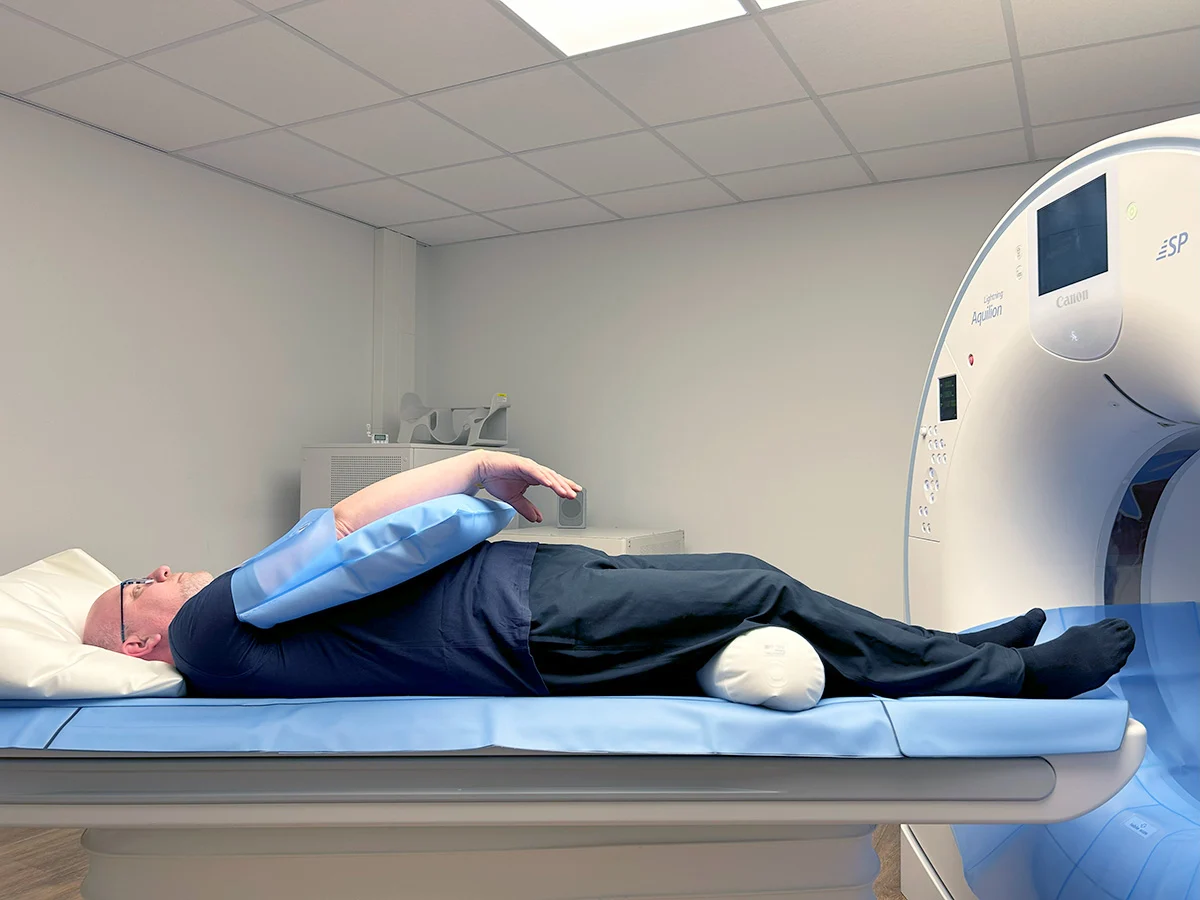
- Positioning: The radiographer helps you lie on the CT table, usually flat on your back. Foam pads or straps may be used to help you stay still. The specific position depends on the body area being scanned
- Scout scan: The table slides through the scanner ring while a quick low-dose preliminary image is taken to plan the exact scan area. This takes a few seconds
- Actual scan: The table moves slowly through the ring while the X-ray tube rotates around you. You will hear a quiet whirring or humming sound. For chest and abdominal scans, the radiographer may ask you to hold your breath for 5–10 seconds to prevent motion blur
- Contrast injection (if applicable): The contrast dye is injected automatically through your IV. You may feel a warm flush spreading through your body, a temporary metallic taste in your mouth, and possibly a sensation as if you need to urinate — all completely normal and lasting only 15–30 seconds
- Post-contrast phases: Some scans require images at multiple time points after contrast injection (arterial phase, venous phase, delayed phase) to characterize organ lesions. The radiographer will tell you if additional passes are needed
- Completion: The IV is removed, a small bandage is applied, and you are free to go. The entire process typically takes 15–30 minutes from table to door
Throughout the scan, the radiographer communicates with you through an intercom from the adjacent control room. You can speak with them at any time if you feel uncomfortable. The scan itself is completely painless — you will not feel the X-rays.
After Your CT Scan: Recovery and Results
There is no recovery period after a CT scan. You can resume all normal activities immediately — eating, drinking, driving, working, and exercising. However, there are a few post-scan guidelines to follow, especially if contrast dye was used.
Post-Contrast Care
- Hydrate generously: Drink 6–8 glasses of water over the next 24 hours to help your kidneys flush the contrast dye from your system. This is the single most important post-scan action for contrast-enhanced scans
- Watch for rare reactions: Delayed contrast reactions (hives, itching, mild swelling) can occur up to 48 hours after the scan in a very small percentage of patients. If you develop a rash, itching, or swelling, take an antihistamine and contact DCDC or your doctor. Seek emergency care immediately if you experience difficulty breathing, facial swelling, or severe dizziness
- Metformin users: If you were advised to pause metformin, do not resume it until your doctor confirms your kidney function is stable — typically 48 hours after the scan with a follow-up creatinine blood test
- Breastfeeding: Current guidelines from the American College of Radiology state that it is safe to continue breastfeeding after receiving iodinated contrast. Only a negligible amount of contrast enters breast milk, and virtually none is absorbed by the infant. If breastfeeding, discuss any concerns with your internal medicine doctor
When to Expect Results
At DCDC, routine CT scan results are available within 24 hours. A consultant radiologist reviews every image and prepares a detailed written report that is sent to your referring doctor. For patients with urgent or critical findings — such as suspected stroke, internal bleeding, or pulmonary embolism — the radiologist communicates findings immediately by phone to the referring physician.
You will receive a copy of your report and can request your scan images on CD or USB in DICOM format. Schedule a follow-up with your referring doctor to discuss the findings in the context of your overall health and determine next steps. If your CT is part of a broader screening, see our annual health checkup guide for a complete overview.
Book Your CT Scan at DCDC
Schedule your CT scan at DCDC Dubai Healthcare City. Same-day appointments available with results within 24 hours.
Special Situations: Pregnancy, Children & Anxiety
CT Scans During Pregnancy
CT scans use ionizing radiation and are generally avoided during pregnancy unless the clinical benefit clearly outweighs the risk. If you are pregnant or suspect you might be, inform your doctor and the radiology team immediately. In many cases, an alternative imaging method such as MRI (which uses no radiation) or ultrasound can provide the diagnostic information needed. In genuine emergencies where CT is the only option to diagnose a life-threatening condition, the scan may still be performed with careful dose optimization and abdominal shielding when possible. You may also find our MRI with Contrast: Safety, Side Effects & Cost helpful.
CT Scans for Children
Children are more sensitive to radiation than adults because their cells are dividing more rapidly. At DCDC, all pediatric CT scans use age-specific, weight-based low-dose protocols that reduce radiation exposure to the minimum needed for diagnostic quality. Parents can typically stay in the room with their child during the scan (wearing a lead apron). For very young children who cannot stay still, gentle immobilization devices or, rarely, mild sedation may be used after consultation with a pediatrician.
Managing Scan Anxiety
While CT scanners are far less enclosed than MRI machines, some patients still feel nervous. The CT scanner is an open ring — not a tunnel — and the scan is over in minutes. If you experience anxiety, let the radiology team know. Practical strategies include closing your eyes during the scan, focusing on steady breathing, listening to calming music through earphones (if the scan area permits), and reminding yourself that the radiographer is watching you at all times and can communicate instantly through the intercom. For patients considering a full body MRI, similar anxiety management strategies apply.
Related Services at DCDC
Expert care and advanced diagnostics at Dubai Healthcare City
Frequently Asked Questions
Prepare Well, Scan Smoothly
Proper preparation for a CT scan is simple but important. Knowing whether to fast, understanding the contrast dye process, wearing appropriate clothing, and reporting allergies and medications in advance ensures the safest experience and the best possible image quality. A well-prepared scan means fewer delays, no need for repeat imaging, and faster results for your doctor.
The most common preparation mistakes are eating before an abdominal contrast scan, forgetting to bring a creatinine blood test result, and wearing clothing with metal components. All of these are easily avoided by following the steps in this guide and confirming instructions with your booking team when you schedule.
At DCDC Dubai Healthcare City, our radiology team provides clear preparation instructions at the time of booking and is available by phone if you have questions beforehand. Results are ready within 24 hours, and our team handles insurance pre-authorization on your behalf. If your doctor has ordered a CT scan, contact us to book your appointment and we will make sure you are fully prepared.
Sources & References
This article was reviewed by our medical team and references the following sources:
- American College of Radiology — ACR Manual on Contrast Media
- Radiological Society of North America — Patient Information: CT Preparation
- European Society of Urogenital Radiology — Contrast Media Safety Guidelines
- Dubai Health Authority — Diagnostic Imaging Standards
- NHS — CT Scan: How to Prepare
Medical content on this site is reviewed by DHA-licensed physicians. See our editorial policy for more information.

Written by
Dr. Osama Elzamzami
Consultant Radiologist
MD, Radiology
Dr. Osama Elzamzami is a Consultant Radiologist specializing in diagnostic imaging including X-ray, CT, MRI, and ultrasound at DCDC Dubai Healthcare City.
Related Articles
CT Scan Cost in Dubai: Prices, Types & What to Expect
CT Angiogram Cost Dubai: Complete Guide
How to Prepare for a CT Angiogram
Complete Guide to MRI Scan in Dubai
More in Diagnostic Imaging
CT Scan vs Ultrasound Dubai: Which Test? (2026)
Read More
Open vs Closed MRI Dubai: Key Differences (2026)
Read More
X-Ray Cost Dubai: Prices by Body Part (2026)
Read More
DEXA Scan Cost Dubai: From AED 399 (2026)
Read MoreCT Scan Cost Dubai: Prices & Types (2026)
Read More
DEXA Scan Dubai: Cost, T-Score & Who Needs It (2026)
Read More© 2026 Doctors Clinic Diagnostic Center (DCDC), Dubai Healthcare City. Originally published at https://doctorsclinicdubai.ae/blog/ct-scan-preparation-guide. All rights reserved. Unauthorized reproduction is prohibited.