اہم نکات
- Children dehydrate 2-3 times faster than adults because of their higher body-surface-area-to-weight ratio and immature kidney function
- The most reliable early sign in infants is fewer than 6 wet nappies in 24 hours; in older children, watch for dark yellow urine and dry lips
- Mild dehydration (less than 3% body weight loss) can be safely managed at home with small, frequent sips of oral rehydration solution (ORS)
- Severe dehydration requires immediate medical attention and may need intravenous (IV) fluid replacement within 1-2 hours
- Dubai summer temperatures exceeding 45 degrees Celsius increase a child's daily fluid needs by 50% or more compared to cooler months
- DCDC offers same-day pediatric consultations, on-site electrolyte testing, and home IV hydration therapy for children who cannot travel to the clinic
Dubai summer temperatures routinely exceed 45 degrees Celsius, and children are among the most vulnerable to heat-related dehydration. Unlike adults, young children cannot always articulate that they feel thirsty, and their bodies lose proportionally more fluid through sweat and breathing. Recognising the early signs of child dehydration can mean the difference between a quick recovery at home and an emergency hospital visit. At DCDC's paediatric department in Dubai Healthcare City, our doctors see a significant increase in dehydration-related pediatric consultations every summer, and the pattern is preventable when parents know what to look for.
This guide covers the full spectrum of child dehydration signs in Dubai, from subtle early warnings to red-flag emergencies. You will find age-specific symptom tables, WHO-recommended oral rehydration guidelines, a home-care action plan, and clear criteria for when professional medical help is needed. Everything here is grounded in clinical evidence from the WHO, AAP, and NHS, adapted to the realities of living in a desert climate.
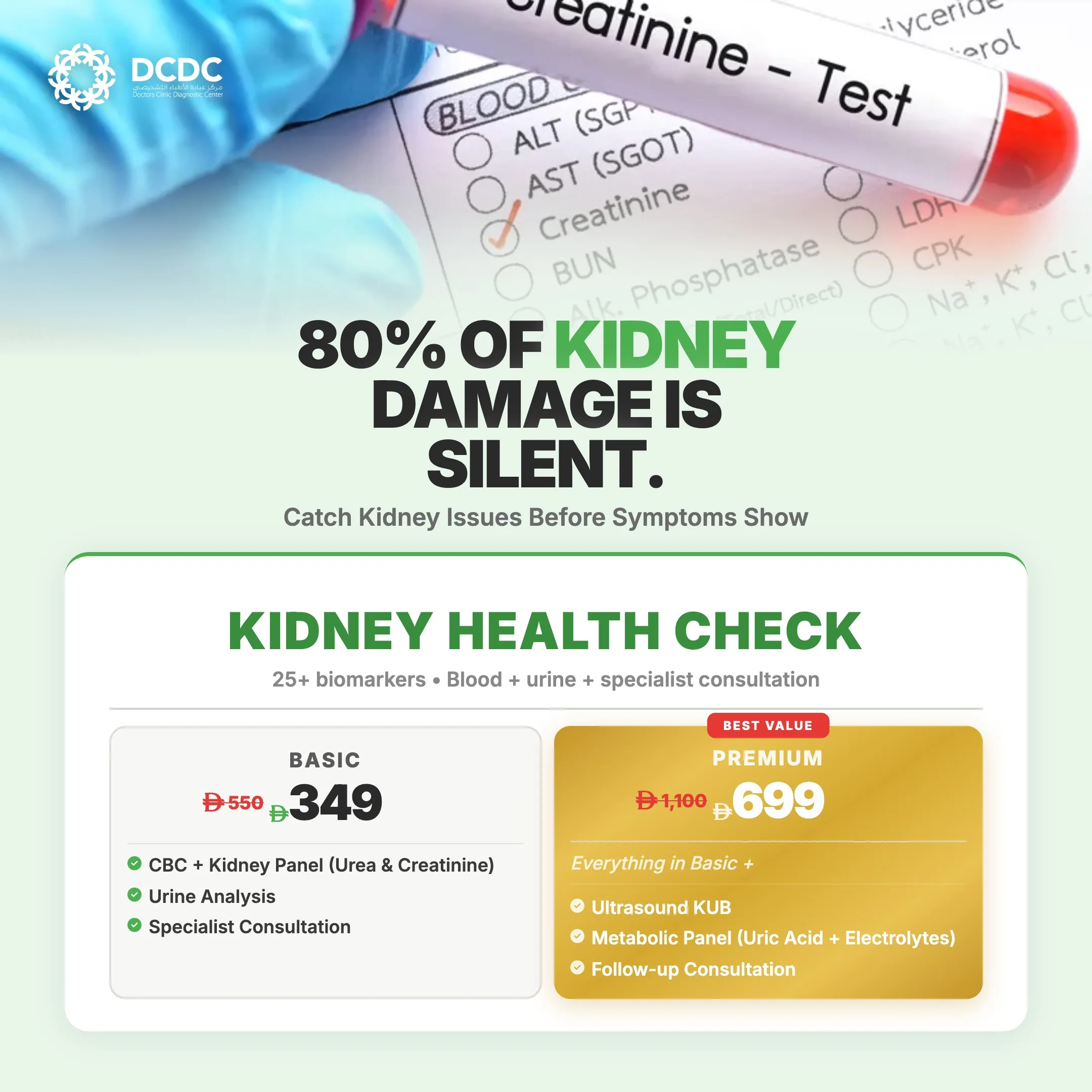
Health Screening Packages
Save with our bundled screening packages — specialist consultation included





Why Child Dehydration Signs Are Harder to Spot in Dubai
Dubai's climate creates a unique set of challenges for keeping children hydrated. Humidity levels of 60-90% during summer months reduce the efficiency of sweat evaporation, meaning children overheat faster but may not appear visibly sweaty. Parents can be misled into thinking their child is fine because they are not drenched in perspiration, when in reality internal fluid reserves are already depleting.
Children have a larger body-surface-area-to-weight ratio than adults, which means they absorb more ambient heat and lose proportionally more fluid per kilogram of body weight. Infants are at particular risk because their kidneys are still developing and cannot concentrate urine as efficiently as adult kidneys. The result is that a child playing outdoors for just 30 minutes in July can lose enough fluid to tip from normal hydration into mild dehydration.
- High humidity masks fluid loss: Children may not appear sweaty despite losing significant amounts of water through their skin and respiratory tract
- Air-conditioned to outdoor transitions: Moving between 22 degrees Celsius interiors and 45+ degrees Celsius exteriors causes rapid thermoregulatory stress, accelerating fluid loss
- Reduced thirst awareness: Children under 5 often do not recognise or communicate thirst until dehydration has already begun
- Illness multiplies risk: Gastroenteritis, fever, and vomiting are common in Dubai summers, and each one independently increases fluid loss beyond what heat alone causes
Early Child Dehydration Signs Every Dubai Parent Must Know
Catching dehydration early is the single most important factor in avoiding complications. The WHO classifies dehydration into three levels: no dehydration (less than 3% body weight loss), some dehydration (3-9% loss), and severe dehydration (more than 9% loss). Most cases that present to emergency rooms have crossed from mild into moderate territory because the early signs were missed.
Early signs of child dehydration include a dry or sticky mouth, fewer tears when crying, slightly darker urine than usual, and mild irritability or lethargy. In babies specifically, parents should monitor nappy output: fewer than six wet nappies in 24 hours is a clinically significant warning. Older children may complain of a headache, feel dizzy when standing up, or simply seem less energetic than normal.
- Dry or sticky mouth and lips: One of the earliest and easiest signs to check. Have your child stick out their tongue; a well-hydrated tongue appears moist and pink
- Reduced urination: For nappy-age children, fewer than 6 wet nappies in 24 hours. For toilet-trained children, going more than 6-8 hours without urinating
- Darker urine colour: Normal urine should be pale straw-coloured. Dark yellow or amber urine indicates concentrated urine and insufficient fluid intake
- No tears when crying: A healthy child produces tears within seconds of crying. Absence of tears is a reliable moderate-to-severe dehydration marker
- Mild irritability or unusual sleepiness: Dehydration affects brain function early. A child who is uncharacteristically fussy or drowsy may be dehydrated
- Cool or mottled hands and feet: Reduced circulation due to lower blood volume can make extremities feel cool to the touch
Dehydration Severity Assessment Table: Mild, Moderate & Severe Signs in Children
The following table, adapted from WHO and AAP clinical guidelines, helps parents and healthcare professionals classify a child's level of dehydration based on observable signs. This assessment is critical for deciding whether home treatment is safe or whether the child needs medical intervention. If your child also has a fever alongside dehydration, read our guide to managing child fever in Dubai for combined symptom management.
| Clinical Sign | Mild (Less Than 3% Loss) | Moderate (3-9% Loss) | Severe (More Than 9% Loss) |
|---|---|---|---|
| Mental state | Alert, normal behaviour | Irritable, restless, or unusually sleepy | Lethargic, difficult to rouse, or unconscious |
| Eyes | Normal appearance | Slightly sunken | Deeply sunken, hollow-looking |
| Tears | Present when crying | Reduced or absent | Absent |
| Mouth and tongue | Moist | Dry, sticky | Very dry, cracked lips |
| Thirst | Drinks normally | Thirsty, drinks eagerly | Too weak or lethargic to drink |
| Skin pinch test | Skin recoils instantly | Skin recoils slowly (1-2 seconds) | Skin stays tented for more than 2 seconds |
| Urine output | Normal to slightly reduced | Noticeably reduced and darker | Little or no urine for 8+ hours |
| Heart rate | Normal for age | Faster than normal (tachycardia) | Very rapid and weak pulse |
| Fontanelle (infants) | Normal or flat | Slightly sunken | Markedly sunken |
| Capillary refill | Less than 2 seconds | 2-3 seconds | More than 3 seconds |
| Action needed | Home rehydration with ORS | Medical assessment recommended | Emergency medical care required immediately |
Adapted from WHO Integrated Management of Childhood Illness (IMCI) guidelines and AAP clinical protocols.
Age-Specific Child Dehydration Signs: Newborns, Toddlers & Older Children
Dehydration does not look the same across all age groups. A newborn's presentation differs substantially from that of a school-age child, and recognising these differences is essential for timely intervention.
Newborns and Infants (0-12 Months)
Newborns are the highest-risk group because they rely entirely on caregivers for fluid intake and cannot communicate thirst. Key dehydration indicators in this age group include a sunken fontanelle (the soft spot on the top of the head), fewer than 6 wet nappies per day, absence of tears when crying, and excessive sleepiness or difficulty waking for feeds. Any infant under 3 months showing signs of dehydration should be evaluated by a doctor immediately, as dehydration can deteriorate rapidly in this age group.
Toddlers (1-3 Years)
Toddlers are active and prone to dehydration because they often refuse drinks when engrossed in play. Watch for decreased energy levels, dry lips and mouth, crankiness beyond their normal temperament, and a noticeable reduction in wet nappies or toilet visits. The skin pinch test is particularly useful in this age group: gently pinch the skin on the back of the hand and release. If it takes more than 1-2 seconds to flatten back, moderate dehydration is likely.
School-Age Children (4-12 Years)
Older children can often verbalise that they feel unwell, but many do not associate symptoms like headache, dizziness, or fatigue with dehydration. Parents should be alert to complaints of feeling lightheaded after standing up, dark-coloured urine, dry or chapped lips, reduced athletic performance, or difficulty concentrating. Children in this age group who are active in sports during Dubai's warmer months are at elevated risk and should have structured fluid intake schedules rather than relying on thirst alone.
What Causes Dehydration in Children During Dubai Summer
Understanding the root causes helps parents anticipate and prevent dehydration before it begins. In Dubai's climate, the causes are both environmental and behavioural.
- Extreme heat exposure: Dubai summer temperatures frequently exceed 45 degrees Celsius with humidity above 70%. Even short outdoor activities can cause rapid fluid loss through sweating and increased respiratory rate
- Inadequate fluid intake: Many children simply do not drink enough, especially during school hours, travel, or when absorbed in activities. Studies show children frequently underestimate their fluid needs during hot weather
- Gastroenteritis and diarrhoea: Viral stomach infections are common in summer and can cause children to lose large volumes of fluid rapidly through vomiting and diarrhoea
- Fever and acute illness: Every 1 degree Celsius rise in body temperature above 37 degrees Celsius increases a child's fluid requirement by approximately 12%. Fever combined with heat exposure is a particularly dangerous combination
- Swimming and water play: Parents often assume children are hydrated because they are in water, but swimming is physically demanding and children sweat even while in the pool
- Sugary drinks replacing water: Juices, sodas, and sweetened beverages can worsen dehydration due to their osmotic effect, drawing water into the gut rather than hydrating the body
How Much Fluid Does Your Child Need? Daily Requirements by Age
The Holliday-Segar formula, endorsed by the AAP, provides baseline daily fluid requirements for children. These figures represent normal conditions. During Dubai's summer heat, fluid needs increase by 50% or more, especially during outdoor activities. For adult-specific dehydration information and fluid guidelines, see our comprehensive dehydration guide.
| Age Group | Approximate Weight | Daily Fluid Requirement (Normal) | Daily Fluid Requirement (Hot Weather / Active) | Practical Guideline |
|---|---|---|---|---|
| 0-6 months | 3-7 kg | 450-700 ml | Increase breastfeed/formula frequency | Exclusively breast milk or formula; do not give plain water |
| 6-12 months | 7-10 kg | 700-1,000 ml | 800-1,200 ml total (including solids) | Breast milk/formula plus small sips of water with meals |
| 1-3 years | 10-14 kg | 1,000-1,400 ml | 1,300-1,800 ml | Roughly 4-6 small cups throughout the day |
| 4-8 years | 16-25 kg | 1,200-1,600 ml | 1,600-2,200 ml | Approximately 5-7 cups; set reminders during school hours |
| 9-13 years | 28-45 kg | 1,600-2,100 ml | 2,100-2,800 ml | 7-10 cups; more during sports and outdoor activity |
| 14+ years | 45-70 kg | 2,000-2,600 ml | 2,600-3,500 ml | Similar to adult requirements; monitor urine colour as guide |
Based on Holliday-Segar formula (AAP). Hot-weather figures add 50% to baseline. Actual needs vary by activity level, illness, and individual metabolism.
Home Treatment: How to Rehydrate a Dehydrated Child Safely
For mild dehydration (less than 3% body weight loss), home rehydration is safe and effective when done correctly. The cornerstone of treatment is oral rehydration solution (ORS), which the WHO and UNICEF consider the most important medical advance of the 20th century for child survival. ORS contains a precise balance of sodium, potassium, glucose, and water that maximises intestinal fluid absorption.
Step-by-Step Home Rehydration Protocol
- Step 1 - Obtain ORS: Purchase WHO-recommended low-osmolality ORS sachets from any pharmacy in Dubai (brands like Pedialyte, Dioralyte, or Hydralyte are widely available). If unavailable, dissolve 6 level teaspoons of sugar and half a teaspoon of salt in 1 litre of clean water as a temporary measure
- Step 2 - Give small, frequent sips: Offer 5 ml (one teaspoon) every 1-2 minutes for the first hour. Using a syringe for infants or a small cup for toddlers helps control the pace. Rapid gulping can trigger vomiting
- Step 3 - Increase volume gradually: After the first hour, if the child is tolerating fluids, increase to 10-15 ml every few minutes. The WHO recommends 75 ml per kilogram of body weight over 4 hours for moderate dehydration
- Step 4 - Continue breastfeeding: Breastfed infants should continue breastfeeding between ORS doses. Breast milk provides both hydration and nutrition
- Step 5 - Monitor output: Track wet nappies or toilet visits. Improvement should be visible within 2-4 hours with increasing urine output and lighter urine colour
- Step 6 - Reintroduce food: Once rehydration is underway, offer bland foods like rice, banana, toast, or plain crackers. Avoid dairy products and sugary foods for 24 hours
What Not to Give a Dehydrated Child
Certain common drinks can actually worsen dehydration and should be avoided. Fruit juices contain high sugar concentrations that can draw water into the intestines, worsening diarrhoea. Sports drinks like Gatorade are formulated for adults and contain too much sugar and too little sodium for young children. Plain water alone, while better than nothing, does not replace the electrolytes lost through sweat, vomiting, or diarrhoea and can even cause dangerous sodium dilution (hyponatraemia) in small children if given in large quantities without electrolyte supplementation.
When to Take a Dehydrated Child to the Doctor or Emergency Room
Not all dehydration can be managed at home. Knowing when to seek professional help can prevent dangerous complications, including organ damage, seizures, and in extreme cases, hypovolaemic shock. The following situations require immediate medical evaluation.
- No urine output for 8 or more hours: This indicates significant fluid deficit and potential kidney stress
- Persistent vomiting: If a child cannot keep down any fluids for more than 2-4 hours, oral rehydration is not possible and IV fluids may be needed
- Sunken eyes or fontanelle: These are signs of moderate-to-severe dehydration requiring clinical assessment
- Lethargy or unresponsiveness: A child who is difficult to rouse, unusually limp, or confused needs emergency care
- Rapid or laboured breathing: Dehydration causes metabolic acidosis, which the body compensates for with rapid breathing (Kussmaul breathing)
- Bloody diarrhoea or stool with mucus: This suggests bacterial infection that needs specific treatment beyond rehydration alone
- Infant under 3 months with any dehydration signs: Young infants deteriorate rapidly and always need professional assessment
- Fever above 39 degrees Celsius combined with refusal to drink: The dual challenge of fever-driven fluid loss and inability to rehydrate orally requires medical intervention
Worried About Your Child's Hydration?
At Doctors Clinic Diagnostic Center (DCDC) in Dubai Healthcare City, same-day pediatric appointments are frequently available. Our team can assess your child's hydration status, run on-site electrolyte panels, and start IV rehydration if needed. Average wait time is just 15 minutes. Call or WhatsApp us now.
We accept 20+ insurance plans with direct billing, including Daman, AXA, Bupa, MetLife, and Cigna.
What to Expect at DCDC When You Bring a Dehydrated Child
Bringing a sick child to an unfamiliar clinic adds stress to an already difficult situation. Here is exactly what happens when you arrive at DCDC with a child showing dehydration signs, so you know what to expect.
- Triage within minutes: Children with dehydration symptoms are prioritised. Our average wait time is 15 minutes, and children presenting with moderate-to-severe signs are seen immediately
- Clinical assessment: The doctor performs a thorough physical examination including skin turgor test, capillary refill, fontanelle assessment (for infants), and checks vital signs including heart rate, blood pressure, and temperature
- On-site electrolyte panel: Our in-house laboratory can run a basic metabolic panel including sodium, potassium, chloride, bicarbonate, glucose, and kidney function markers. Results are typically available within 30-60 minutes, so treatment decisions happen the same visit
- Rehydration treatment: Depending on severity, your child will receive either supervised oral rehydration or intravenous fluids. IV access for children is performed by experienced staff in our child-friendly clinical environment
- Monitoring and discharge: Your child is monitored until clinical improvement is confirmed, with clear discharge instructions and a rehydration plan for home. Follow-up appointments can be booked before you leave
DCDC is located in Building 64, Block A, Al Razi Medical Complex in Dubai Healthcare City, with free dedicated on-site parking. The clinic operates Saturday through Thursday from 8 AM to 10 PM, and Friday from 9 AM to 9 PM, making it convenient for parents who need care outside standard working hours. With a 4.8 out of 5 Google rating from over 1,000 verified reviews and a 98% patient satisfaction rate, parents consistently report feeling confident in the care their children receive.
Dr. Hadeel Elnur on Pediatric Dehydration in Dubai Summer
"Every summer, I see a predictable surge in children presenting with dehydration at our clinic in Dubai Healthcare City. The pattern is remarkably consistent: a child who was playing outside or at the pool, seemed fine during the activity, and then became unwell within 1-2 hours. What concerns me most is that many parents are surprised by how quickly dehydration develops. A child who was running around at 10 AM can be lethargic and dry-mouthed by noon."
"My advice to every parent in Dubai is to adopt a proactive hydration approach rather than a reactive one. Do not wait for your child to say they are thirsty. Set a timer and offer fluids every 20-30 minutes during outdoor activities. Keep ORS sachets in your bag, your car, and your home. And if you notice any of the warning signs we have discussed, do not adopt a wait-and-see approach for more than a few hours. Mild dehydration is easy to treat at home with ORS, but once it progresses to moderate or severe, your child needs professional assessment. At DCDC, we can assess, test, and treat the same day, and for families who cannot travel, we offer home visits with IV hydration for children."
Prevention: A Summer Hydration Checklist for Children in Dubai
Prevention is always better than treatment. The following evidence-based strategies can dramatically reduce your child's dehydration risk during Dubai's hottest months. For a broader overview of summer health risks including heat stroke, read our guide to common childhood illnesses in Dubai.
- Schedule outdoor activities wisely: Avoid outdoor exposure between 10 AM and 4 PM during June through September. Early morning and after sunset are safer for parks, playgrounds, and sports
- Establish a drinking schedule: Do not rely on thirst as a trigger. Offer water every 20-30 minutes during any physical activity. Set phone alarms if necessary
- Use a marked water bottle: Give your child a water bottle with time markings to encourage consistent intake throughout the day. Aim for their age-appropriate daily volume as outlined in the fluid requirements table above
- Offer hydrating foods: Watermelon (92% water), cucumber (96% water), oranges, strawberries, and yoghurt all contribute to total fluid intake and are appealing to children
- Dress appropriately: Light-coloured, loose-fitting, breathable clothing made from cotton or moisture-wicking fabrics helps regulate body temperature. Always use a hat and sunscreen outdoors
- Monitor urine colour: Teach older children the urine colour chart: pale straw means well hydrated, dark yellow means drink more. Make it a game for younger children
- Keep ORS at home and in your car: Having oral rehydration solution readily available means you can begin treatment immediately if early signs appear
- Acclimatise gradually: Children arriving in Dubai or returning from cooler holidays need 7-14 days to adapt to the heat. Increase outdoor time gradually and push fluid intake higher during this adjustment period
- Communicate with schools and carers: Ensure your child's school, nursery, or nanny is following a structured hydration schedule and knows the warning signs of dehydration
- Avoid sugary drinks as hydration: Water, diluted coconut water, and ORS are the best hydration choices. Fruit juices, sodas, and energy drinks are not effective replacements for water
DCDC Home IV Hydration for Children Who Cannot Travel
Some children are too unwell to travel to a clinic, or parents may prefer the comfort of home-based treatment. DCDC offers doctor home visits with IV hydration therapy specifically designed for pediatric patients. A qualified doctor arrives at your home with all necessary equipment, assesses your child, and administers intravenous fluids with electrolyte supplementation under clinical supervision.
Home IV hydration is appropriate for moderate dehydration when the child is stable but unable to tolerate oral fluids adequately. It is not a substitute for emergency room care in cases of severe dehydration, altered consciousness, or shock. Your DCDC doctor will advise whether home treatment is suitable based on a thorough assessment. This service is covered by many of our 20+ insurance partners, and our team handles the pre-authorisation process to minimise administrative burden for parents.
Complications of Untreated Child Dehydration
When dehydration is not addressed promptly, the consequences can escalate from uncomfortable to medically serious. Understanding potential complications reinforces the urgency of early recognition and treatment.
- Electrolyte imbalance: Sodium, potassium, and chloride disturbances can cause muscle cramps, weakness, and in severe cases, cardiac arrhythmias
- Seizures: Significant electrolyte disturbances, particularly hyponatraemia (low sodium) or hypernatraemia (high sodium), can trigger seizures in children
- Kidney injury: Prolonged dehydration reduces blood flow to the kidneys, potentially causing acute kidney injury. This is detected through blood tests that DCDC's on-site laboratory can process the same day
- Hypovolaemic shock: In severe dehydration, blood volume drops to dangerous levels, causing a rapid, weak pulse, falling blood pressure, and organ failure. This is a medical emergency
- Heat stroke: Dehydration impairs the body's ability to cool itself, making the child vulnerable to heat stroke, where core temperature rises above 40 degrees Celsius and the brain and organs can sustain damage
- Cerebral oedema from over-rapid rehydration: Paradoxically, treating chronic or severe dehydration too quickly can cause dangerous brain swelling. This is why severe dehydration must be managed in a clinical setting with careful monitoring
Same-Day Pediatric Appointments at DCDC
Do not wait for dehydration to worsen. DCDC in Dubai Healthcare City offers same-day pediatric consultations, on-site blood tests, and IV rehydration. MOHAP Licensed (No. NIMY7VY5-240925). Book online, call, or WhatsApp now.
Free on-site parking at Building 64, Al Razi Medical Complex. Open Saturday-Thursday 8 AM-10:30 PM, Friday 9 AM-10 PM.
Special Situations: Dehydration During Travel, Fasting & Sports
Certain scenarios unique to life in Dubai create additional dehydration risks for children that deserve specific attention.
Air Travel and Long Car Journeys
Airplane cabins have humidity levels of only 10-20%, far below the recommended 30-60%. Children on flights to and from Dubai lose significant moisture through breathing and skin evaporation without realising it. Offer fluids frequently during flights and avoid salty snacks that increase thirst without hydrating. For car journeys across the UAE, keep a cooler with water and ORS in the vehicle and stop every 1-2 hours for hydration breaks.
Children and Ramadan
While children are not required to fast, some older children begin practising. Families who choose to involve children in fasting should consult a doctor beforehand, monitor closely for dehydration signs, and break the fast immediately if any signs develop. Adequate fluid intake during non-fasting hours is essential, particularly when Ramadan falls during summer months.
Sports and Physical Activity
Children participating in outdoor sports, swimming lessons, or school PE during warmer months need structured hydration plans. The general recommendation is 150-250 ml of water every 20 minutes during exercise in hot weather. For activities lasting more than 60 minutes, electrolyte-containing drinks appropriate for children (not adult sports drinks) should be used. Coaches and PE teachers should enforce water breaks and be trained to recognise early dehydration signs.
DCDC میں متعلقہ خدمات
دبئی ہیلتھ کیئر سٹی میں ماہرانہ دیکھ بھال اور جدید تشخیص
اکثر پوچھے گئے سوالات
آخری خیالات
Child dehydration in Dubai's summer heat is common, but it is also highly preventable. The combination of extreme temperatures, high humidity, and active outdoor lifestyles means every parent in Dubai needs to be proactive about their child's fluid intake rather than reactive to symptoms.
Learn the early signs: dry mouth, fewer wet nappies, darker urine, and unusual irritability. Keep ORS sachets at home and in your car. Establish a drinking schedule for your child and stick to it, regardless of whether they say they are thirsty. And when in doubt, seek professional help early rather than waiting to see if symptoms resolve on their own.
At Doctors Clinic Diagnostic Center (DCDC) in Dubai Healthcare City, our team led by Dr. Hadeel Elnur provides same-day pediatric consultations with on-site electrolyte testing and IV rehydration when needed. With a 4.8/5 Google rating and 98% patient satisfaction, families across Dubai trust DCDC for their children's healthcare needs. If your child cannot travel, our home care service brings IV hydration therapy directly to you.
Your child's health should never wait. If you see the signs, act quickly, and know that expert help is available when you need it.
ذرائع اور حوالہ جات
یہ مضمون ہماری طبی ٹیم نے جائزہ لیا ہے اور درج ذیل ذرائع کا حوالہ دیتا ہے:
- WHO - Integrated Management of Childhood Illness (IMCI): Dehydration Assessment and Treatment
- American Academy of Pediatrics - Clinical Practice Guideline: Maintenance Intravenous Fluids in Children
- NHS - Dehydration: Symptoms, Causes and Treatment
- Mayo Clinic - Dehydration in Children: Symptoms and Causes
- Cleveland Clinic - Dehydration: Signs, Symptoms and Treatment
- StatPearls (NIH) - Pediatric Dehydration: Clinical Assessment and Management
اس سائٹ پر طبی مواد کا جائزہ DHA لائسنس یافتہ ڈاکٹرز نے لیا ہے۔ ہماری دیکھیں تحریری پالیسی مزید معلومات کے لیے۔

تحریر
Dr. Hadeel Elnur
General Practitioner
MD, General Practice
Dr. Hadeel Elnur is a General Practitioner with extensive experience in pediatric care and family medicine. As the first point of contact at DCDC Dubai Healthcare City, she coordinates multi-specialty workups and provides compassionate, evidence-based care for children and families, with particular expertise in managing summer-related pediatric conditions.
متعلقہ مضامین

Child Fever in Dubai: When to Worry & What to Do

Dehydration Symptoms & Treatment in Dubai: Complete Guide
Heat Stroke Prevention in Dubai: Stay Safe This Summer

Child Health Checkup in Dubai: What Parents Should Know

Common Childhood Illnesses in Dubai: A Parent's Guide
General Health میں مزید

Ear Cleaning Dubai: Safe Methods & Cost (2026)
مزید پڑھیںAC Sickness Dubai: Summer Cold Symptoms (2026)
مزید پڑھیں
Allergy Specialist Dubai: Tests & Guide (2026)
مزید پڑھیںAllergy Testing Dubai: IgE Blood Panels & Cost (2026)
مزید پڑھیں
Blood Test Dubai: Types, Cost & Fasting Guide (2026)
مزید پڑھیں
Cancer Screening Dubai: Tests & Cost by Age (2026)
مزید پڑھیں© 2026 Doctors Clinic Diagnostic Center (DCDC), Dubai Healthcare City. Originally published at https://doctorsclinicdubai.ae/blog/child-dehydration-signs-dubai. All rights reserved. Unauthorized reproduction is prohibited.