Key Takeaways
- Pap smear screening is recommended starting at age 21 — screening frequency changes based on age group and whether HPV co-testing is included
- Ages 21-29: Pap smear every 3 years; ages 30-65: Pap + HPV co-testing every 5 years (preferred) or Pap alone every 3 years; over 65: may stop if past results are consistently normal
- The Bethesda system classifies results as Normal, ASC-US, LSIL, HSIL, or AGC — each has specific next steps from repeat testing to colposcopy
- Pap smear cost in Dubai ranges from AED 250-450 for a standard Pap, AED 450-750 for co-testing with HPV, and AED 800-1,500 for follow-up colposcopy if needed
- HPV vaccination (Gardasil 9) protects against 9 HPV types but does NOT replace screening — vaccinated women still need regular Pap smears
- Regular screening reduces cervical cancer risk by over 80% — most abnormal results are treatable with simple outpatient procedures when caught early
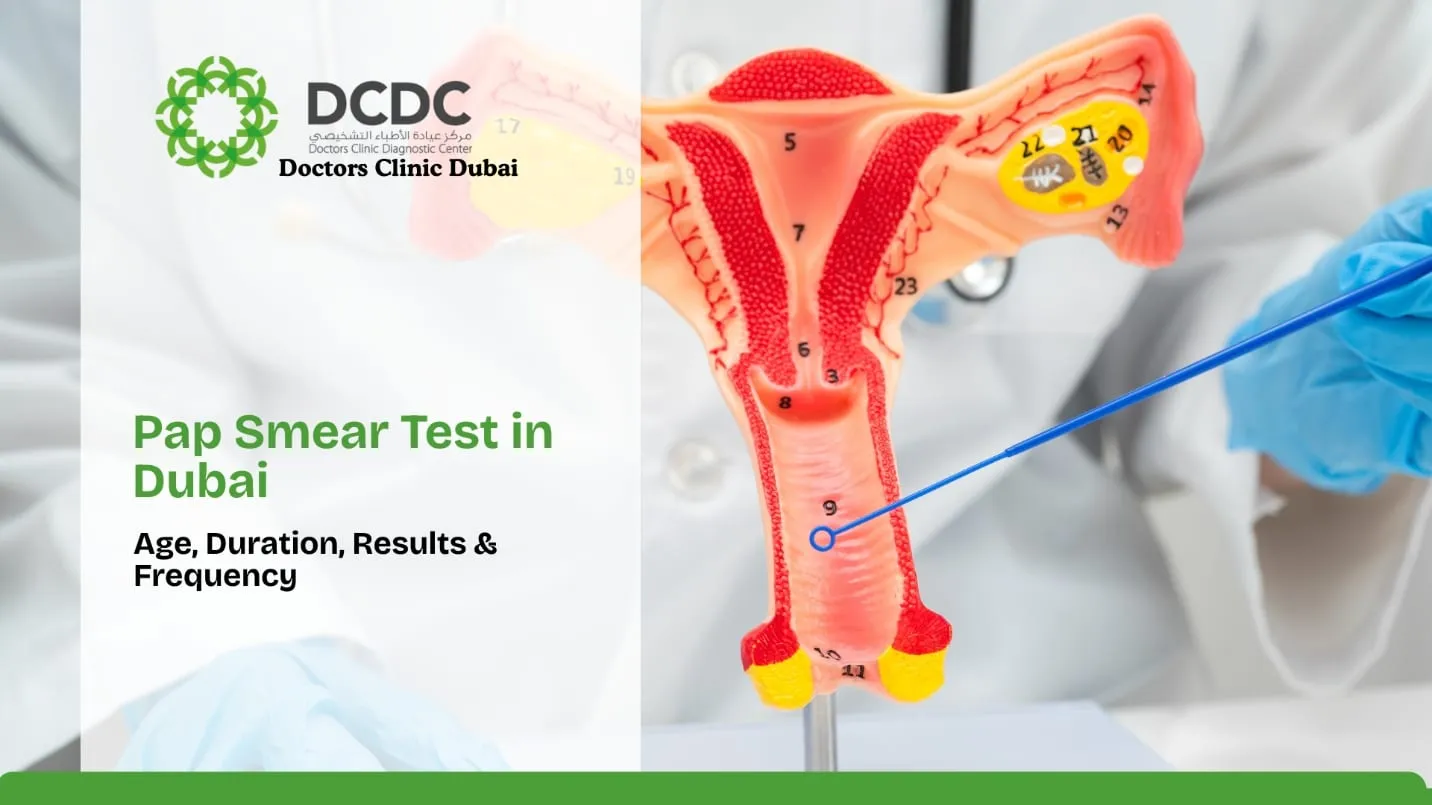
A Pap smear test is a routine gynaecological screening that checks for early signs of cervical cancer and abnormal cervical cells. In Dubai, it is commonly advised for women starting from their early twenties and plays a key role in preventing serious cervical conditions when done regularly. Our Cervical Cancer Screening service at DCDC offers same-day appointments with female gynaecologists in Dubai Healthcare City, with Pap smear testing from AED 250.
This guide explains everything clearly: who needs the test and at what age, the exact screening frequency by age group, how the Bethesda classification system works, what each abnormal result means and what happens next, colposcopy and follow-up procedures, how HPV vaccination affects screening, full cost breakdown including insurance coverage, and what to expect during your visit to DCDC. Whether you are scheduling your first Pap smear or trying to understand an abnormal result, this is the most comprehensive guide for women in Dubai.
Health Screening Packages
Save with our bundled screening packages — specialist consultation included



What Is a Pap Smear Test and Why It Matters
A Pap smear, also called a Pap test or cervical cytology, collects cells from the cervix — the lower part of the uterus that opens into the vagina — to look for cellular changes that may develop into cervical cancer. These changes often appear years or even decades before symptoms, which is why regular screening matters even if you feel completely fine.
Cervical cancer usually develops slowly through a well-defined progression: normal cells develop into pre-cancerous changes (called dysplasia or cervical intraepithelial neoplasia — CIN), which can then progress to invasive cancer if left undetected and untreated. This progression typically takes 10-20 years, giving screening an enormous window for intervention. When abnormal cells are found early, treatment is simpler and highly effective — with cure rates approaching 100% for pre-cancerous changes.
That is why gynaecologists in Dubai strongly recommend Pap smear screening as part of routine women's cancer screening, not just when symptoms appear. Cervical cancer is now considered one of the most preventable cancers in the world, thanks to the combination of effective screening and HPV vaccination.
Pap Smear Screening Frequency by Age: Complete Table
One of the most common questions women ask is how often they need a Pap smear. The answer depends on your age, previous results, and whether HPV co-testing is included. The following table summarises the current guidelines from the American College of Obstetricians and Gynecologists (ACOG) and the US Preventive Services Task Force (USPSTF), which are followed by most gynaecologists in Dubai.
| Age Group | Recommended Screening | Interval | Key Notes |
|---|---|---|---|
| Under 21 | No screening recommended | N/A | Screening before age 21 is not recommended regardless of sexual activity, as cervical abnormalities in this age group almost always resolve spontaneously |
| 21-29 years | Pap smear alone (cervical cytology) | Every 3 years | HPV testing is NOT recommended in this age group — HPV infections are very common and usually transient. Only Pap smear is used |
| 30-65 years | Option 1: Pap + HPV co-testing (PREFERRED) | Every 5 years | Co-testing provides the highest detection rate (over 95% sensitivity) and allows longer screening intervals |
| 30-65 years | Option 2: Pap smear alone | Every 3 years | Acceptable if HPV testing is not available or desired, but requires more frequent screening |
| 30-65 years | Option 3: HPV test alone (primary HPV screening) | Every 5 years | Approved by some guidelines (ACS 2020) — if positive, reflex Pap smear is performed |
| Over 65 | Screening may stop | N/A | Only if the last 3 Pap tests (or 2 co-tests) in the past 10 years were normal AND there is no history of CIN 2+ in the past 25 years |
| After hysterectomy (total — cervix removed) | No screening needed | N/A | Only if the hysterectomy was for a non-cancerous condition AND there is no history of CIN 2 or higher. If cervix remains (supracervical hysterectomy), continue screening |
| HIV-positive or immunosuppressed women | Pap smear (annual initially) | Annual for 3 years, then every 3 years if normal | Immunosuppressed women have higher risk of persistent HPV and faster progression to cancer |
Cervical cancer screening recommendations (ACOG/USPSTF 2026). Your gynaecologist may adjust based on individual risk factors.
The Dubai Health Authority (DHA) follows international guidelines and recommends cervical cancer screening as part of preventive women's health programmes. Many DHA-regulated insurance plans now cover Pap smear testing as a preventive benefit — check with your provider for specific coverage details.
Pap Smear vs HPV Test vs Co-Testing: Which Do You Need?
Many women are confused about the difference between a Pap smear and an HPV test, and whether they need one or both. Understanding these options helps you make informed decisions about your screening. You may also find our Women's Health Screening Dubai: Tests by Age helpful.
| Feature | Pap Smear Alone | HPV Test Alone | Co-Testing (Pap + HPV) |
|---|---|---|---|
| What it detects | Abnormal cervical cells (cytology) | High-risk HPV virus (DNA/RNA) | Both abnormal cells AND HPV virus |
| Sensitivity for CIN 2+ | 70-80% | 90-95% | 95-100% |
| False negative rate | 15-25% | 5-10% | Less than 5% |
| Screening interval | Every 3 years | Every 5 years | Every 5 years |
| Recommended age group | 21-29 years (Pap only); 30-65 as alternative | 25-65 years (if primary HPV screening is offered) | 30-65 years (PREFERRED by ACOG) |
| Cost range in Dubai (AED) | 250-450 | 350-550 | 450-750 |
| Sample collection | Same cervical brush — cells examined under microscope | Same cervical brush — tested for HPV DNA | Both tests from one sample collection (single visit) |
| Main advantage | Direct visualization of cell abnormalities | Detects the causative virus before cells become abnormal | Highest detection rate, longest safe screening interval |
| Main limitation | Higher false negative rate than HPV testing | Cannot distinguish between transient and persistent HPV | Higher cost per screening |
Current guidelines favour co-testing for women 30-65, as it provides the highest detection rate while reducing screening frequency to every 5 years.
HPV (human papillomavirus) is the virus that causes virtually all cervical cancers. Over 200 HPV types exist, but only about 14 are classified as 'high-risk' for cervical cancer. HPV types 16 and 18 are responsible for approximately 70% of all cervical cancers. By detecting high-risk HPV types early, doctors can monitor more closely even if the Pap smear appears normal — because HPV infection typically precedes cellular abnormalities by several years.
Understanding Pap Smear Results: The Bethesda Classification
Pap smear results are reported using the Bethesda System, an internationally standardised classification developed by the National Cancer Institute. Understanding each category helps you know exactly what your results mean and what the recommended next steps are.
Results are typically available within 3-7 working days in Dubai labs.
Normal (NILM — Negative for Intraepithelial Lesion or Malignancy)
No abnormal cells detected. This is the most common result. Continue routine screening according to your age-based schedule. If HPV co-testing was also negative, your next screening is in 5 years.
ASC-US (Atypical Squamous Cells of Undetermined Significance)
The most common abnormal finding, accounting for approximately 40% of all abnormal Pap results. Cells look slightly unusual but are not clearly pre-cancerous. Most ASC-US resolves on its own within 6-12 months. The recommended management depends on HPV status:
- If HPV co-test is negative: Repeat co-testing in 3 years. The risk of significant disease is very low (less than 2%)
- If HPV co-test is positive: Colposcopy is recommended to visually examine the cervix and possibly take a biopsy. The risk of CIN 2+ is approximately 5-10%
- If HPV was not tested: Options include HPV reflex testing (using the same sample), repeat Pap smear in 12 months, or colposcopy
LSIL (Low-Grade Squamous Intraepithelial Lesion)
LSIL represents mild cellular changes usually caused by HPV infection. It corresponds to CIN 1 (cervical intraepithelial neoplasia grade 1) on biopsy. Approximately 60-80% of LSIL cases resolve spontaneously within 12-24 months as the immune system clears the HPV infection. For women aged 25 and older, colposcopy is generally recommended to rule out a higher-grade lesion. For women aged 21-24, repeat Pap smear in 12 months is preferred because the resolution rate is even higher in younger women.
HSIL (High-Grade Squamous Intraepithelial Lesion)
HSIL represents more significant cellular changes with a higher risk of progression to cervical cancer if untreated. It corresponds to CIN 2 or CIN 3 on biopsy. Colposcopy with biopsy is mandatory for all HSIL results, regardless of age. If confirmed on biopsy, treatment is usually recommended:
- LEEP (Loop Electrosurgical Excision Procedure): The most common treatment — uses a thin wire loop with electrical current to remove the abnormal area. Performed as an outpatient procedure under local anaesthesia
- Cone biopsy (conisation): Removes a cone-shaped piece of tissue. Used when the abnormal area extends into the cervical canal
- Cryotherapy: Freezes and destroys abnormal cells. Less commonly used today as LEEP provides a tissue sample for analysis
Treatment for HSIL has a success rate of over 90%. After treatment, close follow-up with Pap smear and HPV testing at 12 and 24 months is essential to confirm clearance.
AGC (Atypical Glandular Cells)
Less common than squamous cell abnormalities but potentially more concerning. Glandular cells line the cervical canal and uterus. AGC can indicate pre-cancerous changes in the endocervix or endometrium. All AGC results require colposcopy, endocervical curettage, and endometrial biopsy (in women over 35 or with abnormal bleeding). AGC is associated with a higher rate of significant disease than ASC-US or LSIL.
Complete Bethesda Results Summary Table
| Bethesda Category | Severity | Frequency Among Abnormal Results | Recommended Next Step | Risk of CIN 2+ |
|---|---|---|---|---|
| NILM (Normal) | None | ~95% of all Pap tests | Routine screening per age schedule | Less than 0.5% |
| ASC-US | Equivocal | ~40% of abnormal results | HPV reflex test or repeat Pap in 12 months | 5-10% (if HPV positive) |
| ASC-H (cannot exclude HSIL) | Intermediate | ~5% of abnormal results | Colposcopy with biopsy | 25-40% |
| LSIL | Low-grade | ~30% of abnormal results | Colposcopy (age 25+); repeat Pap in 12 months (age 21-24) | 12-16% |
| HSIL | High-grade | ~10% of abnormal results | Immediate colposcopy + biopsy; LEEP or excision if confirmed | 50-70% |
| AGC | Variable (may be significant) | ~5% of abnormal results | Colposcopy + endocervical curettage + endometrial biopsy (if age 35+) | 10-40% (varies by subtype) |
Bethesda classification system for Pap smear results. All percentages are approximate. Management decisions should be individualised by your gynaecologist.
Important: Abnormal results do NOT mean cancer. The vast majority indicate early, treatable changes that develop slowly over many years. Even HSIL, the most concerning common finding, represents pre-cancerous changes that are treated with a simple outpatient procedure.
Colposcopy: What Happens After an Abnormal Pap Smear
If your Pap smear returns an abnormal result that requires further investigation, your gynaecologist will recommend a colposcopy. This is a closer examination of the cervix using a special magnifying instrument called a colposcope. Understanding the procedure removes anxiety and helps you prepare.
What Happens During a Colposcopy
- Step 1: You lie in the same position as a Pap smear. A speculum is inserted to view the cervix
- Step 2: The gynaecologist applies a mild acetic acid (vinegar) solution to the cervix. Abnormal areas turn white (acetowhite changes) under the colposcope magnification
- Step 3: If abnormal areas are identified, a small biopsy (tissue sample) is taken for laboratory analysis. You may feel a brief pinch or cramp lasting a few seconds
- Step 4: Results are available in 1-2 weeks. Your gynaecologist will discuss findings and next steps
The entire colposcopy takes 15-20 minutes. You can return to normal activities the same day. Mild spotting may occur for 1-2 days after biopsy. Colposcopy cost in Dubai ranges from AED 800-1,500 depending on whether biopsies are taken. Many insurance plans cover colposcopy when recommended following an abnormal Pap smear. For related information, see our guide on cervical cancer screening in Dubai.
How Is a Pap Smear Test Performed?
The test is simple and usually done during a routine gynaecology visit. You lie comfortably on the examination table while a small instrument (speculum) gently opens the vaginal canal so the cervix can be seen clearly.
A soft brush or spatula is used to collect cervical cells from the surface and just inside the cervical opening. The cells are placed in a liquid medium (liquid-based cytology — LBC) and sent to the laboratory for analysis. The process is quick, causes minimal discomfort, and does not require anaesthesia. Most women describe it as mild pressure rather than pain.
The actual test takes less than 5 minutes, although the full appointment including consultation may last around 15-20 minutes. You can return to normal activities immediately. Mild spotting or light discomfort can occur for a few hours, which is completely normal.
HPV Vaccination and Screening: What You Need to Know
The HPV vaccine (Gardasil 9) is one of the most effective cancer-prevention tools ever developed, protecting against the 9 HPV types responsible for approximately 90% of cervical cancers, genital warts, and HPV-related cancers of the vulva, vagina, anus, and oropharynx. However, vaccination has important implications for screening that many women misunderstand.
Key Facts About HPV Vaccination and Screening
- Vaccination does NOT replace screening: Even fully vaccinated women must continue regular Pap smear screening. The vaccine protects against 7 high-risk HPV types but does not cover ALL cancer-causing HPV types. Approximately 10-15% of cervical cancers are caused by HPV types not included in any vaccine
- Same screening schedule: Vaccinated women follow the same screening guidelines as unvaccinated women — Pap smear from age 21, co-testing from age 30
- Vaccination is most effective before HPV exposure: The vaccine works best when given before sexual debut (recommended ages 9-14 for primary series). However, catch-up vaccination is available up to age 45 and still provides benefit
- Vaccination after an abnormal Pap: If you have already had an abnormal Pap smear or HPV-positive result, vaccination can still protect against other HPV types you have not yet encountered. Discuss with your gynaecologist
- HPV vaccination in the UAE: The DHA includes HPV vaccination in its national immunisation programme for girls. The vaccine is also available at DCDC and other clinics for women up to age 45
As the first generation of fully vaccinated women enters the screening age, some guidelines may eventually adjust screening intervals. However, for now, all major medical bodies recommend that vaccinated women continue standard screening. The combination of vaccination AND regular screening provides near-complete protection against cervical cancer.
Pap Smear Cost in Dubai: Complete 2026 Pricing
Pap smear costs in Dubai vary depending on the clinic, laboratory quality, and whether additional HPV testing or follow-up procedures are included.
| Service | Cost Range (AED) | What Is Included |
|---|---|---|
| Pap Smear (standard liquid-based cytology) | 250 - 450 | Cervical cell collection, laboratory analysis, Bethesda classification report |
| Pap Smear + HPV Co-Testing | 450 - 750 | Cervical cytology + high-risk HPV DNA/RNA testing from same sample |
| HPV Test Alone | 350 - 550 | High-risk HPV type detection (types 16, 18 individually genotyped) |
| Gynaecology Consultation + Pap Smear | 500 - 900 | Full gynaecological consultation + Pap smear in same visit |
| Colposcopy (if needed after abnormal Pap) | 800 - 1,500 | Colposcopic examination with or without biopsy |
| LEEP Procedure (if treatment needed) | 2,000 - 4,000 | Outpatient excision of abnormal cervical tissue under local anaesthesia |
| HPV Vaccination (Gardasil 9 — per dose) | 500 - 900 | One dose of 9-valent HPV vaccine (2-3 dose series required) |
Cervical screening pricing in Dubai (2026). Insurance coverage for preventive Pap smear varies by plan. DCDC accepts direct billing with 20+ insurance partners.
Insurance Coverage for Pap Smear in Dubai
Most UAE insurance plans cover Pap smear as preventive care, especially when done according to standard screening guidelines. Coverage typically includes one Pap smear every 1-3 years depending on age and plan type. DHA-regulated insurance plans are increasingly recognising cervical cancer screening as a covered preventive benefit.
- Daman: Basic and Enhanced plans usually cover preventive gynaecology screening including Pap smear
- Thiqa: Abu Dhabi residents — covers preventive women's health services including cervical screening
- BUPA: Comprehensive plans include annual Pap smear and some include HPV co-testing
- Cigna: Most plans cover cervical cancer screening as preventive care
- AXA, Oman Insurance, Al Sagr: Coverage varies by plan level — check your specific benefits
Always verify coverage before your appointment. Some plans require a referral from your primary care physician, while others allow direct gynaecology visits. Ask your insurance provider whether co-testing (Pap + HPV) is covered or if only the Pap smear alone is included. At DCDC, our reception team can verify your insurance coverage before your appointment. Read more about screening options in our mammogram screening age guide.
How to Prepare for a Pap Smear Test
Proper preparation ensures the most accurate results and a smoother experience.
Best practices 48 hours before your test:
- Avoid sexual intercourse for 48 hours before the test
- Do not use vaginal douches, sprays, or deodorants
- Avoid vaginal creams, medications, or spermicides (unless prescribed by your doctor)
- Do not insert tampons
- Avoid vaginal lubricants or moisturisers
Schedule your Pap smear when you are not menstruating. The best time is 10-20 days after the first day of your last period. Mid-cycle timing provides the clearest cervical cell sample. If you have an active vaginal infection or unusual discharge, postpone the test until the infection is treated — inflammation can interfere with cell analysis and lead to unclear results.
What to Expect at DCDC: Your Pap Smear Visit
At DCDC in Dubai Healthcare City, Pap smear testing is performed by experienced female gynaecologists in a comfortable, private setting. Our MOHAP-licensed clinic maintains the highest standards of patient care, with a 4.8/5 Google rating from over 1,000 verified reviews and 98% patient satisfaction.
- Female doctors available: Dr. Parisa Dini (Consultant OB-GYN) performs Pap smear testing and colposcopy
- Privacy and comfort: Dedicated gynaecology consultation rooms with privacy measures
- Same-day appointments: Walk-in availability or pre-booked slots
- Comprehensive approach: Your gynaecologist will discuss your full gynaecological health, not just the Pap smear, during the consultation
- Fast results: Pap smear results within 3-7 working days, with your gynaecologist reviewing and explaining results
- Direct billing: Insurance accepted with 20+ providers including Daman, AXA, Bupa, and Cigna
- Convenient location: Building 64, Block A, DHCC with free parking. Open Saturday-Thursday 8 AM-10 PM, Friday 9 AM-9 PM
Comprehensive Women's Health Screening at DCDC
Our women's health packages include Pap smear testing, HPV screening, and full gynaecological consultation with a female specialist. Same-day appointments available at Dubai Healthcare City.
Call +971 54 219 5008 or WhatsApp to book
Expert Opinion on Cervical Cancer Prevention
"Cervical cancer is one of the most preventable cancers we see in gynaecology. The Pap smear, combined with HPV testing when appropriate, has dramatically reduced cervical cancer rates in countries with strong screening programmes — by over 80% in some nations. In Dubai, access to quality screening is excellent, but many women delay or skip it due to anxiety or lack of awareness. What I tell every patient is this: a 5-minute test every 3-5 years can prevent a cancer that takes 10-20 years to develop. The maths is overwhelmingly in your favour. For women with abnormal results, I emphasise that the vast majority of findings are treatable with simple outpatient procedures and that close follow-up virtually eliminates the risk of progression to cancer," says Dr. Parisa Dini, Consultant Obstetrician and Gynaecologist.
DHA Cervical Cancer Screening Guidelines for Dubai
The Dubai Health Authority has incorporated cervical cancer screening into its preventive health framework, aligning with WHO's strategy to eliminate cervical cancer as a public health problem by 2030. The DHA guidelines for Dubai include:
- Screening from age 25: The DHA recommends initiating cervical screening from age 25, slightly later than the ACOG recommendation of 21, reflecting the very low risk of cervical cancer before age 25
- HPV-based screening preferred: The DHA is moving towards primary HPV testing as the preferred screening method for women aged 30-65, in line with WHO recommendations
- Insurance coverage mandate: DHA-regulated insurance plans are required to include preventive screening benefits, though the extent of coverage varies by plan tier
- HPV vaccination programme: The DHA has included HPV vaccination in the national immunisation schedule for girls, aiming to reduce cervical cancer incidence in future generations
- Awareness campaigns: The DHA runs periodic cervical cancer awareness campaigns, particularly during Cervical Cancer Awareness Month (January)
Why Regular Pap Smear Testing Saves Lives
Cervical cancer is one of the most preventable cancers when caught early. Regular screening reduces cervical cancer risk by over 80% according to global health data from the World Health Organisation and American Cancer Society. In countries with well-established screening programmes (such as Australia, the UK, and Scandinavian countries), cervical cancer rates have dropped by 70-90% since organised screening began.
Skipping tests often leads to late diagnosis, which requires more complex treatment including surgery, radiation, and chemotherapy — with significantly lower survival rates. Routine Pap smears allow problems to be addressed long before they become serious, often with simple 15-minute outpatient procedures like LEEP that have cure rates exceeding 90%.
The WHO Global Strategy to Accelerate the Elimination of Cervical Cancer targets screening 70% of women twice in their lifetime by 2030. With both vaccination and screening, cervical cancer could become the first cancer to be effectively eliminated worldwide.
Trusted Gynaecology Care in Dubai Healthcare City
Women looking for reliable gynaecology care benefit from choosing a clinic that prioritises comfort, privacy, and accurate diagnosis. At Doctors Clinic Diagnostic Center, gynaecology services are handled by experienced female specialists using modern diagnostic standards. Located in Dubai Healthcare City, near Oud Metha, Umm Hurair 2 Dubai, and Karama Dubai.
Book your screening today — call +971 54 219 5008 or WhatsApp +971 50 970 3884
Related Services at DCDC
Expert care and advanced diagnostics at Dubai Healthcare City
Frequently Asked Questions
Final Thoughts
Pap smear testing is a simple step with an enormous impact on long-term women's health. Understanding the right age to start, how often to screen, what co-testing adds, and what each Bethesda classification means removes fear and confusion around the test. In Dubai, access to qualified female gynaecologists at Doctors Clinic Diagnostic Center and reliable laboratories makes routine screening easy and comfortable.
The combination of regular Pap smear screening and HPV vaccination has the potential to virtually eliminate cervical cancer — a disease that still kills over 340,000 women worldwide each year. Whether you are scheduling your first screening, following up on an abnormal result, or simply overdue for your next test, now is the right time to take action. A 5-minute test can protect you for years to come.
Sources & References
This article was reviewed by our medical team and references the following sources:
- American College of Obstetricians and Gynecologists (ACOG) — Updated Cervical Cancer Screening Guidelines
- US Preventive Services Task Force (USPSTF) — Cervical Cancer Screening Recommendations
- American Cancer Society — Cervical Cancer Screening Guidelines (2020 Update)
- World Health Organization — Global Strategy to Accelerate the Elimination of Cervical Cancer
- Mayo Clinic — Pap Smear: Purpose, Procedure, and Results
- NHS — Cervical Screening (Smear Test)
- National Cancer Institute — Bethesda System for Reporting Cervical Cytology
- Dubai Health Authority — Women's Health Screening Guidelines
Medical content on this site is reviewed by DHA-licensed physicians. See our editorial policy for more information.

Written by
Dr. Parisa Dini
Consultant Obstetrician & Gynecologist
MD, Obstetrics & Gynecology
Dr. Parisa Dini is a Consultant Obstetrician and Gynecologist specializing in women's health screening, cervical cancer prevention, and prenatal care at DCDC Dubai Healthcare City.
Related Articles
Women's Health Screening Dubai: Tests by Age

Cervical Cancer Screening Dubai: Pap Smear & HPV
Breast Cancer Screening Guide for Dubai Women

When to Start Mammograms: Age & Schedule Guide

CA-125 Ovarian Cancer Test Dubai
More in Gynecology

Anomaly Scan Dubai: Cost, Timing & Results (2026)
Read More
Menstrual Cramps Dubai: Relief & When to Worry (2026)
Read More
Irregular Periods Treatment Dubai (2026)
Read More
Premature Ovarian Failure Dubai: Guide (2026)
Read MoreOvarian Cyst Dubai: Symptoms & Treatment (2026)
Read MoreUterine Fibroids Dubai: Treatment Guide (2026)
Read More© 2026 Doctors Clinic Diagnostic Center (DCDC), Dubai Healthcare City. Originally published at https://doctorsclinicdubai.ae/blog/pap-smear-test-dubai. All rights reserved. Unauthorized reproduction is prohibited.