Ключевые выводы
- An OPG (panoramic X-ray) costs AED 150-350 and delivers very low radiation (5-26 µSv), making it the most affordable and safest first-line dental scan
- OPG is sufficient for the majority of dental imaging needs, including routine check-ups, orthodontic planning, wisdom tooth evaluation, and periodontal screening
- CBCT (3D scan) costs AED 500-1,500 and is only necessary when your dentist needs three-dimensional measurements, such as for implant planning, complex extractions, or root canal complications
- Starting with an OPG and upgrading to CBCT only when needed saves money and keeps radiation exposure to a minimum
- Both scans are available at DCDC Dubai Healthcare City on a walk-in basis with same-day radiologist reporting
You have been told you need dental imaging, and now you are wondering: is an OPG (panoramic X-ray) enough, or do you need a CBCT (3D cone beam scan)? The answer depends on what your dentist needs to see. For most patients, the OPG is the right starting point. It is cheaper, uses less radiation, and provides all the information needed for routine dental assessments. CBCT becomes necessary only when two-dimensional imaging cannot answer a specific clinical question, such as measuring bone volume for an implant or tracing a nerve canal before a complex extraction.
This guide walks you through the differences between OPG and CBCT from the patient's perspective: what each scan shows, when an OPG is all you need, when it makes sense to upgrade to CBCT, how cost and radiation compare, and which scan matches each common dental procedure. Every recommendation is reviewed by a consultant radiologist at DCDC Dubai Healthcare City.
OPG vs CBCT: What's the Difference?
The fundamental difference between an OPG and a CBCT is dimension. An OPG captures a flat, two-dimensional panoramic image that shows both jaws, all teeth, the temporomandibular joints (TMJ), and the surrounding bone on a single wide-angle strip. A CBCT captures a three-dimensional volume that can be rotated, sliced in any direction, and measured with sub-millimetre precision. Think of an OPG as a photograph of the front of a building: you see the entire facade, but you cannot tell how deep the building is. A CBCT is more like a 3D architectural model: you can look at the building from every angle and measure every wall.
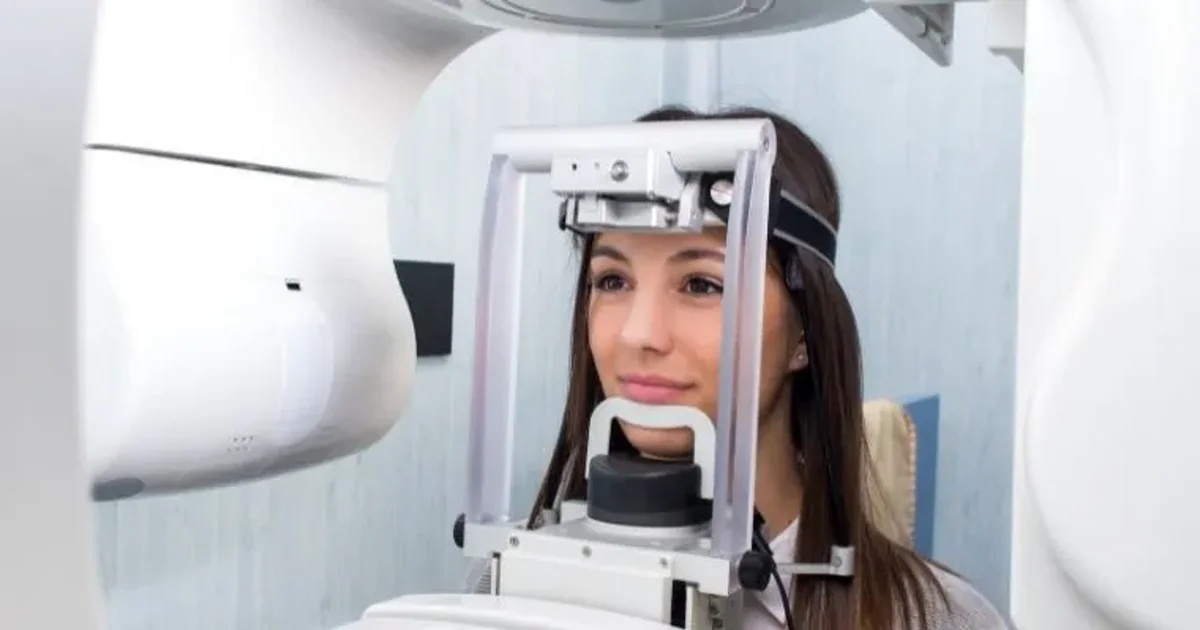
Both scans are painless, require no injections or contrast dye, and take under a minute. The patient stands in front of a machine, bites on a positioning guide, and holds still while the X-ray arm rotates around the head. The difference lies in what happens behind the scenes: the OPG machine captures a continuous sweep that compresses all structures into one flat image, while the CBCT machine captures hundreds of individual projections that software reconstructs into a volumetric 3D dataset.
Here is how the two scans compare across the features that matter most to patients:
| Feature | OPG (Panoramic X-Ray) | CBCT (3D Cone Beam Scan) |
|---|---|---|
| Image type | 2D flat panoramic strip | 3D volumetric dataset |
| Scan time | 15-20 seconds | 10-40 seconds |
| Radiation dose | Very low (5-26 µSv) | Low (30-200 µSv) |
| Cost in Dubai | AED 150-350 | AED 500-1,500 |
| Measurement accuracy | Approximate (20-30% magnification) | True 1:1 measurements |
| Best for | Screening, routine assessment, orthodontics | Implant planning, complex surgery, root canal diagnosis |
| Comfort | Very comfortable; no intraoral sensor | Very comfortable; no intraoral sensor |
| Results at DCDC | Same-day radiologist report | Same-day radiologist report |
OPG vs CBCT side-by-side comparison. Costs are approximate and vary by provider and CBCT field of view.
"Most patients who come to DCDC for dental imaging only need an OPG," says Dr. Osama Elzamzami, Consultant Radiologist (MD, FRCR). "The panoramic image answers the clinical question in approximately 80% of cases. When it does not, we use CBCT to zoom in on the specific area of concern, but we always start with the simplest, lowest-dose scan that can do the job."
When OPG Is All You Need
For the majority of dental patients, an OPG is the only scan required. It provides a complete overview of the oral and maxillofacial region at a fraction of the cost and radiation dose of a CBCT. Here are the situations where an OPG alone is sufficient and no 3D imaging is necessary.
Routine Dental Check-Ups and New Patient Exams
When you visit a new dentist or need a comprehensive baseline record of your dental health, an OPG is the standard first-line image. It reveals cavities, the condition of existing fillings and crowns, bone levels around each tooth, any developing cysts or lesions, and the status of previously treated teeth. This panoramic overview gives your dentist everything needed to create a treatment plan for routine care. Ordering a CBCT for a standard check-up would expose you to unnecessary radiation and cost without providing clinically useful additional information.
Orthodontic Treatment Planning
Orthodontists use an OPG together with a lateral cephalometric X-ray as the standard imaging protocol before starting braces or clear aligner treatment. The OPG shows all erupted and developing teeth, root lengths, tooth angulation, missing teeth, and supernumerary teeth. The cephalometric image provides the skeletal measurements needed for treatment planning. CBCT is only warranted in orthodontics when there is a specific complication, such as a palatally impacted canine that requires precise 3D localization before surgical exposure.
Standard Wisdom Tooth Assessment
The OPG is the gold-standard imaging study for evaluating wisdom teeth. It clearly shows whether the third molars are impacted, partially erupted, or fully erupted; the angle and depth of impaction; the relationship to adjacent teeth; and the presence of associated pathology like dentigerous cysts. In most cases, this is all the oral surgeon needs to plan the extraction. CBCT is reserved for the small percentage of cases where the OPG shows that the roots appear to be in direct contact with the inferior alveolar nerve canal.
Periodontal Disease Monitoring
Patients with gum disease need periodic imaging to track bone levels around their teeth. An OPG provides a global view of bone height across both jaws, making it easy for the periodontist to identify areas of progressive bone loss and compare changes over time. When more localized detail is needed, periapical X-rays of individual teeth are added, but CBCT is not part of the standard periodontal monitoring protocol.
Screening for Jaw Pathology
The broad field of view of an OPG makes it an excellent screening tool for cysts, tumors, and other jaw pathologies. Many of these conditions are first discovered incidentally on a routine OPG. If the OPG identifies a suspicious lesion, CBCT may be ordered to assess its exact extent before surgery, but the initial detection and preliminary assessment are done on the OPG.
TMJ Initial Assessment
Patients with jaw pain, clicking, or limited opening are often referred for an OPG to evaluate the temporomandibular joints. The panoramic image shows the condylar shape, gross bony changes like flattening or osteophytes, and fractures. For the initial assessment of TMJ complaints, this is sufficient. Three-dimensional CBCT of the TMJ is only needed when conservative treatment fails and the clinician suspects subtle bony pathology that the 2D image cannot characterize.
When to Upgrade from OPG to CBCT
There are specific clinical situations where an OPG alone cannot provide the information your dentist needs to treat you safely and effectively. In these cases, upgrading from OPG to CBCT is not a luxury but a clinical necessity. The three-dimensional data from CBCT eliminates the guesswork that comes with a flat 2D image and directly improves treatment outcomes.
Dental Implant Planning
This is the most common reason to move from OPG to CBCT. Before placing a dental implant, your surgeon must know the exact width, height, and density of the bone at the implant site, the precise location of the inferior alveolar nerve in the lower jaw, and the distance to the maxillary sinus floor in the upper jaw. An OPG shows bone height but not width, and its inherent 20-30% magnification makes measurements unreliable for implant sizing. CBCT provides true 1:1 measurements in all three dimensions, allowing the surgeon to select the correct implant diameter and length and, in many cases, to create a computer-guided surgical template for precise placement.
Wisdom Teeth Close to the Nerve
When an OPG shows specific signs that a lower wisdom tooth root may be intimately related to the inferior alveolar nerve canal, such as darkening of the root at the canal crossing, deflection of the canal, or narrowing of the root, the oral surgeon will request a CBCT to determine the true three-dimensional relationship. Is the canal running between the roots, along the outer surface, or along the inner surface? This spatial information directly affects the surgical technique and the informed consent discussion about nerve injury risk.
Complex Root Canal Cases
Endodontists order small-field-of-view CBCT when a root canal treatment has failed and the cause is unclear, when they suspect a vertical root fracture that is invisible on 2D X-rays, when they need to identify the number and curvature of root canals in an anatomically complex tooth, or when a periapical lesion on an X-ray does not match the clinical symptoms. The 3D view eliminates the superimposition of overlapping roots that makes 2D diagnosis unreliable in these cases.
Jaw Surgery Planning
Patients undergoing orthognathic surgery to correct jaw misalignment require large-field-of-view CBCT for three-dimensional surgical planning. The 3D data allows the surgeon to simulate bone cuts, predict the post-surgical jaw position, and in some cases create patient-specific surgical plates. This level of planning is impossible with OPG alone.
Trauma and Suspected Fractures
While an OPG can detect most mandibular fractures, subtle fractures of the condylar neck, alveolar bone fractures, and root fractures from dental trauma are often invisible on a panoramic image. CBCT reveals fracture lines in three dimensions, helping the maxillofacial surgeon plan whether conservative management or surgical fixation is appropriate.
A 42-year-old patient was referred to DCDC after her dentist recommended implants to replace two missing lower molars. Her OPG showed adequate bone height and no obvious pathology. But Dr. Osama Elzamzami recommended a targeted CBCT of the implant sites before proceeding. "The CBCT revealed that the bone ridge was only 4mm wide on the tongue side, far too narrow for a standard implant," he explains. "We recommended bone grafting before implant placement. Without the 3D scan, the surgeon would have discovered this problem mid-surgery, which is a much worse scenario for the patient. This is a textbook example of when upgrading from OPG to CBCT changes the treatment plan and protects the patient."
Not Sure Which Scan You Need?
Bring your dentist's referral to DCDC Dubai Healthcare City and our radiologist will confirm whether an OPG, a CBCT, or both is the right choice for your situation. Walk-ins welcome.
No referral required for self-pay patients
Cost and Radiation Comparison
Cost and radiation are the two practical factors that matter most when choosing between OPG and CBCT. On both counts, the OPG has a significant advantage, which is precisely why it is the recommended first-line scan for the majority of dental imaging needs.
Cost Comparison in Dubai
An OPG scan in Dubai typically costs AED 150 to AED 350, depending on the facility and whether a radiologist report is included. A CBCT scan in Dubai ranges from AED 500 to AED 1,500, with the price varying based on the field of view: a small-FOV CBCT focused on a few teeth costs less than a large-FOV scan that covers both jaws and the sinuses. At DCDC, both OPG and CBCT prices include a consultant radiologist report.
The cost difference is significant. A patient who starts with an OPG and only upgrades to CBCT when clinically necessary saves AED 350-1,150 compared to going straight to CBCT. Over the course of dental treatment that involves multiple imaging appointments, this stepwise approach can save several thousand dirhams without compromising diagnostic quality.
Radiation Dose Comparison
Both OPG and CBCT are low-dose imaging modalities, but there is a meaningful difference between them. Here is how their radiation doses compare to everyday exposures:
| Imaging Type | Effective Dose (µSv) | Equivalent in Days of Background Radiation |
|---|---|---|
| OPG (panoramic X-ray) | 5-26 µSv | 1-3 days |
| CBCT small FOV (few teeth) | 30-80 µSv | 4-10 days |
| CBCT medium FOV (one jaw) | 50-150 µSv | 6-19 days |
| CBCT large FOV (both jaws) | 100-200 µSv | 12-25 days |
| Dubai-London flight (one way) | 40-80 µSv | 5-10 days |
| Medical CT of the head | 1,000-2,000 µSv | 4-8 months |
Radiation dose comparison. Both OPG and CBCT deliver far less radiation than a medical CT scan. Sources: SEDENTEXCT, European Commission RP-172.
The OPG delivers roughly 2 to 10 times less radiation than a CBCT, depending on the CBCT field of view. While both are well within safe limits, the ALARA principle (As Low As Reasonably Achievable) in radiology dictates that the lowest effective dose should always be chosen. This means using an OPG when it answers the clinical question and reserving CBCT for situations where 3D data is genuinely required.
Insurance Coverage
Most dental insurance plans in Dubai cover OPG scans with a standard dental referral. CBCT coverage is less consistent: some insurers cover it for specific indications like implant planning or pre-surgical assessment, but many require pre-authorization and a clinical justification letter from the referring dentist. At DCDC, our team assists with insurance pre-authorization to help patients maximize their coverage for both OPG and CBCT scans.
OPG vs CBCT by Dental Procedure
The easiest way to determine which scan you need is to match the imaging to your specific dental procedure. The following table provides a procedure-by-procedure guide based on international radiology guidelines and the clinical protocols used at DCDC.
| Dental Procedure | Recommended Scan | Why |
|---|---|---|
| Routine dental check-up | OPG | Provides a complete overview of all teeth, bone, and jaw structures at minimal cost and radiation |
| Dental implants | CBCT | Three-dimensional bone measurements (width, height, density) are essential for safe implant placement |
| Orthodontic assessment (braces/aligners) | OPG + cephalometric X-ray | Standard orthodontic imaging protocol; CBCT only if impacted canine requires 3D localization |
| Wisdom tooth evaluation | OPG first | OPG is sufficient in most cases; CBCT added only if roots appear close to the nerve canal |
| Root canal (standard) | OPG + periapical X-ray | Standard 2D imaging is adequate for routine root canal treatment |
| Root canal (complex/retreatment) | CBCT (small FOV) | Identifies missed canals, vertical root fractures, and hidden periapical pathology |
| Periodontal disease monitoring | OPG | Tracks overall bone levels across both jaws; supplemented by periapical X-rays for local detail |
| Jaw surgery (orthognathic) | CBCT (large FOV) | Full 3D craniofacial data is required for virtual surgical planning |
| TMJ assessment (initial) | OPG | Shows condylar shape and gross bony changes; sufficient for initial evaluation |
| TMJ assessment (advanced) | CBCT | Needed when conservative treatment fails and subtle bony pathology is suspected |
| Dental trauma / fracture | OPG first, then CBCT if needed | OPG detects most fractures; CBCT adds detail for subtle root or alveolar fractures |
| Jaw cyst or tumor assessment | OPG for detection, CBCT for surgical planning | OPG identifies the lesion; CBCT maps its 3D extent and relationship to vital structures |
OPG vs CBCT by dental procedure. This guide reflects the imaging protocols recommended by the SEDENTEXCT guidelines and the American Dental Association.
The pattern in this table is clear: OPG is the default starting point for nearly every dental procedure. CBCT is reserved for cases where the flat 2D image cannot provide the specific three-dimensional information needed for safe treatment planning. Starting with an OPG and escalating to CBCT only when indicated is the most cost-effective, radiation-conscious approach for patients.
Can You Get Both on the Same Day?
Yes. At DCDC, patients can have both an OPG and a CBCT performed on the same visit. The combined radiation dose of an OPG plus a small-FOV CBCT is approximately 35-106 µSv, which is equivalent to about 4-13 days of natural background radiation. This is well within safe limits, far less than a single medical CT scan of the head.
There are two common scenarios in which patients receive both scans on the same day:
- Pre-planned dual scan: Your dentist requests both an OPG (for the overall view) and a CBCT (for a specific area) on the same referral. This is common for patients who are having implant planning alongside a general dental assessment. You stand for the OPG first, then the CBCT immediately afterward. Total time in the imaging room is approximately 10-15 minutes.
- Radiologist-recommended upgrade: You come in for an OPG, and the radiologist identifies something on the panoramic image that warrants closer 3D examination, such as a wisdom tooth root that appears to intersect the nerve canal. The radiologist may recommend adding a targeted CBCT of the area of concern during the same visit, saving you a return trip. This happens in approximately 10-15% of OPG appointments at DCDC.
Getting both scans on the same day is convenient, safe, and efficient. The only consideration is cost: if you are using insurance, the CBCT may require a separate pre-authorization from your dentist. Self-pay patients can have both scans performed immediately without any referral requirements.
"I always tell patients that getting both scans on one visit is like getting a full physical and then a focused blood test in the same appointment," says Dr. Osama Elzamzami. "The OPG gives me the panoramic overview, and the CBCT gives me the microscopic detail of a specific area. Together they provide a complete diagnostic picture. And the total radiation from both combined is still less than a single long-haul flight from Dubai to New York."
Choosing the Right Scan at DCDC
Doctors Clinic Diagnostic Center (DCDC) in Dubai Healthcare City offers both digital OPG and CBCT scanning with the latest equipment and expert radiologist interpretation. Our approach is simple: we ensure every patient gets the right scan, nothing more and nothing less.
Here is how the process works at DCDC:
- Step 1 - Arrive with your referral (or without one): If your dentist has provided a referral specifying OPG or CBCT, we perform the requested scan. If you are self-referred, our radiologist will review your clinical situation and recommend the most appropriate imaging.
- Step 2 - Quick, painless scan: OPG takes under 20 seconds. CBCT takes 10-40 seconds. Both are performed while standing, require no injections or contrast, and involve no discomfort.
- Step 3 - Same-day radiologist report: Every scan at DCDC is reviewed and reported by a consultant radiologist, not a technician. Reports are typically ready the same day and are sent directly to your referring dentist or provided to you.
- Step 4 - Upgrade if needed: If the OPG reveals a finding that requires 3D assessment, our radiologist will explain the recommendation and offer an immediate CBCT of the relevant area during the same visit.
What makes DCDC different from standalone imaging centers:
- Board-certified consultant radiologist reads every scan (not a GP or technician)
- Both OPG and CBCT available on-site for seamless imaging workflows
- CBCT data exported in DICOM format compatible with all implant planning software
- Pediatric-optimized protocols with reduced dose settings for children
- Walk-in and appointment options throughout clinic hours
- Insurance coordination and pre-authorization assistance for covered scans
- Conveniently located in Dubai Healthcare City, accessible from Oud Metha, Karama, Bur Dubai, and the wider metro area
Book Your OPG or CBCT Scan at DCDC
Walk in or book ahead for a digital OPG or CBCT scan at DCDC Dubai Healthcare City. Same-day radiologist reporting. No referral needed for self-pay patients. Call or WhatsApp to schedule.
Call: +971 50 970 3884
Часто задаваемые вопросы
Final Thoughts
The choice between OPG and CBCT is not about which scan is "better." It is about which scan matches your clinical situation. For the majority of dental imaging needs, an OPG provides the complete overview your dentist requires at a lower cost and lower radiation dose. When three-dimensional detail is necessary, such as for implant planning, complex extractions, or root canal complications, CBCT adds a layer of precision that no 2D image can offer. The smartest approach is to start with an OPG and let your dentist or radiologist determine whether a CBCT upgrade is warranted.
At DCDC in Dubai Healthcare City, both scans are available on-site with walk-in availability and same-day consultant radiologist reporting. Whether you need a straightforward panoramic X-ray or a detailed 3D scan, our radiology team will ensure you receive exactly the imaging you need. For more details on each scan, explore our guides on what is an OPG X-ray and what is a CBCT scan.
Источники и ссылки
Эта статья проверена нашей медицинской командой и ссылается на следующие источники:
- SEDENTEXCT Project - Evidence-Based Guidelines on Cone Beam CT for Dental and Maxillofacial Radiology
- American Dental Association - Dental Radiographic Examinations: Recommendations for Patient Selection and Limiting Radiation Exposure
- European Commission - Radiation Protection No. 172: Cone Beam CT for Dental and Maxillofacial Radiology
- European Academy of DentoMaxilloFacial Radiology (EADMFR) - Basic Principles for Use of Dental Cone Beam CT
Медицинский контент на этом сайте проверяется врачами, лицензированными DHA. См. нашу редакционную политику для получения дополнительной информации.

Автор
Dr. Osama Elzamzami
Diagnostic Radiology
MD, FRCR
Dr. Osama Elzamzami is a Consultant Radiologist specializing in diagnostic imaging at DCDC Dubai Healthcare City. With extensive experience in dental and maxillofacial radiology including OPG and CBCT, he ensures every patient receives the most appropriate imaging with the lowest radiation dose necessary for accurate diagnosis.