Ключевые выводы
- CBCT delivers 50 to 100 times less radiation than a standard medical CT scan, with a typical dental CBCT dose of 50-200 microsieverts compared to approximately 2,000 microsieverts for a head CT
- CBCT scans cost significantly less than medical CT scans in Dubai, with dental CBCT typically ranging from AED 500 to AED 1,500 versus AED 2,000 to AED 5,000 or more for a medical CT
- CBCT is purpose-built for dental and maxillofacial imaging, producing superior bone detail and spatial resolution for teeth, jaws, and facial structures
- Medical CT remains necessary for evaluating soft tissues, detecting cancers, diagnosing brain conditions, and imaging areas beyond the head and neck
- Your dentist or oral surgeon will almost always recommend CBCT over medical CT for implant planning, orthodontics, wisdom teeth, root canals, and jaw surgery because it provides the needed detail at a fraction of the radiation and cost
If your dentist has recommended a CBCT scan or a doctor has mentioned a CT scan, you may be wondering whether these are the same thing and why one is chosen over the other. The short answer is that they are fundamentally different technologies designed for different clinical purposes. A CBCT (Cone Beam Computed Tomography) scan is a compact, low-dose 3D imaging system optimized for the teeth, jaws, and facial skeleton, while a medical CT (Computed Tomography) scan is a larger, higher-dose system designed to image the entire body, including soft tissues, organs, and blood vessels. Understanding the differences between CBCT vs CT scan technology helps patients make informed decisions about their diagnostic care and understand why their clinician has recommended one over the other.
This article provides a definitive comparison of CBCT and medical CT scanning, covering radiation dose, image quality, cost, scan time, clinical indications, and practical guidance on which scan is appropriate for your specific situation. Whether you are preparing for dental implants, evaluating jaw pain, or simply curious about the technology behind your dental X-rays, this guide explains everything you need to know.
CBCT vs CT Scan: What's the Difference?
The fundamental difference between a CBCT scan and a medical CT scan lies in the shape of the X-ray beam, the size of the machine, the body region it is designed to image, and the radiation dose it delivers. Although both technologies use X-rays to create cross-sectional images, they achieve this through distinctly different engineering approaches, and each is optimized for a specific set of clinical tasks.
A CBCT (Cone Beam CT) machine uses a wide, cone-shaped X-ray beam paired with a flat-panel detector. In a single rotation around the patient's head, the machine captures a complete three-dimensional volume of data in 20 to 40 seconds. The cone-shaped beam illuminates the entire field of view at once, which means fewer rotations and a dramatically lower radiation dose. CBCT machines are compact, with the patient typically standing or sitting upright. There is no tunnel or enclosed bore, making the experience comfortable even for patients with claustrophobia.
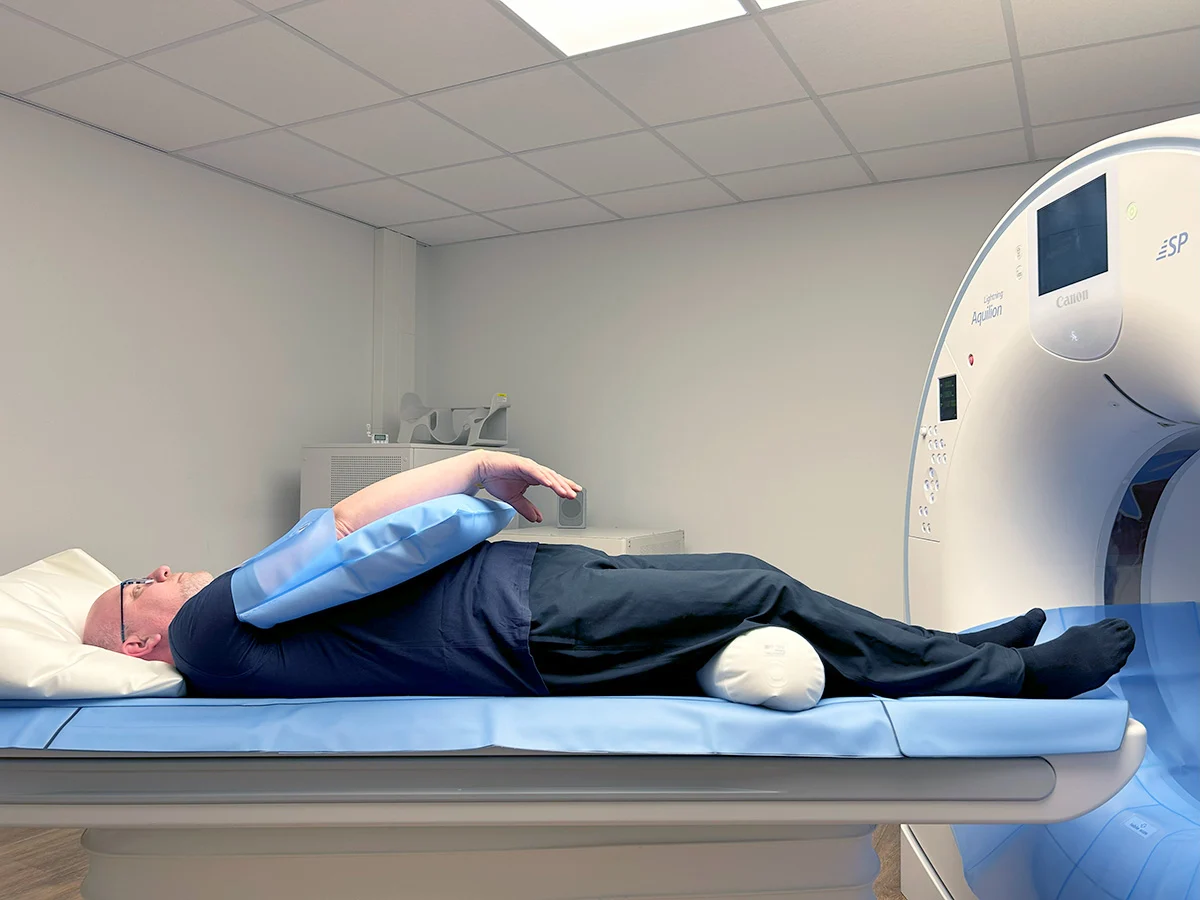
A medical CT scanner, by contrast, uses a narrow, fan-shaped X-ray beam that rotates continuously around the patient while the examination table moves through a large, doughnut-shaped gantry (bore). The fan beam captures thin slices of anatomy one at a time, building up a complete volumetric dataset through hundreds of individual rotations. This approach delivers significantly more radiation but also captures exceptional soft-tissue contrast, which is critical for diagnosing conditions in the brain, chest, abdomen, and other regions of the body. Medical CT machines are large, expensive, and housed in hospital radiology departments.
"The easiest way to understand the difference is this: CBCT is a specialist tool built specifically for teeth and jaws, while medical CT is a generalist tool designed to image everything from the brain to the pelvis," says Dr. Osama Elzamzami, Head of Radiology at DCDC. "For dental and maxillofacial diagnosis, CBCT gives us the bone detail we need at a fraction of the radiation. Medical CT becomes necessary only when we need to see soft tissues or areas outside the head and neck."
Another key distinction is resolution. CBCT scanners typically achieve a spatial resolution of 0.1 to 0.3 millimeters, which is ideal for visualizing fine bone structures, individual tooth roots, thin cortical plates, and narrow nerve canals. Medical CT scanners, while excellent at distinguishing soft-tissue densities, typically have a spatial resolution of 0.5 to 1.0 millimeters for bone imaging. This means CBCT actually produces sharper images of bony anatomy than medical CT, despite using far less radiation.
Radiation Dose Comparison
Radiation dose is one of the most important differences between CBCT and medical CT, and it is the primary reason why dentists and oral surgeons overwhelmingly prefer CBCT for dental imaging. The effective dose from a dental CBCT scan typically ranges from 50 to 200 microsieverts (uSv), depending on the field of view and the specific machine settings. A standard medical CT scan of the head delivers approximately 2,000 microsieverts. This means CBCT exposes the patient to roughly 10 to 40 times less radiation than a medical head CT, and when comparing small-field CBCT scans to full-body CT protocols, the difference can be 50 to 100 times less radiation.
To put these numbers in everyday context, the annual natural background radiation that every person on Earth absorbs from cosmic rays, soil, and food is approximately 2,400 microsieverts per year. A single dental CBCT scan is equivalent to roughly 1 to 3 weeks of this natural background exposure. A medical head CT, by comparison, is equivalent to nearly 10 months of background radiation in a single scan.
- Single dental periapical X-ray: approximately 5 microsieverts
- Panoramic dental X-ray (OPG): approximately 10-20 microsieverts
- Dental CBCT scan (small field): approximately 50-100 microsieverts
- Dental CBCT scan (full jaw): approximately 100-200 microsieverts
- Medical CT scan (head): approximately 2,000 microsieverts
- Medical CT scan (chest): approximately 7,000 microsieverts
- Medical CT scan (abdomen/pelvis): approximately 10,000-20,000 microsieverts
- Annual natural background radiation: approximately 2,400 microsieverts
"Radiation safety is non-negotiable in diagnostic imaging," says Dr. Osama Elzamzami, Head of Radiology at DCDC. "When a patient needs 3D imaging of their teeth or jaws, there is simply no clinical justification for using a medical CT scanner when CBCT provides the same or better bone detail at a tiny fraction of the dose. This is the ALARA principle in action: As Low As Reasonably Achievable."
The lower radiation dose of CBCT is a direct result of its cone-beam geometry. Because the entire field of view is captured in a single rotation with a wide cone-shaped beam, the total X-ray exposure time is dramatically shorter than that of a medical CT, which must make hundreds of narrow fan-beam rotations to build a comparable volume. Additionally, CBCT machines offer adjustable dose settings and field-of-view options that allow the radiographer to limit the scan to only the area of clinical interest, further reducing exposure. For a deeper exploration of CBCT radiation levels, see our detailed guide on CBCT scan safety and radiation.
Image Quality and Resolution Differences
Image quality is not a simple "better or worse" comparison between CBCT and medical CT. Each technology excels in a different domain, and the right choice depends entirely on what the clinician needs to see. Understanding these differences clarifies why CBCT dominates dental imaging while medical CT remains essential for other diagnostic tasks.
Bone and Hard Tissue Detail
CBCT produces superior spatial resolution for bone and hard tissue imaging compared to medical CT. With voxel sizes (the 3D equivalent of pixels) as small as 0.1 millimeters, CBCT can resolve fine anatomical details such as the lamina dura around tooth roots, thin bony septa between teeth, the cortical lining of the inferior alveolar nerve canal, and hairline root fractures. Medical CT scanners, which typically operate with voxel sizes of 0.5 to 1.0 millimeters, cannot consistently resolve these fine structures. This is why a radiologist interpreting dental anatomy will always prefer CBCT images over medical CT images for tasks involving teeth, roots, alveolar bone, and the maxillofacial skeleton.
Soft Tissue Contrast
Medical CT has a decisive advantage in soft tissue contrast resolution. The fan-beam geometry, higher radiation dose, and advanced detector technology of medical CT scanners allow them to distinguish between tissues of very similar density, such as gray matter and white matter in the brain, different muscle groups, lymph nodes, blood vessels, and organ parenchyma. CBCT, by design, does not provide clinically useful soft tissue contrast. While soft tissues are visible on CBCT images, the contrast is insufficient for diagnosing soft tissue pathology. If a clinician suspects a soft tissue tumor, vascular malformation, or brain pathology, a medical CT or MRI is the appropriate imaging choice.
Field of View
CBCT scanners are designed to image the head and neck region only, with adjustable fields of view ranging from a small 4x4 cm volume covering a few teeth to a large 20x17 cm volume covering the entire facial skeleton, including both jaws, the TMJs, the sinuses, and the nasal cavity. Medical CT scanners can image any part of the body, from the top of the head to the tips of the toes, in a single continuous scan if needed. This whole-body capability is what makes medical CT indispensable for trauma evaluation, cancer staging, and the diagnosis of systemic diseases.
Contrast Enhancement
Medical CT scans frequently use intravenous contrast dye (iodinated contrast media) to enhance the visibility of blood vessels, tumors, infections, and inflammatory conditions. The contrast agent makes these structures "light up" on the scan, dramatically improving diagnostic accuracy for soft tissue pathology. CBCT scans do not use intravenous contrast because the technology is not optimized for soft tissue evaluation and because the lower dose and cone-beam geometry do not benefit from contrast enhancement in the same way.
When CBCT Is the Better Choice
For the vast majority of dental and maxillofacial imaging needs, CBCT is the clearly superior choice over medical CT. It delivers higher bone resolution, lower radiation, faster scan times, greater patient comfort, and lower cost. The following clinical scenarios are best served by CBCT imaging.
- Dental implant planning: CBCT provides precise measurements of bone height, width, and density at implant sites, maps the location of the inferior alveolar nerve and maxillary sinus, and allows virtual implant placement using digital planning software. This is the single most common use of CBCT worldwide.
- Impacted wisdom teeth: When a panoramic X-ray shows that wisdom tooth roots are close to the nerve canal, a CBCT scan clarifies the exact three-dimensional relationship, reducing the risk of nerve injury during extraction.
- Orthodontic treatment planning: CBCT reveals impacted canines, root positions, airway dimensions, and skeletal relationships with precision that conventional X-rays cannot match, enabling more predictable orthodontic outcomes.
- Root canal (endodontic) treatment: Complex root anatomy, missed canals, persistent infections, root resorption, and suspected root fractures are all better visualized with CBCT than with periapical X-rays alone.
- TMJ evaluation (bony components): CBCT provides detailed views of the condyle, fossa, and articular eminence, revealing degenerative changes, erosion, osteophytes, and fractures of the temporomandibular joint.
- Jaw surgery (orthognathic) planning: Surgeons use CBCT data for virtual surgical simulation, 3D-printed models, and custom cutting guides that improve accuracy and reduce operating time.
- Periodontal bone loss assessment: CBCT reveals the true three-dimensional pattern of bone loss around teeth, including buccal and lingual defects that are invisible on standard 2D X-rays.
- Supernumerary and ectopic teeth: CBCT precisely locates extra or misplaced teeth within the jaw, guiding surgical removal and orthodontic treatment.
"In more than a decade of radiology practice, I have never encountered a dental imaging question that required a medical CT when CBCT was available," says Dr. Osama Elzamzami, Head of Radiology at DCDC. "CBCT was purpose-built for this job. It gives us sharper bone images, faster results, and dramatically less radiation. For patients, that translates to a safer, faster, and more affordable experience."
Book a CBCT Scan at DCDC
At Doctors Clinic Diagnostic Center in Dubai Healthcare City, our radiology team provides expert CBCT 3D dental imaging with advanced cone beam technology. Get precise diagnostic imaging with same-day results and personalized care from experienced radiology specialists.
When Medical CT Is Necessary
Despite the many advantages of CBCT for dental imaging, there are clinical scenarios where a medical CT scan is the correct and necessary choice. Understanding these situations helps patients appreciate that the two technologies are complementary rather than competitive.
- Soft tissue tumors of the head and neck: When a dentist or oral surgeon suspects a soft tissue mass, lymph node involvement, or a malignancy extending beyond the jawbone, a contrast-enhanced medical CT (or MRI) is essential for evaluating the soft tissue extent and staging the disease.
- Trauma and emergency evaluation: Patients with severe facial trauma, suspected skull fractures, or head injuries require a medical CT scan because it can simultaneously evaluate the brain, facial bones, cervical spine, and soft tissues in a comprehensive trauma protocol.
- Brain and intracranial pathology: Headaches, neurological symptoms, suspected stroke, or intracranial hemorrhage require a medical CT or MRI. CBCT does not image the brain with sufficient soft tissue contrast for neurological diagnosis.
- Salivary gland disease: Evaluation of parotid, submandibular, or sublingual gland tumors, stones, or infections typically requires medical CT with contrast to assess the glandular tissue and surrounding structures.
- Deep neck space infections: When a dental infection has spread beyond the jawbone into the deep fascial spaces of the neck, a contrast-enhanced medical CT is needed to map the extent of the infection, identify abscesses, and guide surgical drainage.
- Cancer staging and follow-up: Patients with diagnosed head and neck cancers require medical CT (often combined with PET) for staging, treatment planning, and post-treatment surveillance.
In practice, your clinician will determine which scan is appropriate based on the specific clinical question. For the overwhelming majority of dental patients, CBCT provides all the information needed. Medical CT is reserved for situations involving soft tissue evaluation, systemic disease, emergency trauma, or oncological assessment.
Master Comparison Table: CBCT vs Medical CT
| Feature | CBCT (Cone Beam CT) | Medical CT |
|---|---|---|
| Radiation dose | 50-200 microsieverts (dental) | 2,000-20,000 microsieverts |
| Cost in Dubai | AED 500-1,500 | AED 2,000-5,000+ |
| Scan time | 20-40 seconds | 5-30 seconds per body region |
| Image type | 3D volumetric (hard tissue focused) | 3D volumetric (soft + hard tissue) |
| Spatial resolution (bone) | 0.1-0.3 mm voxel size | 0.5-1.0 mm voxel size |
| Soft tissue contrast | Limited (not diagnostic) | Excellent (diagnostic quality) |
| Contrast dye | Not used | Frequently used (iodinated IV contrast) |
| Patient position | Standing or seated, open design | Lying down, enclosed bore (tunnel) |
| Body region | Head and neck only | Any body region (head to toes) |
| Best for dental use | Implants, orthodontics, wisdom teeth, root canals, TMJ, jaw surgery | Soft tissue tumors, trauma, deep infections, cancer staging |
| Machine size | Compact (fits in dental clinic) | Large (hospital radiology suite) |
| Appointment duration | 10-15 minutes total | 15-45 minutes total |
Comprehensive comparison of CBCT (Cone Beam CT) and medical CT scan features. CBCT is the preferred choice for dental and maxillofacial imaging due to lower radiation, lower cost, and superior bone resolution.
Cost Comparison in Dubai
Cost is a practical consideration for patients choosing between imaging options, and the difference between CBCT and medical CT pricing in Dubai is substantial. Understanding these costs, and what they include, helps patients plan their diagnostic care and budget accordingly.
A dental CBCT scan in Dubai typically costs between AED 500 and AED 1,500. The price varies depending on the size of the field of view (a small scan covering a few teeth costs less than a full-jaw scan), the facility, and whether a radiologist report is included. At DCDC, the price includes the scan, full 3D image reconstruction, and a detailed written report by a consultant radiologist.
A medical CT scan of the head in Dubai typically costs between AED 2,000 and AED 5,000 or more, depending on whether contrast is used, the facility's pricing tier, and whether the scan is performed in a hospital or a standalone imaging center. If the medical CT includes contrast injection, there may be additional charges for the contrast media, IV cannulation, and a longer radiologist interpretation time. Insurance coverage varies; many insurance plans in the UAE cover medical CT when ordered for a justified clinical indication, but dental CBCT may or may not be covered depending on the policy.
The cost difference is a direct reflection of the underlying technology. Medical CT scanners cost several million dirhams to purchase and install, require dedicated shielded rooms, consume more power, and demand specialized maintenance contracts. CBCT machines are a fraction of the cost to purchase and operate, allowing dental clinics and diagnostic centers to pass the savings on to patients. For dental imaging purposes, choosing CBCT over medical CT saves the patient money while providing equal or superior diagnostic information for teeth, jaws, and facial bones.
For a detailed breakdown of CBCT pricing at DCDC, see our full guide on CBCT scan cost in Dubai.
Which Scan Will Your Dentist Recommend?
In nearly every dental scenario, your dentist, oral surgeon, or orthodontist will recommend a CBCT scan rather than a medical CT scan. This is not a matter of preference or convenience; it is the evidence-based standard of care endorsed by every major dental and radiology professional organization worldwide, including the American Dental Association (ADA), the European Academy of DentoMaxilloFacial Radiology (EADMFR), and the International Commission on Radiological Protection (ICRP).
The clinical decision-making process follows a clear hierarchy. First, the dentist determines whether a conventional two-dimensional X-ray (such as a periapical or panoramic radiograph) provides sufficient information for the clinical question. If 2D imaging is adequate, no further imaging is needed. If the clinical question requires three-dimensional information, such as measuring bone for an implant, locating an impacted tooth in three dimensions, or planning surgery, the dentist will order a CBCT scan. Medical CT is recommended only when the clinical question involves soft tissue evaluation, contrast enhancement, or body regions outside the CBCT field of view.
Patient Story: A Scan That Saved Time, Money, and Radiation Exposure
A 38-year-old woman in Dubai was referred by her general practitioner for a "CT scan of the jaw" after experiencing persistent jaw pain and clicking on the right side. She arrived at a hospital radiology department and was scheduled for a full medical CT of the head with contrast, which would have cost over AED 3,500 and delivered approximately 2,000 microsieverts of radiation. Before proceeding, the hospital radiologist contacted DCDC for a second opinion on the imaging protocol.
"When we reviewed the referral, it was clear that the clinical question was about the bony components of the TMJ, not the soft tissues," explains Dr. Osama Elzamzami, Head of Radiology at DCDC. "A focused CBCT scan of both TMJs gave us high-resolution images of the condyles, fossae, and joint spaces in under 30 seconds, at a fraction of the radiation dose and at a significantly lower cost. The medical CT was completely unnecessary for this patient."
The CBCT scan revealed early degenerative changes in the right condyle, including cortical flattening and a small osteophyte, which explained the patient's symptoms. She was referred to a TMJ specialist with the precise imaging data needed for her treatment plan. The total cost was under AED 1,000, the radiation dose was approximately 150 microsieverts (compared to the 2,000 microsieverts she would have received from the medical CT), and the entire visit lasted 15 minutes. This case illustrates a common scenario: patients are sometimes referred for medical CT when a dental CBCT would provide better diagnostic information at lower dose and lower cost.
Not Sure Which Scan You Need?
Our radiology specialists at DCDC can help determine the right imaging for your clinical needs. Whether it is a CBCT scan for dental and jaw evaluation or a referral for medical CT when soft tissue imaging is required, we ensure you get the right scan the first time.
Located in Dubai Healthcare City. Same-day appointments available.
Часто задаваемые вопросы
Final Thoughts
CBCT and medical CT are both valuable diagnostic tools, but they serve fundamentally different clinical purposes. For dental and maxillofacial imaging, including implant planning, wisdom teeth, orthodontics, root canals, TMJ evaluation, and jaw surgery, CBCT is the clear standard of care. It delivers superior bone resolution, dramatically lower radiation (50-200 microsieverts vs 2,000+ microsieverts), faster scan times, and significantly lower costs compared to medical CT. Medical CT remains essential for soft tissue evaluation, trauma, neurological conditions, and oncological assessment, but it is neither necessary nor appropriate for routine dental imaging.
If your dentist or oral surgeon has recommended a CBCT scan, you can be confident that you are receiving the right imaging for your needs. At Doctors Clinic Diagnostic Center (DCDC) in Dubai Healthcare City, our radiology specialists use advanced CBCT technology to provide precise, same-day diagnostic imaging at a fraction of the radiation and cost of a medical CT. For more information on CBCT, explore our comprehensive guide on what is a CBCT scan, our detailed CBCT scan cost in Dubai guide, or contact DCDC to book your appointment.
Источники и ссылки
Эта статья проверена нашей медицинской командой и ссылается на следующие источники:
- European Academy of DentoMaxilloFacial Radiology (EADMFR) - Basic Principles for Use of Dental Cone Beam CT
- American Dental Association (ADA) - Dental Radiographic Examinations: Recommendations for Patient Selection and Limiting Radiation Exposure
- International Commission on Radiological Protection (ICRP) - Publication 103: The 2007 Recommendations
- RadiologyInfo.org - Cone Beam CT (CBCT)
- Journal of Dental Research - Radiation Dose and Risk Assessment of Cone-Beam Computed Tomography
Медицинский контент на этом сайте проверяется врачами, лицензированными DHA. См. нашу редакционную политику для получения дополнительной информации.

Автор
Dr. Osama Elzamzami
Diagnostic Radiology
MD, FRCR
Dr. Osama Elzamzami is the Head of Radiology at DCDC, specializing in diagnostic imaging including CBCT, CT, MRI, and ultrasound at Doctors Clinic Diagnostic Center in Dubai Healthcare City.