मुख्य बातें
- Diastasis recti is the separation of the rectus abdominis muscles along the midline — it affects 60% of women at 6 weeks postpartum
- You can self-check at home: lie on your back, lift your head, and feel for a gap above and below your belly button
- Crunches, sit-ups, and planks make diastasis recti WORSE — avoid them until assessed by a physiotherapist
- Targeted physiotherapy closes the gap in most women within 3–6 months without surgery
- Diastasis recti is not just cosmetic — it causes lower back pain, poor posture, and pelvic floor dysfunction
- The pelvic floor and deep core must be rehabilitated together for lasting results
- Surgery (abdominoplasty) is only considered when physiotherapy has been fully completed and a significant gap persists
Your baby is six months old but your stomach still looks four months pregnant. You have been doing sit-ups every night and it is not getting better — in fact, it might be getting worse. If a ridge or dome appears along the centre of your abdomen when you sit up, you likely have diastasis recti. And those sit-ups are one of the worst things you can do for it. Our Physiotherapy service at DCDC offers same-day appointments in Dubai Healthcare City.
Diastasis recti is one of the most misunderstood postpartum conditions. Many women are never screened for it, and those who self-diagnose often turn to exercises that worsen the separation. At DCDC's Physiotherapy clinic in Dubai Healthcare City, we see women who have spent months doing the wrong exercises before getting proper guidance. The right programme makes a measurable difference within weeks.
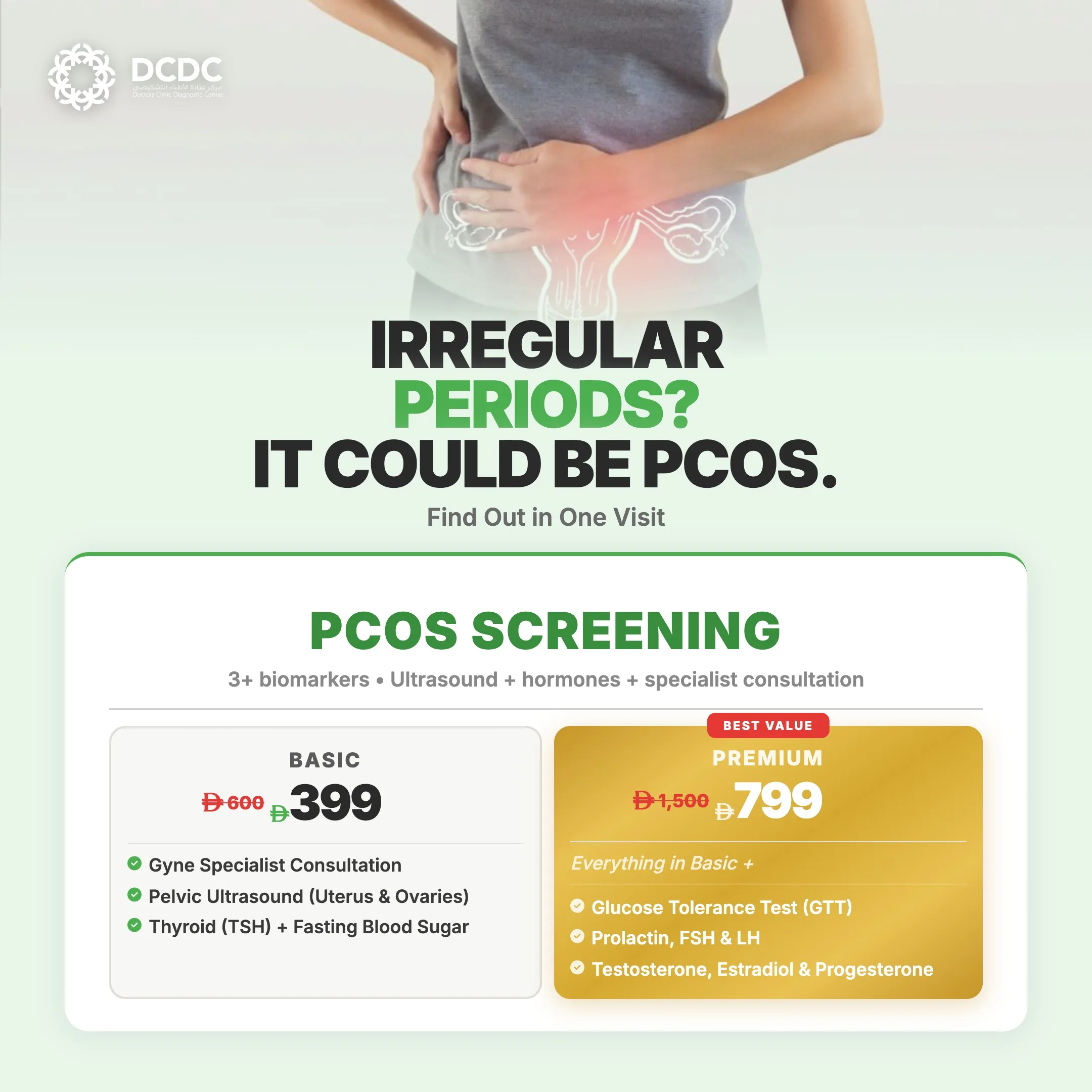
Health Screening Packages
Save with our bundled screening packages — specialist consultation included





What Is Diastasis Recti and Why Does It Happen?
Diastasis recti abdominis (DRA) is the widening of the gap between the two sides of the rectus abdominis muscle — the "six-pack" muscle. These two muscle bellies are connected by a strip of connective tissue called the linea alba. During pregnancy, hormonal changes soften this tissue while the expanding uterus stretches it, causing the muscles to move apart. The separation is a normal adaptation to pregnancy, but it becomes a problem when the gap does not close after delivery.
Diastasis recti is not just a cosmetic issue. The linea alba is a critical component of your core's ability to transfer force and maintain trunk stability. When it is stretched and weakened, your core cannot function properly, leading to lower back pain, poor posture, pelvic floor dysfunction, and difficulty with everyday tasks like lifting your child.
How Do You Self-Check for Diastasis Recti?
You can perform a basic self-check at home. This will not replace a professional assessment, but it gives you a starting point. A physiotherapist uses the same technique with more precision and also evaluates the tension of the linea alba, which matters as much as the width of the gap.
- Step 1: Lie on your back with your knees bent and feet flat on the floor
- Step 2: Place your fingers horizontally across your midline, just above your belly button
- Step 3: Slowly lift your head and shoulders off the floor (like starting a crunch)
- Step 4: Feel how many fingers fit into the gap between the muscles. Also note whether the tissue beneath your fingers feels firm or soft and squishy
- Step 5: Repeat the test at, above, and below the belly button — the gap may be different at each point
How Is Diastasis Recti Severity Graded?
The severity of diastasis recti is measured by the width of the inter-recti distance (IRD). However, width alone does not determine how problematic the separation is. The tension and ability of the linea alba to generate force is equally important. A 3cm gap with good tension may function better than a 2cm gap with no tension at all.
| Grade | Gap Width | Description | Treatment Approach |
|---|---|---|---|
| Normal | Less than 2cm (1–2 fingers) | Within normal limits | General core strengthening |
| Mild | 2–3cm (2–3 fingers) | Common at 6 weeks postpartum, good prognosis | Physiotherapy programme (8–12 weeks) |
| Moderate | 3–5cm (3–4 fingers) | Requires dedicated rehabilitation | Extended physiotherapy (3–6 months) |
| Severe | Greater than 5cm (4+ fingers) | May require surgical consideration after rehab | Intensive physiotherapy, surgical review if no progress |
Which Exercises Help Diastasis Recti — and Which Make It Worse?
This is the most critical section of this guide. Many popular abdominal exercises increase intra-abdominal pressure in a way that pushes the muscles further apart. The exercises that help diastasis recti work from the inside out, rebuilding the deep core before loading the superficial muscles. Getting this wrong does not just slow recovery — it can make the separation permanently worse.
Exercises That HELP
- Diaphragmatic breathing: Reconnects the deep core system — the foundation of all rehabilitation
- Transverse abdominis activation: Gentle "drawing in" of the lower belly, coordinated with breathing
- Pelvic floor contractions: The pelvic floor and deep core work as a unit and must be trained together
- Heel slides and toe taps: Supine exercises that load the core gently while maintaining control
- Modified side plank: From knees, once deep core activation is established
- Pallof press: Anti-rotation exercise that trains the core without flexion
- Glute bridges: Strengthen the posterior chain while engaging the deep core
Exercises That Make It WORSE
- Crunches and sit-ups: Create forward pressure that pushes the muscles apart
- Full planks: Too much load on the linea alba before it has healed
- V-sits and leg raises: High intra-abdominal pressure with poor core control
- Double leg lowers: Overloads the superficial abdominals
- Heavy overhead pressing: Increases downward pressure on the abdominal wall
- Twisting movements under load: Rotational force on a compromised linea alba
What Does a Diastasis Recti Physiotherapy Programme Look Like?
A structured rehabilitation programme progresses through three phases over 3–6 months. Each phase builds on the previous one, and progression is based on your body's response, not a fixed calendar. Your physiotherapist will reassess regularly and adjust the programme accordingly.
| Phase | Duration | Focus | Key Exercises |
|---|---|---|---|
| Phase 1: Reconnection | Weeks 1–4 | Activating the deep core, breathing retraining | Diaphragmatic breathing, TA activation, pelvic floor, glute bridges |
| Phase 2: Loading | Weeks 5–12 | Progressively loading the core under control | Heel slides, bird-dog, modified side plank, Pallof press, resistance band work |
| Phase 3: Integration | Months 3–6 | Functional movements and return to exercise | Squats, lunges, deadlifts (modified), gradual return to planks and running |
How Are Diastasis Recti and the Pelvic Floor Connected?
The pelvic floor and the deep abdominal muscles are part of the same functional unit. When the abdominal wall is compromised by diastasis recti, the pelvic floor often compensates — or fails to function properly. Research shows that 66% of women with diastasis recti also have some degree of pelvic floor dysfunction, including incontinence and prolapse. This is why effective diastasis recti treatment always includes pelvic floor rehabilitation.
When Is Surgery Needed for Diastasis Recti?
Surgery (typically abdominoplasty with rectus repair) is only considered when a comprehensive physiotherapy programme has been completed — meaning at least 3–6 months of consistent, supervised rehabilitation — and a functionally significant gap persists. Most women with mild to moderate diastasis recti recover fully with physiotherapy alone. Surgery may be appropriate for severe separations (greater than 5cm) with poor tissue quality, herniation through the linea alba, or significant functional impairment despite full rehabilitation.
If you are considering surgery, our OB/GYN team can provide a referral and guidance on whether it is appropriate for your situation.
What Is a Realistic Timeline for Diastasis Recti Recovery?
Improvement is gradual and depends on severity, consistency with exercises, and how long the separation has been present. Women who begin rehabilitation within the first year postpartum generally respond faster. However, it is never too late to start — we have seen significant improvement in women who begin treatment years after delivery.
| Starting Point | Expected Progress at 3 Months | Expected Progress at 6 Months |
|---|---|---|
| Mild (2–3cm) | Gap closes to normal range | Full functional recovery |
| Moderate (3–5cm) | 1–2cm reduction, improved tension | Gap at or near normal, good function |
| Severe (5cm+) | Improved tension, some width reduction | Significant improvement, surgical review if plateau |
Get Your Diastasis Recti Assessed
Our physiotherapists at DCDC in Dubai Healthcare City provide accurate diastasis recti assessment and create personalised rehabilitation programmes. Stop guessing and get a proper diagnosis.
DCDC में संबंधित सेवाएं
दुबई हेल्थकेयर सिटी में विशेषज्ञ देखभाल और उन्नत निदान
Physiotherapy
Evidence-based physiotherapy and rehabilitation for diastasis recti
अपॉइंटमेंट बुक करेंPelvic Health
Comprehensive pelvic floor and core assessment for postpartum women
अपॉइंटमेंट बुक करेंGynecology & Obstetrics
Full-spectrum women's health care including postnatal support
अपॉइंटमेंट बुक करेंFrequently Asked Questions
Stop the Sit-Ups, Start the Right Programme
If you have been doing crunches to fix your postpartum belly and seeing no improvement — or getting worse — now you understand why. Diastasis recti requires a specific, progressive rehabilitation approach that works from the inside out. The right exercises produce measurable results within weeks.
The most important step is getting assessed. A 30-minute appointment with our physiotherapy team will tell you exactly where you stand, give you a clear plan, and save you months of wasted effort on exercises that do not help.
स्रोत एवं संदर्भ
यह लेख हमारी चिकित्सा टीम द्वारा समीक्षित है और निम्नलिखित स्रोतों का संदर्भ देता है:
- Sperstad et al: Diastasis Recti Abdominis During Pregnancy and 12 Months After Childbirth (BJSM 2016)
- Benjamin et al: Effects of Exercise on Diastasis of the Rectus Abdominis (Physiotherapy Theory and Practice 2014)
- Lee & Hodges: Behaviour of the Linea Alba During a Curl-up Task (Journal of Orthopaedic & Sports Physical Therapy 2016)
- Mota et al: Diastasis Recti Abdominis: Prevalence, Risk Factors and Impact on Function (Physiotherapy 2015)
- Cochrane Review: Exercise for Diastasis Recti Abdominis
- International Urogynecological Association: Pelvic Floor and Diastasis Recti
इस साइट पर चिकित्सा सामग्री DHA-लाइसेंस प्राप्त चिकित्सकों द्वारा समीक्षित है। हमारी देखें संपादकीय नीति अधिक जानकारी के लिए।

लेखक
Dr. Parisa Dini
Gynecology & Obstetrics
MD, OB-GYN
Dr. Parisa Dini is a Gynecologist at Doctors Clinic Diagnostic Center (DCDC) in Dubai Healthcare City, providing comprehensive women's health care services including prenatal care, screening, and preventive gynecology.
Related Articles
Complete Guide to Physiotherapy in Dubai: Types, Costs & What to Expect
Postnatal Recovery Physiotherapy: Getting Back to Yourself
Pelvic Floor Physiotherapy Dubai: Complete Guide

Prenatal Physiotherapy Exercises for a Healthy Pregnancy
More in Women's Health

Perimenopause vs Menopause Dubai: Signs (2026)
और पढ़ें
Mother & Baby Home Care Dubai: Guide (2026)
और पढ़ें
Gestational Diabetes Dubai: Screening (2026)
और पढ़ें
Mammogram Preparation Dubai: What to Expect (2026)
और पढ़ें
CA-125 Test Dubai: Ovarian Cancer Marker (2026)
और पढ़ेंMammogram vs Breast Ultrasound Dubai (2026)
और पढ़ें© 2026 Doctors Clinic Diagnostic Center (DCDC), Dubai Healthcare City. Originally published at https://doctorsclinicdubai.ae/blog/diastasis-recti-physiotherapy-treatment. All rights reserved. Unauthorized reproduction is prohibited.