Points cles
- The pelvic floor is a group of muscles supporting the bladder, uterus, and rectum — weakness or tightness causes real symptoms
- Urinary leakage during exercise, coughing, or sneezing is common but never normal — physiotherapy resolves it in most cases
- Pelvic floor therapy is not just for postpartum women: menopausal women, athletes, and men also benefit
- Kegel exercises only help if done correctly — up to 50% of women perform them wrong without professional guidance
- A typical treatment programme takes 8–12 sessions over 3–4 months for measurable improvement
- Biofeedback and manual therapy techniques provide faster results than exercises alone
- Pelvic floor strength is directly connected to core stability and lower back health
You leak a little when you sneeze, laugh hard, or jump in a fitness class. You figured it was just something women deal with after having kids. It is not. Urinary incontinence affects roughly one in three women, and pelvic floor physiotherapy resolves the problem in up to 80% of cases — without medication or surgery. Our Pelvic Health service at DCDC offers same-day appointments in Dubai Healthcare City.
At DCDC's Pelvic Health clinic in Dubai Healthcare City, we see patients who have lived with pelvic floor dysfunction for years before seeking help, often because they did not know treatment existed. This guide explains what the pelvic floor actually does, how to recognise dysfunction, and what evidence-based physiotherapy involves.
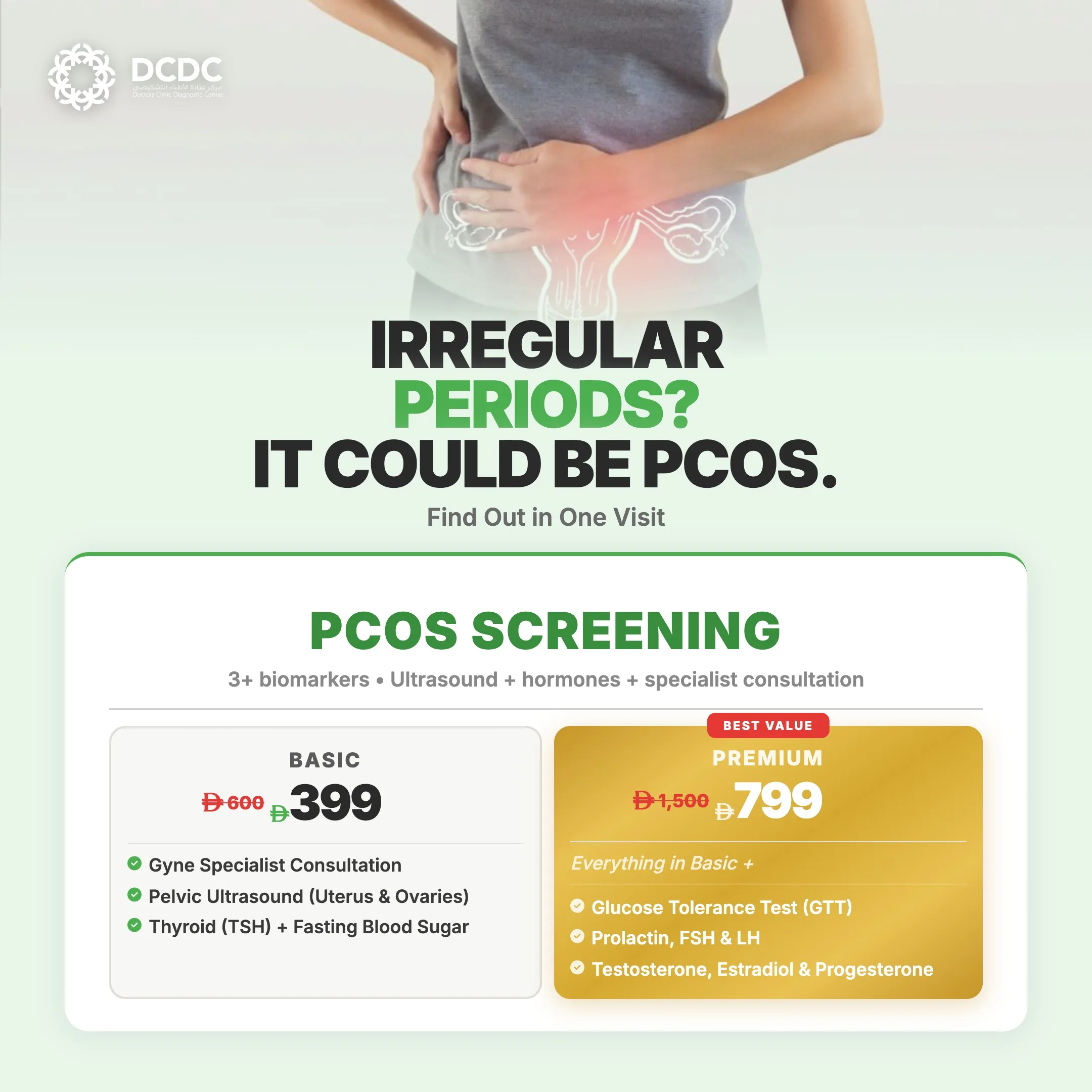
Health Screening Packages
Save with our bundled screening packages — specialist consultation included





What Is the Pelvic Floor and Why Does It Matter?
The pelvic floor is a hammock-shaped group of muscles stretching from the pubic bone to the tailbone. These muscles support three critical organs: the bladder, the uterus (or prostate in men), and the rectum. They also control urination, bowel movements, and sexual function. When these muscles become weak, tight, or uncoordinated, the consequences affect daily life in ways most people do not expect.
Think of the pelvic floor as the foundation of your core. Just as a building collapses without a solid foundation, your core cannot function properly if the pelvic floor is compromised. This is why lower back pain, hip pain, and abdominal weakness often have a pelvic floor component that gets overlooked.
What Are the Signs of Pelvic Floor Dysfunction?
Pelvic floor dysfunction presents differently depending on whether the muscles are too weak, too tight, or poorly coordinated. Recognising symptoms early leads to faster, more complete recovery. Many patients are surprised to learn their chronic hip pain or lower back issues are connected to the pelvic floor.
- Stress incontinence: Leaking urine when coughing, sneezing, laughing, or exercising
- Urge incontinence: Sudden, intense need to urinate with inability to hold it
- Pelvic organ prolapse: Feeling of heaviness, pressure, or bulging in the vaginal area
- Pelvic pain: Chronic pain in the pelvis, lower abdomen, or during intercourse
- Bowel dysfunction: Difficulty controlling gas or stool, chronic constipation
- Sexual dysfunction: Pain during intercourse, reduced sensation, difficulty with arousal
- Core weakness: Persistent lower back pain, inability to engage abdominal muscles effectively
Who Benefits from Pelvic Floor Physiotherapy?
Pelvic floor physiotherapy is not exclusively a postpartum treatment. While new mothers are the largest group we see, the therapy benefits a much wider population. Anyone experiencing pelvic floor symptoms — regardless of age, gender, or whether they have had children — can benefit from a professional assessment.
| Patient Group | Common Issues | How Physiotherapy Helps |
|---|---|---|
| Postpartum women | Incontinence, prolapse, diastasis recti | Restores muscle strength and coordination after delivery |
| Pregnant women | Pelvic girdle pain, preparation for labour | Teaches pushing techniques, reduces tearing risk |
| Menopausal women | Incontinence, prolapse from hormonal changes | Compensates for oestrogen-related tissue changes |
| Athletes & gym-goers | Stress incontinence during high-impact exercise | Retrains pressure management during exertion |
| Men (post-prostatectomy) | Urinary incontinence after prostate surgery | Accelerates return of bladder control |
| Chronic pain patients | Pelvic pain, painful intercourse | Releases hypertonic (too-tight) muscles |
What Happens in a Pelvic Floor Physiotherapy Session?
The first session is an assessment lasting about 45–60 minutes. Your physiotherapist will take a detailed history covering bladder and bowel habits, obstetric history, exercise routine, and symptoms. A physical examination may include external and internal assessment of the pelvic floor muscles to evaluate strength, endurance, coordination, and resting tone.
- Assessment: Muscle strength grading (Oxford scale 0–5), checking for prolapse, evaluating coordination
- Biofeedback: Sensors show you on-screen whether you are contracting the correct muscles — essential since many patients unknowingly use the wrong technique
- Manual therapy: Internal or external trigger point release for tight, painful muscles
- Exercise prescription: Individualised programme targeting your specific weakness pattern
- Behavioural strategies: Bladder retraining, fluid management, and posture correction
Which Exercises Strengthen the Pelvic Floor?
Kegel exercises are the foundation of pelvic floor rehabilitation, but they only work if performed correctly. Research shows that up to 50% of women perform Kegels incorrectly when relying on written or verbal instructions alone, often bearing down instead of lifting up. This is why professional guidance with biofeedback makes such a significant difference.
- Slow Kegels: Contract and hold for 8–10 seconds, relax for equal time. Build to 10 repetitions, 3 times daily
- Fast Kegels: Quick contract-release pulses to train the fast-twitch fibres that prevent leaking during coughing or sneezing
- Relaxation exercises: Deep diaphragmatic breathing to release a hypertonic (too tight) pelvic floor — just as important as strengthening
- Core integration: Coordinating pelvic floor activation with transverse abdominis and deep back muscles
- Functional training: Practising correct pelvic floor engagement during lifting, coughing, and exercise movements
How Long Does Pelvic Floor Treatment Take?
Most patients notice improvement within 4–6 weeks of consistent, correctly performed exercises. A full treatment programme typically involves 8–12 sessions over 3–4 months. However, timelines vary depending on the severity of dysfunction, how long symptoms have been present, and patient adherence to the home exercise programme.
| Condition | Typical Sessions | Expected Timeline |
|---|---|---|
| Mild stress incontinence | 6–8 sessions | 2–3 months |
| Moderate incontinence or prolapse | 8–12 sessions | 3–4 months |
| Chronic pelvic pain | 10–16 sessions | 4–6 months |
| Postpartum recovery | 6–10 sessions | 2–4 months |
| Post-prostatectomy (men) | 8–12 sessions | 3–6 months |
How Is the Pelvic Floor Connected to Core Strength?
The pelvic floor forms the base of the deep core system, which also includes the transverse abdominis (deep abdominal muscle), the multifidus (deep back muscle), and the diaphragm. These four muscle groups work together like a pressurised canister. If any one component is weak or dysfunctional, the entire system is compromised. This is why many women with postpartum core weakness also have pelvic floor dysfunction, and vice versa.
At our physiotherapy clinic, we always assess the pelvic floor as part of core rehabilitation — and we always assess core function as part of pelvic floor treatment. Treating one without the other limits results.
Book a Pelvic Floor Assessment
Our physiotherapists at DCDC in Dubai Healthcare City provide confidential, evidence-based pelvic floor assessment and treatment. Most patients see improvement within the first month.
Services associés au DCDC
Soins spécialisés et diagnostics avancés à Dubai Healthcare City
Frequently Asked Questions
Pelvic Floor Health Is Not Optional
Leaking urine is common, but it is not something you have to accept. Pelvic pain does not have to become your new normal after childbirth. And that heaviness you feel is not just something that happens with age.
Pelvic floor physiotherapy is the gold-standard first-line treatment for these conditions, backed by decades of research. The earlier you start, the better the outcomes. If you are experiencing any of the symptoms described above, book an assessment at our Pelvic Health clinic in Dubai Healthcare City.
Sources et references
Cet article a ete revise par notre equipe medicale et fait reference aux sources suivantes :
- Cochrane Review: Pelvic Floor Muscle Training for Urinary Incontinence in Women
- International Continence Society: Pelvic Floor Rehabilitation Guidelines
- NICE Guidelines: Urinary Incontinence and Pelvic Organ Prolapse in Women
- American College of Obstetricians and Gynecologists: Pelvic Floor Disorders
- Physiotherapy Evidence Database (PEDro): Pelvic Floor Interventions
Le contenu medical de ce site est revise par des medecins agrees DHA. Voir notre politique editoriale pour plus d'informations.

Redige par
Dr. Parisa Dini
Gynecology & Obstetrics
MD, OB-GYN
Dr. Parisa Dini is a Gynecologist at Doctors Clinic Diagnostic Center (DCDC) in Dubai Healthcare City, providing comprehensive women's health care services including prenatal care, screening, and preventive gynecology.
Related Articles
Complete Guide to Physiotherapy in Dubai: Types, Costs & What to Expect

Prenatal Physiotherapy Exercises for a Healthy Pregnancy
Postnatal Recovery Physiotherapy: Getting Back to Yourself
Diastasis Recti: How Physiotherapy Helps Recovery
More in Women's Health

Perimenopause vs Menopause Dubai: Signs (2026)
Lire la suite
Mother & Baby Home Care Dubai: Guide (2026)
Lire la suite
Gestational Diabetes Dubai: Screening (2026)
Lire la suite
Mammogram Preparation Dubai: What to Expect (2026)
Lire la suite
CA-125 Test Dubai: Ovarian Cancer Marker (2026)
Lire la suiteMammogram vs Breast Ultrasound Dubai (2026)
Lire la suite© 2026 Doctors Clinic Diagnostic Center (DCDC), Dubai Healthcare City. Originally published at https://doctorsclinicdubai.ae/blog/pelvic-floor-physiotherapy-dubai. All rights reserved. Unauthorized reproduction is prohibited.