
Points cles
- Prolonged sitting increases intradiscal pressure by 40% compared to standing and is the primary driver of office-related back pain
- Dubai-specific factors like extreme AC, long car commutes, and sedentary weekday-active weekend patterns amplify back pain risk
- An ergonomic desk setup takes 10 minutes but can prevent years of chronic pain. Monitor height, chair angle, and keyboard position matter most.
- Five simple desk exercises done twice daily can significantly reduce pain and stiffness. Consistency matters more than intensity.
- If your back pain involves numbness, tingling, leg pain, or persists beyond 4 weeks despite ergonomic changes, stretching alone is not enough
- A single physiotherapy ergonomic assessment costs less than one week of productivity lost to back pain
It is 3 PM in your Dubai office and your lower back is aching again. You have been sitting since 8 AM, the AC is blasting on your left shoulder, and you skipped the gym all week. You are not alone. Back pain is the most common reason for workplace absenteeism in the UAE, and the desk-heavy, car-dependent Dubai lifestyle makes it almost inevitable without proactive prevention. Our Physiotherapy service at DCDC offers same-day appointments in Dubai Healthcare City.
This guide is written specifically for Dubai office workers. It addresses the unique environmental and lifestyle factors that contribute to desk-related back pain in this city, and provides actionable solutions you can implement today.


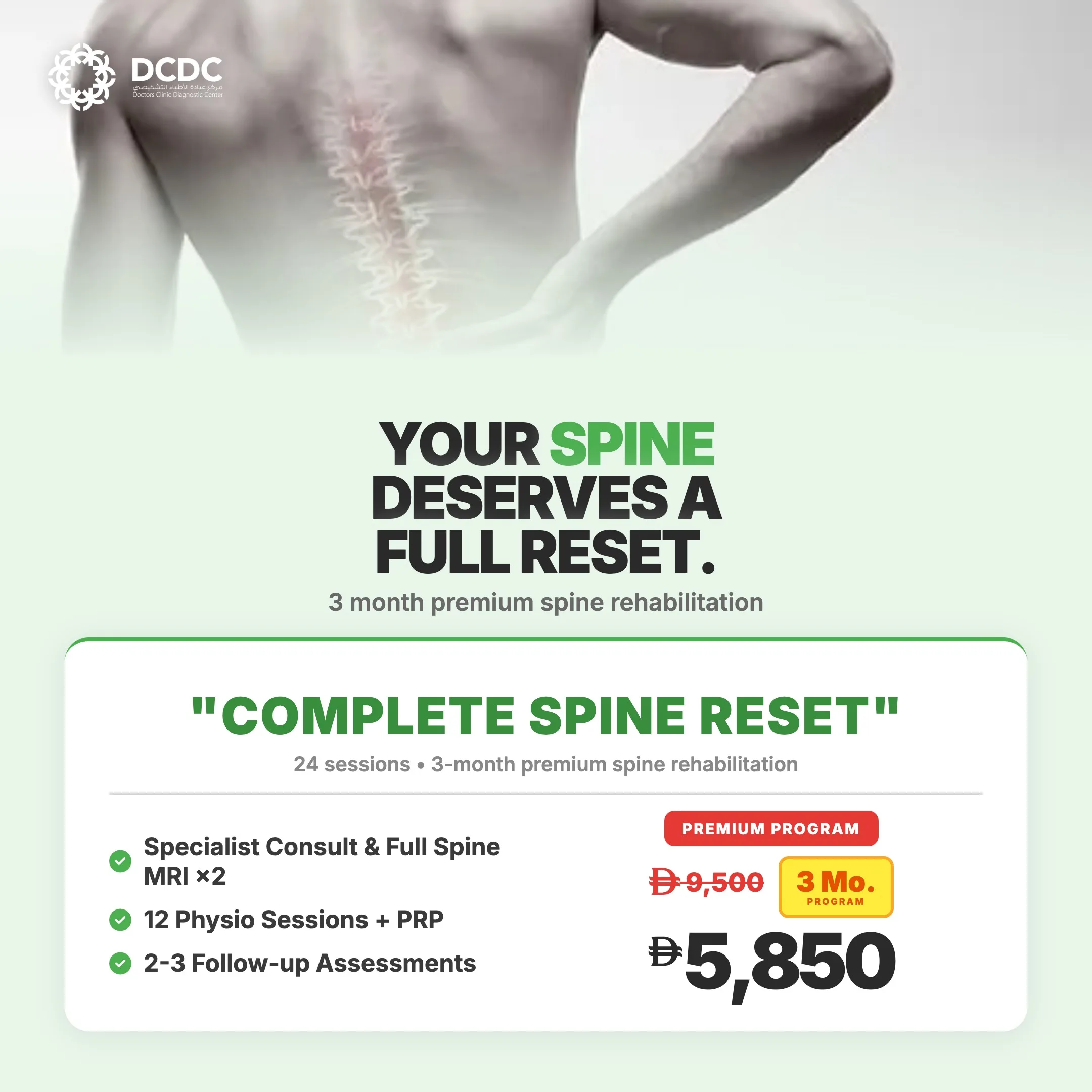
Why Is Back Pain So Common Among Dubai Office Workers?
Back pain among desk workers is a global problem, but Dubai has several compounding factors that make it worse. Understanding these helps explain why generic advice often falls short for residents here.
Dubai-Specific Lifestyle Factors
- Extreme air conditioning: Most Dubai offices are heavily air-conditioned, and the constant cold air causes sustained muscle contraction, especially in the neck, shoulders, and upper back. Moving between 45 degrees outside and 20 degrees inside creates repeated thermal shock to muscles.
- Long car commutes: The average Dubai commute is 30-60 minutes each way. Car seats are not designed for spinal health, and sitting in traffic adds another 1-2 hours of static sitting to an already sedentary day.
- Weekend warrior syndrome: Five days of minimal movement followed by intense Friday gym sessions or Saturday hikes creates a pattern of underconditioning and overloading that the spine tolerates poorly.
- Limited walking culture: Unlike cities with public transport and walkable streets, Dubai's car-centric design means most professionals walk less than 3,000 steps on workdays, far below the recommended 8,000-10,000.
- Extended work hours: Many Dubai professionals work 9-10+ hour days, meaning 50+ hours per week of sustained sitting.
- Stress and pressure: Dubai's competitive work environment leads to elevated cortisol, which increases muscle tension and lowers pain thresholds.
How Should You Set Up Your Desk Ergonomically?
Proper ergonomic setup is the single most impactful change you can make. It takes 10 minutes and costs nothing if you already have an adjustable chair. Here is a systematic checklist for your workstation.
Chair Setup
- Seat height: Adjust so your feet are flat on the floor and knees are at 90-100 degrees. If the chair is too high, use a footrest.
- Seat depth: Leave a 2-3 finger gap between the seat edge and the back of your knees to avoid compressing the popliteal area.
- Backrest angle: Recline slightly to 100-110 degrees. This reduces intradiscal pressure by 20-30% compared to sitting upright at 90 degrees.
- Lumbar support: The curve of the backrest should match the natural curve of your lower back. If your chair lacks lumbar support, use a rolled towel or a small cushion.
- Armrests: Adjust so your elbows rest at 90 degrees with shoulders relaxed. Armrests that are too high cause shoulder tension; too low causes you to lean.
Monitor, Keyboard, and Mouse
- Monitor height: Top of the screen at or slightly below eye level. If using a laptop, invest in a laptop stand and external keyboard.
- Monitor distance: Arm's length away (50-70 cm). Text should be readable without leaning forward.
- Keyboard position: Directly in front of you, close enough that your elbows stay at your sides at 90 degrees. Avoid reaching forward.
- Mouse placement: Right next to the keyboard at the same height. A mouse pad with wrist support helps maintain a neutral wrist position.
- Dual monitors: If you use two screens, place the primary one directly in front and the secondary angled toward you. Avoid placing both off-center, which causes sustained neck rotation.
What Are the 5 Best Desk Exercises for Back Pain?
These five exercises can be performed at your desk without any equipment. Do the full sequence twice daily, ideally mid-morning and mid-afternoon. The entire routine takes less than 8 minutes. For related information, see our guide on Lower Back Pain: Causes & Physio Exercises.
- 1. Seated cat-cow (1 minute): Sit forward on your chair, hands on knees. Arch your back and look up (cow), then round your back and tuck chin (cat). 10 slow repetitions. This mobilizes the entire spine and counteracts sustained flexion posture.
- 2. Seated hip flexor stretch (1 minute each side): Sit sideways on the edge of your chair. Let the outer leg drop back and down. Push your hip gently forward until you feel a stretch in the front of the hip. Hold 30 seconds, repeat twice each side. Tight hip flexors pull the pelvis forward and increase lumbar strain.
- 3. Thoracic rotation (1 minute): Sit upright, cross arms over chest. Rotate your upper body to the right, hold 5 seconds, then left. 8 repetitions each direction. This mobilizes the thoracic spine, which stiffens quickly from desk work and forces the lower back to compensate.
- 4. Standing back extension (1 minute): Stand up, place hands on your lower back, and gently lean backward. Hold for 3 seconds at end range. 10 repetitions. This reverses the flexed posture of sitting and reduces intradiscal pressure.
- 5. Wall angels (2 minutes): Stand with your back against a wall, feet 6 inches from the wall. Place arms against the wall in a "goalpost" position. Slowly slide arms up and down, keeping contact with the wall. 10 repetitions. Corrects rounded shoulder posture and activates the upper back muscles that desk work weakens.
How Can You Check Your Own Posture?
Use this quick posture self-assessment checklist twice a day. Set a phone reminder for 11 AM and 3 PM. It takes 30 seconds and helps you catch poor posture before it causes pain.
- Ears over shoulders: Is your head jutting forward? If your ear is in front of your shoulder line, you have forward head posture.
- Shoulders relaxed and down: Are your shoulders creeping up toward your ears? Consciously drop them.
- Lower back curve maintained: Can you feel a gentle inward curve in your lower back, or have you slumped into a C-shape?
- Both feet flat on floor: Are you crossing your legs or sitting on one foot? This creates pelvic asymmetry.
- Weight even on both sit bones: Are you leaning to one side? Redistribute your weight evenly.
- Screen at eye level: Are you looking down at your laptop? Raise it up.
When Is Stretching Not Enough?
Desk exercises and ergonomic changes solve the majority of office-related back pain. But there are clear signs that self-management has reached its limit and professional help is needed. Do not push through these warning signs.
- Pain radiating into the leg or arm: This suggests nerve involvement, not just muscle tension. See a physiotherapist or spine specialist.
- Numbness or tingling in hands or feet: May indicate nerve compression from disc or joint pathology.
- Pain that persists beyond 4 weeks: Despite ergonomic changes and regular exercises, pain lasting over a month warrants professional assessment.
- Morning stiffness lasting more than 30 minutes: Could indicate an inflammatory condition that requires medical evaluation.
- Pain waking you at night: Night pain that disrupts sleep should always be investigated.
- Weakness in grip or legs: Any loss of strength associated with back or neck pain needs prompt evaluation.
- Headaches originating from the neck: Cervicogenic headaches are common in desk workers and respond well to physiotherapy but not to stretching alone.
At DCDC, our physiotherapy team regularly sees office workers whose back pain started as mild stiffness but progressed to disc problems or chronic pain because they waited too long to seek help. Early intervention is both more effective and less expensive.
What Does Professional Treatment for Office Back Pain Include?
When self-management is not enough, a physiotherapy program for office-related back pain typically includes a combination of hands-on treatment and long-term behavioral changes tailored to your specific work environment. You may also find our Plantar Fasciitis: Physiotherapy Treatment Guide helpful.
- Ergonomic workplace assessment: Your physiotherapist reviews photos or videos of your actual desk setup and provides specific modification recommendations.
- Manual therapy: Hands-on joint mobilization and soft tissue work to address stiffness and muscle tension that exercises alone cannot resolve.
- Personalized exercise program: A targeted plan addressing your specific weaknesses, whether that is core stability, thoracic mobility, hip flexibility, or postural endurance.
- Dry needling: For chronic muscle trigger points that do not respond to stretching, particularly in the upper trapezius, levator scapulae, and lumbar paraspinals.
- Movement retraining: Teaching you how to sit, stand, lift, and transition between positions in ways that protect your spine throughout the workday.
Desk Pain Slowing You Down?
Book a physiotherapy assessment at Doctors Clinic Diagnostic Center in Dubai Healthcare City. Our physiotherapy team specializes in treating desk-related pain with ergonomic advice, manual therapy, and tailored exercise programs.
Services associés au DCDC
Soins spécialisés et diagnostics avancés à Dubai Healthcare City
Frequently Asked Questions
Your Back Does Not Have to Hurt
Office back pain is not an inevitable part of desk work, even in Dubai's challenging environment. The combination of a properly set up workstation, regular desk exercises, and consistent physical activity outside of work hours prevents the vast majority of cases. The solutions are simple, but they require consistency.
If you are already in pain and self-management is not providing relief, do not wait for it to become chronic. A physiotherapy assessment can identify the specific factors driving your pain and get you on a targeted treatment plan. At DCDC in Dubai Healthcare City, we see office workers every day and understand the unique challenges of this city's work culture.
Sources et references
Cet article a ete revise par notre equipe medicale et fait reference aux sources suivantes :
- Occupational Medicine - Sedentary Work and Musculoskeletal Disorders
- European Spine Journal - Sitting Posture and Lumbar Spine Loading
- Dubai Health Authority - Workplace Health Guidelines
- Ergonomics - Office Workstation Design Standards (ISO 9241)
- BMC Musculoskeletal Disorders - Exercise for Office Workers with Back Pain
Le contenu medical de ce site est revise par des medecins agrees DHA. Voir notre politique editoriale pour plus d'informations.

Redige par
Dr. Hadi Komshi
Specialist Internal Medicine
MD, DHA-Licensed
Dr. Hadi Komshi is a DHA-licensed Internal Medicine Specialist at Doctors Clinic Diagnostic Center in Dubai Healthcare City, with extensive experience in managing acute and chronic medical conditions including musculoskeletal pain and rehabilitation.
Related Articles

Lower Back Pain: Causes, Exercises & When to See a Physiotherapist
Back Pain in Dubai: Causes, Treatment & When to Get an MRI
Physiotherapy Dubai: Complete Guide
More in Physiotherapy
Physiotherapy Packages Dubai: Save 20%+ (2026)
Lire la suite
Shoulder Pain Dubai: 7 Causes & When to Worry (2026)
Lire la suite
PRP vs Cortisone Dubai: Which Injection? (2026)
Lire la suite
PRP Injection for Joints Dubai: From AED 1,500 (2026)
Lire la suitePhysiotherapy Cost Dubai: AED 250–500/Session (2026)
Lire la suitePhysiotherapy Dubai: Types, Cost & Guide (2026)
Lire la suite© 2026 Doctors Clinic Diagnostic Center (DCDC), Dubai Healthcare City. Originally published at https://doctorsclinicdubai.ae/blog/office-worker-back-pain-prevention. All rights reserved. Unauthorized reproduction is prohibited.