Points cles
- MRI uses no ionizing radiation while CT exposes patients to X-ray radiation, making MRI safer for repeated screening
- CT scans are significantly faster (5-15 minutes) compared to full body MRI (60-90 minutes)
- MRI provides superior soft tissue contrast, making it better for brain, spine, joint, and organ imaging
- CT excels at detecting bone fractures, lung conditions, and acute emergencies due to speed and bone detail
- Both imaging methods are complementary rather than competing; the right choice depends on the clinical question
When patients need comprehensive body imaging, two options dominate the conversation: full body MRI and CT scan. Both provide detailed internal images, but they work on fundamentally different principles and excel in different clinical scenarios. Understanding these differences helps patients and physicians choose the most appropriate imaging method for each situation.
How MRI and CT Scans Work: The Fundamental Difference
MRI (Magnetic Resonance Imaging) uses powerful magnetic fields and radio waves to create images of the body's internal structures. It measures how hydrogen atoms in body tissues respond to magnetic pulses, which produces exceptional contrast between different types of soft tissue. MRI does not use any ionizing radiation.
CT (Computed Tomography) uses X-ray beams that rotate around the body to create cross-sectional images. A computer processes these X-ray measurements to generate detailed 3D images. CT provides excellent visualization of bones, blood vessels, and organs, but involves exposure to ionizing radiation.
Full Body MRI vs. CT Scan: Complete Comparison
The following comparison table highlights the key differences between full body MRI and CT scan across all major factors that patients and physicians consider when choosing between these imaging methods.
| Factor | Full Body MRI | CT Scan |
|---|---|---|
| Radiation exposure | None (magnetic fields only) | Yes (ionizing X-ray radiation) |
| Scan duration | 60-90 minutes | 5-15 minutes |
| Soft tissue detail | Excellent (superior) | Good |
| Bone detail | Good | Excellent (superior) |
| Brain imaging | Gold standard | Good for emergencies |
| Lung imaging | Limited (motion artifacts) | Excellent |
| Joint and ligament imaging | Excellent | Limited |
| Liver and kidney imaging | Excellent | Good |
| Spinal cord visualization | Excellent | Limited |
| Cost (approximate) | AED 5,000-15,000 | AED 1,500-4,000 |
| Contrast dye | Gadolinium (rare reactions) | Iodine-based (more common reactions) |
| Claustrophobia concern | Yes (enclosed tube) | Minimal (open ring design) |
| Metal implants | May be contraindicated | Generally safe |
| Availability for emergencies | Limited (long scan time) | Excellent (fast results) |
| Repeat screening safety | Safe (no radiation) | Cumulative radiation risk |
This comparison reflects general characteristics. Specific clinical scenarios may alter the preferred choice.
"I often tell patients that MRI and CT are not rivals — they are teammates," explains Dr. Osama Elzamzami, Consultant Radiologist at DCDC. "Each technology reveals information the other cannot. The real skill in diagnostic radiology is knowing which tool to use for which question, and sometimes the answer is both."
When Is Full Body MRI the Better Choice?
Full body MRI is the preferred imaging method in several clinical scenarios where its unique strengths provide diagnostic advantages over CT. The absence of radiation is particularly significant for screening and surveillance purposes.
- Cancer screening and surveillance: MRI's radiation-free nature makes it ideal for repeated screening, especially for individuals with hereditary cancer risk or cancer survivors requiring regular monitoring.
- Brain and neurological conditions: MRI is the gold standard for brain imaging, providing unmatched detail of brain tissue, nerves, and vascular structures. CT is used for emergencies but MRI is preferred for detailed diagnosis.
- Spine and spinal cord evaluation: MRI is the only imaging method that clearly visualizes the spinal cord itself, making it essential for suspected cord compression, disc herniations, and spinal tumors.
- Joint and soft tissue injuries: Ligament tears, cartilage damage, and meniscal injuries are best evaluated with MRI. CT provides limited information about these structures.
- Liver and abdominal organ characterization: MRI with contrast is often superior to CT for characterizing liver lesions, distinguishing benign from malignant masses, and evaluating bile duct pathology.
- Pediatric and pregnancy imaging: When imaging is necessary for children or pregnant women, MRI is strongly preferred due to the absence of radiation exposure.
- Proactive health screening: For individuals seeking comprehensive baseline imaging without a specific medical concern, MRI offers thorough assessment without radiation risk.
When Is CT Scan the Better Choice?
CT scanning has distinct advantages in situations where speed, bone detail, or lung imaging is critical. Its rapid scan time makes it indispensable in emergency medicine.
- Emergency and trauma situations: CT's speed (5-15 minutes) is life-saving in emergencies. It can quickly identify internal bleeding, organ damage, and fractures in trauma patients.
- Lung conditions and screening: Low-dose CT is the standard for lung cancer screening and is far superior to MRI for detecting small lung nodules, pneumonia, and other pulmonary conditions.
- Bone fractures and skeletal evaluation: CT provides the clearest images of bone structures and is the preferred method for complex fractures, spinal alignment issues, and bone tumors.
- Kidney stones and urinary tract evaluation: Non-contrast CT is the standard for detecting kidney stones and evaluating urinary tract obstruction due to excellent stone visualization.
- Acute stroke assessment: While MRI provides more detail, CT is used first in stroke evaluation because it can quickly rule out hemorrhagic stroke within minutes.
- Vascular imaging (CT angiography): CT angiography provides rapid, detailed visualization of blood vessels, particularly useful for evaluating aortic aneurysms, pulmonary embolism, and coronary artery disease.
- Patients with MRI contraindications: Patients with certain pacemakers, cochlear implants, or metallic foreign bodies who cannot undergo MRI can safely have CT scans.
Radiation Exposure: Why It Matters
One of the most significant differences between MRI and CT is radiation exposure. A single full-body CT scan exposes the patient to approximately 10-30 millisieverts (mSv) of radiation, which is equivalent to several years of natural background radiation. While a single CT scan carries a very low individual risk, the concern grows with repeated exposure over time.
MRI uses zero ionizing radiation. This makes it the clearly superior choice for situations requiring repeated imaging, such as cancer surveillance, monitoring chronic conditions, or periodic health screening. For patients who need regular imaging over years or decades, the cumulative radiation from repeated CT scans becomes a meaningful consideration.
It is important to note that when a CT scan is medically necessary, the diagnostic benefit far outweighs the minimal radiation risk. The goal is not to avoid CT entirely, but to use the most appropriate imaging method for each specific clinical question.
Cost Comparison: MRI vs. CT in Dubai
Cost is a practical factor in imaging decisions, especially when insurance coverage varies. In Dubai, CT scans are generally less expensive than MRI scans due to shorter scan times and lower operational costs.
| Imaging Type | Approximate Cost in Dubai (AED) |
|---|---|
| Single-region CT scan | 800 – 2,000 |
| Full body CT scan | 1,500 – 4,000 |
| Single-region MRI scan | 900 – 2,500 |
| Full body MRI scan | 5,000 – 15,000 |
Prices are approximate ranges and vary by facility, scan complexity, and contrast use.
While MRI is more expensive, the diagnostic value and absence of radiation often justify the cost, particularly for screening purposes or when the clinical question specifically requires MRI's soft tissue capabilities. Many insurance plans cover MRI when it is medically indicated.
Can You Get Both MRI and CT Scan?
Yes, MRI and CT are frequently used together as complementary examinations. In many clinical scenarios, having both scans provides a more complete diagnostic picture than either alone. For example, a patient with a suspected liver tumor might first have a CT scan for initial assessment and then an MRI for more detailed characterization of the lesion.
Other common scenarios where both may be used include cancer staging (CT for chest and MRI for abdomen/pelvis), trauma evaluation (CT for acute assessment and MRI for follow-up of soft tissue injuries), and spinal conditions (CT for bone detail and MRI for disc and nerve evaluation).
A 60-year-old man was referred to DCDC after routine blood work revealed elevated liver enzymes and a mildly raised PSA level. His physician ordered both a CT scan and a full body MRI to investigate. The CT scan, completed in under 15 minutes, identified a small calcified gallstone and provided a clear view of his lung fields, ruling out any pulmonary nodules. The full body MRI, performed the following day, revealed a suspicious soft tissue lesion in the liver that the CT had classified as a simple cyst, as well as a PI-RADS 4 lesion in the prostate that warranted further evaluation. The complementary findings from both scans gave his referring physician a complete diagnostic picture that guided the next steps — a liver-specific MRI with contrast and a targeted prostate biopsy. This case illustrated exactly why both modalities are often needed together rather than viewed as alternatives.
At Doctors Clinic Diagnostic Center, our radiologists can advise on whether a single imaging method or a combination approach is most appropriate for your specific clinical needs. Both MRI and CT scan services are available on-site.
Patient Experience: What to Expect with Each
The patient experience differs significantly between MRI and CT, and this can influence the choice for some patients.
MRI Patient Experience
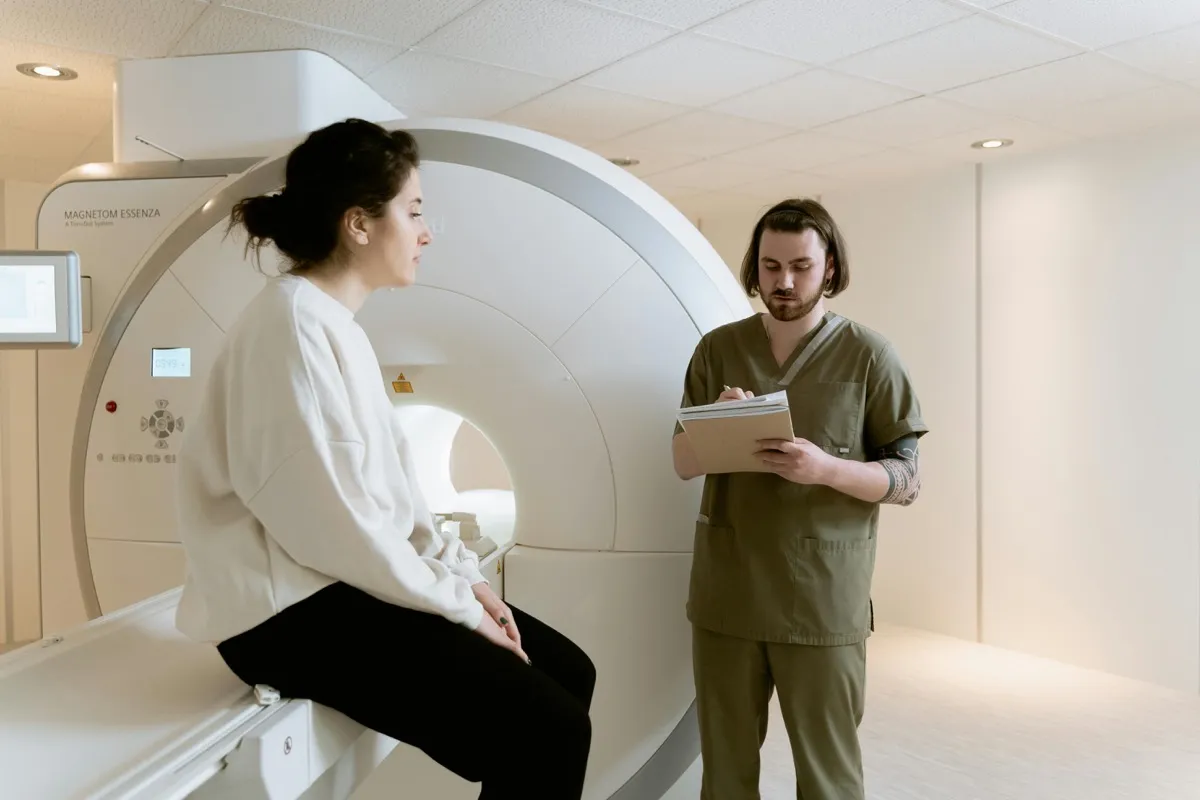
MRI requires lying still in a cylindrical tube for 60-90 minutes. The machine produces loud knocking and humming sounds, requiring earplugs or headphones. Some patients experience claustrophobia, though open MRI machines are available for those who need a more spacious environment. The scan is painless, and patients can communicate with the technologist throughout via an intercom system.
CT Patient Experience
CT is considerably faster and generally more comfortable. The machine has an open ring design, which causes less claustrophobia than MRI. The scan takes only 5-15 minutes, making it easier for patients who have difficulty lying still. If contrast is needed, patients may feel a warm sensation or metallic taste momentarily when the dye is injected. The machine is much quieter than an MRI scanner.
Making the Right Choice at DCDC
At Doctors Clinic Diagnostic Center in Dubai Healthcare City, both MRI and CT scan services are performed by experienced radiologists using modern equipment. Performing over 1,000 diagnostic imaging studies monthly since 2013, DCDC has more than 13 years of experience as a leading diagnostic center in Dubai Healthcare City, serving both local residents and international patients who visit from around the world for our comprehensive diagnostic services. Our team helps patients and referring physicians select the most appropriate imaging method based on the clinical question, patient factors, and diagnostic goals.
For patients seeking comprehensive screening without radiation, full body MRI is the clear choice. For acute conditions, emergencies, or lung-specific evaluations, CT provides faster and equally valuable diagnostic information. Our radiologists are available to discuss which approach best serves your specific needs.
"The decision between MRI and CT should never be driven by convenience alone," explains Dr. Osama Elzamzami, Consultant Radiologist at DCDC. "A CT scan is fast, but if the clinical question requires soft tissue characterization, speed will not compensate for the information you miss. Conversely, ordering an MRI when a CT would suffice adds time and cost without added benefit. Our role is to help guide that decision."
Need Help Choosing Between MRI and CT?
At Doctors Clinic Diagnostic Center, we offer both MRI and CT scan services with experienced radiologists who can recommend the best imaging approach for your specific needs.
Contact UsQuestions frequentes
Final Thoughts
The choice between full body MRI and CT scan is not about which is universally better, but which is more appropriate for your specific situation. MRI offers unmatched soft tissue detail and radiation-free imaging, making it ideal for screening, brain imaging, and musculoskeletal evaluation. CT provides rapid, detailed images with excellent bone and lung visualization, making it essential for emergencies and specific diagnostic questions.
At Doctors Clinic Diagnostic Center in Dubai Healthcare City, our team of experienced radiologists helps patients navigate this decision with clear, evidence-based guidance. For MRI pricing details, see our full body MRI cost guide for Dubai. Whether you need an MRI, a CT scan, or both, we are committed to delivering accurate diagnostics with a patient-centered approach. Contact us to discuss which imaging option best addresses your health concerns.
Sources et references
Cet article a ete revise par notre equipe medicale et fait reference aux sources suivantes :
- American College of Radiology - Appropriateness Criteria
- Radiological Society of North America - MRI vs CT Information
- European Society of Radiology - Imaging Guidelines
- Dubai Health Authority - Diagnostic Imaging Standards
Le contenu medical de ce site est revise par des medecins agrees DHA. Voir notre politique editoriale pour plus d'informations.

Redige par
Dr. Osama Elzamzami
Consultant Radiologist
MD, Radiology
Dr. Osama Elzamzami is a Consultant Radiologist specializing in diagnostic imaging including MRI, CT, and ultrasound at DCDC Dubai Healthcare City.