Mga Pangunahing Punto
- Regular ultrasound shows structure and anatomy, while Doppler ultrasound measures blood flow speed and direction
- Both use the same sound wave technology with no radiation, making them equally safe
- Many modern machines can perform both regular and Doppler ultrasound in a single session
- Doppler costs slightly more than regular ultrasound due to the additional blood flow analysis
- Your doctor chooses the type based on your symptoms and what diagnostic information is needed
If your doctor has recommended an ultrasound, you may wonder whether you need a regular ultrasound or a Doppler ultrasound. While both use sound waves to create images inside your body, they serve different diagnostic purposes. A regular ultrasound captures pictures of organs and tissues, while a Doppler ultrasound specifically measures how blood flows through your vessels.
This article breaks down the differences between Doppler and regular ultrasound in clear terms. You will learn what each type shows, when doctors choose one over the other, whether a single scan can provide both types of information, and how costs compare at clinics in Dubai.
The Core Difference: Structure vs. Flow
The fundamental difference between regular ultrasound and Doppler ultrasound comes down to what each one measures. Think of it this way: a regular ultrasound is like taking a photograph of a river, showing you the banks, rocks, and surrounding landscape. A Doppler ultrasound is like measuring the speed and direction of the water flowing through that river.
A regular ultrasound (also called B-mode or grayscale ultrasound) sends sound waves into your body and creates images based on how those waves bounce back from different tissues. It excels at showing the size, shape, and texture of organs like the liver, kidneys, thyroid, and uterus. It can detect cysts, tumors, gallstones, and structural abnormalities with high clarity.
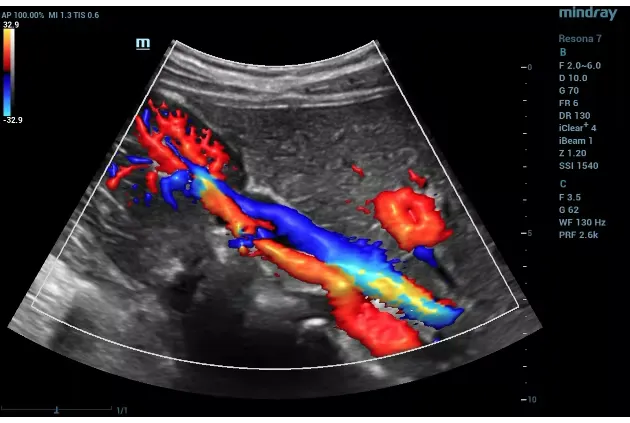
A Doppler ultrasound uses the same sound wave technology but adds an extra layer of analysis. It detects changes in the frequency of sound waves as they bounce off moving red blood cells. This frequency shift, based on the Doppler effect, reveals blood flow speed, direction, and any areas of blockage or turbulence within arteries and veins.
Side-by-Side Comparison
The following table provides a clear overview of how Doppler and regular ultrasound compare across important factors that patients and doctors consider when choosing the right scan.
| Feature | Regular Ultrasound | Doppler Ultrasound |
|---|---|---|
| What it shows | Organ structure, size, shape, texture | Blood flow speed, direction, and blockages |
| Technology | B-mode (grayscale) imaging | Doppler frequency shift analysis |
| Radiation | None | None |
| Pain level | Painless | Painless |
| Scan duration | 15–30 minutes | 20–45 minutes |
| Contrast dye needed | No | Usually no |
| Typical cost in Dubai (AED) | 300–800 | 500–1,200 |
| Real-time imaging | Yes (structural) | Yes (structural + flow) |
| Primary use | Organ evaluation, pregnancy, gallstones | Blood clots, artery stenosis, vein problems |
| Can be combined | Yes, on modern machines | Yes, on modern machines |
Both types are non-invasive and safe. The choice depends on what clinical information your doctor needs.
When Is Regular Ultrasound the Right Choice?
Regular ultrasound is the workhorse of diagnostic imaging. It is often the first imaging test doctors order because it is quick, affordable, and provides excellent views of soft tissue structures without any radiation exposure.
Common Uses for Regular Ultrasound
- Abdominal pain evaluation: Checking the liver, gallbladder, kidneys, spleen, and pancreas for stones, cysts, or enlargement
- Pregnancy monitoring: Confirming pregnancy, checking fetal growth, and detecting structural abnormalities during routine prenatal scans
- Thyroid assessment: Evaluating thyroid nodules, size, and guiding biopsies when needed
- Pelvic examination: Assessing the uterus and ovaries for fibroids, cysts, or other gynecological concerns
- Musculoskeletal imaging: Examining tendons, muscles, and joints for tears or inflammation
- Breast evaluation: Supplementing mammography to characterize breast lumps or guide biopsies
In these situations, the doctor needs to see what an organ looks like rather than how blood flows through it. A standard ultrasound scan provides exactly this structural information.
When Is Doppler Ultrasound Needed?
Doppler ultrasound becomes necessary whenever blood flow assessment is the primary diagnostic question. If your symptoms suggest a circulation problem, your doctor will specifically request a Doppler study rather than a standard ultrasound.
Common Uses for Doppler Ultrasound
- Deep vein thrombosis (DVT): Detecting blood clots in leg veins that could travel to the lungs
- Carotid artery assessment: Measuring narrowing in neck arteries to evaluate stroke risk
- Peripheral artery disease: Checking blood flow in leg arteries when patients have pain while walking
- Varicose veins: Identifying faulty valves causing blood to pool in leg veins
- Renal artery evaluation: Assessing blood supply to the kidneys, especially in patients with resistant hypertension
- Pregnancy complications: Monitoring umbilical and fetal blood flow in high-risk pregnancies
- Post-surgical follow-up: Verifying blood flow after vascular surgery or organ transplantation
A Doppler scan answers questions that a regular ultrasound simply cannot. When you need to know whether blood is flowing properly, how fast it is moving, and whether there are blockages, Doppler is the tool that provides those answers.
"The beauty of modern ultrasound is that we no longer have to choose between seeing structure and measuring flow," explains Dr. Osama Elzamzami, Consultant Radiologist at DCDC. "With our advanced equipment, we can seamlessly switch between regular imaging and Doppler in a single session, giving referring physicians a complete diagnostic picture without requiring the patient to come back for a second scan."
Can One Scan Do Both?
Yes, and this is one of the most common questions patients ask. Modern ultrasound machines are equipped with both regular imaging and Doppler capabilities. During a single appointment, the sonographer can switch between modes seamlessly. This means you can get structural images and blood flow analysis without needing two separate sessions.
For example, if a patient comes in with leg pain and swelling, the sonographer might start with regular ultrasound to look at the anatomy of the veins, then switch to color Doppler to check blood flow and detect any clots. Similarly, during a kidney ultrasound, the radiologist may add Doppler to assess renal blood flow if the clinical picture suggests vascular involvement.
However, whether both modes are used depends entirely on what your doctor has requested and what the clinical question requires. A combined exam takes slightly longer and may cost more than a standard ultrasound alone, but it eliminates the need for a return visit.
Cost Comparison in Dubai
Cost is a practical concern for many patients. In Dubai, the price difference between regular and Doppler ultrasound reflects the additional analysis involved in blood flow assessment.
| Ultrasound Type | Typical Price Range (AED) |
|---|---|
| Abdominal ultrasound (regular) | 300 – 600 |
| Pelvic ultrasound (regular) | 300 – 600 |
| Thyroid ultrasound (regular) | 300 – 500 |
| Pregnancy ultrasound (regular) | 400 – 700 |
| Venous Doppler (legs) | 600 – 1,000 |
| Carotid Doppler | 700 – 1,200 |
| Renal Doppler | 600 – 1,000 |
| Combined regular + Doppler exam | 700 – 1,400 |
Prices vary based on clinic, insurance coverage, and whether additional regions are scanned. Contact your provider for exact pricing.
Insurance plans in Dubai frequently cover both regular and Doppler ultrasound when medically justified by a doctor's referral. Pre-authorization may be required for Doppler studies at some insurance providers.
How to Know Which One You Need
In practice, you do not need to decide which type of ultrasound you need. Your doctor will determine the appropriate scan based on your symptoms, medical history, and the specific clinical question. However, understanding the general guidelines can help you know what to expect.
- If your concern involves organ structure (lumps, pain, stones, pregnancy checks), regular ultrasound is likely sufficient
- If your concern involves circulation (leg swelling, numbness, stroke risk, varicose veins), Doppler is needed
- If your doctor suspects both structural and vascular issues, a combined examination may be ordered
- For follow-up after vascular surgery or transplant, Doppler is specifically required
Ultrasound Services at DCDC Dubai
At Doctors Clinic Diagnostic Center in Dubai Healthcare City, both regular and Doppler ultrasound services are available with experienced radiologists and modern equipment. The clinic provides the full range of ultrasound examinations, from routine abdominal and pregnancy scans to specialized vascular Doppler assessments.
The radiology team works closely with referring physicians to ensure the correct type of ultrasound is performed for each patient's needs. Results are delivered promptly, with clear and detailed reports that support accurate clinical decision-making. Same-day appointments are available in many cases, and the clinic accepts major insurance plans.
With over 1,000 diagnostic scans performed every month and more than 13 years of continuous operation since 2013, DCDC has built a reputation as one of the leading diagnostic imaging centers in Dubai Healthcare City. The center serves patients from across the UAE and internationally, with a multilingual team that ensures clear communication and patient-centered care throughout every examination.
A recent example illustrates the value of combined scanning: a 38-year-old schoolteacher from Abu Dhabi came to DCDC with persistent right-sided abdominal pain. Her referring physician initially requested a standard abdominal ultrasound, which revealed a slightly enlarged kidney. During the same session, the radiologist added Doppler assessment and discovered reduced blood flow to the right kidney, suggesting early renal artery stenosis. This finding, which would have been missed on a standard ultrasound alone, led to timely referral to a nephrologist and early intervention that preserved her kidney function.
Not Sure Which Ultrasound You Need?
Our experienced radiologists at Doctors Clinic Diagnostic Center in Dubai Healthcare City can guide you to the right ultrasound examination. We offer both regular and Doppler ultrasound with prompt, detailed reporting.
Book Ultrasound AppointmentMga Madalas Itanong
Final Thoughts
Regular ultrasound and Doppler ultrasound are complementary tools rather than competing ones. Regular ultrasound gives doctors a clear view of organ structure and anatomy, while Doppler adds the critical ability to assess blood circulation. Many examinations combine both modes in a single session, providing comprehensive diagnostic information.
If you are unsure which type you need, trust your doctor's recommendation. The choice depends on your symptoms and the clinical question being answered. What matters most is having the scan performed at a well-equipped facility with experienced radiologists who can interpret the findings accurately. For a full breakdown of Doppler pricing by type, see our guide on Doppler ultrasound cost in Dubai. At Doctors Clinic Diagnostic Center, both types are available with clear pricing and reliable reporting.
Mga Sanggunian at Reperensya
Ang artikulong ito ay sinuri ng aming medikal na team at tumutukoy sa mga sumusunod na sanggunian:
- American Institute of Ultrasound in Medicine - Practice Guidelines
- Radiological Society of North America - Ultrasound Overview
- European Federation of Societies for Ultrasound in Medicine and Biology
Ang medikal na nilalaman sa site na ito ay sinusuri ng mga DHA-licensed na manggagamot. Tingnan ang aming patakarang editorial para sa higit pang impormasyon.

Isinulat ni
Dr. Osama Elzamzami
Consultant Radiologist
MD, Radiology
Dr. Osama Elzamzami is a Consultant Radiologist specializing in diagnostic imaging including MRI, CT, ultrasound, and Doppler studies at DCDC Dubai Healthcare City.