Mga Pangunahing Punto
- CBCT detects up to 34% more root canals than conventional periapical X-rays, revealing hidden anatomy that directly affects treatment success
- Three-dimensional CBCT imaging identifies periapical infections, root resorption, and pathology that are invisible or ambiguous on two-dimensional radiographs
- CBCT maps complex root anatomy including extra canals, curved roots, and canal bifurcations, enabling endodontists to treat every canal in a tooth
- The American Association of Endodontists recommends CBCT for retreatment cases, suspected root fractures, and teeth with unusual anatomy or persistent symptoms
- DCDC in Dubai Healthcare City offers same-day CBCT imaging with detailed radiologist reports to support accurate endodontic diagnosis and treatment planning
Root canal treatment relies on the endodontist's ability to locate, clean, and seal every canal inside a tooth. When a canal is missed or an infection goes undetected, the treatment fails. CBCT (Cone Beam Computed Tomography) has transformed endodontics by giving clinicians a complete three-dimensional view of root anatomy, periapical pathology, and surrounding structures that conventional two-dimensional X-rays cannot provide. Research consistently demonstrates that endodontic CBCT imaging detects up to 34% more root canals than standard periapical radiographs, a finding that directly translates to higher treatment success rates and fewer retreatment procedures.
This guide explains why endodontists use CBCT scans, what three-dimensional imaging reveals that regular X-rays miss, how CBCT improves root canal retreatment outcomes, its role in detecting root fractures, when a CBCT scan is recommended before root canal therapy, how CBCT compares to periapical radiographs for endodontic cases, and how DCDC in Dubai Healthcare City supports endodontic diagnosis with advanced CBCT technology.
Why Endodontists Use CBCT Scans
Endodontics is the branch of dentistry focused on treating the soft tissue (pulp) inside a tooth, and the success of every root canal procedure depends on a thorough understanding of the tooth's internal anatomy. Human teeth exhibit extraordinary anatomical variation: a single upper molar may have three, four, or even five separate canals, each with its own curvature, branching pattern, and apical exit. A standard periapical X-ray compresses this three-dimensional anatomy into a flat, two-dimensional shadow image, which means overlapping roots, hidden canals, and subtle periapical lesions can be completely invisible to the clinician.
CBCT for root canal treatment eliminates this diagnostic limitation. The three-dimensional volumetric dataset allows the endodontist to examine the tooth from any angle, scroll through cross-sectional slices in axial, coronal, and sagittal planes, and identify every canal, curvature, and periapical change with sub-millimeter precision. This level of diagnostic detail is not a luxury; it is a clinical necessity in cases where anatomy is complex, previous treatment has failed, or symptoms persist despite apparently adequate conventional imaging.
A landmark study published in the Journal of Endodontics found that CBCT imaging changed the diagnosis in 62% of endodontic cases when compared to periapical radiography alone. The clinical implication is clear: in a substantial proportion of cases, relying solely on two-dimensional X-rays leads to an incomplete or incorrect diagnosis that can compromise treatment outcomes. This is why the American Association of Endodontists (AAE) and the European Society of Endodontology (ESE) both endorse the selective use of CBCT when conventional imaging does not provide sufficient diagnostic information.
"A two-dimensional X-ray shows you what it can, but a CBCT scan shows you what you need to see," explains Dr. Osama Elzamzami, Diagnostic Radiologist at DCDC. "In endodontics, the difference between a visible and a hidden canal can be the difference between a successful treatment and a tooth that eventually needs extraction."
What CBCT Reveals That Regular X-Rays Miss
The diagnostic superiority of CBCT over conventional periapical radiography in endodontics is well documented across multiple clinical domains. Understanding exactly what CBCT reveals that standard X-rays miss helps patients and referring dentists appreciate why three-dimensional imaging is recommended for certain root canal cases.
Extra and Hidden Root Canals
The most clinically significant advantage of endodontic CBCT is its ability to detect additional root canals that are invisible on periapical X-rays. Research published in the International Endodontic Journal demonstrates that CBCT identifies up to 34% more canals than conventional radiography, particularly the second mesiobuccal canal (MB2) of upper first molars, which is present in approximately 90% of teeth but is detected on periapical X-rays in fewer than 55% of cases. A missed canal harbors bacteria and necrotic tissue that continue to cause infection, making it the single most common reason for root canal treatment failure.
Periapical Lesions and Infections
Periapical lesions, the areas of bone destruction caused by infection at the tip of a tooth root, are frequently underestimated or entirely missed on two-dimensional X-rays. A periapical radiograph can only show a lesion when it has eroded through the buccal or lingual cortical plate of bone, meaning early-stage infections confined to cancellous bone remain invisible. CBCT detects periapical pathology at a significantly earlier stage and provides accurate measurements of lesion size, which is essential for treatment planning and for monitoring healing after root canal therapy. Studies show that CBCT detects periapical lesions in up to 34% more roots compared to periapical radiographs.
Root Resorption
Internal and external root resorption are conditions where the tooth structure is gradually dissolved by the body's own cells. On a two-dimensional X-ray, resorption can appear as a vague radiolucency that is difficult to distinguish from other pathology. CBCT provides definitive visualization of the type (internal vs. external), location, and extent of resorption, enabling the endodontist to determine whether the tooth is restorable and to plan the most appropriate treatment approach.
Canal Anatomy and Curvatures
Root canals are not straight tubes; they curve, branch, merge, and split in patterns that vary enormously between individuals and even between teeth in the same patient. CBCT allows the endodontist to trace the entire course of each canal from the pulp chamber to the apical foramen, identifying sharp curvatures, S-shaped bends, canal bifurcations, and accessory canals that could complicate instrumentation. This three-dimensional roadmap reduces the risk of procedural errors such as canal transportation, ledge formation, and instrument separation.
CBCT for Root Canal Retreatment
Root canal retreatment, the procedure performed when initial root canal therapy fails, is one of the strongest clinical indications for CBCT imaging. When a patient presents with persistent pain, swelling, or a draining sinus tract after a previous root canal, the endodontist must determine why the initial treatment failed before attempting retreatment. The most common causes of failure are missed canals, inadequate cleaning and shaping, short or long root canal fillings, and persistent infection around the root tip.
A conventional periapical X-ray can show the presence of existing root canal filling material and a periapical radiolucency, but it cannot reliably answer the critical question: why did the treatment fail? CBCT answers this question definitively. The three-dimensional images reveal missed canals that were never treated, separated instruments lodged in canals, voids and gaps in the root canal filling, perforation sites where the original treatment deviated through the root wall, and the true extent of periapical infection in three dimensions.
The American Association of Endodontists specifically recommends CBCT imaging for retreatment cases, stating that three-dimensional imaging provides information critical to the retreatment decision-making process, including whether retreatment, periapical surgery, or extraction is the most appropriate course of action. At DCDC, endodontists regularly refer patients for a pre-retreatment CBCT scan that provides the comprehensive diagnostic foundation needed to plan a successful second intervention.
"Retreatment without a CBCT scan is like navigating without a map," says Dr. Osama Elzamzami. "The scan tells us exactly what went wrong the first time, where the untreated anatomy is, and what obstacles we will encounter. That information transforms the retreatment from a guessing exercise into a precisely planned procedure."
Need a CBCT Scan Before Root Canal Treatment?
At DCDC in Dubai Healthcare City, our radiology team provides detailed 3D CBCT imaging to support accurate root canal diagnosis. Get same-day results and a comprehensive radiologist report to share with your endodontist.
CBCT for Detecting Root Fractures
Vertical root fractures (VRFs) are among the most challenging conditions to diagnose in endodontics. A vertical root fracture is a crack that runs along the length of the root, typically originating from the canal space and extending outward toward the root surface. VRFs cause persistent infection, bone loss, and sinus tract formation, and they usually mean the tooth must be extracted because the fracture cannot be repaired. The clinical challenge is that the signs and symptoms of a vertical root fracture closely mimic those of a failed root canal or a periodontal lesion, making accurate diagnosis essential to avoid unnecessary retreatment of a tooth that actually requires extraction.
On conventional periapical X-rays, vertical root fractures are notoriously difficult to detect. The fracture line is extremely thin, often running in the buccolingual (cheek-to-tongue) plane where it is superimposed on the root canal filling and is geometrically invisible in the mesiodistal projection of a standard X-ray. Studies report that periapical radiography has a sensitivity of only 20-30% for detecting vertical root fractures, meaning that the majority of fractures are missed.
CBCT significantly improves the detection of vertical root fractures by providing cross-sectional views that eliminate superimposition. The axial slices of a CBCT scan can directly visualize the fracture line as it extends from the canal space through the root dentin to the root surface. While CBCT is not 100% sensitive for VRF detection (metal posts and gutta-percha can create scatter artifacts that obscure the fracture line), its diagnostic accuracy is substantially higher than periapical radiography, with reported sensitivity values of 70-80% in clinical studies. When combined with clinical findings such as a narrow, isolated periodontal pocket and a J-shaped radiolucency, CBCT provides the strongest non-surgical evidence for a root fracture diagnosis.
When Is CBCT Recommended for Root Canal?
CBCT is not needed for every root canal case. A straightforward root canal on an anterior tooth with simple anatomy and a clear periapical radiograph does not require three-dimensional imaging. The decision to order a CBCT scan follows the ALARA principle (As Low As Reasonably Achievable) and is based on whether the additional diagnostic information will change the treatment plan or improve the clinical outcome. The following scenarios represent the established clinical indications for CBCT root canal imaging:
- Complex root anatomy: Teeth known to have highly variable anatomy, such as upper molars (MB2 canal), mandibular premolars (multiple canals), and mandibular molars with extra roots (radix entomolaris), benefit from pre-treatment CBCT to map all canals before instrumentation begins
- Retreatment cases: When initial root canal treatment has failed and the cause of failure is unclear on conventional radiographs, CBCT is recommended to identify missed canals, short fills, perforations, separated instruments, and persistent periapical infection
- Suspected root fracture: Patients presenting with symptoms suggestive of a vertical root fracture (isolated deep pocket, sinus tract, pain on biting) require CBCT to confirm or rule out the fracture before deciding between retreatment and extraction
- Persistent symptoms after treatment: When a patient continues to experience pain, swelling, or a sinus tract despite apparently adequate root canal treatment, CBCT is indicated to identify the source of ongoing pathology, which may include a missed canal, inadequate obturation, or an adjacent tooth as the true source of symptoms
- Pre-surgical planning: Endodontic microsurgery (apicoectomy) requires precise knowledge of root tip position, proximity to anatomical structures such as the inferior alveolar nerve or mental foramen, cortical bone thickness, and the relationship to adjacent roots. CBCT provides the three-dimensional surgical roadmap that periapical radiographs cannot offer
- Unusual periapical pathology: When periapical imaging reveals an atypical radiolucency that could represent a cyst, granuloma, or neoplasm, CBCT helps characterize the lesion's extent, borders, and relationship to adjacent structures, guiding the decision between endodontic treatment and surgical biopsy
- Dental trauma: Teeth that have sustained traumatic injuries, particularly luxation injuries and root fractures, benefit from CBCT to assess the full extent of damage including horizontal root fractures, alveolar bone fractures, and root resorption that may not be visible on periapical X-rays
CBCT vs Periapical X-Ray for Endodontics
Both CBCT and periapical radiographs play important roles in endodontic diagnosis, and understanding the strengths and limitations of each modality helps clinicians and patients make informed imaging decisions. The periapical X-ray remains the first-line imaging tool for root canal treatment because it is fast, low-cost, low-dose, and provides sufficient information for the majority of straightforward cases. CBCT is reserved for situations where the two-dimensional image does not answer the clinical question.
| Feature | Periapical X-Ray (2D) | CBCT Scan (3D) |
|---|---|---|
| Imaging dimension | Two-dimensional (single plane) | Three-dimensional (all planes) |
| Canal detection rate | Detects 55-65% of MB2 canals | Detects up to 90% of MB2 canals |
| Periapical lesion detection | Requires cortical bone erosion to be visible | Detects lesions in cancellous bone before cortical involvement |
| Root fracture sensitivity | 20-30% for vertical root fractures | 70-80% for vertical root fractures |
| Radiation dose | 5-10 microsieverts per exposure | 50-200 microsieverts per scan |
| Anatomical superimposition | Overlapping roots obscure detail | No superimposition; each slice is isolated |
| Scan time | Less than 1 second | 20-40 seconds |
| Cost (Dubai) | AED 50-150 per film | AED 500-1,500 per scan |
| Best endodontic use | Initial diagnosis, working length, follow-up | Complex anatomy, retreatment, fractures, surgery planning |
Comparison of periapical X-ray and CBCT for endodontic diagnosis. CBCT is indicated when 2D imaging does not provide sufficient diagnostic information.
The decision to use CBCT rather than a periapical X-ray is never about replacing one modality with the other. Rather, the two imaging techniques are complementary. A periapical X-ray is always the starting point, and CBCT is added when the two-dimensional image raises questions that only three-dimensional imaging can answer. This approach follows the guidelines published by the AAE and ESE, which state that CBCT should be used selectively as an adjunct to, not a replacement for, conventional radiography in endodontics.
Patient Story: How CBCT Saved a Tooth From Extraction
A 38-year-old patient was referred to DCDC for a CBCT scan after experiencing persistent pain in a lower molar that had undergone root canal treatment two years earlier. Her dentist had taken multiple periapical X-rays, which showed an apparently well-treated tooth with root canal filling material extending to the full length of the roots and no visible periapical radiolucency. Despite the "normal" appearance on the two-dimensional X-rays, the patient continued to experience dull, intermittent pain and sensitivity to pressure when chewing.
The CBCT scan revealed two critical findings that the periapical X-rays had completely missed. First, there was a missed distal canal that had never been located or treated during the original root canal procedure. The untreated canal still contained necrotic pulp tissue and bacteria, which were the source of the patient's ongoing symptoms. Second, a periapical lesion measuring 4 mm in diameter was present at the apex of the untreated canal, but it was situated entirely within the cancellous bone on the buccal aspect of the root, a location that made it invisible on the standard mesiodistal projection of a periapical X-ray.
"Without the CBCT scan, this tooth would likely have been extracted because no cause for the persistent symptoms was apparent on conventional imaging," notes Dr. Osama Elzamzami. "The three-dimensional view immediately revealed the missed canal and the hidden infection. The patient underwent retreatment targeting the untreated canal, and her symptoms resolved completely within weeks."
Endodontic CBCT Imaging at DCDC
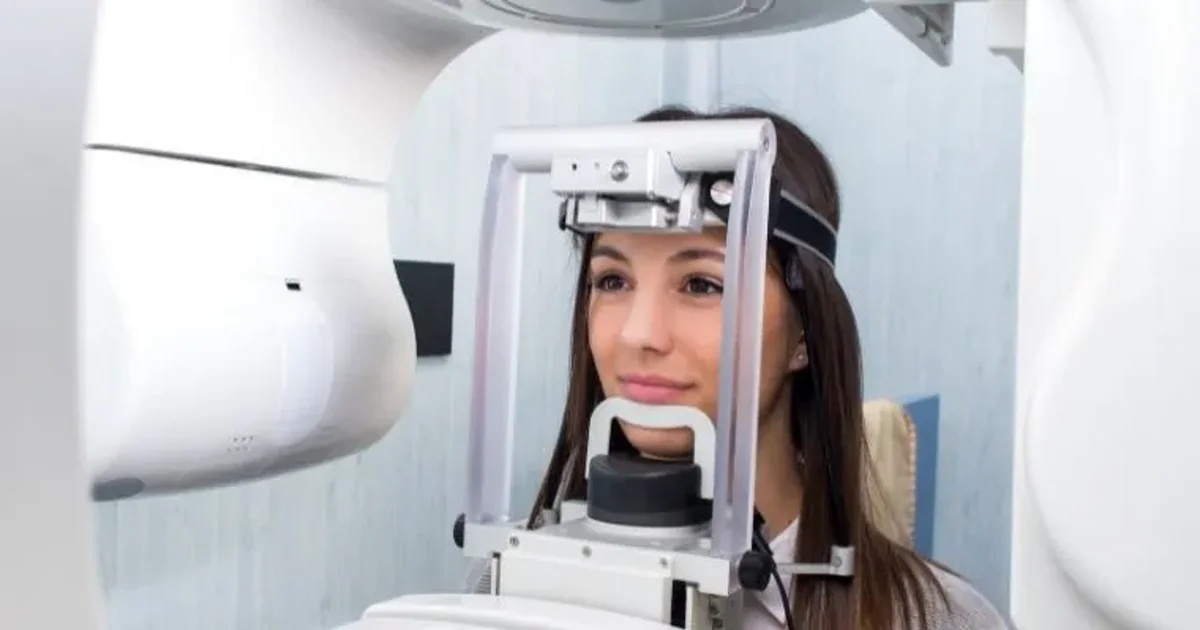
DCDC (Doctors Clinic Diagnostic Center) in Dubai Healthcare City provides advanced CBCT imaging services that are specifically optimized for endodontic applications. The center's radiology team works closely with endodontists throughout Dubai and the UAE, providing the detailed three-dimensional imaging that supports accurate diagnosis, treatment planning, and outcome assessment for complex root canal cases.
Endodontic-Focused Imaging Protocols
For endodontic referrals, DCDC uses small-field-of-view (FOV) CBCT protocols that focus on the tooth or teeth of interest. A small FOV scan captures a cylindrical volume typically measuring 4 cm x 4 cm or 5 cm x 5 cm, which is sufficient to image the target tooth, its roots, and the surrounding periapical bone with maximum spatial resolution while delivering the lowest possible radiation dose. The voxel size (the three-dimensional equivalent of a pixel) for these endodontic protocols is as small as 0.1 mm, providing the fine detail needed to visualize narrow canals, fracture lines, and small periapical lesions.
Detailed Radiologist Reports
Every CBCT scan performed at DCDC is interpreted by a consultant radiologist who provides a comprehensive written report tailored to the clinical question. For endodontic referrals, the report includes a detailed description of root canal anatomy (number of roots, number of canals per root, canal configurations using Vertucci classification), the presence and dimensions of any periapical pathology, assessment for root resorption or fractures, proximity to adjacent anatomical structures, and any incidental findings. The report and the full 3D image dataset are shared digitally with the referring endodontist, typically on the same day as the scan.
Booking and Location
DCDC is located in Dubai Healthcare City, accessible from Oud Metha, Karama, Bur Dubai, Downtown Dubai, and the wider UAE. Endodontic CBCT scans can be booked by phone, WhatsApp, or through the online booking form. No special preparation is required. The scan itself takes less than one minute, and most patients are in and out of the imaging suite within 15 minutes. For pricing details, see our guide on CBCT scan cost in Dubai.
Book an Endodontic CBCT Scan at DCDC
Get precise 3D CBCT root canal imaging at Doctors Clinic Diagnostic Center in Dubai Healthcare City. Our radiology team provides same-day results with detailed endodontic reports to support your treatment plan.
Or call us directly for immediate booking assistance
Mga Madalas Itanong
Final Thoughts
CBCT imaging has fundamentally improved the accuracy and predictability of root canal treatment by giving endodontists a complete three-dimensional understanding of tooth anatomy, periapical pathology, and root integrity. The ability to detect hidden canals, identify early infections, map complex root anatomy, and diagnose root fractures directly translates to higher treatment success rates, fewer retreatment procedures, and better long-term outcomes for patients. While not every root canal case requires a CBCT scan, the technology is indispensable for complex, retreatment, and diagnostically challenging cases where two-dimensional X-rays leave critical questions unanswered.
If your endodontist has recommended a CBCT scan before root canal treatment, or if you are experiencing persistent symptoms after a previous root canal, a 3D scan at DCDC in Dubai Healthcare City provides the diagnostic clarity needed for effective treatment planning. For more information on CBCT technology, see our comprehensive guide on what is a CBCT scan, or learn about imaging safety in our article on CBCT scan safety and radiation.
Mga Sanggunian at Reperensya
Ang artikulong ito ay sinuri ng aming medikal na team at tumutukoy sa mga sumusunod na sanggunian:
- American Association of Endodontists (AAE) - Position Statement on Use of CBCT in Endodontics
- International Endodontic Journal - Detection of Root Canals with CBCT vs Periapical Radiography
- Journal of Endodontics - CBCT in Endodontic Diagnosis and Treatment Planning
- European Society of Endodontology (ESE) - Position Statement on CBCT in Endodontics
Ang medikal na nilalaman sa site na ito ay sinusuri ng mga DHA-licensed na manggagamot. Tingnan ang aming patakarang editorial para sa higit pang impormasyon.

Isinulat ni
Dr. Osama Elzamzami
Diagnostic Radiology
MD, FRCR
Dr. Osama Elzamzami is a Diagnostic Radiologist specializing in CBCT, CT, MRI, and ultrasound imaging at DCDC Dubai Healthcare City, with extensive experience in dental and maxillofacial radiology.