Key Takeaways
- Tooth fillings in Dubai start from AED 150 for a single-surface composite restoration, with costs ranging up to AED 3,500 for gold inlays depending on material, cavity size, and tooth location
- Composite resin (tooth-colored) fillings account for over 70% of all fillings placed worldwide and offer 90%+ success rates at 10 years, making them the default choice for most patients
- The four main filling materials — composite, glass ionomer, ceramic, and gold — each serve different clinical needs, and the right choice depends on cavity size, tooth position, and budget
- A standard tooth filling procedure takes 20 to 45 minutes per tooth, is performed under local anaesthesia, and patients can eat soft food within two hours of treatment
- Dental caries affects roughly 2 billion people globally according to the WHO, and Dubai residents face additional risk factors including high sugar intake and reduced saliva flow from air conditioning
- Delaying a filling when decay is present allows bacteria to reach the pulp (nerve), which can lead to infection, abscess, and the need for root canal treatment — a far more complex and costly procedure
A tooth filling is the most effective and most common way to treat a cavity and restore a damaged tooth to full function. Whether you have a small cavity discovered during a routine check-up or need to replace an old filling that has cracked, understanding the types of filling materials available, how much they cost per tooth in Dubai, and what happens during the procedure helps you make an informed decision. At DCDC in Dubai Healthcare City, cosmetic tooth-colored fillings start from AED 150 per tooth, with same-day appointments frequently available.
This comprehensive guide covers everything you need to know about tooth fillings in Dubai in 2026 — from the four main filling materials and how they compare in durability, aesthetics, and cost, to the step-by-step procedure, how long each type lasts, sensitivity management, aftercare instructions, insurance coverage, and answers to the questions patients ask most often. Whether you are considering a simple composite filling for a front tooth or a durable ceramic inlay for a molar, this guide will help you choose the right option.
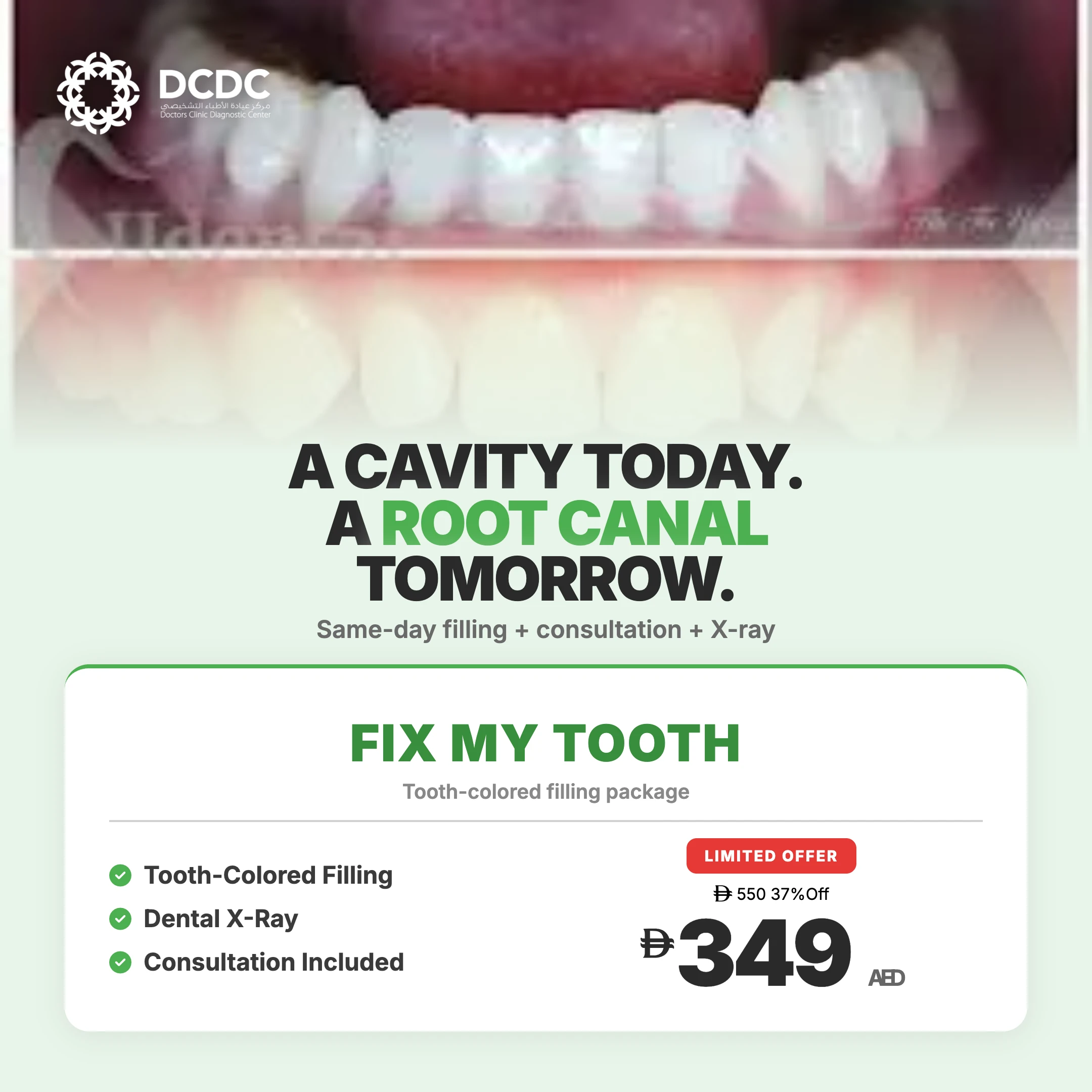

What Is a Tooth Filling and When Do You Need One?
A tooth filling is a restorative dental material used to repair a tooth that has been damaged by decay (dental caries), fracture, or erosion. The procedure involves removing the decayed or damaged portion of the tooth, thoroughly cleaning the resulting cavity, and filling it with a biocompatible material that restores the tooth's original shape, strength, and — in the case of tooth-colored materials — its natural appearance. Fillings are among the most frequently performed dental procedures in the world, with hundreds of millions placed annually.
You should see a dentist about a possible tooth filling if you experience any of the following symptoms or situations:
- Visible hole or dark spot on a tooth: A pit, hole, or persistent dark area on the chewing surface or between teeth is the most obvious sign of active decay that requires a filling.
- Tooth sensitivity to hot, cold, or sweet: Sensitivity that lingers after exposure to temperature changes or sugar often indicates decay has penetrated through the enamel into the dentin layer.
- Pain when biting or chewing: Sharp or dull pain triggered by biting pressure can signal decay, a cracked filling, or a fractured cusp — all potentially treatable with a new filling if addressed early.
- Food consistently getting stuck in one spot: Repeated food trapping in the same area suggests the tooth surface is compromised by decay or an old filling that has broken down.
- A chipped, cracked, or worn tooth: Trauma, teeth grinding (bruxism), or acid erosion can damage tooth structure, and a composite filling can restore the lost shape and protect against further damage.
- An old filling that is cracked, leaking, or discoloured: Fillings do not last forever — an old restoration showing signs of failure should be replaced before bacteria re-enter the tooth and cause deeper decay.
- Routine X-ray reveals hidden decay: Some cavities, especially between teeth (interproximal caries), are invisible to the naked eye and only detected on dental X-rays during a regular check-up.
Early treatment is critical. When decay is limited to the enamel or superficial dentin, a simple filling resolves the problem in a single 20-to-45-minute appointment. If decay progresses deeper and reaches the pulp (nerve), the tooth may require root canal treatment — a significantly more complex, time-consuming, and expensive procedure. This is why regular dental check-ups every six months are so important: catching a cavity early means a smaller, less costly filling and a much better long-term prognosis for the tooth.
Types of Tooth Fillings: Complete Material Comparison
Modern dentistry offers four main filling materials, each with specific advantages and limitations. The choice depends on the location of the tooth, the size and depth of the cavity, your aesthetic preferences, durability requirements, and budget. Below is a detailed breakdown of each type.
Composite Resin (Tooth-Colored Fillings)
Composite resin is the most widely used filling material today, accounting for over 70% of all fillings placed worldwide according to the Journal of Dental Research. It consists of acrylic resin combined with finely ground glass or quartz particles that can be precisely shade-matched to your natural tooth colour. Composite bonds directly to the tooth structure using an adhesive system, which means less healthy enamel and dentin need to be removed during preparation compared to amalgam. The material is placed in layers, each hardened with a blue LED curing light. Modern nano-hybrid composites achieve survival rates exceeding 90% at 10 years in posterior teeth.
Glass Ionomer Cement (GIC)
Glass ionomer cement is a unique material that chemically bonds to both enamel and dentin and releases fluoride over time, helping to prevent secondary decay around the filling margins. It is tooth-coloured but less translucent and aesthetically refined than composite. GIC is softer and less wear-resistant, making it unsuitable for large load-bearing restorations on chewing surfaces. It is primarily used for cavities near or below the gum line (cervical lesions), in children's primary teeth, as a temporary filling, or as a base layer beneath other restorative materials. Resin-modified glass ionomer (RMGIC) is a stronger hybrid variation with improved handling and aesthetics.
Ceramic (Porcelain) Inlays and Onlays
Ceramic fillings are custom-fabricated restorations made from dental porcelain or lithium disilicate (e.g., IPS e.max). Unlike direct fillings placed and shaped inside the mouth, ceramic restorations are indirect — designed digitally or with a dental impression and fabricated in a dental laboratory or using in-office CAD/CAM milling. Inlays fit within the cusps of the tooth; onlays cover one or more cusps. Ceramic offers excellent aesthetics, outstanding biocompatibility, high stain resistance, and exceptional durability with a lifespan of 10 to 15 years or more. Ceramic is ideal for large cavities in premolars and molars where a direct composite might not provide sufficient long-term strength.
Gold Inlays and Onlays
Gold alloy restorations are the most durable filling option available, routinely lasting 15 to 30 years or longer. Gold is highly biocompatible, does not corrode, wears at a rate similar to natural enamel (protecting opposing teeth), and provides an excellent marginal seal. The main disadvantages are cost and appearance — gold fillings are conspicuously metallic, making them unsuitable for visible front teeth. They are typically chosen for large restorations in posterior molars where aesthetics are secondary and maximum longevity is the priority.
Tooth Filling Cost in Dubai: Price Per Tooth (2026)
The cost of a tooth filling in Dubai depends on the filling material, the number of tooth surfaces involved, the tooth location (front vs. back), and the dentist's experience. Below is a comprehensive price guide for 2026 based on current Dubai dental clinic pricing.
| Filling Type | Cost Per Tooth (AED) | Durability | Best For |
|---|---|---|---|
| Composite (1 surface) | 150–300 | 5–10 years | Small cavities, front teeth |
| Composite (2–3 surfaces) | 300–600 | 5–10 years | Medium cavities, any tooth |
| Glass Ionomer | 100–250 | 3–5 years | Children, gum-line cavities, temporary |
| Ceramic Inlay | 800–2,000 | 10–15+ years | Large molar cavities, high aesthetics |
| Ceramic Onlay | 1,000–2,500 | 10–15+ years | Cusp replacement, premolars/molars |
| Gold Inlay/Onlay | 1,500–3,500 | 15–30 years | Maximum durability, back teeth |
Tooth filling cost comparison in Dubai (2026). Prices are per tooth and may vary based on cavity size and clinic.
At DCDC in Dubai Healthcare City, cosmetic tooth-coloured composite fillings start from AED 150 per tooth — positioned competitively compared to other Dubai dental clinics where composite fillings typically range from AED 200 to AED 800 depending on the facility. DCDC offers direct billing with 20+ insurance providers including Daman, AXA, and Bupa, so most patients with comprehensive dental coverage pay reduced out-of-pocket costs or nothing at all for basic filling procedures.
Factors That Affect Tooth Filling Cost
Several factors influence the final price of your tooth filling. Understanding these helps you anticipate costs and avoid surprises:
- Number of surfaces involved: A single-surface filling (one side of the tooth) costs less than a multi-surface filling. A cavity that spans two or three surfaces requires more material, more time, and more precise shaping, increasing the cost.
- Filling material chosen: Composite resin is the most affordable option for direct fillings. Ceramic and gold are indirect (lab-fabricated) restorations that cost more due to the laboratory fees, additional appointment, and higher material cost.
- Tooth location: Back teeth (molars and premolars) are harder to access and require more time to restore. Front teeth are easier to reach but may require more meticulous aesthetic finishing for an invisible result.
- Cavity depth and complexity: A deep cavity that approaches the pulp may require a protective liner or base beneath the filling, adding to the cost. Extremely large cavities may be better served by an inlay, onlay, or crown rather than a direct filling.
- Replacement vs. new filling: Replacing an old filling involves removing the existing restoration, cleaning out any secondary decay, and placing a new filling — which can take longer and cost more than treating a new cavity.
- Clinic location and credentials: Clinics in premium locations such as Dubai Healthcare City (DHCC) may have higher overhead but are MOHAP-licensed and follow stricter clinical standards, infection control protocols, and quality assurance processes.
Step-by-Step Tooth Filling Procedure
Understanding exactly what happens during a tooth filling procedure reduces anxiety and helps you prepare. The process is straightforward, painless under local anaesthesia, and typically completed in a single visit lasting 20 to 45 minutes per tooth.
Step 1: Examination and X-Ray
Your dentist examines the tooth visually and with an explorer instrument to assess the cavity. A periapical or bitewing X-ray may be taken to determine the depth of decay and its proximity to the pulp. This determines whether a filling is sufficient or if more extensive treatment (such as a root canal or crown) is needed.
Step 2: Local Anaesthesia
A topical numbing gel is applied to the gum tissue, followed by a local anaesthetic injection to completely numb the tooth and surrounding area. You will feel pressure but no pain during the procedure. The anaesthetic takes effect within 2 to 5 minutes.
Step 3: Decay Removal
Using a high-speed dental handpiece (drill) with a diamond or carbide bur, the dentist removes all decayed tooth material. The cavity is then checked with a dental explorer and sometimes a caries-detecting dye to ensure no residual decay remains. Conservative preparation aims to remove only the minimum amount of healthy tooth structure necessary.
Step 4: Tooth Preparation and Bonding
For composite fillings, the cavity walls are etched with a mild acid gel for 15 to 20 seconds, rinsed, and dried. A bonding agent (adhesive) is then applied and cured with a blue LED light. This creates a micro-mechanical bond between the composite resin and the tooth structure, which is what allows composite fillings to preserve more healthy tooth tissue than amalgam.
Step 5: Filling Placement and Curing
Composite resin is placed into the cavity in incremental layers, each approximately 2 mm thick. Each layer is shaped and then hardened (polymerised) using a blue LED curing light for 20 to 40 seconds. The layering technique reduces internal stress and minimises post-operative sensitivity. For ceramic or gold restorations, a dental impression is taken and a temporary filling placed while the lab fabricates the permanent inlay or onlay — requiring a second appointment.
Step 6: Bite Adjustment and Polishing
After the final layer is placed and cured, you are asked to bite on articulating paper (carbon paper) to check the bite. Any high spots are adjusted with a fine bur. The filling is then contoured to match the natural anatomy of the tooth and polished to a smooth, glossy finish that resists plaque accumulation and feels natural against your tongue.
Need a Tooth Filling in Dubai?
Book your appointment at DCDC in Dubai Healthcare City. Same-day composite fillings from AED 150, direct insurance billing, and free parking.
Call +971 54 219 5008 or WhatsApp us
How Long Does a Tooth Filling Last?
Filling longevity depends on the material used, the size of the restoration, your oral hygiene habits, and factors such as teeth grinding (bruxism) and diet. Here is what the clinical evidence shows for each material:
- Composite resin: 5 to 10 years on average, though many well-placed composites in patients with good oral hygiene last 12 to 15 years. Modern nano-filled composites show 90%+ survival at 10 years in clinical studies.
- Glass ionomer: 3 to 5 years in load-bearing areas. GIC is not designed for long-term use on chewing surfaces but performs well in non-stress-bearing locations.
- Ceramic (porcelain): 10 to 15 years or longer. Ceramic inlays and onlays are highly resistant to wear and staining, and studies show survival rates above 90% at 15 years.
- Gold: 15 to 30 years, making gold the most durable filling option. Some gold restorations have been documented lasting 40+ years.
For more on when a filling might not be enough, see our guide on tooth filling vs. crown in Dubai — which explains the clinical criteria your dentist uses to decide between the two.
Post-Filling Sensitivity: Causes and Solutions
Some degree of sensitivity after a filling is normal and usually temporary. Understanding the causes helps you distinguish between expected healing and a potential problem that needs attention.
- Thermal sensitivity (hot/cold): Mild sensitivity to hot or cold foods and drinks is the most common post-filling symptom. It is caused by the proximity of the filling to the dental pulp and typically resolves within 1 to 3 weeks as the tooth settles.
- Bite sensitivity: Pain when biting can indicate the filling is slightly too high (supracontact). A quick bite adjustment by your dentist — a painless 5-minute visit — resolves this immediately.
- Referred sensitivity: Sometimes a newly filled tooth transmits signals to adjacent teeth, making them feel sensitive. This is temporary and resolves on its own.
- Galvanic sensitivity: If a new metal filling (gold) is placed adjacent to an existing metal filling of a different composition, a small electrical current can be generated between them, causing a brief sharp sensation. This is rare and usually fades within days.
If sensitivity persists beyond 4 to 6 weeks, worsens rather than improves, or is accompanied by spontaneous throbbing pain, contact your dentist. Persistent symptoms may indicate that the decay was deeper than initially assessed, or that the filling needs further adjustment or replacement.
Aftercare: How to Make Your Tooth Filling Last
Proper aftercare extends the life of your filling and protects your overall oral health. Follow these evidence-based guidelines:
- Wait before eating: Composite fillings are fully hardened by the curing light during the procedure, so you can eat as soon as the anaesthesia wears off (1–2 hours). Start with soft foods on the opposite side and avoid very hot or cold items for the first 24 hours.
- Maintain excellent oral hygiene: Brush twice daily with fluoride toothpaste and floss once daily. Pay particular attention to the margins of the filling where it meets the natural tooth — this is where secondary decay is most likely to develop.
- Use a desensitising toothpaste: If sensitivity is present, switch to a desensitising toothpaste containing potassium nitrate or stannous fluoride for 2 to 4 weeks.
- Avoid excessive force: Do not chew ice, hard sweets, pen caps, or fingernails. These habits can crack or chip any filling, especially composite restorations.
- Address teeth grinding (bruxism): If you grind or clench your teeth, ask your dentist about a custom night guard. Bruxism is one of the leading causes of premature filling failure.
- Attend regular check-ups: Visit your dentist every 6 months. Routine examinations and X-rays detect early signs of filling breakdown, secondary decay, or marginal defects before they become serious problems.
- Limit staining habits: Coffee, tea, red wine, and tobacco can stain the surface of composite fillings over time. While composite resists staining better than earlier generations, minimising exposure helps maintain the match with your natural tooth colour.
For a deeper understanding of routine dental maintenance, read our guide to dental cleaning cost in Dubai — professional cleanings every six months are the single most effective way to prevent new cavities and protect existing fillings.
What to Expect at DCDC: Your Tooth Filling Visit
At Doctors Clinic Diagnostic Center (DCDC) in Dubai Healthcare City, the tooth filling experience is designed for efficiency, comfort, and clinical excellence. Here is what happens from arrival to departure:
- Arrival and check-in: Park in DCDC's free dedicated parking lot at Building 64, Block A, Al Razi Medical Complex. Check-in at reception — most patients are seen within 15 minutes of their appointment time.
- Clinical examination: Your dentist performs a visual and tactile examination, reviews any X-rays, and discusses the cavity's size, depth, and optimal filling material with you. You receive a clear treatment plan and cost estimate before any work begins.
- Comfort-focused treatment: Topical numbing gel is applied before the local anaesthetic injection for a painless start. The dentist uses rubber dam isolation when indicated, which keeps the tooth dry and improves bond quality while protecting your airway.
- Filling placement: The cavity is cleaned, etched, bonded, and filled in layers using the material you selected. Each layer is cured with a blue LED light. The entire process takes 20 to 45 minutes per tooth.
- Bite check and polish: Articulating paper is used to verify your bite, and the filling is polished to a smooth, natural finish. You are given personalised aftercare instructions before leaving.
- Insurance and payment: DCDC offers direct billing with 20+ insurance providers. The clinic handles pre-authorisation — you do not need to pay upfront and claim later.
According to Dr. Chadi El Masry, DDS, a dental surgeon at DCDC: "The most important factor in a successful filling is not just the material — it is the technique. Proper moisture isolation, incremental layering, and meticulous bite adjustment are what determine whether a composite filling lasts 5 years or 15 years. At DCDC, we invest the time to get each of these steps right because shortcuts in filling placement always show up as problems down the road."
Tooth Filling vs. Root Canal: When a Filling Is Not Enough
A filling treats decay that is confined to the enamel and dentin layers of the tooth. When decay extends into the pulp chamber — the innermost part of the tooth containing nerves and blood vessels — a simple filling is no longer sufficient. At that point, root canal treatment is required to remove the infected pulp tissue, disinfect the canals, and seal the tooth before placing a crown or large filling on top.
Signs that a cavity may have progressed beyond filling territory include spontaneous throbbing pain (especially at night), prolonged sensitivity to hot or cold that lingers for minutes, swelling around the tooth, a pimple-like bump on the gum, and darkening of the tooth. If you experience any of these symptoms, see a dentist promptly — delaying treatment can lead to dental abscess, bone loss, and potential tooth loss.
For related information on dental emergencies and when to seek urgent care, see our dental emergency guide for Dubai.
Insurance Coverage for Tooth Fillings in Dubai
Most comprehensive dental insurance plans in the UAE cover basic restorative procedures including tooth fillings. Here is what you need to know about insurance and fillings in Dubai:
- Basic filling coverage: Standard dental insurance plans typically cover composite (tooth-coloured) fillings as a basic restorative benefit, usually at 80% to 100% of the allowed amount after any deductible.
- Material upgrades: Some plans cover fillings at the amalgam-equivalent rate. If you choose a more expensive material (ceramic or gold inlay), you may need to pay the difference between the allowed amount and the actual cost.
- Annual limits: Most dental plans have an annual benefit maximum (e.g., AED 5,000–10,000). Basic fillings rarely consume a significant portion of this limit, but multiple large restorations could approach it.
- Pre-authorisation: Some insurance plans require pre-authorisation for restorative work. DCDC's staff handles this process directly — you do not need to make phone calls or submit paperwork yourself.
- Direct billing: At DCDC, direct billing is available with 20+ insurance providers including Daman, AXA, Bupa, MetLife, and Cigna. This means you pay only your co-payment or deductible at the time of treatment — no need to pay the full amount and file a claim later.
Tooth Decay in Dubai: Why Cavities Are Common Here
Dubai residents face several unique risk factors for dental caries that contribute to a higher-than-expected prevalence of cavities in the UAE population:
- High sugar consumption: The UAE has one of the highest per-capita sugar consumption rates in the Middle East, driven by sweetened beverages, desserts, and processed foods. Sugar feeds the oral bacteria (primarily Streptococcus mutans) that produce the acid responsible for dissolving tooth enamel.
- Air-conditioning-related dry mouth: Spending extended hours in air-conditioned environments — standard in Dubai — reduces salivary flow. Saliva is the mouth's natural defence against decay, neutralising acids and remineralising early enamel lesions. Reduced saliva production means reduced protection.
- Frequent snacking culture: Continuous snacking and sipping throughout the day keeps the oral pH acidic for extended periods, giving bacteria more time to attack tooth enamel between brushings.
- Delayed dental visits: Studies show that many UAE residents visit the dentist only when symptoms appear rather than for preventive check-ups, allowing early-stage decay to progress to the point where larger, more expensive fillings — or root canals — are needed.
These factors make regular dental check-ups and early intervention with fillings even more important in Dubai. A cavity treated early with a AED 150–300 composite filling could save you thousands of dirhams in root canal treatment and crown placement if the decay is allowed to progress.
Protect Your Teeth Before Small Cavities Become Big Problems
Book a dental check-up at DCDC in DHCC. Fillings from AED 150, free parking, same-day appointments, and direct insurance billing with 20+ providers.
Call +971 54 219 5008 or WhatsApp us
Composite vs. Ceramic Fillings: Which Should You Choose?
The two most popular filling options in Dubai are composite resin (direct) and ceramic (indirect). Here is a head-to-head comparison to help you decide:
| Factor | Composite Resin | Ceramic Inlay/Onlay |
|---|---|---|
| Aesthetics | Excellent (shade-matched) | Excellent (highly translucent) |
| Durability | 5–10 years (up to 15 with good care) | 10–15+ years |
| Strength | Good for small-medium cavities | Superior for large cavities |
| Number of visits | 1 visit | 2 visits (or 1 with CAD/CAM) |
| Cost per tooth | AED 150–600 | AED 800–2,500 |
| Stain resistance | Moderate (can stain over years) | High (resists staining well) |
| Repairability | Easy to repair chairside | Requires replacement if fractured |
| Best for | Small-medium cavities, any tooth | Large cavities, molars, high aesthetics |
Composite vs. ceramic dental filling comparison for Dubai patients (2026)
For small to medium-sized cavities, composite resin is the most cost-effective and practical choice — it looks natural, bonds well, and is completed in a single visit. For larger cavities, especially in molars that bear heavy chewing forces, a ceramic inlay or onlay provides superior strength, longevity, and long-term value despite the higher initial cost.
Signs You Need to Replace an Old Filling
All fillings eventually wear out and need replacement. Recognising the warning signs early prevents the need for more invasive treatment. Visit your dentist if you notice:
- Visible cracks or chips in the filling — even small cracks can allow bacteria to enter and cause decay beneath the filling
- Dark discolouration around the filling margins — this may indicate leakage and secondary decay underneath
- Sensitivity that was not present before — new sensitivity around a previously comfortable filling suggests breakdown or recurrent decay
- Rough or sharp edges — a filling that feels rough to your tongue may be wearing down or breaking apart
- Food trapping near the filling — repeated food impaction suggests the filling is no longer sealing the cavity properly
- Pain when biting — could indicate the filling has cracked or decay has developed beneath it
Your dentist at DCDC checks the integrity of all existing fillings during every routine visit, using visual examination, dental explorer probing, and periodic X-rays to detect problems that are not yet visible to the naked eye. DCDC's 4.8/5 Google rating from over 1,000 verified patient reviews reflects a consistent standard of thorough, patient-focused dental care.
Related Services at DCDC
Expert care and advanced diagnostics at Dubai Healthcare City
Frequently Asked Questions
Final Thoughts
A tooth filling is one of the simplest, most effective, and most cost-efficient dental procedures available — and catching decay early with a filling prevents the need for far more complex and expensive treatments like root canals, crowns, or extractions down the line. With composite fillings starting from AED 150 per tooth in Dubai and modern materials offering excellent aesthetics and durability, there is no reason to delay treatment when a cavity is diagnosed.
At DCDC in Dubai Healthcare City, our dental team provides same-day composite fillings, ceramic inlays, and comprehensive dental care in a MOHAP-licensed facility with free parking, extended hours (Sat–Thu until 10 PM), and direct billing with 20+ insurance providers. If you suspect a cavity or need to replace an old filling, book a dental check-up today — early treatment saves time, money, and your natural tooth.
Sources & References
This article was reviewed by our medical team and references the following sources:
- World Health Organization — Oral Health Fact Sheet
- NHS — Dental Fillings Overview
- Cleveland Clinic — Dental Fillings: Types, How Long They Last, Procedure & Costs
- Mayo Clinic — Cavities/Tooth Decay: Diagnosis & Treatment
- Journal of Dental Research — Longevity of Posterior Composite Restorations
- American Dental Association — Dental Filling Options
Medical content on this site is reviewed by DHA-licensed physicians. See our editorial policy for more information.

Written by
Dr. Chadi El Masry
Dental Surgeon
DDS
Dr. Chadi El Masry is a Dental Surgeon at Doctors Clinic Diagnostic Center (DCDC) in Dubai Healthcare City, specializing in cosmetic and restorative dentistry.
Related Articles
Dental Fillings Cost Dubai: From AED 150 (2026)
Tooth Filling vs Crown Dubai: Which Do You Need? (2026)

Dental Cleaning Cost Dubai: From AED 200 (2026)

Dental Crown Cost Dubai: From AED 1,000 (2026)
Dental Emergency Guide Dubai (2026)
More in Dental
Teeth Cleaning Dubai: Scaling & Polishing From AED 200
Read MoreDental Crown Cost Dubai: Zirconia & E-max AED 1,000
Read More
Teeth Whitening Dubai: Zoom & Laser Price From AED 699
Read More
Zirconia vs Porcelain Crown Dubai: Guide (2026)
Read MoreZoom Whitening Cost Dubai: From AED 699 (2026)
Read More
Mouth Ulcers Dubai: Causes & When to Worry (2026)
Read More© 2026 Doctors Clinic Diagnostic Center (DCDC), Dubai Healthcare City. Originally published at https://doctorsclinicdubai.ae/blog/tooth-filling-dubai-guide. All rights reserved. Unauthorized reproduction is prohibited.