Key Takeaways
- Cosmetic (tooth-colored) dental fillings in Dubai start from AED 150 for a single-surface composite restoration, with prices ranging up to AED 3,500 for gold inlays depending on material, tooth location, and cavity size
- Composite resin fillings now account for over 70 percent of all fillings placed worldwide and offer a 90 percent or higher success rate at 10 years, making them the standard of care for most restorations
- The five main filling materials — composite, amalgam, ceramic, glass ionomer, and gold — each have distinct advantages in aesthetics, durability, cost, and material properties. This guide compares all five
- Most comprehensive dental insurance plans in the UAE cover basic filling procedures, though cosmetic upgrades from amalgam-equivalent to composite or ceramic may involve a co-payment of AED 50-150
- Dental caries (tooth decay) affects approximately 2 billion people globally according to the WHO, and the UAE has a particularly high prevalence due to dietary sugar consumption and reduced saliva flow in hot climates
- A filling that is cracked, leaking, or causing sensitivity should be replaced promptly — delaying replacement allows bacteria to re-enter the tooth, leading to deeper decay, infection, or root canal treatment (from AED 700 per tooth at DCDC; AED 1,500–3,000 at many other clinics)
- For large cavities where a direct filling may not be strong enough, inlays and onlays (AED 800-2,000) provide a durable intermediate option between fillings and crowns
Tooth decay remains one of the most common chronic health conditions worldwide, and a timely dental filling is the most effective way to stop it from progressing. Whether you have a newly diagnosed cavity or need to replace an old filling, understanding the types of materials available, their relative costs, and what to expect during the procedure helps you make a confident, informed decision. In Dubai, cosmetic composite fillings start from AED 150, and most insurance plans cover the basic procedure.
This comprehensive guide covers everything you need to know about dental fillings in Dubai — from all five filling materials (composite, amalgam, ceramic, glass ionomer, and gold) and how they compare in durability, aesthetics, cost per tooth, and material properties, to a step-by-step explanation of the procedure, when inlays and onlays are better than fillings, sensitivity after treatment, insurance coverage details, aftercare instructions, lifespan comparison, and answers to the most frequently asked questions. Whether you are considering a simple composite filling or a long-lasting ceramic inlay, this guide will help you choose the right restoration for your tooth.
What Is a Dental Filling? When You Need One
A dental filling is a restorative material used to repair a tooth that has been damaged by decay (caries), fracture, or wear. The procedure involves removing the decayed or damaged portion of the tooth, cleaning the resulting cavity, and filling it with a biocompatible material that restores the tooth's original shape, function, and — in the case of tooth-colored materials — its appearance. Fillings are one of the most common dental procedures performed worldwide, with hundreds of millions placed every year across all age groups.
You may need a dental filling if you experience any of the following signs or symptoms:
- Visible cavity or hole in a tooth: You can sometimes see or feel a dark spot, pit, or hole on the chewing surface or between teeth. This is the most obvious sign of decay that requires a filling
- Tooth sensitivity: A tooth that is sensitive to hot, cold, sweet, or acidic foods and drinks may have early to moderate decay that has reached the dentin layer beneath the enamel
- Spontaneous or biting pain: Pain when chewing or a dull ache that comes and goes can indicate decay, a cracked filling, or a fractured cusp
- Food getting stuck repeatedly: If food consistently catches in the same spot, the tooth surface may be compromised by decay or an old filling that has broken down
- Dark staining or discoloration on a tooth: While not all dark spots are cavities, a dark area that is soft when probed by a dentist typically indicates active decay
- A chipped, cracked, or worn tooth: Teeth damaged from trauma, grinding (bruxism), or erosion can be restored with composite fillings
- An old filling that needs replacement: Fillings do not last forever. An old amalgam or composite filling that is cracked, leaking, or showing decay around its margins needs replacement
- Dental X-ray findings: Cavities between teeth (interproximal caries) are often invisible to the naked eye and only detected on routine dental X-rays. This is why regular checkups are essential
Early detection is critical. When decay is limited to the enamel or superficial dentin, a simple filling can resolve the problem in a single appointment costing from AED 150. If decay progresses deeper into the tooth and reaches the pulp (nerve), a more complex root canal treatment becomes necessary — costing from AED 700 per tooth at DCDC (AED 1,500–3,000 at many other clinics) plus a crown (from AED 1,000 at DCDC). This is why regular dental check-ups — ideally every six months — are so important. Catching a cavity early means a smaller, less expensive filling and a better long-term outcome.
Dental Filling Cost in Dubai: Complete Pricing by Type
Dental filling costs in Dubai vary significantly depending on the type of filling material, the size and location of the cavity, the number of surfaces involved, and the clinic. At Doctors Clinic Diagnostic Center, cosmetic composite fillings start from AED 150. The following table provides a detailed pricing breakdown for every filling type available in Dubai.
| Filling Type | Cost Per Tooth (AED) | Cost Factors | Number of Visits |
|---|---|---|---|
| Composite resin — single surface | From 150 - 300 | Smallest, simplest cavity (one wall of the tooth) | 1 |
| Composite resin — two surfaces | 250 - 400 | Cavity involving two walls (e.g., biting surface + one side) | 1 |
| Composite resin — three+ surfaces | 350 - 500 | Large cavity, multiple walls, more material and time needed | 1 |
| Glass ionomer cement (GIC) | 200 - 400 | Used for cervical lesions, baby teeth, or temporary fillings | 1 |
| Resin-modified glass ionomer (RMGIC) | 250 - 450 | Stronger than standard GIC, better aesthetics | 1 |
| Ceramic / porcelain inlay | 800 - 1,500 | Custom-fabricated, laboratory costs included | 2 (or 1 with CAD/CAM) |
| Ceramic / porcelain onlay | 1,000 - 2,000 | Covers one or more cusps, larger than inlay | 2 (or 1 with CAD/CAM) |
| Gold inlay | 1,500 - 2,500 | Gold alloy cost + laboratory fabrication | 2 |
| Gold onlay | 2,000 - 3,500 | Larger coverage, more gold alloy needed | 2 |
Dental filling prices in Dubai by material and size (2026). DCDC composite fillings start from AED 150. Contact us for current pricing.
At DCDC, the from-AED 150 price for composite fillings includes the consultation, X-ray (if needed), local anaesthesia, filling placement, and polishing — all in a single visit with no hidden fees. Compared to hospital-based dental departments in Dubai that charge AED 400-800 for the same procedure due to facility fees, clinic-based filling at DCDC offers significant cost savings without compromising quality.
Composite vs Amalgam vs Ceramic vs Glass Ionomer vs Gold: Full Comparison
Modern dentistry offers five main filling materials, each with specific strengths and limitations. The choice of material depends on the location of the tooth, the size of the cavity, aesthetic requirements, durability needs, and budget. Below is a comprehensive comparison table — the most detailed available for Dubai patients.
| Property | Composite Resin | Amalgam (Silver) | Ceramic (Porcelain) | Glass Ionomer | Gold |
|---|---|---|---|---|---|
| Aesthetics | Excellent — shade-matched to natural tooth | Poor — dark silver/grey, highly visible | Excellent — translucent, mimics natural enamel | Fair — tooth-colored but less translucent | Poor — gold-colored, conspicuous |
| Durability (lifespan) | 5-10 years (often longer with care) | 10-15 years | 10-15+ years | 3-5 years | 15-30 years |
| Strength | Good — nano-hybrid composites approach amalgam strength | Very high — excellent for heavy chewing forces | Very high — ceramic is extremely hard | Low-moderate — not suitable for heavy-load areas | Excellent — gold has ideal wear properties |
| Tooth preservation | High — bonds to tooth, minimal removal needed | Low — requires undercuts, more tooth removed | High — conservative preparation | High — chemically bonds to tooth | Low-moderate — requires retention form |
| Fluoride release | No | No | No | Yes — helps prevent secondary decay | No |
| Mercury content | None | ~50% mercury by weight | None | None | None |
| Biocompatibility | Excellent | Good (controversy around mercury) | Excellent | Excellent | Excellent |
| Stain resistance | Moderate — can stain over years | N/A — already dark | Excellent — highly stain-resistant | Moderate | Excellent — does not stain |
| Cost per tooth (AED) | 150-500 | 100-300 (rarely placed today) | 800-2,000 | 200-400 | 1,500-3,500 |
| Number of visits | 1 | 1 | 2 (or 1 with CAD/CAM) | 1 | 2 |
| Best for | Any tooth — most versatile choice | Back teeth only (rarely used today) | Large posterior restorations | Baby teeth, cervical lesions, temporary | Maximum durability in back teeth |
| Post-operative sensitivity | Mild — usually resolves in 1-2 weeks | Minimal | Minimal | Minimal | Minimal |
| Repairability | Yes — can be repaired in place | No — must be fully replaced | Difficult — usually must be replaced | Yes — can be patched | No — must be fully replaced |
Comprehensive comparison of all five dental filling materials available in Dubai clinics (2026). Amalgam is included for reference but is rarely placed in modern practice.
Composite Fillings: The Modern Standard of Care
Composite resin is the most widely used filling material today, accounting for over 70 percent of all fillings placed worldwide. It is a mixture of acrylic resin (BIS-GMA or UDMA) and finely ground glass, quartz, or ceramic particles (fillers) that can be precisely shade-matched to your natural tooth colour using a standardised shade guide. Modern nano-hybrid and nano-filled composites contain filler particles as small as 20 nanometres, providing significantly improved strength, wear resistance, and polish retention compared to earlier generations.
Composite bonds directly to the tooth structure using an adhesive system (etch-and-bond technique), which means less healthy tooth needs to be removed during preparation compared to amalgam. This is a significant advantage — preserving natural tooth structure is one of the fundamental principles of modern conservative dentistry. The filling is placed in incremental layers (1.5-2mm per layer), with each layer hardened using a special blue LED curing light (wavelength 450-470nm) for 20-40 seconds. Clinical studies show over 90 percent survival rates at 10 years for posterior composite restorations, with annual failure rates of approximately 1.8 percent — comparable to amalgam.
Dr. Chadi El Masry, Dental Surgeon at DCDC, notes: "Composite fillings have evolved dramatically over the past decade. The nano-hybrid materials we use today are stronger, more wear-resistant, and more aesthetic than anything available even five years ago. For most patients, composite is the ideal choice — it preserves tooth structure, looks completely natural, and with proper oral hygiene, can last well beyond 10 years. I only recommend ceramic inlays when the cavity is too large for a direct composite to provide sufficient structural support."
Glass Ionomer Fillings: When They Are the Right Choice
Glass ionomer cement (GIC) occupies a unique niche in restorative dentistry. It chemically bonds to both enamel and dentin without requiring an etch-and-bond step, and it releases fluoride continuously over its lifetime — providing active protection against secondary decay at the filling margins. This fluoride release makes GIC particularly valuable in patients at high risk for recurrent caries.
GIC is tooth-colored but not as translucent or aesthetically refined as composite resin — it has a slightly opaque, chalky appearance. It is also significantly softer and less wear-resistant than composite, making it unsuitable for large restorations on chewing surfaces of adult teeth. However, its unique properties make it the ideal choice in specific clinical situations.
- Baby teeth (deciduous teeth): The tooth will be lost naturally, so long-term durability is less important. Fluoride release provides active protection during the tooth's remaining lifespan. Placement is quick, which is important for young patients with limited cooperation
- Cervical lesions (near the gum line): These areas are difficult to keep dry during composite placement, and GIC's chemical bonding works well even in slightly moist conditions
- Temporary fillings: When a tooth needs a temporary restoration (e.g., between root canal appointments), GIC provides a good seal and releases fluoride
- Base or liner: GIC is often placed as a base beneath composite fillings in deep cavities to provide fluoride protection near the pulp and reduce the total volume of composite needed
- Elderly patients with root caries: Root surfaces are more susceptible to decay, and the fluoride release from GIC provides ongoing protection
Resin-modified glass ionomer (RMGIC) is an improved variant that adds resin components to traditional GIC, resulting in better aesthetics, higher strength, and improved moisture tolerance while retaining fluoride release. RMGIC costs AED 250-450 per filling and is a good middle ground between traditional GIC and composite for specific clinical situations.
Ceramic and Gold Fillings: When to Choose Inlays and Onlays
When a cavity is too large for a direct composite filling to provide adequate strength — but not so large that a full crown is needed — inlays and onlays offer an ideal intermediate solution. These are indirect restorations fabricated outside the mouth (in a dental laboratory or using CAD/CAM milling) and then bonded to the prepared tooth. They are sometimes called "partial crowns" because they restore part of the tooth's chewing surface.
Inlays vs Onlays: What Is the Difference?
- Inlay: Fits within the cusps (tips) of the tooth, filling the cavity between cusps. Used when the cusps are still intact and strong. Think of it as a precisely fitted puzzle piece that sits inside the tooth
- Onlay: Covers one or more cusps in addition to filling the cavity. Used when one or more cusps are weakened, cracked, or missing. Provides more structural support than an inlay. More expensive because more material and fabrication is needed
Ceramic (Porcelain) Inlays and Onlays
Ceramic restorations are made from dental porcelain or lithium disilicate (e.g., IPS e.max). They offer excellent aesthetics (virtually indistinguishable from natural tooth), outstanding biocompatibility, high resistance to staining, and exceptional durability with a lifespan of 10 to 15 years or longer. Ceramic is the preferred material for visible premolars and for patients who want the most natural-looking restoration possible. Cost: AED 800-2,000 per tooth.
Gold Inlays and Onlays
Gold alloy restorations represent the gold standard for durability in dentistry. Gold inlays and onlays can last 15 to 30 years or longer — the longest of any dental restoration. Gold is highly biocompatible, does not corrode, wears at a similar rate to natural enamel (protecting opposing teeth), and provides an excellent marginal seal. The primary drawbacks are cost (AED 1,500-3,500) and appearance — gold is conspicuous, making it unsuitable for visible teeth. Gold is typically chosen for large restorations in upper molars where aesthetics are less of a concern. For detailed pricing on inlays and onlays, see our dedicated guide on dental inlays and onlays cost in Dubai.
Composite vs Amalgam Fillings: Which Is Better?
This is one of the most common questions patients ask, and the answer is clear for most situations: composite resin fillings are the preferred choice in modern dentistry and have largely replaced amalgam worldwide. In most Dubai dental clinics — including DCDC — amalgam is no longer placed at all.
Amalgam fillings were the standard of care for over 150 years. They are a metallic alloy containing silver, tin, copper, and approximately 50 percent mercury by weight. While the mercury in dental amalgam is bound in a stable compound and considered safe by major health organisations including the WHO and ADA, public concern about mercury exposure and the availability of superior aesthetic alternatives have led to a dramatic decline in amalgam use. The Minamata Convention on Mercury (2013) encourages a global phase-down, and many European countries have banned or restricted amalgam use.
| Feature | Composite Resin | Amalgam (Silver) |
|---|---|---|
| Appearance | Tooth-colored, virtually invisible | Dark silver/grey, highly visible |
| Tooth preservation | Minimal removal — bonds to tooth | More removal needed — requires mechanical retention (undercuts) |
| Mercury content | Zero | ~50% mercury |
| Durability | 5-10 years (annual failure rate 1.8%) | 10-15 years (annual failure rate 3.0%) |
| Repair | Can be repaired in place if partially damaged | Must be completely replaced |
| Thermal expansion | Similar to natural tooth | Different from tooth — expands/contracts with temperature, can cause cracks over time |
| Tooth fracture risk | Lower — bonds to and supports tooth | Higher — wedging forces from expansion can crack tooth walls over time |
| Post-operative sensitivity | Mild, usually 1-2 weeks | More common due to metal conductivity |
| Cost (AED) | 150-500 | 100-300 (rarely available) |
| Current use | Standard of care globally (70%+ of all fillings) | Declining rapidly — banned in some countries, rarely placed in UAE |
Composite resin vs amalgam fillings: head-to-head comparison. Composite is preferred for nearly all modern restorations.
If you have old amalgam fillings that are still intact and functional, there is no medical need to replace them — but many patients choose to have them replaced with composite for cosmetic reasons, mercury concerns, or because the amalgam is showing signs of deterioration. If you are considering regular preventive care to avoid fillings altogether, our guide on dental cleaning cost in Dubai explains how professional cleaning helps prevent the decay that leads to fillings.
The Dental Filling Procedure: Step by Step
Understanding what happens during a filling appointment can ease any anxiety and help you prepare. A direct composite filling is typically completed in a single visit lasting 30 to 60 minutes, depending on the size and location of the cavity. Here is the detailed step-by-step process at DCDC.
- Step 1 — Diagnosis and treatment planning: Your dentist examines the tooth clinically and with digital dental X-rays (minimal radiation exposure) to assess the extent of decay. The X-ray reveals whether decay is confined to the enamel and dentin or has reached the pulp. If decay is limited to the outer layers, a filling is the appropriate treatment
- Step 2 — Local anaesthetic: The area around the tooth is numbed with local anaesthetic. Topical numbing gel is applied first, followed by a slow injection technique that minimises discomfort. Many patients report feeling only slight pressure. For very small or superficial cavities, anaesthetic may not be needed
- Step 3 — Isolation: A rubber dam or cotton rolls and suction isolate the tooth from saliva and moisture. Keeping the tooth dry is essential for a strong bond between the composite and the tooth
- Step 4 — Decay removal: Using a dental handpiece (high-speed drill) and hand instruments, the dentist carefully removes all decayed tooth structure. Caries-detecting dye may be used to ensure all decay is removed while preserving maximum healthy tooth. The cavity is then cleaned and dried
- Step 5 — Bonding agent: An etching gel (37% phosphoric acid) is applied to the prepared cavity for 15-20 seconds, creating a micro-rough surface with thousands of tiny pores. After rinsing and drying, a dental adhesive (bonding agent) is applied and cured with a blue LED light (20 seconds). This creates a strong chemical and micromechanical bond
- Step 6 — Composite placement: The composite resin is placed in incremental layers (1.5-2mm each), with each layer cured for 20-40 seconds using the LED curing light. Layering minimises polymerisation shrinkage stress, achieves natural colour depth (dentine shade + enamel shade), and ensures thorough curing throughout
- Step 7 — Shaping and occlusal adjustment: Once the final layer is cured, the dentist shapes the filling to match the natural anatomy of the tooth using fine diamond burs and finishing instruments. Articulating paper (thin coloured paper) is used to check the bite — the filling is adjusted until it feels completely natural
- Step 8 — Polishing: The filling is polished with progressively finer polishing discs, cups, and diamond paste. Proper polishing creates a smooth, glossy surface that resists staining and plaque accumulation, mimics natural enamel light reflection, and improves the filling's longevity
For indirect ceramic or gold restorations (inlays and onlays), the process requires two appointments. At the first visit, the tooth is prepared and a digital scan or impression is taken. A temporary filling is placed while the restoration is fabricated in a dental laboratory (one to two weeks). At the second visit, the temporary is removed and the custom inlay or onlay is bonded permanently to the tooth. Some practices with CAD/CAM technology (such as CEREC) can fabricate ceramic restorations in a single appointment using chairside milling.
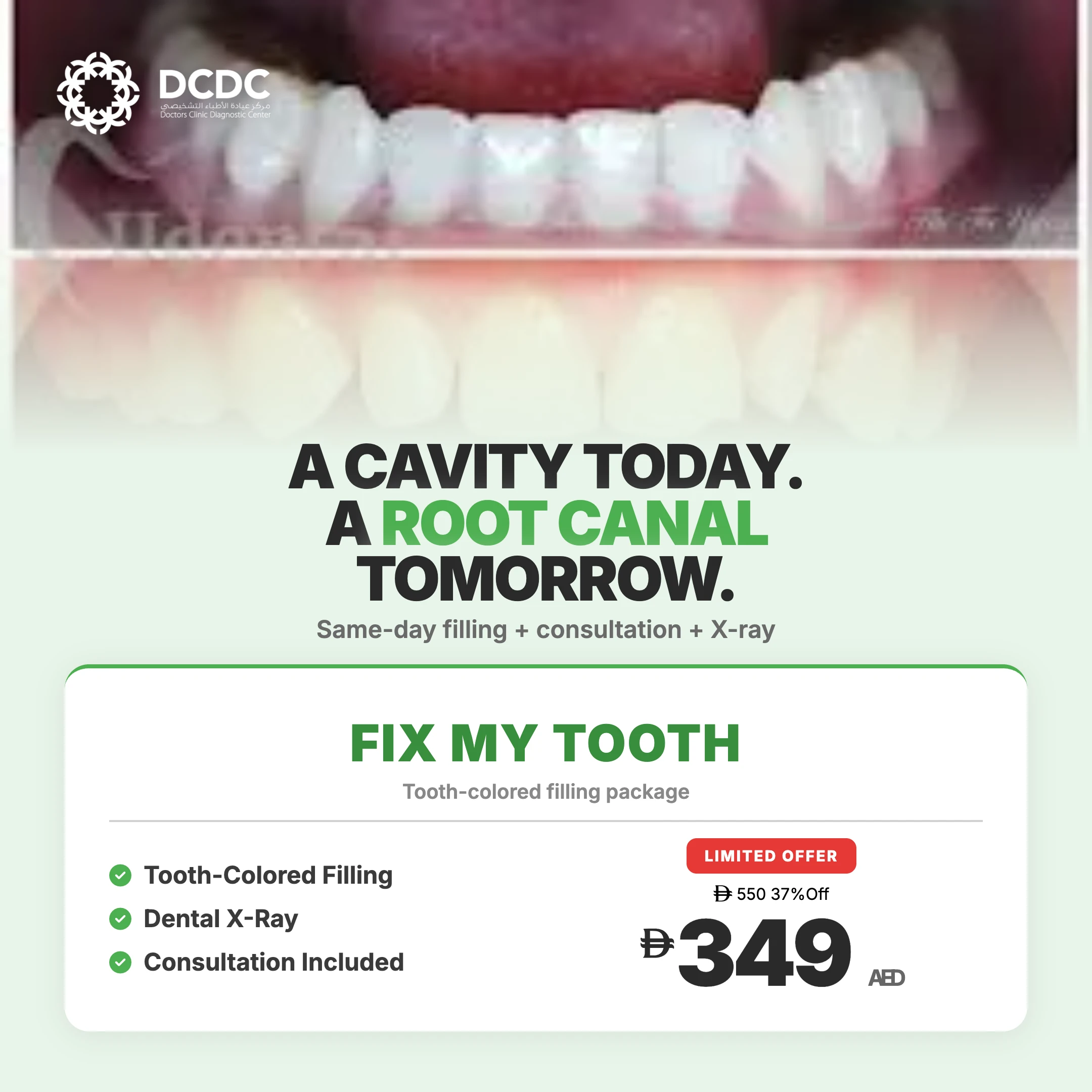
Tooth-Colored Dental Fillings From AED 150
Restore your smile with natural-looking composite fillings at Doctors Clinic Diagnostic Center in DHCC. Our experienced dental team uses advanced bonding techniques and premium composite materials for durable, invisible restorations. Cosmetic fillings start from AED 150 with insurance accepted.
Book your appointment today or walk in during clinic hours.
Factors That Affect Filling Cost in Dubai
Understanding why filling prices vary so widely — from AED 150 to AED 3,500 — helps you evaluate quotes and make informed decisions. Several factors influence the final cost.
- Filling material: The most significant cost factor. Composite resin (AED 150-500) is the most affordable direct material. Glass ionomer (AED 200-400) is similar. Ceramic inlays/onlays (AED 800-2,000) cost more due to laboratory fabrication. Gold (AED 1,500-3,500) is the most expensive due to alloy costs
- Number of surfaces: A single-surface filling (one wall) costs the least. Each additional surface adds material, time, and complexity. A four-surface filling may cost 2-3 times more than a single-surface
- Tooth location: Front teeth require higher aesthetic precision (shade matching, translucency). Back teeth require greater functional strength and can be harder to access. Molar fillings are often slightly more expensive
- Cavity depth: A deeper cavity requires more material, more time, and potentially additional protective layers (liner or base) near the pulp. Very deep cavities approaching the nerve may require indirect pulp capping, adding to cost
- Direct vs indirect: Direct fillings (composite, GIC) are completed in one visit. Indirect restorations (ceramic, gold) require impressions/scans, lab fabrication, and a second appointment — all adding cost
- Clinic location: Clinics in DHCC and premium locations have higher overheads than suburban clinics, but must meet strict DHA quality standards
- Dentist specialisation: A general dentist and a specialist restorative dentist may charge differently. Specialists handle more complex cases and use advanced techniques
- Number of fillings: Multiple fillings in one visit may be offered at a slightly reduced per-tooth rate. Ask about package pricing if you need several fillings
At DCDC, we provide transparent pricing before any treatment begins. Your dentist will examine the tooth, explain the extent of decay, recommend the most appropriate filling material, and provide a clear cost estimate — including any insurance coverage — before proceeding. For patients concerned about gum health alongside their fillings, our guide on gum disease treatment cost covers how periodontal conditions can affect the success and longevity of dental restorations.
Does Insurance Cover Dental Fillings in Dubai?
Most comprehensive dental insurance plans in the UAE cover dental fillings as a basic restorative benefit. However, the extent of coverage varies, and understanding the details before your appointment prevents surprises.
| Coverage Type | What's Covered | Typical Patient Cost | Notes |
|---|---|---|---|
| Basic restorative (front teeth) | Composite fillings — fully covered | AED 0 - 50 co-pay | Composite is the standard material for anterior teeth |
| Basic restorative (back teeth) | Amalgam-equivalent coverage | AED 50 - 150 upgrade co-pay for composite | Some plans cover only amalgam-rate for posteriors. Composite upgrade is modest |
| Major restorative (inlays/onlays) | 50-80% coverage typically | AED 200 - 800 depending on plan | Pre-authorisation usually required. Annual maximums apply |
| Annual maximum (basic plans) | AED 3,000 - 10,000 | Fillings count toward this limit | Track your annual usage |
| Annual maximum (comprehensive) | AED 10,000 - 25,000 | Higher limit allows more restorations per year | May include separate ortho and prosthetic limits |
| Waiting period (new policies) | 3-6 months for restorative benefits | N/A | Preventive benefits (cleaning, exam) usually immediate |
Dental filling insurance coverage in the UAE (2026). DCDC accepts all major insurance providers with direct billing.
At Doctors Clinic Diagnostic Center, we accept all major insurance providers in the UAE. Our reception team will verify your coverage and explain any out-of-pocket costs before treatment begins, so there are no surprises. For self-pay patients, we offer competitive cash pricing with transparent per-tooth costs.
How Long Do Dental Fillings Last? Lifespan Comparison
No dental filling is permanent — all restorations have a finite lifespan and will eventually need replacement. However, expected durability varies significantly by material, and several factors determine whether your filling reaches its maximum potential lifespan.
| Material | Average Lifespan | Maximum Lifespan (with excellent care) | Annual Failure Rate | Key Longevity Factor |
|---|---|---|---|---|
| Composite resin | 7-10 years | 15+ years | 1.8% | Oral hygiene, bruxism control, filling size |
| Amalgam | 10-15 years | 20+ years | 3.0% | Now rarely placed; existing ones can be monitored |
| Glass ionomer | 3-5 years | 7 years | 6-8% | Location (low-stress areas last longer) |
| Ceramic inlay/onlay | 10-15 years | 20+ years | 1-2% | Bonding technique, bruxism control |
| Gold inlay/onlay | 15-30 years | 40+ years documented | < 1% | Gold's ideal wear properties and marginal seal |
Dental filling lifespan comparison by material type. Data from Journal of Dental Research and clinical longitudinal studies.
Several factors significantly influence actual lifespan. Oral hygiene is paramount — patients who brush twice daily, floss regularly, and attend professional cleanings every six months enjoy significantly longer-lasting fillings. Bruxism (teeth grinding) is a major cause of premature failure. Diet matters too: frequent sugar or acidic food/drink exposure promotes secondary decay around filling margins. Filling size is important — small, single-surface fillings last longer than large, multi-surface restorations. And the dentist's technique is critical, particularly for composite where proper moisture control, bonding protocol, and layering directly affect long-term success.
Signs You Need a Filling Replaced
Even well-placed fillings eventually deteriorate. Recognising the signs of a failing filling and seeking timely replacement prevents small problems from becoming large, expensive ones. Delaying replacement risks deeper decay that may require root canal treatment (from AED 700 per tooth at DCDC; AED 1,500–3,000 at many other clinics) or a dental crown (from AED 1,000 at DCDC) — both significantly more expensive than a replacement filling.
- Sensitivity or pain: A filled tooth that becomes sensitive to hot, cold, or sweet stimuli may indicate the filling seal has broken down. New pain on biting suggests a cracked filling or secondary decay beneath
- Visible cracks or chips: If you can see a crack in your filling or notice a piece has broken off, bacteria can enter the gap and cause decay beneath
- Dark discoloration around the filling: A dark shadow or staining around the edges indicates leakage and secondary decay (recurrent caries)
- Rough or sharp edges: If your tongue detects roughness, a sharp edge, or a change in contour, the filling material is degrading
- The filling feels loose or moves: A filling that shifts when you bite has lost its bond and needs immediate replacement
- Floss catches or shreds: Consistently catching or shredding floss indicates a rough or overhanging margin that traps bacteria
- Recurring food impaction: Food consistently getting stuck where it did not before suggests the contact point or filling contour has deteriorated
- X-ray findings: Your dentist may detect early secondary decay or gap formation around old fillings on routine X-rays — before you notice any symptoms. This is why regular checkups are essential
Sensitivity After a Dental Filling: What Is Normal?
Post-operative sensitivity is one of the most common concerns patients have after getting a dental filling. Understanding what is normal — and what warrants a return visit — helps you manage expectations and avoid unnecessary worry.
Normal Post-Filling Sensitivity
- Cold sensitivity: Mild to moderate sensitivity to cold drinks and foods is the most common post-filling symptom. It typically peaks in the first 2-3 days and gradually resolves within 1-2 weeks. Using a desensitising toothpaste (containing potassium nitrate) can accelerate resolution
- Bite sensitivity: Slight tenderness when biting or chewing on the filled tooth for the first few days is normal, particularly with deeper fillings. This reflects the pulp's temporary inflammatory response to the procedure
- Sweet sensitivity: Brief sensitivity to sweet foods may occur for a few days as the dentin-bonding interface stabilises
- Air sensitivity: The tooth may feel sensitive when you breathe in cold air for the first week — this resolves as the filling-tooth bond matures
When to Call Your Dentist
- High bite: If the filling feels high or uneven and you cannot close your teeth comfortably, call your dentist for a quick adjustment. An unadjusted high filling can cause persistent pain and damage the opposing tooth
- Spontaneous, throbbing pain: Pain that occurs without any trigger (no eating, no temperature change) may indicate pulp inflammation. If it persists beyond 48 hours, contact your dentist
- Increasing sensitivity after 2 weeks: Sensitivity should be improving, not worsening. Escalating sensitivity may indicate pulpitis (nerve inflammation) requiring treatment
- Sharp, electric-shock pain: A sudden sharp pain when biting on a specific spot may indicate a cracked cusp or premature contact point that needs adjustment
- Swelling or fever: These are signs of infection and require prompt dental attention
Caring for Your Dental Fillings: Aftercare Guide
Proper aftercare extends the lifespan of your fillings and keeps the restored tooth healthy. Here is what to do immediately after your filling and in the long term.
First 24-48 Hours
- Wait for anaesthesia to wear off: Avoid eating on the numbed side until full sensation returns (2-4 hours). Biting your cheek, lip, or tongue while numb can cause painful injuries you will not feel at the time
- Avoid hard and sticky foods: For 24 hours, avoid ice, hard candy, nuts, toffee, and chewing gum on the filled tooth
- Expect mild sensitivity: Slight sensitivity to cold and biting pressure is normal for a few days to two weeks, particularly for deeper fillings
- Check your bite: If it feels high or uneven after the anaesthesia wears off, contact your dentist for an adjustment — do not try to "get used to it"
Long-Term Maintenance
- Brush twice daily with fluoride toothpaste: Pay particular attention to filling margins where plaque accumulates
- Floss daily: Especially around interproximal (between-teeth) fillings. Consider interdental brushes for larger gaps
- Limit sugar and acidic foods: Frequent sugar feeds bacteria that cause secondary decay around filling margins. Acidic drinks (citrus juice, fizzy drinks, energy drinks) erode enamel
- Wear a night guard if you grind: A custom night guard (AED 500-1,500) protects fillings and natural teeth from excessive bruxism forces — the leading cause of premature filling failure
- Attend 6-monthly dental checkups: Regular examinations with X-rays allow your dentist to catch early signs of wear, cracking, or secondary decay — when repair is simple and inexpensive
- Avoid using teeth as tools: Do not open bottles, tear packaging, or bite non-food objects with your teeth
- Minimise staining: Composite fillings can stain over years from coffee, tea, red wine, and turmeric. If staining becomes noticeable, your dentist can polish or replace the surface layer
Why Choose DCDC for Dental Fillings in Dubai
At Doctors Clinic Diagnostic Center in Dubai Healthcare City, our dental team combines clinical expertise with advanced materials and technology to deliver high-quality dental fillings that look natural and last. Here is what differentiates DCDC.
- Affordable, transparent pricing: Cosmetic composite fillings start from AED 150 — significantly lower than hospital-based dental departments (AED 400-800). No hidden fees, no surprise charges
- Premium composite materials: We use advanced nano-hybrid composite resins from leading manufacturers that offer superior aesthetics, strength, and longevity compared to older-generation composites
- Experienced dental team: Our dental team has extensive experience in restorative and cosmetic dentistry, ensuring precise shade matching, accurate anatomy reproduction, and optimal bonding technique for every filling
- Modern dental technology: Digital dental X-rays (minimal radiation), LED curing lights, ultrasonic scalers, and ergonomic dental chairs for patient comfort
- Comprehensive dental services under one roof: Beyond fillings, we offer dental cleaning, teeth whitening, root canal treatment, dental crowns, and dental implants
- Insurance accepted: We work with all major insurance providers in the UAE with direct billing. Our team handles pre-authorisation and claims processing
- Trust and reputation: 4.8/5 Google rating from over 1,000 reviews. 98% patient satisfaction. MOHAP-licensed facility in Dubai Healthcare City
- Convenient access: Located in DHCC with easy access from Sheikh Zayed Road. Free parking. Walk-in appointments welcome. Average wait time 15 minutes
Expert Dental Fillings at DCDC — From AED 150
Whether you need a new filling or want to replace an old one, our dental team at Doctors Clinic Diagnostic Center delivers natural-looking, durable restorations using premium composite materials. Cosmetic fillings start from AED 150 with all major insurance plans accepted.
Call us today, book online, or walk in during clinic hours.
Related Services at DCDC
Expert care and advanced diagnostics at Dubai Healthcare City
Frequently Asked Questions
Final Thoughts
Dental fillings are one of the most common and effective treatments in dentistry, and modern materials make it possible to restore a damaged tooth so naturally that the filling is virtually invisible. In Dubai, composite fillings start from AED 150, making this essential treatment both accessible and affordable. The key is not to delay — a small cavity treated early with a simple filling (AED 150-300) prevents the need for more complex and expensive procedures like root canal treatment (from AED 700 per tooth at DCDC), crowns (from AED 1,000 at DCDC), or even extraction and implant (AED 5,000-8,000) later on.
At Doctors Clinic Diagnostic Center in Dubai Healthcare City, our dental team provides expert cosmetic fillings using premium composite materials, advanced bonding techniques, and meticulous attention to aesthetics and function. Whether you need a simple single-surface filling or a ceramic inlay for a large cavity, we offer transparent pricing, insurance acceptance with direct billing, and a comfortable clinical environment backed by a 4.8/5 Google rating from over 1,000 patients. Contact us today to book your dental appointment or walk in during clinic hours.
Sources & References
This article was reviewed by our medical team and references the following sources:
- American Dental Association — Dental Filling Materials
- World Health Organization — Oral Health Fact Sheet
- NHS — Dental Fillings Overview
- Cleveland Clinic — Dental Fillings: Types, How Long They Last, Procedure & Costs
- Journal of Dental Research — Longevity of Posterior Composite Restorations vs Amalgam
- Mayo Clinic — Cavities and Tooth Decay
- Minamata Convention on Mercury — Dental Amalgam Phase-Down
Medical content on this site is reviewed by DHA-licensed physicians. See our editorial policy for more information.

Written by
Dr. Chadi El Masry
Dental Surgeon
DDS
Dr. Chadi El Masry is a Dental Surgeon at Doctors Clinic Diagnostic Center (DCDC) in Dubai Healthcare City with extensive experience in restorative and cosmetic dentistry.
Related Articles

Dental Cleaning Cost Dubai: From AED 200 (2026)
Root Canal Cost Dubai: From AED 700 (2026)

Dental Crown Cost Dubai: Types & Pricing
Dental Inlays & Onlays Cost Dubai (2026)
Hollywood Smile Dubai: Cost & Veneer Guide (2026)
More in Dental
Zirconia vs Porcelain Crown Dubai: Guide (2026)
Read More
Zoom Whitening Cost Dubai: From AED 699 (2026)
Read More
Mouth Ulcers Dubai: Causes & When to Worry (2026)
Read MoreDental Anxiety Dubai: Tips to Overcome Fear (2026)
Read MoreDry Mouth Dubai: Causes & Treatment (2026)
Read MoreChipped Tooth Repair Dubai: What to Do (2026)
Read More© 2026 Doctors Clinic Diagnostic Center (DCDC), Dubai Healthcare City. Originally published at https://doctorsclinicdubai.ae/blog/dental-fillings-cost-dubai. All rights reserved. Unauthorized reproduction is prohibited.