Key Takeaways
- The most common tooth cavity signs are tooth sensitivity to hot, cold, or sweet foods, a visible hole or dark spot on the tooth, pain when biting down, persistent bad breath, and a rough or pitted feeling when you run your tongue over the tooth
- Cavity pain tends to linger after the trigger is removed, while ordinary tooth sensitivity fades within seconds — this timing difference is the clearest way to tell the two apart at home, though only a dental exam and X-ray can confirm a cavity
- Tooth decay progresses through five stages — from early enamel demineralisation (white spots) to enamel decay, dentin decay, pulp involvement, and finally an abscess — and the earlier a cavity is caught, the simpler and cheaper the treatment
- Dubai's lifestyle factors — frequent coffee and tea consumption, air-conditioned dry mouth, sugary drinks, and irregular eating schedules during long work hours — can accelerate cavity formation compared to more temperate climates
- A simple tooth-colored filling in Dubai starts from AED 150 and takes 30 to 60 minutes, while a cavity left untreated until it reaches the nerve requires a root canal from AED 700 per tooth plus a protective crown from AED 1,000
- DCDC recommends a dental checkup every six months, especially in Dubai's climate, so that cavities are caught while they are still small — early detection at DCDC's Dubai Healthcare City clinic often means a same-day filling instead of a multi-visit root canal
- Children's cavities in baby teeth still require prompt treatment because untreated decay can affect the permanent teeth developing underneath, cause pain that disrupts eating and sleep, and lead to infection
A dull ache when you bite into something sweet, a rough patch you keep running your tongue over, a dark spot that was not there last year — these are often the first tooth cavity signs people notice, and they are easy to dismiss until the discomfort becomes impossible to ignore. Tooth decay is one of the most common chronic conditions worldwide, and in Dubai's climate — with its heavy coffee and tea culture, sugary drinks, and air-conditioned dry mouth — cavities can progress faster than many people expect. The good news is that a cavity caught early can often be treated with a simple 30-minute tooth-colored filling starting from AED 150, while a cavity left untreated can progress to a root canal or worse.
This guide walks through every warning sign of a cavity, explains how to tell cavity pain apart from ordinary tooth sensitivity, breaks down the five stages of tooth decay from first symptoms to abscess, and covers what causes cavities to form faster in Dubai's climate. You will also find a complete breakdown of cavity treatment options and costs, what actually happens during a cavity exam and filling at DCDC in Dubai Healthcare City, prevention strategies suited to Dubai's lifestyle, guidance for parents on children's cavities, and answers to the most common questions patients ask about tooth decay.


What Is a Tooth Cavity?
A tooth cavity — also called dental caries or tooth decay — is a permanently damaged area on the hard surface of a tooth that develops into a small hole or opening. Cavities form when bacteria that naturally live in dental plaque feed on sugars and starches left behind from food and drink, producing acid as a byproduct. This acid gradually dissolves the minerals in tooth enamel, a process called demineralisation. Over time, if the acid attack continues faster than saliva and fluoride can repair the enamel, the surface breaks down and a cavity forms.
Cavities do not appear overnight. They develop in stages, beginning with an invisible loss of minerals inside the enamel and progressing — if untreated — through the enamel, into the dentin layer beneath it, and eventually into the tooth's inner pulp, where the nerves and blood vessels live. This is why a cavity that starts as a barely noticeable rough spot can, months or years later, become a source of severe pain requiring root canal treatment. According to the World Health Organization, untreated dental caries affects nearly half the global population and remains the most common noncommunicable disease worldwide, making early recognition of cavity signs one of the most impactful things you can do for your oral health.
9 Warning Signs You May Have a Cavity
Cavities are frequently silent in their earliest stage, which is exactly why regular checkups matter. But as decay progresses, it typically produces one or more recognisable symptoms. If you notice any of the following, it is worth scheduling a dental exam rather than waiting for the problem to resolve on its own.
- Sensitivity to hot, cold, or sweet foods: A twinge of discomfort when you drink iced water, hot coffee, or eat something sugary is often the earliest noticeable sign that decay has reached the dentin layer beneath the enamel, where thousands of microscopic tubules connect directly to the nerve.
- A visible hole, pit, or dark spot on the tooth: As decay progresses, it can create a physical hole you can see or feel with your tongue, or a discoloured area that appears white, brown, or black. Front teeth cavities are often spotted this way; back teeth cavities may only be visible on an X-ray.
- Pain when biting or chewing: Sharp or dull pain that occurs specifically when pressure is applied to a tooth can indicate that decay has weakened the tooth structure or is close to the nerve.
- A rough or uneven feeling on the tooth surface: Running your tongue over your teeth and noticing a jagged edge, soft spot, or texture change that was not there before is a subtle but reliable early warning sign.
- Persistent bad breath or an unpleasant taste: Bacteria breaking down food particles trapped inside a cavity can produce a lingering bad odour or an unusual taste in the mouth that does not go away with brushing.
- Toothache that comes and goes — or becomes constant: Intermittent aching that is triggered by eating, or a constant dull throb, both suggest active decay. Pain that keeps you awake at night is a sign the decay may already be affecting the pulp.
- Food regularly getting stuck in one spot: If food consistently lodges in the same place between or on top of teeth, a cavity may have created a new gap or pit that traps debris.
- Staining that will not brush away: Brown, black, or white spot staining that persists despite brushing can indicate demineralisation or active decay beneath the surface.
- Swelling or tenderness in the surrounding gum: Gum tissue near a decayed tooth can become inflamed or tender, particularly when the cavity is near the gumline or has begun to affect the tooth root.
It is worth noting that early-stage cavities frequently cause no symptoms at all, which is one reason routine dental exams matter so much. Your dentist can often spot the earliest signs of decay on a bitewing X-ray months or years before you would ever feel it. For a full breakdown of what a routine exam covers and how often you should be going, see our guide on dental checkups in Dubai.
Cavity vs Tooth Sensitivity: How to Tell the Difference
Because both conditions can cause pain when eating or drinking something hot, cold, or sweet, many people struggle to tell a cavity apart from ordinary tooth sensitivity. The distinction matters, because sensitivity from worn enamel or gum recession is managed very differently than an active cavity, which requires a filling. Here is how to tell them apart.
| Feature | Tooth Sensitivity | Cavity (Tooth Decay) |
|---|---|---|
| How long the pain lasts | Sharp, brief pain that stops within seconds of removing the trigger | Pain often lingers for minutes after the trigger is gone, or aches on its own |
| What triggers it | Cold air, cold or hot drinks, sometimes brushing | Hot, cold, sweet, or acidic foods — and often pressure from biting or chewing |
| Visible signs | Usually none; enamel and tooth surface look normal | May show a hole, dark spot, white spot, or rough texture on the tooth |
| Pain with biting pressure | Rare | Common, especially as decay progresses closer to the nerve |
| Bad breath or bad taste | Not typically associated | Can occur as bacteria break down trapped food debris in the cavity |
| Underlying cause | Worn enamel, gum recession, recent whitening, or a cracked filling | Bacterial acid breaking down enamel and dentin |
General guide to distinguishing tooth sensitivity from a cavity. A dental exam and X-ray remain the only reliable way to confirm which condition you are experiencing.
The safest rule of thumb is this: if sensitivity resolves the moment you remove the hot, cold, or sweet trigger, it is more likely ordinary sensitivity. If the discomfort lingers, worsens with pressure, or is accompanied by a visible spot or hole, treat it as a probable cavity and book an exam. For a closer look at treatment pricing once a cavity is confirmed, see our guide on dental fillings cost in Dubai.
What Causes Cavities? Risk Factors in Dubai
Cavities form when three factors combine: bacteria in dental plaque, a source of sugars or starches for those bacteria to feed on, and enough time for acid to demineralise the enamel faster than saliva can repair it. Several everyday habits and environmental factors increase this risk — and a number of them are especially common in Dubai.
- Frequent coffee and tea consumption: Dubai has one of the highest per-capita coffee and karak tea consumption rates in the region. Many of these drinks are taken with sugar, and frequent sipping throughout the day keeps the mouth in an acidic state for extended periods, giving bacteria more opportunities to attack enamel.
- Air-conditioning and dry mouth: Dubai residents spend the majority of their day in air-conditioned homes, offices, cars, and malls. Prolonged exposure to dry, conditioned air combined with mouth breathing can reduce saliva flow. Saliva is the mouth's natural defence against cavities — it neutralises acid and delivers minerals back to the enamel — so reduced saliva flow means less protection.
- Sugary and carbonated drinks: High consumption of soft drinks, sweetened juices, and energy drinks — common in Dubai's hot climate as people reach for cold beverages — exposes teeth to both sugar and acid, a combination that is particularly damaging to enamel.
- Irregular eating schedules and long work hours: Busy professionals who snack throughout the day rather than eating at set mealtimes expose their teeth to more frequent acid attacks, since each exposure to sugar or starch triggers a fresh wave of bacterial acid production.
- Deep grooves in molars: The back teeth (molars and premolars) have natural pits and fissures that trap food and plaque more easily than smooth tooth surfaces, making them the most common location for cavities in both children and adults.
- Inconsistent brushing and flossing: Skipping the twice-daily brushing routine, especially before bed, allows plaque to accumulate overnight when saliva flow is naturally lowest, creating ideal conditions for decay.
- Dry mouth from medication: Many common medications — including antihistamines, blood pressure medications, and antidepressants — reduce saliva production as a side effect, compounding the dry-mouth effect of air conditioning.
- Acid reflux and frequent vomiting: Stomach acid reaching the mouth, whether from GERD or other causes, directly erodes enamel and accelerates decay, particularly on the inner surfaces of the back teeth.
Tooth Decay Stages Explained
Understanding how tooth decay progresses helps explain why early intervention makes such a dramatic difference in both treatment complexity and cost. Dental caries generally develops through five recognised stages.
| Stage | What Happens | Typical Symptoms | Treatment |
|---|---|---|---|
| 1. Initial demineralisation | Acid begins dissolving minerals in the outer enamel, creating a chalky white spot | None, or a faint white spot — usually painless | Fluoride treatment and improved hygiene can reverse this stage |
| 2. Enamel decay | The white spot progresses and the enamel surface begins to break down | Mild sensitivity to sweets or cold; sometimes still painless | Small filling from AED 150; sealants may help on molars |
| 3. Dentin decay | Decay passes through the enamel into the softer, more sensitive dentin layer | Noticeable sensitivity to hot, cold, or sweet; visible hole possible | Composite filling from AED 150–350 |
| 4. Pulp involvement (pulpitis) | Decay reaches the nerve and blood vessels inside the tooth | Spontaneous or lingering pain, pain when biting, pain at night | Root canal treatment from AED 700 per tooth, plus a crown from AED 1,000 |
| 5. Abscess formation | Untreated infection spreads beyond the root tip into surrounding bone | Severe throbbing pain, swelling, fever, pus, possible tooth mobility | Urgent root canal or extraction; antibiotics if infection has spread |
Tooth decay generally progresses through five stages. Treatment becomes more complex — and more expensive — at every stage, which is why routine checkups that catch stage 1 or 2 decay are so valuable.
When to See a Dentist in Dubai
Not every cavity requires an emergency visit, but certain signs warrant prompt attention rather than waiting for your next scheduled checkup. Use this guide to gauge urgency.
- See a dentist within the week if you notice new sensitivity to hot, cold, or sweet foods, a rough spot or visible discoloration on a tooth, or occasional mild discomfort when chewing.
- See a dentist within 24–48 hours if you have persistent pain that does not fully resolve, pain that wakes you up at night, or a tooth that has become noticeably sensitive to pressure.
- Seek urgent dental care immediately if you experience severe, throbbing pain, visible facial or gum swelling, fever alongside tooth pain, or pus discharge near a tooth — these can indicate an abscess that requires prompt treatment.
DCDC in Dubai Healthcare City offers extended hours — Saturday to Thursday 8 AM to 10 PM and Friday 9 AM to 9 PM — precisely because dental pain rarely waits for convenient business hours. With an average wait time of just 15 minutes and free on-site parking, getting an urgent exam does not have to mean a long, stressful day. If your symptoms point toward something more serious than a simple cavity, our Dental Checkup Dubai guide explains exactly what a comprehensive exam involves and how to prepare for it.
How Cavities Are Diagnosed at DCDC
Diagnosing a cavity accurately requires more than a visual check, since a large portion of decay — particularly between teeth or beneath old fillings — is invisible to the naked eye. At DCDC, our dental specialists use a combination of clinical examination and imaging to confirm cavities and determine exactly how deep the decay has progressed.
- Visual and tactile examination: Your dentist inspects each tooth surface under strong clinical lighting and uses a dental explorer to feel for soft spots, pits, and rough texture changes that indicate active decay.
- Digital X-rays: Bitewing X-rays reveal decay between teeth and beneath the gumline long before it is visible or symptomatic — often catching cavities at the earliest, most treatable stage.
- Assessment of symptoms and history: Your dentist asks about the pattern, triggers, and duration of any discomfort to distinguish a cavity from other causes of tooth pain such as sensitivity, cracked teeth, or gum disease.
- Oral cancer screening: Every cleaning and comprehensive exam at DCDC includes an oral cancer screening as a standard part of the visit — a quick, painless check of the soft tissues in the mouth.
Once a cavity is confirmed, your dentist explains exactly which stage of decay is present, what treatment is recommended, and provides transparent, itemised pricing before any work begins — no surprise costs after the fact.
Cavity Treatment Options and Cost in Dubai
The right treatment for a cavity depends entirely on how far the decay has progressed. Catching a cavity early keeps treatment simple and affordable; waiting allows decay to reach the nerve, which requires more extensive — and more expensive — treatment. The table below breaks down cavity treatment options and typical costs in Dubai.
| Treatment | When It's Needed | Price Range (AED) | Typical Duration |
|---|---|---|---|
| Fluoride treatment / remineralisation | Stage 1 decay — white spot, no cavitation yet | From 150–250 | 15–20 minutes |
| Composite (tooth-colored) filling | Stage 2–3 decay — enamel or dentin cavity | From 150–350 | 30–60 minutes |
| Dental inlay/onlay | Larger cavities where a standard filling isn't sufficient | 600–1,800 | 1–2 visits |
| Root canal treatment | Stage 4 decay — infection has reached the pulp/nerve | From 700 per tooth | 45–120 minutes |
| Post-root-canal crown | Protects a tooth after root canal treatment | From 1,000 | 2 visits |
| Extraction (last resort) | Stage 5 — tooth is non-restorable due to extensive decay | 300–1,500 | 20–40 minutes |
Cavity treatment costs at DCDC in Dubai (2026). Prices are approximate and vary with case complexity; your dentist provides an itemised quote before treatment. Direct billing is available with 20-plus insurance partners.
The financial case for early treatment is stark: a stage 2 cavity treated with a simple composite filling starts from AED 150 and takes as little as 30 minutes. The same tooth, left untreated until decay reaches the nerve, requires a root canal from AED 700 per tooth plus a crown from AED 1,000 — a total starting from AED 1,700 at DCDC, and multiple appointments instead of one. For readers weighing whether a filling or a more involved procedure applies to their situation, our detailed guide on root canal cost in Dubai breaks down pricing by tooth type and complexity.
Think You Have a Cavity? Get a Same-Day Filling at DCDC
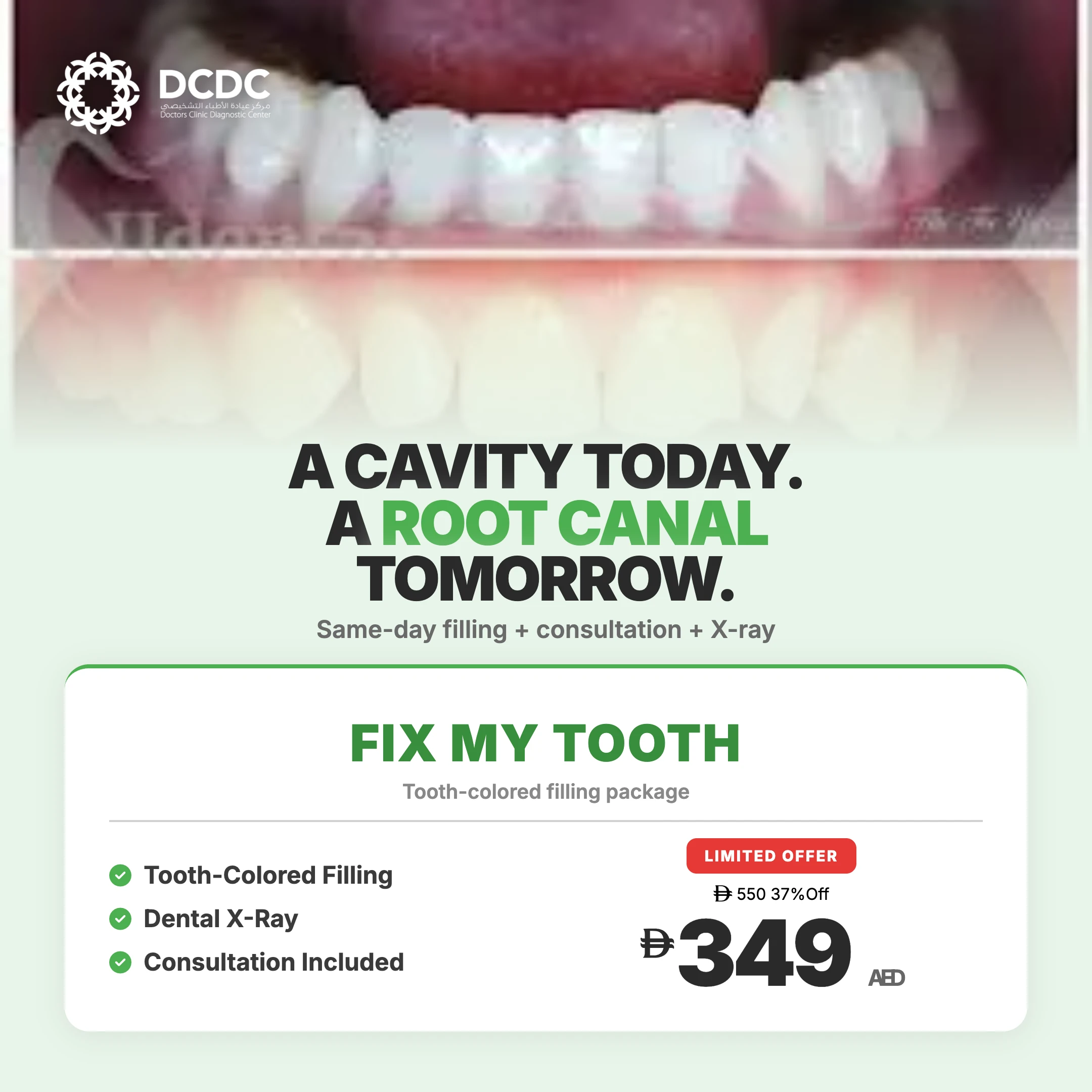
Tooth-colored composite fillings at Doctors Clinic Diagnostic Center in Dubai Healthcare City start from AED 150 and are completed in 30 to 60 minutes with metal-free, shade-matched materials and rubber dam isolation. Our 6-plus dental specialists, including Dr. Chadi El Masry, are rated 4.8/5 from 1,000+ verified reviews.
Book online, WhatsApp us, or walk in — Sat–Thu 8 AM–10 PM, Fri 9 AM–9 PM.
What to Expect During Cavity Treatment at DCDC
Many patients delay treating a cavity simply because they are unsure what the visit will involve. Here is the complete patient journey for a routine filling appointment at DCDC's clinic in Building 64, Block A, Al Razi Medical Complex, Dubai Healthcare City.
- Arrival and check-in: Free dedicated on-site parking makes arriving stress-free. Our multilingual reception team (Arabic, English, Farsi, Urdu, Hindi) handles check-in quickly — the average wait time across DCDC is just 15 minutes.
- Insurance verification: If you carry dental insurance, our team verifies coverage in real time. DCDC offers direct billing with over 20 insurance providers, including Daman, AXA, Bupa, MetLife, and Cigna, so most patients only pay their co-payment.
- Dental examination with digital X-rays: Your dentist examines the affected tooth and takes digital X-rays as needed to confirm the extent of decay and rule out involvement of the nerve.
- Treatment plan discussion: You receive a clear explanation of the diagnosis, the recommended treatment, and transparent, itemised pricing before anything begins — no surprises.
- Local anaesthesia: For most fillings, a local anaesthetic numbs the area completely so the procedure is pain-free. Many very shallow cavities can even be treated without any anaesthesia at all, if the patient prefers.
- Rubber dam isolation and decay removal: A rubber dam keeps the tooth dry and isolated from saliva while the dentist removes the decayed tissue using a dental handpiece, preserving as much healthy tooth structure as possible.
- Shade-matched composite filling: The cavity is filled with a metal-free, tooth-colored composite resin that is precisely shade-matched to your natural teeth, then hardened layer by layer with a curing light and polished smooth.
- Same-day completion and bite check: The entire procedure typically takes 30 to 60 minutes per filling. Your dentist checks your bite before you leave to ensure the filling feels completely natural.
- Follow-up guidance: You receive clear aftercare instructions, and your dentist will recommend a follow-up checkup — typically at your next six-month cleaning — to monitor the tooth long-term.
"Many patients come to DCDC only when cavity pain becomes severe. Early detection during routine checkups can often mean a simple 30-minute filling instead of a root canal. I recommend dental checkups every six months, especially in Dubai where coffee consumption and AC-related dry mouth increase cavity risk," says Dr. Chadi El Masry, a cosmetic and restorative dentistry specialist and Hollywood Smile specialist at DCDC.
How to Prevent Cavities in Dubai's Climate
Preventing cavities is significantly easier — and cheaper — than treating them. A handful of habits, adapted to Dubai's particular climate and lifestyle, meaningfully reduce your risk.
- Brush twice daily with fluoride toothpaste: Thorough two-minute brushing morning and night removes the plaque bacteria that produce cavity-causing acid, and fluoride helps remineralise early enamel damage before it becomes a cavity.
- Floss once a day: Flossing clears plaque and trapped food from between teeth, one of the most common sites for cavities to start — and a place your toothbrush cannot reach.
- Stay hydrated to counter AC-related dry mouth: Since Dubai's air-conditioned environments reduce saliva flow, drinking water throughout the day helps maintain the saliva that naturally neutralises acid and protects enamel.
- Limit sugary coffee, tea, and soft drinks: If you enjoy karak tea or sweetened coffee, try reducing added sugar and rinsing with water afterward rather than sipping continuously throughout the day, which prolongs acid exposure.
- Chew sugar-free gum after meals: Chewing stimulates saliva production, which helps buffer acid and clear food debris when brushing is not immediately possible.
- Get professional cleanings every six months: Ultrasonic scaling removes hardened plaque (calculus) that a toothbrush cannot remove, and each cleaning at DCDC includes cavity detection and an oral cancer screening. See our guide on dental cleaning cost in Dubai for details.
- Ask about dental sealants for molars: Sealants coat the deep grooves of back teeth, where food and plaque naturally accumulate, providing an extra protective barrier especially useful for children and teenagers.
- Do not ignore early symptoms: Sensitivity, a rough spot, or a faint discoloration is your body's earliest warning sign. Addressing it promptly keeps treatment simple, fast, and inexpensive.
Cavities and gum health are closely connected — inflamed or receding gums expose the tooth root, which is softer than enamel and more vulnerable to decay. If you notice bleeding or swollen gums alongside cavity symptoms, our guide on gum disease treatment in Dubai covers diagnosis and treatment in detail.
Children's Cavities: What Parents Should Know
Cavities in baby teeth are common, and many parents assume that because these teeth will eventually fall out, treatment can wait. This is a costly misconception. Baby teeth hold space for the permanent teeth developing underneath them, guide proper jaw development, and are essential for chewing and speech. A cavity in a baby tooth that is left untreated can cause significant pain, disrupt eating and sleep, and — if infection spreads — damage the permanent tooth forming beneath it.
- Watch for early signs in children: White or brown spots on teeth, complaints about sensitivity to sweets, reluctance to chew on one side of the mouth, and visible holes are all signs parents should have checked promptly.
- Baby bottle tooth decay: Prolonged exposure to milk, formula, or juice — especially from a bottle at bedtime — can cause rapid decay across the front teeth in very young children. Avoiding bedtime bottles with anything other than water helps prevent this pattern.
- Sealants are especially valuable for children: Because children's molars have particularly deep grooves and developing brushing habits are still imperfect, dental sealants are one of the most effective preventive tools available.
- Start dental visits early: Pediatric dental guidance recommends a first dental visit by age one, or within six months of the first tooth erupting, so that any decay is caught at the earliest, most treatable stage.
- Supervise brushing until children can do it well independently: Most children lack the fine motor skills to brush thoroughly on their own until around age seven or eight, so parental supervision and assistance meaningfully reduces cavity risk.
At DCDC, our dental team treats patients of all ages in a calm, welcoming environment, using gentle techniques suited to nervous or first-time young patients. If your child shows any signs of a cavity, prompt evaluation is always the safer choice.
Dr. Chadi El Masry's Clinical Perspective on Cavities
"The pattern I see most often is a patient who noticed a small sensitivity or rough spot months earlier, decided to wait it out, and only booked an appointment once the pain became constant," explains Dr. Chadi El Masry. "By that point, what could have been a simple filling has often progressed to needing a root canal. The biology of a cavity is unforgiving — it does not heal itself once the enamel has broken down, and it only ever gets worse without treatment."
"In Dubai specifically, I remind patients that our lifestyle works against our teeth in small but cumulative ways — frequent coffee and tea, sugary cold drinks in the heat, and dry mouth from spending most of the day in air conditioning. None of these need to be eliminated entirely, but awareness helps. My honest advice is simple: a dental checkup every six months is the single highest-value thing you can do for your teeth, because it catches decay while it is still invisible to you but visible to us on an X-ray."
Cavity Myths vs Facts
Misunderstandings about cavities often lead people to delay treatment or make choices that increase their risk. Here are some of the most common myths, corrected.
- Myth: If it does not hurt, it is not a cavity. Fact: Early-stage cavities are frequently painless. By the time a cavity causes noticeable pain, it has often already progressed into the dentin or close to the nerve. Regular X-rays catch decay long before symptoms appear.
- Myth: Sugar-free means cavity-free. Fact: Acidic foods and drinks — including many sugar-free sodas and citrus products — can erode enamel through acid alone, independent of sugar content, particularly with frequent consumption.
- Myth: Baby teeth cavities do not matter since the tooth will fall out anyway. Fact: Untreated decay in baby teeth can cause pain, infection, and damage to the permanent tooth developing underneath, and can also disrupt proper spacing for adult teeth.
- Myth: A hole in a tooth means it is too late to save it. Fact: Even a visible cavity can typically be treated with a straightforward filling. Only decay that has progressed to the nerve requires root canal treatment, and only severe structural loss requires extraction.
- Myth: Whitening toothpaste prevents cavities. Fact: Whitening toothpaste addresses surface staining, not decay. Fluoride is the active ingredient responsible for cavity prevention, and not every whitening formula contains an effective fluoride concentration.
Notice Any of These Cavity Signs? Book a Dental Exam at DCDC
Do not wait for a treatable cavity to become a dental emergency. Our team of 6-plus dental specialists at Doctors Clinic Diagnostic Center in Dubai Healthcare City provides thorough exams, digital X-ray diagnosis, and same-day, tooth-colored fillings from AED 150. Direct billing is available with 20-plus insurance partners, including Daman, AXA, Bupa, MetLife, and Cigna.
Rated 4.8/5 from 1,000+ verified reviews with a 98% patient satisfaction rate. Free parking on-site.
Related Services at DCDC
Expert care and advanced diagnostics at Dubai Healthcare City
Cosmetic Fillings
Tooth-colored composite fillings from AED 150 for cavity treatment
Book AppointmentRoot Canal Treatment
Painless root canal from AED 700 per tooth for deep decay reaching the nerve
Book AppointmentDental Cleaning
Professional cleaning with cavity detection and oral cancer screening
Book AppointmentFrequently Asked Questions
Final Thoughts
Tooth cavity signs are your body's early warning system, and recognising them — sensitivity that lingers, a rough or discoloured spot, pain when biting, persistent bad breath — gives you the chance to treat decay while it is still simple, fast, and inexpensive. Dubai's climate and lifestyle, from frequent coffee and tea to air-conditioned dry mouth, can accelerate the pace of decay, which makes routine six-month checkups even more valuable here than in many other places. The single biggest factor in how much a cavity costs to treat, and how comfortable that treatment is, is how early it is caught.
At Doctors Clinic Diagnostic Center in Dubai Healthcare City, our team of 6-plus dental specialists — including Dr. Chadi El Masry — diagnoses and treats cavities with digital X-rays, shade-matched composite fillings from AED 150, and a transparent, patient-first approach. With a 4.8/5 Google rating from over 1,000 verified reviews, a 98% patient satisfaction rate, direct billing with 20-plus insurance partners, free parking, and extended hours (Sat–Thu 8 AM–10 PM, Fri 9 AM–9 PM), getting a cavity checked and treated in Dubai has never been more straightforward. If you have noticed any of the warning signs in this guide, book your exam today.
Sources & References
This article was reviewed by our medical team and references the following sources:
- World Health Organization — Oral Health Fact Sheet
- Cleveland Clinic — Cavities (Tooth Decay): Symptoms, Causes & Treatment
- NHS — Tooth Decay Overview
- American Dental Association — Cavities (Tooth Decay)
- Mayo Clinic — Cavities/Tooth Decay: Symptoms and Causes
- Colgate — Watch Out For These Signs of a Cavity
Medical content on this site is reviewed by DHA-licensed physicians. See our editorial policy for more information.

Written by
Dr. Chadi El Masry
Cosmetic & Restorative Dentistry
DDS
Dr. Chadi El Masry is a Cosmetic & Restorative Dentistry specialist at Doctors Clinic Diagnostic Center (DCDC) in Dubai Healthcare City.
Related Articles
Dental Fillings Cost Dubai: From AED 150

Dental Checkup Dubai: What to Expect
Root Canal Cost Dubai: From AED 700

Dental Cleaning Cost Dubai: From AED 200

Gum Disease Treatment Dubai: From AED 1,000
More in Dental
Zirconia vs Porcelain Crown Dubai: Guide (2026)
Read More
Zoom Whitening Cost Dubai: From AED 699 (2026)
Read MoreMouth Ulcers Dubai: Causes & When to Worry (2026)
Read MoreDental Anxiety Dubai: Tips to Overcome Fear (2026)
Read MoreDry Mouth Dubai: Causes & Treatment (2026)
Read MoreChipped Tooth Repair Dubai: What to Do (2026)
Read More© 2026 Doctors Clinic Diagnostic Center (DCDC), Dubai Healthcare City. Originally published at https://doctorsclinicdubai.ae/blog/tooth-cavity-signs-treatment-dubai. All rights reserved. Unauthorized reproduction is prohibited.