اہم نکات
- An OPG (orthopantomogram) is a panoramic X-ray that captures both jaws, all teeth, and surrounding structures in a single image
- The scan takes under 15 seconds and requires no injections, contrast dye, or special preparation
- OPG X-rays are completely painless - you simply stand still while the machine rotates around your head
- The image reveals impacted teeth, bone loss, jaw fractures, cysts, tumors, TMJ disorders, and sinus abnormalities
- DCDC Dubai Healthcare City offers digital OPG scans on a walk-in basis with same-day results from a consultant radiologist
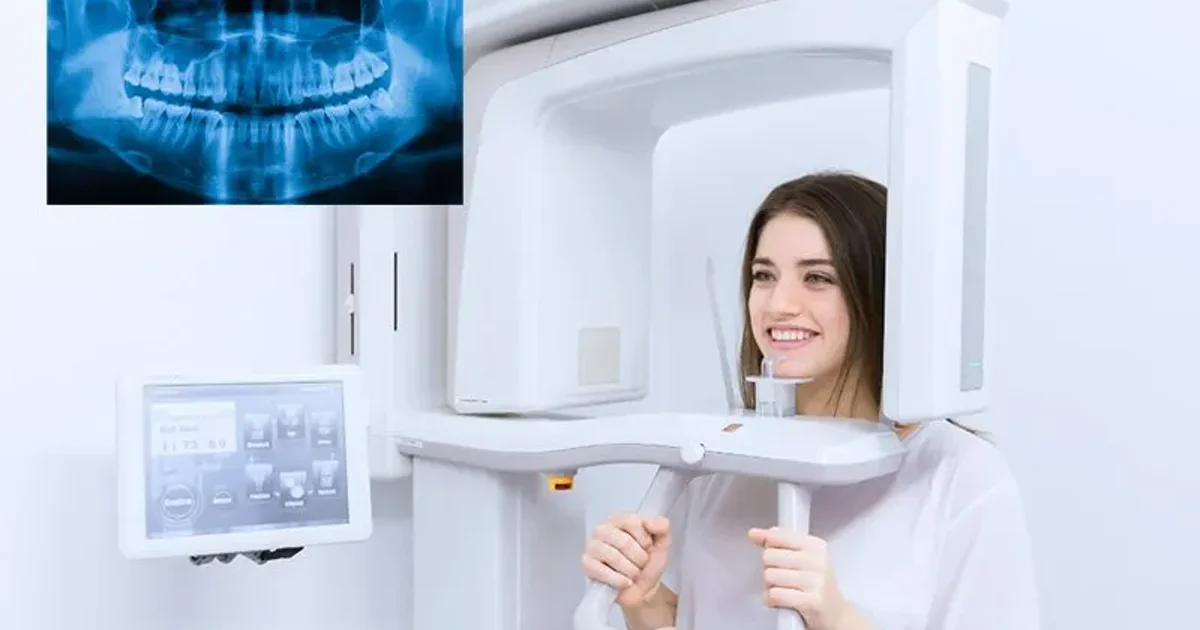
An OPG X-ray (orthopantomogram) is a panoramic dental X-ray that captures a flat, two-dimensional image of the entire mouth - including both jaws, all teeth, the temporomandibular joints, and surrounding bone - in a single scan lasting less than 15 seconds. It is the most widely used extraoral dental imaging technique in the world, and it serves as the standard first-line screening tool for dentists, oral surgeons, and orthodontists evaluating jaw and tooth conditions.
This guide explains what OPG stands for, how the scan works, what it reveals, when you need one, how it compares to intraoral X-rays, and where to get a reliable OPG scan in Dubai. Every section is reviewed by a consultant radiologist to ensure clinical accuracy.
What Does OPG Stand For?
OPG stands for orthopantomogram, a compound term derived from the Greek words "ortho" (straight), "pan" (all), and "tomogram" (a sectional image) - collectively meaning a straight, all-encompassing sectional image of the jaws and teeth. In everyday clinical practice the scan is also referred to as a panoramic radiograph, a panoramic X-ray, a pantomogram, or simply a "pano." Regardless of the name used, the imaging principle is identical: a single X-ray beam sweeps around the patient's head to produce one continuous flat image that displays both the upper jaw (maxilla) and the lower jaw (mandible) from ear to ear.
The concept was first developed by Finnish radiologist Yrjo Veli Paatero in the 1940s, and commercial OPG machines became widely available in dental clinics by the 1960s. Today, digital OPG systems have replaced film-based units in most modern clinics, producing higher-resolution images at lower radiation doses while allowing instant viewing on a computer screen.
What makes the OPG unique among dental X-ray techniques is its ability to display the entire oral and maxillofacial region on a single image. Intraoral X-rays, by comparison, only capture two to three teeth at a time. This panoramic perspective gives clinicians a broad overview that is invaluable for screening, treatment planning, and monitoring changes over time.
How Does an OPG X-Ray Work?
An OPG X-ray works by rotating an X-ray tube and a detector in a coordinated semicircle around the patient's head, using a technique called tomographic motion to capture a focused image of the curved jaw structures on a flat two-dimensional plane. The entire acquisition takes between 15 and 20 seconds, during which the patient remains completely still.
Here is what happens step by step during an OPG scan:
- Positioning: The patient stands upright (or sits in a wheelchair-accessible unit) and places their chin on a small chin rest. A bite block or positioning guide is placed between the front teeth to align the jaws correctly.
- Head stabilization: Lateral head guides gently press against the temples to prevent any movement during the scan. The technologist adjusts the machine height to match the patient's anatomy.
- Exposure: The X-ray tube and the digital detector begin rotating simultaneously around the patient's head in a semicircular arc from one ear to the other. This rotation takes approximately 15 to 20 seconds.
- Image reconstruction: The digital detector captures a continuous stream of narrow X-ray slices as it moves. Software then reconstructs these slices into a single panoramic image showing the full mandible, maxilla, teeth, TMJ joints, and adjacent structures.
- Display: The completed image appears on the radiologist's workstation within seconds, ready for interpretation and reporting.
Because the X-ray source is outside the mouth (extraoral), the patient does not need to bite down on uncomfortable film packets or sensors, making the OPG significantly more comfortable than traditional intraoral dental X-rays. This is particularly beneficial for patients with a strong gag reflex, limited mouth opening, or dental anxiety.
"The OPG is the dental world's most versatile screening tool," explains Dr. Osama Elzamzami, Consultant Radiologist at DCDC. "In a single 15-second scan, we capture both jaws, all teeth, the temporomandibular joints, and the surrounding bone - giving dentists a complete overview that no single intraoral X-ray can provide."
What Does an OPG X-Ray Show?
An OPG X-ray shows the complete dental and maxillofacial anatomy in one image, enabling radiologists and dentists to identify a wide range of conditions that would otherwise require multiple separate intraoral films. The panoramic view is particularly powerful because it reveals the spatial relationship between structures across the entire jaw, not just one localized area.
Structures and conditions visible on a standard OPG include:
- All erupted teeth in both the upper and lower jaws, including their roots, crowns, and surrounding bone
- Unerupted and impacted teeth, especially wisdom teeth (third molars) that are trapped beneath the gum or growing at an angle
- Developing teeth in children and adolescents, allowing dentists to assess eruption patterns and predict crowding
- Tooth decay (caries), particularly large interproximal cavities between teeth
- Periapical pathology such as dental abscesses, granulomas, and root-tip infections
- Bone loss from periodontal (gum) disease, visible as reduced bone height around tooth roots
- Jawbone abnormalities including cysts, tumors, and benign growths such as ameloblastomas or odontomas
- Jaw fractures from trauma affecting the mandible, condyles, or maxilla
- Temporomandibular joints (TMJ) - the hinge joints on each side of the jaw - showing signs of arthritis, erosion, or dislocation
- Maxillary sinuses, revealing sinusitis, polyps, mucous retention cysts, or tooth roots projecting into the sinus floor
- Nasal cavity and nasal septum for gross deviation or obstruction
- Dental restorations such as fillings, crowns, bridges, and implants, and their relationship to adjacent anatomy
- The inferior alveolar nerve canal, which is critical for implant planning and wisdom tooth extraction
It is important to note that while the OPG provides an excellent overview, its two-dimensional nature means that some fine details - such as very early cavities or hairline root fractures - may require supplementary intraoral X-rays or cone-beam computed tomography (CBCT) for confirmation. The OPG is best understood as a screening tool that identifies areas of concern, which can then be examined in greater detail if needed.
When Do You Need an OPG X-Ray?
An OPG X-ray is needed whenever a dentist, oral surgeon, or orthodontist requires a comprehensive view of both jaws and all teeth to diagnose a condition, plan a treatment, or monitor healing after a procedure. It is the most frequently requested extraoral dental imaging study worldwide, and its indications span virtually every dental specialty.
Orthodontic Assessment
Orthodontists routinely request an OPG before starting braces or clear aligner treatment. The panoramic image reveals the position and angulation of all teeth - including those still developing beneath the gums in younger patients - helping the orthodontist plan tooth movement, identify missing teeth, and detect supernumerary (extra) teeth that could interfere with alignment.
Wisdom Teeth Evaluation
The OPG is considered the standard imaging study for evaluating wisdom teeth. It shows whether the third molars are impacted, partially erupted, or fully erupted, and - critically - it reveals their proximity to the inferior alveolar nerve canal. This information is essential for oral surgeons to assess extraction difficulty and minimize the risk of nerve injury during surgery.
Dental Implant Planning
Before placing dental implants, clinicians need to evaluate the height and width of available bone, the location of the nerve canal in the lower jaw, and the position of the maxillary sinuses above the upper jaw. An OPG provides this initial overview. In complex cases, a CBCT scan may follow for three-dimensional measurements, but the OPG remains the essential starting point.
Jaw Pain and TMJ Disorders
Patients presenting with jaw clicking, locking, or chronic facial pain are frequently referred for an OPG to evaluate the temporomandibular joints. The image can reveal bony changes such as condylar flattening, osteophytes (bone spurs), or erosion that suggest degenerative joint disease, as well as fractures or dislocations of the condylar process.
General Dental Checkup and Screening
Many general dentists include an OPG as part of a new patient examination or periodic comprehensive review. The panoramic view provides a baseline record of the patient's dental status that can be compared against future images to track disease progression, bone changes, or treatment outcomes.
Trauma and Injury Assessment
In emergency settings, an OPG is often the first imaging study ordered for patients who have sustained facial trauma. It can identify fractures of the mandible, condyles, or midface structures quickly and non-invasively, helping emergency physicians and maxillofacial surgeons plan definitive treatment.
A 28-year-old patient came to DCDC with recurring jaw pain that three different dentists could not diagnose from intraoral X-rays alone. A single OPG scan at DCDC immediately revealed an impacted wisdom tooth pressing against the inferior alveolar nerve canal - the root cause of the chronic discomfort. "This is a classic case where the panoramic view tells the full story," says Dr. Osama Elzamzami. "The intraoral X-rays each showed only a small piece of the puzzle. The OPG connected the dots in 15 seconds."
OPG X-Ray vs Intraoral X-Ray: Key Differences
The OPG (panoramic) X-ray and the intraoral X-ray are complementary tools that serve different diagnostic purposes, and understanding the key differences helps patients know why their dentist may recommend one, the other, or both. The most fundamental distinction is coverage: the OPG captures the entire oral and maxillofacial region in one shot, while intraoral X-rays provide high-resolution detail of a small, targeted area.
| Feature | OPG (Panoramic) X-Ray | Intraoral X-Ray |
|---|---|---|
| Coverage area | Both jaws, all teeth, TMJ, sinuses - ear to ear | 2-3 teeth per image |
| Detail level | Good overview; moderate fine detail | Very high detail for small area |
| Best for | Screening, impacted teeth, fractures, orthodontic planning, implant overview | Detecting early cavities, root canal assessment, checking individual restorations |
| Scan duration | 15-20 seconds | < 1 second per exposure |
| Radiation dose | 10-20 μSv (equivalent to 1-2 days background radiation) | 1-8 μSv per image (but multiple images are often needed) |
| Sensor placement | Outside the mouth (extraoral) | Inside the mouth (sensor or film on tongue side of teeth) |
| Patient comfort | Very comfortable; no intraoral sensor | Can be uncomfortable; may trigger gag reflex |
| Number of images | 1 image covers everything | Full-mouth series requires 14-20 separate images |
OPG and intraoral X-rays are complementary. A comprehensive dental examination often begins with an OPG for the overview and adds targeted intraoral images where higher detail is needed.
In practice, most dental professionals use the OPG as a screening tool and then take periapical or bitewing intraoral X-rays of specific areas that require closer inspection. For example, if an OPG reveals a suspicious area around a molar root, a periapical film of that tooth provides the fine resolution needed to confirm or rule out a root fracture or periapical abscess.
Digital OPG X-Ray at DCDC Dubai Healthcare City
Get a high-resolution digital OPG scan with same-day radiologist reporting at Doctors Clinic Diagnostic Center. Walk-ins welcome. Located in Dubai Healthcare City, serving patients from Oud Metha, Umm Hurair 2, Karama, and across Dubai.
No referral required for self-pay patients
OPG X-Ray Procedure: What to Expect
The OPG X-ray procedure is one of the simplest and fastest imaging studies in dentistry, requiring no preparation, no fasting, no injections, and no recovery time - you walk in, stand in the machine for about 15 seconds, and walk out with your scan complete. Here is exactly what happens from the moment you arrive at the radiology department.
- Step 1 - Arrival and registration: You check in at the reception desk. No appointment is strictly necessary at walk-in facilities like DCDC, although booking ahead can reduce waiting time.
- Step 2 - Remove metal and jewelry: The radiographer will ask you to remove eyeglasses, earrings, necklaces, hairpins, hearing aids, and any removable dental appliances (dentures or retainers). Metal objects can create artifacts that obscure the image.
- Step 3 - Wear a lead apron: A lead thyroid collar and/or lead apron is placed on you to protect the thyroid gland and body from scattered radiation.
- Step 4 - Position in the machine: You step up to the OPG unit and rest your chin on the chin support. The radiographer adjusts the machine height and positions your head using the light-beam guides.
- Step 5 - Bite on the positioning guide: You gently bite down on a sterile plastic bite block that keeps your front teeth slightly apart and your jaws in the correct alignment.
- Step 6 - Stand still: The radiographer steps behind a protective screen and activates the machine. The X-ray tube and detector arm begin rotating around your head. You must remain completely still and avoid swallowing during the 15-to-20-second sweep.
- Step 7 - Scan complete: The machine stops, and you step away. The digital image appears on the workstation within seconds. The entire process from positioning to completion typically takes under 5 minutes.
No preparation is needed before an OPG scan. You do not need to fast, stop any medications, or arrange someone to drive you home. Results are typically available the same day at DCDC, with the radiologist's written report sent directly to your referring dentist or provided to you in person.
Patients with mobility challenges can have the OPG taken in a seated position if the machine has wheelchair accessibility, or an alternative imaging method may be recommended by the radiologist.
Is an OPG X-Ray Safe?
Yes, an OPG X-ray is very safe and delivers one of the lowest radiation doses of any medical imaging procedure, with a typical effective dose of approximately 10 to 20 microsieverts (μSv) - equivalent to roughly 1 to 2 days of natural background radiation that every person receives simply from living on Earth. For context, you absorb more radiation during a single long-haul flight from Dubai to London than you do from an OPG scan.
To put the numbers in perspective:
- OPG X-ray: approximately 10-20 μSv
- Full-mouth intraoral X-ray series (14-20 films): approximately 35-170 μSv
- Chest X-ray: approximately 20 μSv
- CBCT (dental cone beam): approximately 30-200 μSv depending on field of view
- CT scan of the head: approximately 2,000 μSv
- Average annual background radiation: approximately 2,400 μSv per year (6.5 μSv per day)
An OPG delivers less radiation than a single long-haul flight (which exposes passengers to 40-80 μSv of cosmic radiation). The dose is also well below the threshold at which any measurable health risk has ever been demonstrated in scientific studies.
OPG safety for children: Panoramic X-rays are commonly used in pediatric dentistry because they avoid the discomfort of intraoral sensors in small mouths and provide a comprehensive overview of developing teeth and jaw growth. Modern digital OPG machines include automatic dose-reduction protocols for pediatric patients that lower the radiation output based on the child's size, making the scan even safer for young patients.
Pregnancy precautions: As a general principle, elective dental imaging is postponed during pregnancy, particularly during the first trimester. However, if an OPG is clinically necessary for an urgent condition (such as a jaw infection or fracture), it can be performed with appropriate lead shielding. The radiation dose from an OPG is extremely low and directed away from the abdomen, making the actual risk negligible. Patients should always inform the radiographer if there is any possibility of pregnancy.
OPG X-Ray at DCDC Dubai Healthcare City
Doctors Clinic Diagnostic Center (DCDC) offers state-of-the-art digital OPG X-ray services at its facility in Dubai Healthcare City, providing patients and referring dentists with high-resolution panoramic imaging, rapid turnaround, and expert radiologist reporting under one roof.
What patients can expect at DCDC:
- Digital OPG technology: DCDC uses the latest digital panoramic X-ray systems, which produce sharper images at lower radiation doses than older film-based machines. Images are available for viewing within seconds of the scan.
- Instant results: The digital image is immediately visible to the radiologist. A formal written report is typically completed the same day, and in urgent cases, a verbal preliminary report can be communicated to your dentist within minutes.
- Walk-ins welcome: While appointments are available, DCDC accepts walk-in patients for OPG scans throughout clinic hours. No referral is required for self-pay patients, making it easy to get scanned at your convenience.
- Consultant radiologist reporting: Every OPG at DCDC is reviewed and reported by a consultant radiologist - not a technician or a general practitioner - ensuring the highest standard of diagnostic accuracy.
- Insurance accepted: DCDC accepts major insurance providers in Dubai. Patients with insurance may need a referral from their dentist or GP to activate coverage.
- Convenient location: DCDC is located in Dubai Healthcare City, easily accessible from Oud Metha, Umm Hurair 2, Karama, Bur Dubai, and the wider Dubai metro area. Free parking and metro access are available nearby.
Whether you have been referred by your dentist for wisdom tooth assessment, orthodontic planning, or implant evaluation, or you simply need a baseline panoramic dental X-ray for a new dental provider, DCDC provides a seamless imaging experience from registration to report delivery.
Book Your OPG Scan Today
Walk in or book ahead for a digital OPG X-ray at DCDC Dubai Healthcare City. Same-day results. No referral needed for self-pay. Call or WhatsApp to schedule.
اکثر پوچھے گئے سوالات
Final Thoughts
The OPG X-ray remains one of the most valuable and versatile tools in dental and maxillofacial imaging. In less than 15 seconds, it provides a comprehensive panoramic view that helps dentists, orthodontists, and oral surgeons diagnose conditions ranging from impacted wisdom teeth and bone loss to jaw fractures and TMJ disorders. With very low radiation, zero pain, and no special preparation required, it is also one of the most patient-friendly imaging studies available. For detailed pricing information, visit our guide on OPG X-ray cost in Dubai.
If your dentist has recommended an OPG, or if you need a panoramic dental X-ray for orthodontic treatment, implant planning, or a routine dental evaluation, Doctors Clinic Diagnostic Center in Dubai Healthcare City offers digital OPG scans with same-day consultant radiologist reporting and walk-in availability. Explore our full range of OPG X-ray services or contact us to book your scan today.
ذرائع اور حوالہ جات
یہ مضمون ہماری طبی ٹیم نے جائزہ لیا ہے اور درج ذیل ذرائع کا حوالہ دیتا ہے:
- American Dental Association - Dental Radiographic Examinations: Recommendations for Patient Selection and Limiting Radiation Exposure
- European Commission - Radiation Protection 136: European Guidelines on Radiation Protection in Dental Radiology
- RadiologyInfo.org - Panoramic Dental X-ray (Orthopantomogram)
- British Dental Journal - The Orthopantomogram: An Indispensable Diagnostic Aid
اس سائٹ پر طبی مواد کا جائزہ DHA لائسنس یافتہ ڈاکٹرز نے لیا ہے۔ ہماری دیکھیں تحریری پالیسی مزید معلومات کے لیے۔

تحریر
Dr. Osama Elzamzami
Consultant Radiologist
MD, Radiology
Dr. Osama Elzamzami is a Consultant Radiologist specializing in diagnostic imaging including X-ray, CT, MRI, OPG, CBCT, and ultrasound at DCDC Dubai Healthcare City. With extensive experience in dental and maxillofacial radiology, he provides expert reporting for panoramic and cone-beam imaging studies.