اہم نکات
- Scoliosis is a lateral spinal curvature greater than 10 degrees (Cobb angle), most commonly diagnosed in adolescents aged 10-16
- Adolescent idiopathic scoliosis (AIS) accounts for 80% of all cases -- the exact cause is unknown but has a genetic component
- Physiotherapy-specific exercise programmes (Schroth, SEAS) have been shown to reduce curve progression and improve function in mild to moderate scoliosis
- Bracing is recommended for growing adolescents with curves between 25-45 degrees and has been proven to prevent progression to surgery in 72% of cases
- Surgery (spinal fusion) is typically considered for curves exceeding 45-50 degrees in growing adolescents or curves causing significant functional impairment
- Adult scoliosis management focuses on pain relief, functional improvement, and preventing progression -- it differs significantly from adolescent treatment
- School screening for scoliosis is important but imperfect -- parents should know the signs to watch for during growth spurts
- Not all scoliosis worsens. Mild curves (under 20 degrees) in skeletally mature individuals rarely progress and may need only monitoring
Your child's school nurse flagged an uneven shoulder line, or you noticed one hip sitting higher than the other. A spine X-ray confirms scoliosis, and suddenly you are facing decisions about treatment that feel overwhelming. The reality is that most scoliosis is mild, does not require surgery, and responds well to physiotherapy-based management. Understanding the condition -- what the numbers mean, which treatments are evidence-based, and what to watch for -- puts you in control.
Scoliosis affects 2-3% of adolescents, and while the word itself can cause panic, the majority of cases are mild and manageable. This guide covers what every parent needs to know about adolescent scoliosis, as well as information for adults living with scoliosis. We will explain the Cobb angle measurement, when bracing is needed, what Schroth physiotherapy involves, and the evidence behind each treatment approach.
What Is Scoliosis and What Are the Different Types?
Scoliosis is a three-dimensional deformity of the spine involving lateral curvature (side-bending) of more than 10 degrees, along with rotation. It is not simply "bad posture" -- the vertebrae themselves rotate and the spine curves in a structural pattern. There are several distinct types, and the type determines the treatment approach.
- Adolescent idiopathic scoliosis (AIS): By far the most common type (80% of cases). "Idiopathic" means the cause is unknown, though there is a strong genetic component. Diagnosed between ages 10-18, more common and more likely to progress in girls
- Congenital scoliosis: Present at birth due to vertebral malformation during fetal development. Requires early specialist assessment and may need surgical intervention depending on the specific anomaly
- Neuromuscular scoliosis: Caused by conditions affecting the muscles or nerves (cerebral palsy, muscular dystrophy, spinal muscular atrophy). Often more severe and progressive than idiopathic scoliosis
- Degenerative (adult) scoliosis: Develops in adulthood due to disc degeneration, facet joint arthritis, and ligament laxity. Different from adolescent scoliosis that persists into adulthood
How Is the Cobb Angle Measured and What Does It Mean?
The Cobb angle is the standard measurement used to quantify scoliosis severity. It is measured on a standing full-spine X-ray by drawing lines along the top of the most tilted vertebra above the curve apex and the bottom of the most tilted vertebra below it. The angle between these lines is the Cobb angle. Understanding your child's Cobb angle is essential because treatment decisions are based directly on this number, combined with the child's remaining growth potential.
| Cobb Angle | Classification | Treatment Approach | Monitoring |
|---|---|---|---|
| Less than 10 degrees | Spinal asymmetry (not scoliosis) | None required | No routine follow-up needed |
| 10-20 degrees | Mild scoliosis | Physiotherapy-specific exercises (Schroth/SEAS), observation | X-ray every 6-12 months during growth |
| 20-25 degrees | Moderate (mild-moderate) | Intensive physiotherapy, consider bracing if growing and curve progressing | X-ray every 4-6 months during growth |
| 25-45 degrees | Moderate to severe | Bracing (full-time, 18-23 hours/day) plus physiotherapy | X-ray every 4-6 months, close monitoring |
| Over 45 degrees | Severe | Surgical consultation (spinal fusion typically recommended for growing adolescents) | Specialist-directed |
Treatment decisions also depend on skeletal maturity (Risser sign), growth remaining, curve pattern, and clinical appearance. This table is a guide, not a rigid protocol.
What Is the Schroth Method for Scoliosis?
The Schroth method is the most studied and widely used physiotherapy-specific exercise approach for scoliosis. Developed in Germany and refined over decades, it uses a combination of three-dimensional postural corrections, rotational breathing, and muscle activation patterns specific to each patient's curve type. Unlike general exercises, Schroth exercises are designed to de-rotate, elongate, and stabilise the spine in a corrected position. For related information, see our guide on Arthritis: Physiotherapy Management Guide.
- Curve-specific corrections: Exercises are tailored to the individual's curve pattern (thoracic, lumbar, thoracolumbar, or combined). A right thoracic curve requires different corrections than a left lumbar curve
- Rotational angular breathing: Directed breathing into the concave side of the curve helps expand collapsed areas of the rib cage and improves thoracic symmetry
- Postural awareness: Patients learn to identify and maintain corrected posture during daily activities, not just during exercise sessions
- Muscle activation: Specific muscles are strengthened to actively hold the spine in a more corrected position throughout the day
A 2016 study published in Scoliosis and Spinal Disorders found that Schroth exercises reduced Cobb angle by an average of 3-5 degrees in mild to moderate curves and significantly reduced progression compared to standard care alone. While these changes may seem small, preventing a 25-degree curve from progressing to 45 degrees can mean the difference between physiotherapy management and surgery.
What Is the SEAS Approach to Scoliosis?
SEAS (Scientific Exercise Approach to Scoliosis) is an Italian-developed method that emphasises active self-correction and functional integration. While Schroth focuses on sustained corrective positions, SEAS trains the patient to achieve and maintain their best possible posture through active self-correction during everyday activities. It uses fewer clinic-based sessions and more independent practice, making it practical for adolescents who may resist frequent therapy visits.
Both Schroth and SEAS are recommended by the International Scientific Society on Scoliosis Orthopaedic and Rehabilitation Treatment (SOSORT). The choice between them often depends on the individual patient, therapist training, and practical considerations. At DCDC, our physiotherapy team will recommend the approach best suited to your child's specific curve, age, and lifestyle.
When Is Bracing Needed for Scoliosis?
Bracing is recommended for growing adolescents with curves between 25-45 degrees. The landmark BrACT study (2013, New England Journal of Medicine) demonstrated that bracing reduced the progression of high-risk curves to the surgical threshold from 48% to 28%, with success rates improving the more hours per day the brace was worn. Full-time wear (18-23 hours daily) is most effective.
- Who needs a brace: Adolescents with Cobb angle 25-45 degrees, Risser sign 0-2 (significant growth remaining), and documented curve progression
- Brace types: The most common is a rigid thoracolumbosacral orthosis (TLSO) custom-moulded to the patient. Nighttime-only braces exist for specific curve patterns but have less evidence
- Duration: Bracing continues until skeletal maturity (usually 16-18 years, confirmed by Risser 4-5). It is then gradually weaned
- Compliance challenges: Wearing a brace 18+ hours daily is difficult for adolescents. Family support, proper fit, and honest discussion about the alternative (potential surgery) improve compliance
- Bracing with exercises: Physiotherapy should continue alongside bracing. In-brace exercises and out-of-brace exercises complement the correction the brace provides
When Is Scoliosis Surgery Needed?
Spinal fusion surgery is typically recommended for adolescents with curves exceeding 45-50 degrees that are still progressing, or curves causing significant pain, functional impairment, or cardiopulmonary compromise. Surgery involves fusing vertebrae together with rods and screws to correct and stabilise the curve. Modern techniques achieve significant correction (50-70% of the curve), but the fused segment permanently loses flexibility. You may also find our Plantar Fasciitis: Physiotherapy Treatment Guide helpful.
The decision for surgery is never taken lightly and should involve discussion with an experienced spine specialist. Surgery is not a failure of conservative treatment -- some curves are simply too severe or progressive for bracing and exercise alone. Post-surgical physiotherapy is essential for recovery and return to activity.
What Exercises Help Mild Scoliosis?
For mild scoliosis (10-20 degrees), the following exercises can be beneficial when performed consistently. These should be prescribed and supervised by a physiotherapist trained in scoliosis management to ensure they are appropriate for the specific curve pattern.
- Active self-correction: Learning to identify and maintain the most corrected spinal position possible using mirror feedback. This becomes the foundation for all other exercises
- Core stabilisation in corrected position: Holding the corrected posture while performing planks, bird-dogs, and other core exercises
- Asymmetric stretching: Stretching the concave side of the curve while strengthening the convex side (e.g., side-stretching away from the concavity)
- Rotational breathing exercises: Expanding the rib cage on the concave side through directed breathing
- Balance and proprioception: Single-leg balance exercises that challenge postural control in the corrected position
- Swimming: Generally recommended as a whole-body exercise that loads the spine symmetrically, though specific strokes may be preferred depending on curve pattern
How Is Adult Scoliosis Different from Adolescent Scoliosis?
Adult scoliosis is an increasingly recognised condition that falls into two categories: adolescent scoliosis that persists into adulthood, and new degenerative scoliosis that develops in middle age due to disc and joint degeneration. The treatment goals and approach are fundamentally different from adolescent management because the spine is no longer growing.
- Pain management: Adults with scoliosis more commonly experience pain than adolescents. Physiotherapy focuses on reducing pain through exercise, manual therapy, and postural management
- Functional improvement: Maintaining mobility, strength, and the ability to perform daily activities without pain
- Preventing progression: Degenerative scoliosis can progress 1-2 degrees per year. Core strengthening and postural awareness may slow this progression
- No bracing: Bracing is not effective in adults because the spine is not growing and cannot be moulded
- Surgery is less common: Adult scoliosis surgery is more complex and reserved for severe pain unresponsive to conservative care, progressive neurological symptoms, or significant functional decline
What Should Parents Watch for During Growth Spurts?
Scoliosis can progress rapidly during growth spurts, particularly between ages 10-14. School screening catches some cases, but it is imperfect. Parents should check for the following signs regularly and seek an orthopaedic assessment if any are noticed. Read more in our Carpal Tunnel: Non-Surgical Treatment Dubai.
- One shoulder sitting higher than the other
- One shoulder blade more prominent than the other, especially when bending forward (Adam's forward bend test)
- Uneven waist creases or one hip appearing higher
- The body leaning to one side when standing naturally
- Clothes hanging unevenly (one sleeve shorter, hemline crooked)
- Rib prominence visible when bending forward
Concerned About Your Child's Spine or Posture?
Early detection and treatment of scoliosis produces the best outcomes. Our physiotherapy and orthopaedic team at DCDC Dubai Healthcare City provides thorough scoliosis assessments, Cobb angle measurement, and evidence-based treatment programmes. Do not wait -- growth spurts are when curves are most likely to progress.
Book a Scoliosis Assessment
DCDC میں متعلقہ خدمات
دبئی ہیلتھ کیئر سٹی میں ماہرانہ دیکھ بھال اور جدید تشخیص
Frequently Asked Questions
Final Thoughts
A scoliosis diagnosis can feel overwhelming, especially for parents. But understanding the condition transforms anxiety into actionable decisions. Most scoliosis is mild, most mild scoliosis does not progress, and when it does, evidence-based physiotherapy and bracing are highly effective at preventing it from reaching the surgical threshold.
The most important actions are early detection, consistent monitoring during growth, and working with a physiotherapist trained in scoliosis-specific methods. If your child has been diagnosed with scoliosis or you have noticed postural asymmetry, our team at DCDC Dubai Healthcare City can provide a comprehensive assessment and create a management plan tailored to the specific curve type, severity, and growth stage.
ذرائع اور حوالہ جات
یہ مضمون ہماری طبی ٹیم نے جائزہ لیا ہے اور درج ذیل ذرائع کا حوالہ دیتا ہے:
- New England Journal of Medicine - Effects of Bracing in Adolescents with Idiopathic Scoliosis (BrACT Study, 2013)
- Scoliosis and Spinal Disorders - Schroth Exercises for Adolescent Idiopathic Scoliosis (2016)
- SOSORT Guidelines - Orthopaedic and Rehabilitation Treatment of Idiopathic Scoliosis (2016)
- Scoliosis Research Society - Patient Education
- European Spine Journal - SEAS Approach to Scoliosis (2014)
- Spine - Natural History of Untreated Idiopathic Scoliosis After Skeletal Maturity
اس سائٹ پر طبی مواد کا جائزہ DHA لائسنس یافتہ ڈاکٹرز نے لیا ہے۔ ہماری دیکھیں تحریری پالیسی مزید معلومات کے لیے۔
تحریر
Dr. Hadi Komshi
Specialist Internal Medicine
MD, DHA-Licensed
Dr. Hadi Komshi is a DHA-licensed Internal Medicine Specialist at Doctors Clinic Diagnostic Center in Dubai Healthcare City, with extensive experience in managing acute and chronic medical conditions including musculoskeletal pain and rehabilitation.
Related Articles

Pediatric Physiotherapy in Dubai: What Parents Should Know
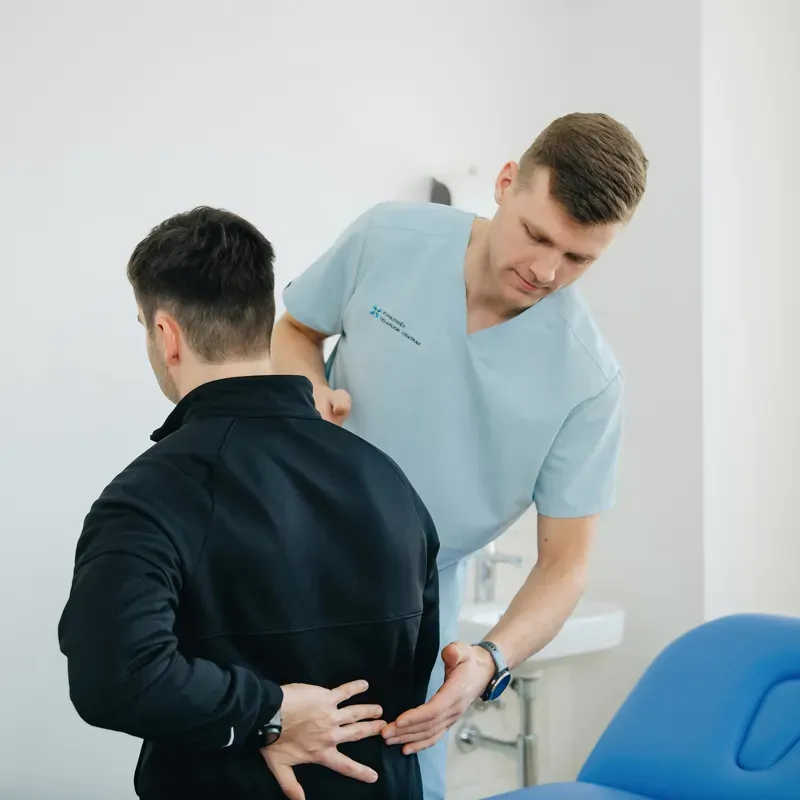
Physiotherapy in Dubai: Your Complete Guide

Lower Back Pain Exercises: Physiotherapy Guide
More in Physiotherapy
Physiotherapy Packages Dubai: Save 20%+ (2026)
مزید پڑھیں
Shoulder Pain Dubai: 7 Causes & When to Worry (2026)
مزید پڑھیں
PRP vs Cortisone Dubai: Which Injection? (2026)
مزید پڑھیں
PRP Injection for Joints Dubai: From AED 1,500 (2026)
مزید پڑھیںPhysiotherapy Cost Dubai: AED 250–500/Session (2026)
مزید پڑھیںPhysiotherapy Dubai: Types, Cost & Guide (2026)
مزید پڑھیں© 2026 Doctors Clinic Diagnostic Center (DCDC), Dubai Healthcare City. Originally published at https://doctorsclinicdubai.ae/blog/scoliosis-physiotherapy-treatment. All rights reserved. Unauthorized reproduction is prohibited.