मुख्य बातें
- A CBCT scan provides a three-dimensional view of wisdom teeth, showing the exact relationship between tooth roots and the inferior alveolar nerve canal with sub-millimeter accuracy
- CBCT imaging before wisdom tooth extraction reduces the risk of nerve injury and surgical complications by 25-30% compared to relying on two-dimensional panoramic X-rays alone
- The scan reveals all four types of wisdom tooth impaction — mesioangular, distoangular, horizontal, and vertical — along with root morphology, bone density, and proximity to adjacent teeth
- CBCT is specifically recommended when a panoramic X-ray shows signs of nerve proximity, such as root darkening, canal deflection, or root narrowing near the inferior alveolar nerve
- DCDC in Dubai Healthcare City provides advanced CBCT wisdom tooth assessment with same-day reporting and direct coordination with your oral surgeon
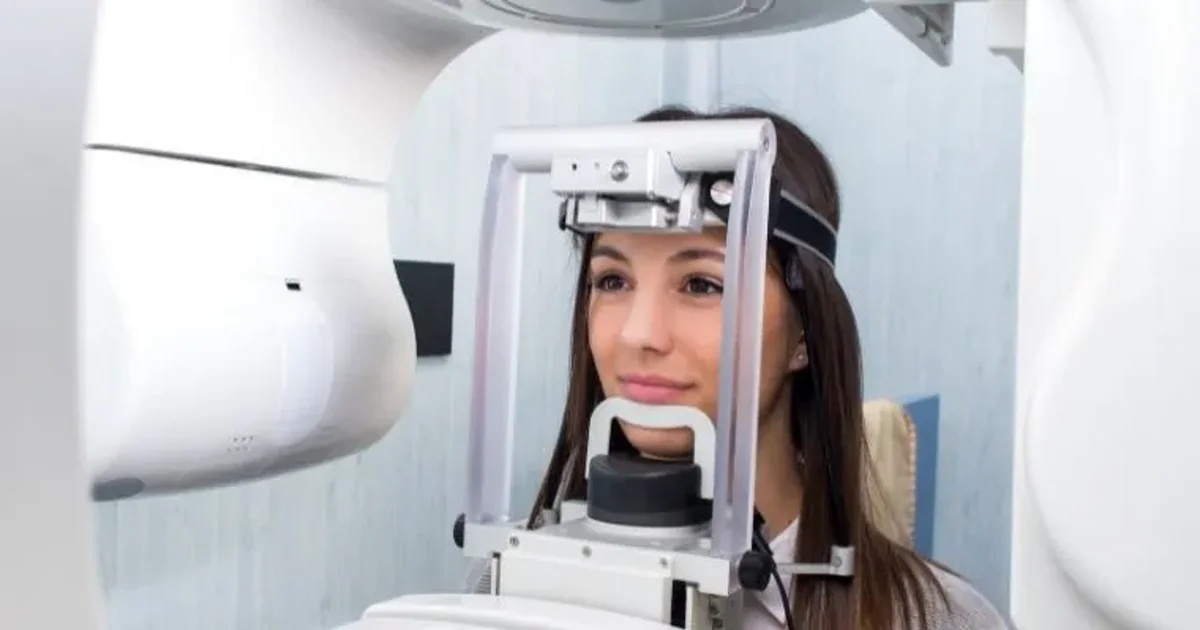
A CBCT scan for wisdom teeth is a three-dimensional X-ray examination that gives oral surgeons a complete picture of impacted or partially erupted third molars before extraction. Unlike a standard panoramic X-ray, which compresses the entire jaw into a single flat image, CBCT wisdom teeth imaging produces a volumetric dataset that can be rotated, sliced, and measured in every plane. This level of detail is critical because wisdom teeth frequently sit in close proximity to the inferior alveolar nerve, a structure whose damage during extraction can cause permanent numbness of the lower lip, chin, and gums. By mapping the exact three-dimensional relationship between the tooth roots and the nerve canal, a 3D scan wisdom teeth assessment allows the surgeon to plan a precise, nerve-safe surgical approach that significantly reduces the risk of postoperative complications.
This article explains why CBCT is important before wisdom tooth extraction, what the scan reveals about impaction type and nerve proximity, how CBCT compares to a standard OPG X-ray, what your surgeon looks for on the images, and how to get a wisdom teeth CBCT at Doctors Clinic Diagnostic Center (DCDC) in Dubai Healthcare City.
Why CBCT Is Important Before Wisdom Tooth Extraction
Wisdom tooth extraction is one of the most commonly performed oral surgery procedures worldwide, yet it carries a measurable risk of complications when the surgeon cannot fully visualize the anatomy before operating. The most serious complication is injury to the inferior alveolar nerve (IAN), which runs through a bony canal in the lower jaw directly beneath the roots of the lower wisdom teeth. Damage to this nerve during extraction can result in temporary or permanent numbness, tingling, or pain in the lower lip, chin, and gingiva on the affected side — a condition called inferior alveolar nerve paresthesia.
A standard panoramic X-ray (OPG) provides only a two-dimensional overview of the jaw. While it can suggest that a wisdom tooth root may be close to the nerve canal, it cannot confirm the three-dimensional relationship. The roots may appear to overlap with the canal on the flat image, but in reality they may pass buccally (toward the cheek) or lingually (toward the tongue) without actually touching the nerve. Conversely, a 2D X-ray can make a tooth appear safe when the roots are in fact directly contacting or compressing the nerve canal.
A CBCT scan eliminates this guesswork. By producing cross-sectional images through the wisdom tooth and surrounding bone, the scan shows the surgeon whether the nerve canal passes buccal, lingual, or directly through the roots. Research published in the British Journal of Oral and Maxillofacial Surgery demonstrates that CBCT assessment before wisdom tooth extraction reduces the incidence of inferior alveolar nerve injury by 25-30% compared to surgery planned on panoramic radiographs alone. This reduction is attributed to the surgeon's ability to modify the surgical technique — for example, performing a coronectomy (intentional partial root retention) instead of complete extraction when the roots are intimately associated with the nerve.
"When a panoramic X-ray shows any sign that the wisdom tooth roots are close to the nerve canal, I always recommend a CBCT before proceeding with extraction," explains Dr. Osama Elzamzami, Specialist in Diagnostic Radiology at DCDC. "The 3D images allow us to tell the surgeon exactly where the nerve sits in relation to each root, which directly changes the surgical plan and protects the patient."
What CBCT Shows About Your Wisdom Teeth
A CBCT scan of the wisdom teeth region captures a wealth of anatomical information that is invisible on a standard two-dimensional X-ray. The three-dimensional dataset allows the radiologist and surgeon to evaluate every aspect of the tooth, the surrounding bone, and the adjacent critical structures. The following details are routinely assessed on a wisdom tooth CBCT:
- Root number and morphology: Wisdom teeth can have anywhere from one to five roots, and these roots may be straight, curved, hooked, dilacerated, or fused. CBCT reveals the exact number, shape, curvature, and divergence of each root, which directly influences the extraction technique and the degree of bone removal required.
- Root-nerve relationship: The scan shows whether the roots are separated from the inferior alveolar nerve canal by a layer of intact bone, whether they are in direct contact with the canal wall, or whether the canal actually passes between the roots. This is the single most important piece of information for surgical planning.
- Impaction depth and angulation: CBCT provides precise measurements of how deeply the tooth is embedded in the bone and at what angle it is tilted relative to the adjacent second molar. These measurements determine whether the extraction will require a simple elevation or a complex surgical approach with bone removal and tooth sectioning.
- Bone density and thickness: The scan reveals the density and thickness of the buccal and lingual bone plates surrounding the wisdom tooth. Thin or deficient bone may require special surgical considerations to prevent jaw fracture or the creation of a communication with the oral cavity.
- Relationship to the second molar: Impacted wisdom teeth frequently cause resorption (erosion) of the distal root of the adjacent second molar. CBCT detects even early stages of this resorption that are invisible on panoramic X-rays, which may alter the treatment timing and urgency.
- Associated pathology: The scan identifies any cysts (such as dentigerous cysts), tumors, or infections associated with the impacted wisdom tooth, along with the precise extent of the lesion and its relationship to adjacent structures.
- Proximity to the lingual nerve: While the lingual nerve itself is a soft tissue structure not directly visible on CBCT, the scan shows the thickness and integrity of the lingual bone plate. A very thin or absent lingual plate increases the risk of lingual nerve injury during extraction, and this information allows the surgeon to take protective measures.
Impacted Wisdom Teeth: Types CBCT Reveals
Wisdom teeth become impacted when there is insufficient space in the jaw for them to erupt fully into the correct position. The type and severity of impaction directly influences the difficulty of extraction, the risk of complications, and the surgical approach. CBCT imaging classifies impaction with far greater accuracy than panoramic X-rays because it eliminates the superimposition and distortion inherent in 2D imaging. The four primary types of wisdom tooth impaction, along with their CBCT findings and clinical significance, are summarized in the table below:
| Impaction Type | Angulation | CBCT Findings | Clinical Significance |
|---|---|---|---|
| Mesioangular | Tilted forward (toward the second molar) | Crown directed mesially, roots often curve distally; nerve canal frequently located lingual or inferior to the apex | Most common type (43% of impactions); moderate extraction difficulty; risk of second molar damage |
| Distoangular | Tilted backward (away from the second molar) | Crown directed distally into the ascending ramus; roots may project toward the nerve canal or the lingual plate | Most difficult extraction type; higher risk of mandibular angle fracture; requires significant bone removal |
| Horizontal | Lying sideways (parallel to the jaw) | Crown pressing against the second molar root; roots directed toward the inferior alveolar nerve canal or buccal plate | High extraction difficulty; greatest risk of nerve injury and second molar resorption; often requires coronectomy consideration |
| Vertical | Upright but unable to erupt | Tooth oriented correctly but blocked by the second molar or insufficient arch space; nerve canal position variable | Least complicated impaction; lower extraction difficulty; nerve risk depends on root depth relative to canal |
Classification of wisdom tooth impaction types as visualized on CBCT scan, with typical findings and clinical implications for extraction planning.
Beyond angulation, CBCT also reveals the depth classification of the impaction according to the Pell and Gregory system, which grades the tooth as Class I (sufficient space distal to the second molar), Class II (partial space), or Class III (fully embedded in the ramus). The scan simultaneously shows the tooth's vertical depth relative to the occlusal plane (Position A, B, or C). This combined classification provides the surgeon with a standardized framework for predicting extraction difficulty and planning the appropriate technique.
CBCT and Inferior Alveolar Nerve Mapping
Mapping the inferior alveolar nerve (IAN) is the most critical application of CBCT in wisdom tooth assessment. The IAN is a branch of the trigeminal nerve that provides sensation to the lower lip, chin, lower teeth, and gingiva. It runs through the mandibular canal, a bony tunnel that passes directly beneath the roots of the lower wisdom teeth. When this nerve is damaged during extraction, the patient may experience numbness, altered sensation, or neuropathic pain that can last weeks, months, or in rare cases become permanent.
On a panoramic X-ray, several radiographic signs suggest that the wisdom tooth roots may be close to the nerve canal: darkening of the root where it overlaps the canal, deflection or narrowing of the canal, diversion of the canal around the root, and narrowing or loss of the root outline at the point of contact. When any of these signs are present, international guidelines from the National Institute for Health and Care Excellence (NICE) and the European Association for Cranio-Maxillo-Facial Surgery (EACMFS) recommend a CBCT scan to clarify the relationship before extraction.
CBCT nerve mapping reveals critical details that are impossible to determine from a 2D X-ray:
- Spatial relationship: Whether the nerve canal passes buccal (outer), lingual (inner), or inferior (below) to the wisdom tooth roots — or in some cases, directly between bifurcated roots
- Canal integrity: Whether there is an intact layer of cortical bone separating the nerve canal from the root surface, or whether the cortical boundary has been lost, indicating direct contact between the nerve and the tooth
- Canal diameter: The cross-sectional dimensions of the nerve canal at the point of closest proximity, which helps predict the degree of potential nerve compression during extraction
- Root-canal contact area: The length and extent of any direct contact between the root surface and the nerve canal wall, which correlates with the risk and severity of potential nerve injury
"In approximately 30-40% of cases where the panoramic X-ray suggests nerve proximity, the CBCT reveals that the nerve is actually separated from the roots by intact bone and the extraction can proceed normally," notes Dr. Osama Elzamzami. "In the remaining cases, the CBCT confirms true intimate contact, and the surgeon can decide to perform a coronectomy or modify the surgical approach to protect the nerve. Either way, the patient benefits from a decision based on evidence rather than guesswork."
Patient Story: CBCT Reveals Nerve Wrapped Around Wisdom Tooth Root
A 28-year-old patient was referred to DCDC after her dentist noticed on a panoramic X-ray that her lower left wisdom tooth roots appeared to overlap directly with the inferior alveolar nerve canal. She had been experiencing intermittent pressure and mild discomfort in the area, and extraction had been recommended. However, the 2D X-ray could not confirm whether the roots were truly contacting the nerve or simply overlapping in the image due to the flat projection.
The CBCT scan revealed a finding that fundamentally changed the surgical plan: the inferior alveolar nerve canal did not simply pass below the roots — it tracked directly between the two divergent roots of the wisdom tooth, with the cortical bone boundary completely absent on both sides. This meant that any attempt to extract the tooth completely would almost certainly result in direct nerve trauma.
Armed with this information, the oral surgeon recommended a coronectomy — a procedure in which the crown of the tooth is removed while the roots are deliberately left in place to avoid disturbing the nerve. The procedure was performed successfully, the patient experienced no nerve symptoms whatsoever, and a follow-up CBCT six months later confirmed that the retained roots had migrated slightly away from the nerve canal, a well-documented biological phenomenon that further reduces the risk of any future complication. Without the CBCT, the surgeon would have attempted a complete extraction and the patient would have faced a high probability of permanent lip numbness.
Need a CBCT Scan Before Wisdom Tooth Extraction?
DCDC in Dubai Healthcare City provides advanced 3D CBCT imaging for wisdom teeth with same-day results. Our radiologists deliver detailed nerve mapping reports directly to your oral surgeon so your extraction is planned with precision.
CBCT vs OPG for Wisdom Teeth: When to Upgrade
A panoramic X-ray (OPG) remains the standard first-line imaging modality for wisdom tooth assessment. It provides a broad overview of both jaws, all four wisdom teeth, and the general position of the inferior alveolar nerve canal in a single, low-dose image. For straightforward cases — where the wisdom teeth are erupted or partially erupted, positioned away from the nerve canal, and have uncomplicated root anatomy — an OPG provides sufficient information for extraction planning without the need for additional imaging.
However, a CBCT should be obtained when any of the following conditions are identified on the panoramic X-ray:
- Radiographic signs of nerve proximity: Darkening of the root at the canal crossing, deflection or narrowing of the canal, diversion of the canal, loss of the lamina dura of the canal, or narrowing of the root tip
- Deep horizontal or distoangular impaction: These impaction types carry the highest risk of complications and benefit most from 3D surgical planning
- Unusual root morphology: When the OPG suggests dilacerated (severely curved), hooked, or bulbous roots that may complicate extraction
- Suspected pathology: When a radiolucent area around the wisdom tooth suggests a dentigerous cyst or other lesion whose full extent must be assessed in three dimensions
- Second molar root resorption: When the OPG suggests the impacted wisdom tooth may be eroding the root of the adjacent second molar
- Previous failed extraction attempt: When a prior surgical attempt was abandoned due to unexpected anatomy or nerve proximity
- Patient with high anxiety about nerve risk: When a CBCT can provide reassurance by confirming that the nerve is safely separated from the roots, or justify a more conservative approach when true proximity is confirmed
For a comprehensive comparison of these two imaging modalities across all dental applications, see our detailed guide on CBCT vs OPG X-ray: which do you need?
What Your Surgeon Sees on CBCT
When an oral surgeon receives a CBCT dataset for a wisdom tooth case, they systematically evaluate the images in multiple planes to build a complete mental model of the surgical anatomy. Understanding what the surgeon looks for helps patients appreciate why this imaging is so valuable for their safety. Here is the structured assessment process:
- Axial plane (horizontal slices): The surgeon scrolls through cross-sectional slices from the top of the tooth to the root apices. This view shows the buccolingual (cheek-to-tongue) position of the roots relative to the nerve canal — the single most important relationship for surgical planning. It also reveals the thickness of the buccal and lingual bone plates.
- Coronal plane (front-to-back slices): These slices show the vertical relationship between the root apices and the superior border of the nerve canal. The surgeon measures the distance between the closest root tip and the canal wall and notes whether the cortical bone boundary of the canal is intact or interrupted.
- Sagittal plane (side-to-side slices): This view provides a lateral perspective on the tooth's angulation, the depth of impaction, and the anteroposterior extent of any contact between the roots and the nerve canal.
- Panoramic reconstruction: The CBCT software generates a curved panoramic image similar to an OPG but with much less distortion. This view gives the surgeon a familiar overview while allowing them to cross-reference specific areas with the 3D data.
- Cross-sectional slices along the jaw: Sequential cross-sections perpendicular to the arch of the jaw show the tooth-nerve relationship at multiple points along the length of the root, identifying the exact location of closest proximity.
Based on this assessment, the surgeon determines the optimal surgical approach: whether to extract the tooth from the buccal or lingual side, how much bone to remove, whether to section the crown from the roots, whether a coronectomy is safer than complete extraction, and what postoperative instructions to provide regarding nerve-related symptoms. Every one of these decisions is informed by information that only CBCT can provide.
"The CBCT essentially serves as a surgical roadmap," says Dr. Osama Elzamzami. "The surgeon knows exactly what they are going to find before they make the first incision. There are no surprises, and that predictability translates directly into safer, faster, and less traumatic surgery for the patient."
Wisdom Teeth CBCT at DCDC Dubai
Doctors Clinic Diagnostic Center (DCDC) in Dubai Healthcare City provides dedicated CBCT imaging for wisdom tooth assessment using advanced cone beam technology with optimized protocols specifically designed for third molar evaluation. The center's radiology team has extensive experience in dental and maxillofacial imaging, and every wisdom tooth CBCT scan is reported by a specialist radiologist who provides a structured, detailed assessment of all clinically relevant findings.
What the DCDC Wisdom Tooth CBCT Report Includes
Every CBCT report for wisdom teeth at DCDC follows a standardized format that oral surgeons rely on for extraction planning. The report includes:
- Impaction classification: Type (mesioangular, distoangular, horizontal, vertical), Pell and Gregory class, and Winter's depth classification
- Root assessment: Number of roots, morphology, curvature, and any ankylosis (fusion to bone)
- Nerve canal relationship: Distance from root apices to the canal, buccolingual position of the canal relative to the roots, integrity of the cortical boundary, and explicit nerve risk categorization
- Adjacent tooth status: Presence or absence of second molar root resorption and the degree of any bone loss around the adjacent tooth
- Associated pathology: Identification of any cysts, infections, or other pathological findings
- Surgical considerations: Observations relevant to surgical approach, such as thin lingual plate, proximity to the mandibular angle, or unfavorable root anatomy
Fast Turnaround and Surgeon Coordination
DCDC provides same-day reporting for wisdom tooth CBCT scans in most cases. The 3D image dataset and the radiologist's report are shared digitally with the referring oral surgeon or dentist, eliminating the need for the patient to carry physical films between appointments. For urgent cases where extraction is time-sensitive due to infection or severe pain, DCDC offers priority reporting to ensure the surgeon has the imaging information needed to proceed without delay.
Booking and Location
DCDC is located in Dubai Healthcare City, easily accessible from Oud Metha, Karama, Bur Dubai, Downtown Dubai, and the wider UAE. Wisdom teeth CBCT appointments can be booked by phone, WhatsApp, or through the online booking form. No special preparation is needed — you can eat, drink, and take your normal medications before the scan. The scan itself takes under 40 seconds, and the entire appointment typically lasts 10 to 15 minutes. For information on pricing, see our guide on CBCT scan cost in Dubai.
Book Your Wisdom Teeth CBCT at DCDC
Get a precise 3D assessment of your wisdom teeth before extraction. DCDC's CBCT imaging team provides detailed nerve mapping, impaction classification, and same-day reporting to ensure your surgeon has the complete picture for a safe procedure.
Or call us directly for same-day availability
अक्सर पूछे जाने वाले प्रश्न
Final Thoughts
A CBCT scan for wisdom teeth is not an optional luxury — for complex and high-risk cases, it is a diagnostic necessity that directly protects patient safety. The ability to visualize the three-dimensional relationship between impacted wisdom tooth roots and the inferior alveolar nerve transforms extraction planning from an exercise in educated guesswork into a precise, evidence-based surgical strategy. With documented reductions of 25-30% in nerve injury rates, CBCT has become the standard of care for any wisdom tooth case where the panoramic X-ray raises concern about nerve proximity, deep impaction, or complex anatomy.
At Doctors Clinic Diagnostic Center in Dubai Healthcare City, patients receive expert CBCT wisdom tooth assessment with advanced cone beam technology, specialist radiology reporting, and same-day results that keep their surgical plans on track. If your dentist or oral surgeon has recommended a CBCT scan before wisdom tooth extraction, or if you want to ensure the safest possible approach to your procedure, booking a wisdom teeth CBCT at DCDC is a straightforward step toward a better outcome. For general information about CBCT technology, see our complete guide on what is a CBCT scan.
स्रोत एवं संदर्भ
यह लेख हमारी चिकित्सा टीम द्वारा समीक्षित है और निम्नलिखित स्रोतों का संदर्भ देता है:
- British Journal of Oral and Maxillofacial Surgery - CBCT Assessment of the Relationship Between Mandibular Third Molars and the Inferior Alveolar Nerve
- National Institute for Health and Care Excellence (NICE) - Guidance on the Extraction of Wisdom Teeth
- European Association for Cranio-Maxillo-Facial Surgery (EACMFS) - Guidelines for Use of CBCT in Dental and Maxillofacial Surgery
- Journal of Oral and Maxillofacial Surgery - Coronectomy vs Total Removal of Third Molars Close to the Inferior Alveolar Nerve: Systematic Review and Meta-Analysis
- International Journal of Oral and Maxillofacial Surgery - Diagnostic Accuracy of Panoramic Radiography and CBCT for Predicting Inferior Alveolar Nerve Exposure
इस साइट पर चिकित्सा सामग्री DHA-लाइसेंस प्राप्त चिकित्सकों द्वारा समीक्षित है। हमारी देखें संपादकीय नीति अधिक जानकारी के लिए।

लेखक
Dr. Osama Elzamzami
Diagnostic Radiology
MD, FRCR
Dr. Osama Elzamzami is a Specialist in Diagnostic Radiology with expertise in CBCT, CT, MRI, and ultrasound imaging at DCDC Dubai Healthcare City.