Mga Pangunahing Punto
- The CT angiogram procedure takes approximately 10-15 minutes for the scan itself, with total appointment time around 45-60 minutes
- A beta-blocker may be given before the scan to slow your heart rate below 65 beats per minute for optimal image quality
- Iodine-based contrast dye is injected through an IV line to highlight the coronary arteries during the scan
- You will be asked to hold your breath for 5-15 seconds during the actual image acquisition
- Results are typically reviewed and available within 24 hours at DCDC Dubai Healthcare City
If you have been referred for a CT angiogram, understanding the procedure beforehand can help reduce any anxiety and ensure you are well prepared. A CT angiogram, also called CT coronary angiography, is a non-invasive imaging test that takes detailed pictures of the coronary arteries using a CT scanner and contrast dye. The entire process is straightforward, requires no sedation, and allows you to return to normal activities the same day.
This guide walks you through every step of the CT angiogram procedure, from preparation and arrival through the scan itself, and explains what happens afterward including when you can expect your results.
Before Your CT Angiogram: Preparation Steps
Proper preparation ensures your CT angiogram produces the clearest possible images. Your referring cardiologist or the radiology team at DCDC will provide specific instructions, but the following general guidelines apply to most patients.
Fasting Requirements
You will typically be asked to avoid eating for 4-6 hours before your scan. This reduces the chance of nausea from the contrast dye. You may drink water during this fasting period to stay hydrated. Some centers allow light, non-caffeinated liquids up to 2 hours before the appointment.
Caffeine Restriction
You should avoid caffeine for at least 12-24 hours before the scan. Caffeine increases heart rate, which can reduce image quality. This includes coffee, tea, energy drinks, chocolate, and some soft drinks. If you are unsure about a specific product, check the label or ask the radiology team.
Medications
Continue taking your regular medications unless specifically told otherwise by your doctor. If you are taking metformin for diabetes, your doctor may advise temporarily pausing it around the time of the scan because of the contrast dye. Bring a list of your current medications to the appointment.
Beta-Blocker for Heart Rate Control
For optimal image quality, your heart rate should ideally be below 65 beats per minute during the scan. If your heart rate is above this level, the radiology team may administer a beta-blocker medication (usually metoprolol) either as a tablet taken 1-2 hours before the scan or as an intravenous dose at the time of the appointment. Beta-blockers are safe, well-tolerated, and commonly used during cardiac CT scans. Your heart rate will be monitored throughout.
What to Wear and Bring
Wear comfortable, loose-fitting clothing without metal snaps, zippers, or underwire. You may be asked to change into a hospital gown. Remove all jewelry, watches, and metal accessories before the scan. Bring your doctor's referral, insurance card, identification, and any previous cardiac test results if available.
Arriving at the Center
Plan to arrive 30-45 minutes before your scheduled scan time. This allows for registration, reviewing your medical history, obtaining consent, and any necessary pre-scan preparation including heart rate assessment and beta-blocker administration if needed.
Upon arrival at DCDC in Dubai Healthcare City, the reception team will guide you through the check-in process. A radiology nurse or technologist will review your medical history, check for any contraindications (kidney disease, iodine allergy, pregnancy), and explain the procedure in detail.
The IV Line and Contrast Dye
A small intravenous (IV) cannula will be placed in a vein in your arm or hand. This IV line serves two purposes: it allows administration of beta-blocker medication if needed and delivers the contrast dye during the scan.
The contrast dye used in CT angiography is an iodine-based solution that makes blood vessels appear bright and clearly defined on the CT images. The dye is injected through the IV line by an automated power injector at a precisely controlled rate and volume. Most patients feel a warm sensation and a metallic taste in the mouth when the contrast is injected. These sensations are normal, harmless, and last only 30-60 seconds.
If you have a known allergy to iodine or contrast dye, inform the team immediately. Pre-medication with antihistamines and steroids may be given, or an alternative imaging approach may be recommended.
During the Scan: Step-by-Step
The actual CT scan is the fastest part of the entire appointment. Here is what happens, step by step.
Step 1: Positioning on the Scanner Table
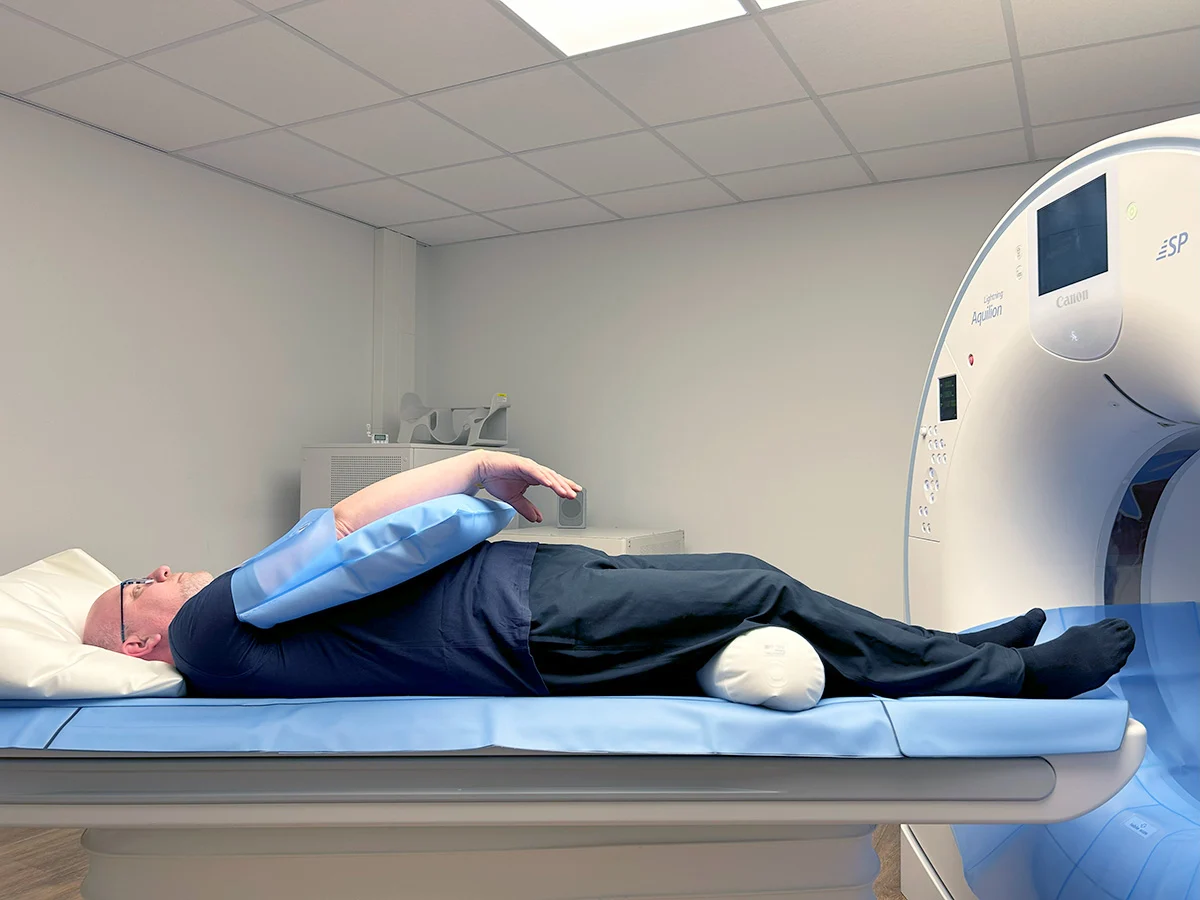
You will lie on your back on the CT scanner table with your arms raised above your head. ECG electrodes (small adhesive patches) are placed on your chest to monitor your heart rhythm and synchronize the scan with your heartbeat. The technologist will ensure you are comfortable and will explain each step as it happens.
Step 2: Calcium Score Scan (Optional)
In some cases, a quick calcium score scan is performed first, before the contrast dye is injected. This takes just a few seconds and provides baseline information about calcified plaque in the coronary arteries. It also helps the technologist plan the contrast-enhanced scan.
Step 3: Test Breath Hold
Before the main scan, the technologist will ask you to practice holding your breath. A steady breath hold is essential because any chest movement during the scan blurs the images. The hold typically lasts 5-15 seconds. The technologist will give clear verbal instructions: "Take a deep breath in... hold... and relax." Most patients find this comfortable with a brief practice.
Step 4: Contrast Injection and Scan
When everything is ready, the power injector delivers the contrast dye through your IV line. The scanner table moves smoothly into the CT scanner (a large, open ring). As the contrast dye reaches your coronary arteries, the scanner captures the images during your breath hold. The actual scan acquisition takes only 5-10 seconds.
You may hear a whirring or buzzing sound from the scanner during image acquisition. The CT scanner at DCDC has a wide, open design that minimizes any sensation of confinement, making the experience more comfortable than closed MRI machines.
Step 5: Completion
After the images are captured, the technologist checks the image quality. In most cases, a single acquisition is sufficient. Occasionally, if the heart rate varied or a breath hold was not maintained, a brief additional scan may be needed. The entire scanning process from first lying down to standing up typically takes 10-15 minutes.
CT Angiogram Procedure Timeline
| Phase | Duration | What Happens |
|---|---|---|
| Registration & check-in | 10-15 min | Medical history review, consent, allergy screening |
| Heart rate assessment | 5-10 min | ECG check; beta-blocker given if heart rate above 65 bpm |
| IV placement | 5 min | IV cannula inserted in arm or hand for contrast delivery |
| Positioning & ECG leads | 5 min | Lie on scanner table; ECG patches placed on chest |
| Calcium score (optional) | < 1 min | Quick non-contrast scan if requested |
| Practice breath hold | 1-2 min | Rehearse 5-15 second breath hold with technologist |
| Contrast injection & scan | < 1 min | Power injector delivers dye; scanner acquires images |
| Image quality check | 2-3 min | Technologist reviews images; repeat if needed |
| IV removal & discharge | 5 min | IV removed; resume normal activities immediately |
Total appointment time is approximately 45-60 minutes. The actual scan takes under one minute.
After the CT Angiogram
Immediate Recovery
There is no recovery period required after a CT angiogram. Once the scan is complete, the IV line is removed, and you can get dressed and leave. You can eat, drink, drive, and return to work or normal activities immediately. There are no restrictions on physical activity.
Contrast Dye Clearance
The contrast dye is naturally eliminated from your body by the kidneys within 24-48 hours. Drinking plenty of water after the scan helps flush the dye from your system. Most patients experience no side effects from the contrast. Rarely, some individuals may notice mild nausea, skin warmth, or a slight headache that resolves quickly.
Beta-Blocker Effects
If you received a beta-blocker before the scan, you may feel slightly more fatigued or notice a slower heart rate for a few hours. These effects are temporary and resolve on their own. If you experience dizziness or lightheadedness, rest briefly before leaving the center.
When Will You Get Your Results?
At DCDC, CT angiogram images are processed and reconstructed by advanced 3D software to create detailed views of the coronary arteries. A consultant radiologist analyzes the images and prepares a comprehensive report. The results are then reviewed with a cardiologist who interprets the findings in the context of your clinical history.
Results are typically available within 24 hours. In urgent cases, same-day reporting can be arranged. You will receive your results through a follow-up consultation with your referring cardiologist, who will explain the findings and discuss any recommended next steps, whether that involves lifestyle changes, medication, additional testing, or reassurance that your arteries appear healthy.
Is the CT Angiogram Procedure Painful?
The CT angiogram is not painful. The only discomfort is a brief pinch when the IV cannula is inserted, similar to a standard blood test. The warm flush from the contrast injection can feel unusual but is not painful. Some patients report a temporary sensation of needing to urinate during the contrast injection, which resolves within seconds.
One patient who experienced this firsthand was a 60-year-old woman who had been anxious about the procedure, particularly the contrast dye injection. After her scan at DCDC, she described the experience as far easier than she had anticipated. The entire scan was over in about 10 minutes, and she was able to leave the center and go about her day immediately afterward. "Many patients come in nervous, especially if they have never had a CT scan with contrast before," says Dr. Shahoo Mazhari, Consultant Cardiologist at DCDC. "But once they see how quick and straightforward it is, the relief is immediate. I often hear patients say they wish they had done it sooner instead of worrying for months."
No sedation or general anesthesia is required, and you remain awake and aware throughout the entire procedure. The technologist is in constant communication with you via an intercom and can see you through a window at all times.
Common Concerns and What to Expect
- Claustrophobia: The CT scanner is open on both sides, unlike a closed MRI. Most patients do not experience claustrophobia during a CT angiogram
- Radiation exposure: Modern CT scanners use low-dose protocols (3-5 mSv), comparable to about 1-2 years of natural background radiation
- Contrast allergy: True contrast allergies are rare. If you have a known allergy, pre-medication protocols are available
- Kidney function: A blood test for creatinine levels may be required before the scan to ensure your kidneys can safely process the contrast dye
- Pregnancy: CT angiography is generally avoided during pregnancy due to radiation exposure. Inform the team if you are or might be pregnant
The CT Angiogram Procedure at DCDC Dubai Healthcare City
At Doctors Clinic Diagnostic Center, the CT angiogram procedure is designed to be as smooth and comfortable as possible. The center's experienced radiology and cardiology teams guide patients through every step, from pre-scan preparation to results discussion. DCDC uses a modern multi-slice CT scanner with ECG-gating technology and low-dose radiation protocols to ensure both accuracy and patient safety.
With over 13 years serving patients in Dubai Healthcare City and more than 1,000 diagnostic scans completed every month, DCDC has earned its reputation as a leading diagnostic center in Dubai. The center attracts international patients from around the world who travel specifically for its premier cardiac imaging services.
"Patient comfort is just as important as image quality," says Dr. Shahoo Mazhari, Consultant Cardiologist at DCDC. "When a patient feels at ease, their heart rate stays stable, they hold their breath more steadily, and we get the best possible images. That is why we invest so much in the patient experience from the moment they walk through the door."
Located in Dubai Healthcare City, the center is easily accessible from Oud Metha, Karama, Bur Dubai, and surrounding areas. Whether you need a CT angiogram for the first time or a follow-up scan, DCDC provides a professional, patient-friendly environment with clear communication at every stage.
Ready for Your CT Angiogram?
At Doctors Clinic Diagnostic Center in Dubai Healthcare City, we make the CT angiogram procedure simple and comfortable. Our expert team provides clear preparation instructions, gentle care during the scan, and fast, detailed results reviewed by specialist cardiologists.
Book CT AngiogramMga Madalas Itanong
Final Thoughts
The CT angiogram procedure is one of the most patient-friendly cardiac imaging tests available. It is fast, non-invasive, requires no sedation, and allows you to resume your day immediately afterward. Understanding each step of the process, from preparation through results, helps you approach the scan with confidence. At Doctors Clinic Diagnostic Center, our team ensures that every patient receives clear instructions, comfortable care, and expert-reviewed results.
If you have been referred for a CT angiogram or are considering one as part of your cardiac evaluation, the procedure is far simpler than many patients expect. A few hours of preparation and 15 minutes on the scanner table can provide your cardiologist with the detailed coronary artery information needed to guide your care effectively. For information about pricing and insurance, see our guide on CT angiogram cost in Dubai.
Mga Sanggunian at Reperensya
Ang artikulong ito ay sinuri ng aming medikal na team at tumutukoy sa mga sumusunod na sanggunian:
- Society of Cardiovascular Computed Tomography (SCCT) - Patient Preparation Guidelines
- American College of Radiology - CT Angiography Protocols
- European Society of Cardiology - Cardiac CT Imaging Standards
Ang medikal na nilalaman sa site na ito ay sinusuri ng mga DHA-licensed na manggagamot. Tingnan ang aming patakarang editorial para sa higit pang impormasyon.

Isinulat ni
Dr. Shahoo Mazhari
Consultant Cardiologist
MD, Board Certified in Cardiology
Dr. Shahoo Mazhari is a Consultant Cardiologist specializing in non-invasive cardiac imaging, coronary CT angiography, and preventive cardiology at DCDC Dubai Healthcare City.