نکات کلیدی
- The OPG is the standard first-line screening X-ray for dental implant candidates, providing a panoramic view of both jaws, available bone, and critical anatomical landmarks in a single 15-second scan.
- OPG reveals vertical bone height, proximity to the inferior alveolar nerve canal, maxillary sinus floor position, and the condition of adjacent teeth - all essential for initial implant feasibility assessment.
- OPG is a two-dimensional image and does not show bone width (buccolingual dimension), bone density, or precise three-dimensional nerve position, which limits its use as a standalone implant planning tool.
- For complex or posterior implant cases, a CBCT scan is typically ordered after the OPG to provide the three-dimensional measurements needed for safe and accurate implant placement.
- At DCDC Dubai Healthcare City, patients receive digital OPG and CBCT imaging with same-day consultant radiologist reporting, supporting a complete implant imaging workflow under one roof.
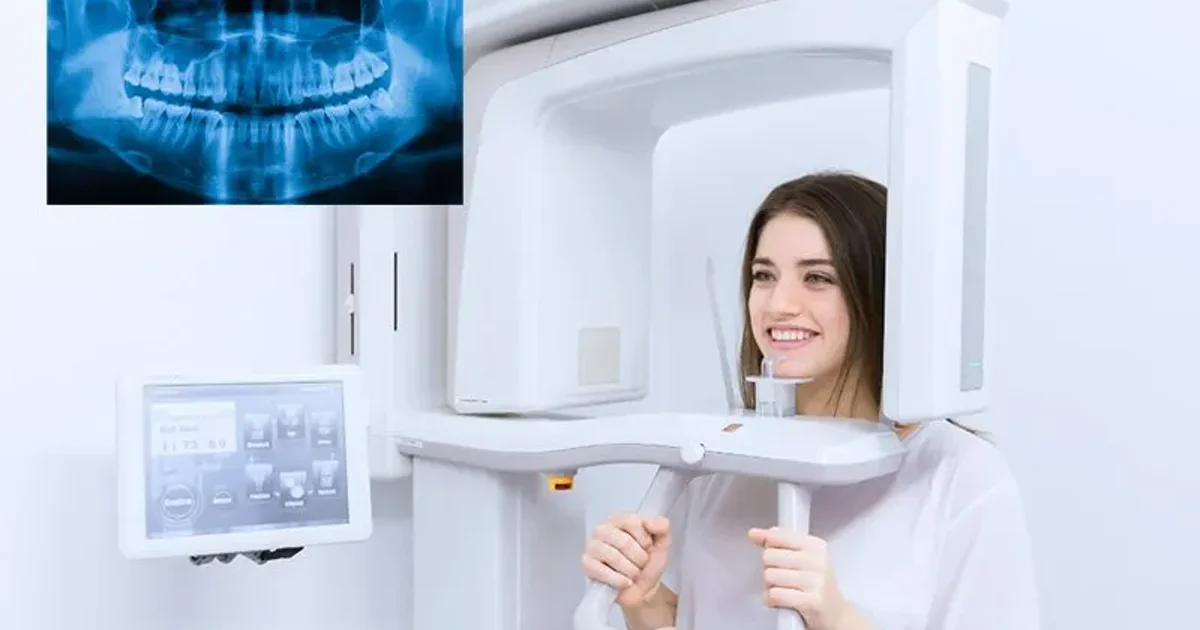
An OPG X-ray (orthopantomogram) is the standard first imaging study ordered when a patient is being evaluated for dental implants. This single panoramic scan captures both jaws from ear to ear in under 15 seconds, giving the implant surgeon an immediate overview of available bone height, the position of vital structures such as the inferior alveolar nerve and maxillary sinuses, and the condition of adjacent teeth. While the OPG does not replace the three-dimensional detail provided by a CBCT scan, it serves as the essential screening tool that determines whether a patient is a viable implant candidate and whether further advanced imaging is needed.
This guide explains why the OPG is the first step in implant planning, exactly what it reveals and what it misses, when an upgrade to CBCT is necessary, and how the implant imaging process works at DCDC in Dubai Healthcare City. Every section is reviewed by Dr. Osama Elzamzami, Consultant Radiologist (MD, FRCR), to ensure clinical accuracy.
Why OPG Is the First Step for Implant Planning
Before a single implant can be placed, the surgeon needs answers to a series of fundamental questions: Is there enough bone to support the implant? Where exactly is the nerve canal running through the lower jaw? How close is the sinus floor to the proposed implant site in the upper jaw? Are the neighboring teeth healthy, or do they need treatment first? The OPG panoramic X-ray answers all of these questions in a single, rapid, low-cost scan - which is why it has been the universally accepted starting point for implant assessment for decades.
The OPG functions as a triage tool. It quickly separates straightforward implant cases from complex ones. A patient with clearly adequate bone height, no nerve proximity concerns, and healthy adjacent teeth may proceed to implant placement with minimal additional imaging. A patient whose OPG reveals thin bone ridges, close nerve canals, or sinus complications will be directed to a CBCT scan for the precise three-dimensional measurements required for safe surgical planning.
"I start every implant case with an OPG," says Dr. Osama Elzamzami, Consultant Radiologist at DCDC. "It is the fastest way to see the complete picture - both jaws, all remaining teeth, the nerve canals, the sinuses, and any existing pathology. Within seconds I can determine whether the patient is a clear candidate for implants, whether they need bone grafting, or whether a CBCT is required for detailed surgical planning. Skipping the OPG and going straight to CBCT is like reading chapter five of a textbook without reading the introduction."
From a practical standpoint, the OPG is also the most accessible and affordable dental imaging study available. Every general dental clinic and diagnostic center with radiological services offers OPG scans, making it an ideal first-line investigation that can be performed the same day as the initial implant consultation. The low radiation dose - approximately 10 to 20 microsieverts, equivalent to one to two days of natural background radiation - means there is no meaningful safety concern about adding this scan to the diagnostic workflow.
What OPG Reveals for Implant Assessment
The OPG provides a wealth of anatomical information that directly informs implant planning. Although it is a two-dimensional image, the panoramic perspective captures structures and spatial relationships that no single intraoral X-ray can match. Here is exactly what the implant surgeon and radiologist evaluate on an OPG when assessing a potential implant site.
Vertical Bone Height
The most critical measurement for implant planning is the amount of vertical bone available at the proposed implant site. Standard dental implants range from 8 to 13 millimeters in length, so the surgeon needs to confirm there is sufficient bone height to accommodate the implant without encroaching on the nerve canal below or the sinus above. The OPG displays the full height of the alveolar ridge from crest to the inferior border of the mandible (in the lower jaw) or to the sinus floor (in the upper jaw), allowing a reliable initial measurement. While OPG measurements carry a magnification factor of approximately 20 to 30 percent, experienced clinicians account for this when interpreting the image.
Inferior Alveolar Nerve Canal Position
The inferior alveolar nerve runs through a bony canal within the mandible, supplying sensation to the lower lip, chin, and teeth. Damaging this nerve during implant placement is one of the most serious complications in implant dentistry, potentially causing permanent numbness. The OPG clearly shows the nerve canal as a radiolucent band running through the lower jaw, allowing the surgeon to estimate the distance between the proposed implant site and the nerve. If the OPG suggests the nerve is close to the implant zone, a CBCT is ordered to measure the exact three-dimensional distance.
Maxillary Sinus Floor Position
In the upper jaw, the maxillary sinuses sit directly above the posterior teeth. When these teeth are lost, the sinus can gradually expand downward into the bone (a process called pneumatization), reducing the available bone height for implant placement. The OPG shows the sinus floor clearly, enabling the surgeon to determine whether there is enough bone between the ridge crest and the sinus to place an implant, or whether a sinus lift procedure will be required first.
Condition of Adjacent Teeth and Restorations
Implants do not exist in isolation - they must integrate with the surrounding dentition. The OPG reveals the health of teeth adjacent to the proposed implant site, including any signs of decay, periapical pathology, periodontal bone loss, or failed restorations. If neighboring teeth need treatment before or alongside implant placement, the OPG provides the evidence for comprehensive treatment planning.
Existing Pathology
Cysts, tumors, residual root fragments, foreign bodies, and areas of active infection are all visible on the OPG. Any of these findings at or near the planned implant site must be addressed before implant surgery can proceed. The panoramic view ensures that pathology in remote areas of the jaw - which might otherwise be missed on targeted intraoral X-rays - is identified and managed.
Overall Jaw Architecture
The OPG provides a global view of jaw symmetry, ridge contour, and the general pattern of bone resorption. For patients requiring multiple implants or full-arch rehabilitation, this overview is invaluable for initial planning, allowing the surgeon to assess the entire jaw as a single unit rather than evaluating individual sites in isolation.
OPG Limitations for Dental Implants
Despite its value as a screening tool, the OPG has inherent limitations that every implant patient and clinician must understand. These limitations do not diminish the importance of the OPG - they simply define the boundary where two-dimensional imaging ends and three-dimensional imaging begins.
The primary limitations of OPG for implant planning include:
- No bone width measurement: The OPG shows bone in the vertical (superior-inferior) and horizontal (mesial-distal) dimensions, but it cannot display the buccolingual dimension - the thickness of the bone ridge from cheek to tongue. This is critical because an implant requires adequate width of bone on all sides. A ridge that appears tall enough on the OPG may be too narrow for implant placement, a fact that only a CBCT or direct clinical assessment can reveal.
- Magnification and distortion: OPG images have an inherent magnification factor of approximately 20 to 30 percent, and the degree of magnification is not uniform across the image. Structures closer to the X-ray tube appear more magnified than structures closer to the detector. While calibration and experience help clinicians compensate for this, precise millimeter-level measurements from OPG alone are not reliable enough for final implant planning.
- Two-dimensional superimposition: Because the OPG compresses three-dimensional anatomy into a flat image, structures at different depths can overlap and obscure one another. For example, the zygomatic arch may overlap with the upper molar roots, or the cervical spine may create ghost shadows over the anterior jaw region, reducing diagnostic clarity in those areas.
- No bone density assessment: The OPG cannot quantify bone density (measured in Hounsfield units on CT/CBCT), which influences implant stability, healing time, and the choice of implant design. Dense cortical bone and spongy trabecular bone appear differently on the OPG, but the image does not provide the numeric density values that surgeons increasingly use for treatment planning.
- Limited three-dimensional nerve localization: While the OPG shows the approximate vertical position of the inferior alveolar nerve canal, it does not reveal its position in the buccolingual plane. The nerve may run closer to the buccal (cheek) or lingual (tongue) side of the jaw, and this information is essential for safe implant angle planning - information that only CBCT can provide.
"The OPG tells you whether to explore further - it does not tell you exactly where to drill," explains Dr. Osama Elzamzami. "It is a screening tool, not a surgical blueprint. For straightforward anterior cases with clearly abundant bone, the OPG combined with clinical examination may be sufficient. For posterior cases near the nerve or sinus, I always recommend a CBCT for the final surgical plan."
When to Upgrade from OPG to CBCT
The decision to advance from OPG to CBCT imaging is not always necessary - but when it is needed, it is non-negotiable. The following clinical scenarios almost always warrant a CBCT after the initial OPG screening.
- Posterior mandibular implants near the nerve canal: When the OPG shows that the available bone height above the inferior alveolar nerve is less than 12 to 15 millimeters (accounting for magnification), a CBCT is essential to measure the exact distance and determine the nerve's buccolingual position.
- Upper posterior implants near the maxillary sinus: If the OPG indicates limited bone between the ridge crest and the sinus floor, CBCT quantifies the exact available height and width, and helps plan whether a sinus lift procedure is needed and the optimal surgical approach.
- Narrow or atrophic ridges: When the OPG suggests significant ridge resorption, CBCT confirms the bone width and helps determine whether bone grafting is required before implant placement.
- Multiple implants or full-arch cases: Patients requiring several implants or all-on-four/all-on-six full-arch rehabilitations need precise three-dimensional planning. CBCT allows virtual implant placement using planning software, ensuring optimal positioning, angulation, and spacing.
- Guided implant surgery: If the surgeon plans to use a surgical guide (a digitally designed template that directs drill placement), CBCT data is mandatory - the guide is manufactured from the three-dimensional CBCT scan.
- Previous failed implants or complications: Patients with a history of implant failure, nerve injury, or infection at the proposed site require CBCT to evaluate the cause and plan a revised approach.
- Anatomical variations: Bifid (split) mandibular canals, accessory mental foramina, or unusual sinus anatomy identified or suspected on the OPG all warrant CBCT confirmation before implant surgery.
In straightforward cases - such as a single implant in the anterior mandible with obviously abundant bone and no nerve proximity - the OPG combined with a thorough clinical examination may be sufficient, and the additional cost and radiation of CBCT can be avoided. The OPG serves as the gatekeeper that determines which imaging pathway each patient follows.
OPG vs CBCT for Implant Planning
Understanding the differences between OPG and CBCT is essential for implant patients who want to know why their clinician may request one, both, or which one first. The two modalities are complementary, not competing - the OPG provides the overview, and the CBCT provides the surgical detail.
| Feature | What OPG Shows for Implants | What OPG Misses (CBCT Needed) |
|---|---|---|
| Bone height (vertical) | Yes - visible from ridge crest to nerve canal or sinus floor, with magnification correction | Precise millimeter measurements require CBCT calibration |
| Bone width (buccolingual) | Not visible - OPG is a 2D image and cannot show ridge thickness | CBCT provides exact cross-sectional width measurements |
| Bone density | General visual assessment only (cortical vs. trabecular) | CBCT provides Hounsfield unit values for objective density grading |
| Nerve canal (vertical position) | Yes - the canal is visible as a radiolucent band in the mandible | Exact 3D nerve position (buccal vs. lingual) requires CBCT |
| Nerve canal (buccolingual position) | Not visible on 2D panoramic image | CBCT shows precise location relative to the planned implant axis |
| Sinus floor position | Yes - the sinus floor boundary is visible above the upper posterior teeth | CBCT quantifies available bone height and reveals sinus membrane details |
| Adjacent tooth condition | Yes - decay, periapical pathology, and bone loss are visible | CBCT adds detail for root proximity and three-dimensional root anatomy |
| Surgical guide fabrication | Not possible from OPG data | CBCT data is mandatory for digitally designed surgical guides |
| Radiation dose | Approximately 10-20 μSv (very low) | Approximately 30-200 μSv depending on field of view |
| Cost | Lower - standard screening-level pricing | Higher - advanced 3D imaging pricing |
| Scan time | 15-20 seconds | 15-30 seconds |
The OPG serves as the first-line screening tool that identifies whether CBCT is needed. For straightforward implant cases, OPG plus clinical examination may suffice. For complex cases near the nerve or sinus, CBCT provides the three-dimensional precision required for safe implant placement.
The clinical standard of care in modern implant dentistry is an OPG-first approach: screen every patient with an OPG, and escalate to CBCT only when the clinical situation requires three-dimensional data. This protocol minimizes radiation exposure, controls imaging costs, and ensures that advanced imaging is reserved for the cases that genuinely benefit from it.
Dental Implant Imaging at DCDC Dubai Healthcare City
Get your digital OPG and CBCT scan for implant planning at Doctors Clinic Diagnostic Center. Same-day consultant radiologist reporting. Walk-ins welcome.
No referral required for self-pay patients
How Many X-Rays Do You Need for Implants?
The number of X-rays required during the implant journey depends on the complexity of the case and the stage of treatment. Most patients undergo at least two to four imaging studies between the initial consultation and the final restoration. Here is a typical implant imaging timeline.
Stage 1: Initial Screening (OPG)
Every implant case begins with an OPG. This single panoramic X-ray provides the baseline assessment described throughout this guide - bone height, nerve canal position, sinus floor location, adjacent tooth condition, and overall jaw architecture. The OPG determines whether the patient is a viable implant candidate and whether further imaging is needed.
Stage 2: Detailed Planning (CBCT, If Needed)
If the OPG identifies complexity - proximity to the nerve, limited bone height near the sinus, narrow ridges, or multiple implant sites - a CBCT scan is ordered. This provides the three-dimensional data the surgeon needs for precise implant positioning, angulation, and length selection. For guided surgery cases, the CBCT is also used to design and manufacture the surgical guide.
Stage 3: Post-Surgical Verification (Periapical or OPG)
After the implant is surgically placed, a periapical X-ray or a follow-up OPG is taken to confirm the implant is in the correct position, the bone around the implant appears healthy, and there are no immediate complications such as encroachment on the nerve canal or sinus.
Stage 4: Healing Follow-Up (Periapical)
During the osseointegration period (typically three to six months), a periapical X-ray may be taken to verify that the bone is integrating with the implant surface and no peri-implant pathology has developed.
Stage 5: Prosthetic Phase and Annual Monitoring
Once the final crown, bridge, or prosthesis is placed, a periapical X-ray confirms proper seating and bone levels. Thereafter, annual or biannual periapical X-rays monitor the bone around the implant to detect early signs of peri-implantitis (bone loss around the implant) so that intervention can occur before the implant is compromised.
A 45-year-old patient visited DCDC for implant evaluation after losing two lower molars. The initial OPG immediately revealed adequate bone height above the nerve canal on the right side but borderline bone on the left. Dr. Osama Elzamzami recommended a targeted CBCT of the left mandibular region. The CBCT confirmed the bone width was sufficient for a standard-diameter implant on the right but identified a narrow ridge on the left that required bone grafting before implant placement. "Without the OPG as the first step, we would not have known where to focus the CBCT," Dr. Elzamzami explains. "The OPG flagged the problem side, and the CBCT gave us the millimeter-level detail to plan the graft and the implant together. This two-step imaging approach saved the patient time, reduced unnecessary radiation, and led to a predictable surgical outcome."
Implant Imaging at DCDC Dubai
Doctors Clinic Diagnostic Center (DCDC) in Dubai Healthcare City provides a complete implant imaging pathway under one roof, from initial OPG screening to CBCT surgical planning and post-operative follow-up imaging. Every scan is performed using state-of-the-art digital equipment and reported by a consultant radiologist the same day.
What makes DCDC the preferred choice for implant imaging in Dubai:
- Complete imaging workflow: OPG, CBCT, and periapical X-rays are all available on-site, meaning patients complete their entire implant imaging assessment in a single visit without needing to travel between different facilities.
- Digital OPG and CBCT technology: DCDC uses the latest digital panoramic and cone-beam CT systems, delivering high-resolution images at optimized radiation doses. Digital images are available for viewing within seconds of the scan.
- Same-day consultant radiologist reporting: Every OPG and CBCT at DCDC is reviewed and formally reported by a consultant radiologist, not a technician or general practitioner. Reports are sent directly to the referring implant surgeon or provided to the patient in person.
- Walk-ins welcome: While appointments are available, DCDC accepts walk-in patients for OPG and CBCT scans throughout clinic hours. Self-pay patients do not need a referral, making it easy to get scanned at your convenience.
- Insurance accepted: DCDC works with major insurance providers in Dubai. Patients with insurance coverage may need a referral from their dentist or implant surgeon to activate imaging benefits.
- Central location: Located in Dubai Healthcare City, DCDC is easily accessible from Oud Metha, Umm Hurair 2, Karama, Bur Dubai, and the wider Dubai metro area, with nearby parking and metro access.
Whether you have been referred by your implant surgeon for pre-surgical imaging, need a follow-up X-ray after implant placement, or want an initial OPG to explore your implant options, DCDC provides the technology, expertise, and convenience to support every stage of your implant journey.
Start Your Implant Imaging Assessment
Walk in or book ahead for a digital OPG and CBCT scan at DCDC Dubai Healthcare City. Same-day results from a consultant radiologist. Call or WhatsApp to schedule.
سؤالات متداول
Final Thoughts
The OPG remains the indispensable first step in dental implant planning. Its ability to capture both jaws, all remaining teeth, the nerve canals, and the maxillary sinuses in a single 15-second scan makes it the most efficient screening tool available for determining implant candidacy. While the OPG cannot replace the three-dimensional precision of CBCT for complex surgical planning, it establishes the clinical foundation upon which all subsequent imaging and treatment decisions are built.
If you are considering dental implants, the imaging journey starts with an OPG. At Doctors Clinic Diagnostic Center in Dubai Healthcare City, you can complete your entire implant imaging assessment - from initial OPG screening to CBCT surgical planning - under one roof, with same-day consultant radiologist reporting and walk-in availability. For more information about OPG imaging, read our comprehensive guide on what is an OPG X-ray, or explore our detailed article on OPG X-ray cost in Dubai.
منابع و مراجع
این مقاله توسط تیم پزشکی ما بررسی شده و به منابع زیر ارجاع میدهد:
- European Association for Osseointegration (EAO) - Consensus Statements on Radiographic Examination for Implant Patients
- American Academy of Oral and Maxillofacial Radiology (AAOMR) - Clinical Recommendations for Use of CBCT in Implant Planning
- International Journal of Oral and Maxillofacial Implants - Radiographic Assessment for Dental Implants: A Systematic Review
- British Dental Journal - Imaging Modalities for Dental Implant Planning
محتوای پزشکی این سایت توسط پزشکان دارای مجوز DHA بررسی میشود. مشاهده سیاست تحریریه برای اطلاعات بیشتر.

نوشته شده توسط
Dr. Osama Elzamzami
Diagnostic Radiology
MD, FRCR
Dr. Osama Elzamzami is a Consultant Radiologist specializing in diagnostic imaging including X-ray, CT, MRI, OPG, CBCT, and ultrasound at DCDC Dubai Healthcare City. With extensive experience in dental and maxillofacial radiology, he provides expert reporting for panoramic and cone-beam imaging studies used in implant planning and surgical assessment.