نکات کلیدی
- Most neck pain originates from the cervical spine (C1-C7) and responds well to physiotherapy within 4-6 weeks
- Tech neck from prolonged phone and screen use is the most common cause of neck pain in Dubai's working population
- Chin tucks, isometric holds, and cervical stretches can reduce neck pain by 50-70% when done consistently
- Cervicogenic headaches (headaches originating from the neck) are frequently misdiagnosed as migraines or tension headaches
- Red flags requiring urgent evaluation include arm weakness, numbness in both hands, difficulty walking, or loss of bladder control
- An MRI is only needed when symptoms persist beyond 6 weeks, there are neurological signs, or trauma is involved
- Sleeping position and pillow choice significantly affect cervical spine alignment and neck pain
- Wry neck (acute torticollis) is extremely painful but usually resolves within 1-2 weeks with physiotherapy
You wake up unable to turn your head, or you finish a workday with a dull ache that crawls from your neck into your skull. Neck pain is the fourth leading cause of disability worldwide, and in a city where most people spend 8-10 hours at desks and screens, it is one of the most common complaints we see at our physiotherapy clinic in Dubai Healthcare City.
This guide focuses specifically on the cervical spine (the seven vertebrae from C1 to C7 that make up your neck) and the conditions that cause pain in this region. If your pain is primarily between the shoulder blades or in the upper back, our office worker back pain guide may be more relevant. Here, we cover tech neck, whiplash, cervical disc disease, wry neck, and cervicogenic headaches -- and exactly what to do about each.

What Causes Neck Pain and Why Is It So Common in Dubai?
The cervical spine supports the weight of your head (approximately 4.5-5.5 kg) and allows more range of motion than any other part of the spine. This mobility comes at a cost: the neck is vulnerable to strain, postural overload, and degenerative changes. In Dubai, three factors amplify the problem -- long commutes in traffic, desk-heavy work cultures, and high smartphone usage. When you tilt your head forward just 15 degrees to look at a phone, the effective load on your cervical spine doubles to roughly 12 kg. At 45 degrees, it reaches 22 kg.
| Condition | Typical Cause | Key Symptoms | Recovery Timeline |
|---|---|---|---|
| Tech Neck (postural strain) | Prolonged forward head posture from screens | Dull ache at base of skull and upper trapezius, stiffness after sitting | 2-4 weeks with posture correction and exercises |
| Acute Wry Neck (torticollis) | Sudden onset from sleeping position or quick movement | Severe one-sided pain, head locked to one side, muscle spasm | 5-10 days with manual therapy and gentle mobilisation |
| Cervical Disc Herniation | Disc bulge pressing on nerve root (C5-C7 most common) | Sharp pain radiating down arm, numbness/tingling in fingers, weakness | 6-12 weeks with physiotherapy; surgery in <10% of cases |
| Whiplash (Grade I-II) | Car accident, sports collision | Neck pain and stiffness starting hours to days after impact, headache | 4-12 weeks; 85% recover fully with physiotherapy |
| Cervicogenic Headache | Dysfunction in upper cervical joints (C1-C3) | One-sided headache starting from neck, worse with head positions, no aura | 4-8 weeks with manual therapy and specific exercises |
| Cervical Spondylosis | Age-related wear and tear of discs and joints | Gradual stiffness, grinding sensation, intermittent pain | Ongoing management; physiotherapy maintains mobility and reduces flare-ups |
Common cervical spine conditions seen in clinical practice at DCDC Dubai Healthcare City.
How Does Physiotherapy Treat Neck Pain?
Physiotherapy for neck pain is not simply massage and heat. A structured cervical rehabilitation programme addresses the root cause -- whether that is joint stiffness, muscle weakness, nerve irritation, or poor movement patterns. At our Dubai Healthcare City clinic, neck treatment typically combines manual therapy with a progressive exercise programme that you continue at home. The goal is not just pain relief but long-term prevention of recurrence.
Manual Therapy Techniques
- Cervical joint mobilisation: Gentle, graded pressure applied to stiff cervical segments to restore normal movement
- Soft tissue release: Targeted work on the upper trapezius, levator scapulae, suboccipital muscles, and scalenes
- Neural mobilisation: Techniques to free irritated nerve roots, particularly for disc-related arm pain
- Dry needling: For trigger points in the cervical and upper back muscles causing referred pain patterns
What Are the Best Exercises for Neck Pain?
The exercises below target the deep cervical flexors, scapular stabilisers, and cervical range of motion. These are the same exercises our physiotherapists prescribe most frequently for neck pain patients. They specifically address the cervical spine and are different from the general upper back and postural exercises covered in our ergonomics content. Start gently and stop if you experience dizziness, sharp pain radiating down the arm, or numbness.
Core Cervical Exercises
- Chin tucks (deep neck flexor activation): Sit tall, draw your chin straight back as if making a double chin. Hold 5-10 seconds, repeat 10 times. This is the single most important exercise for tech neck and postural cervical pain
- Isometric neck holds: Place your palm against your forehead and push your head into your hand without moving. Repeat in all four directions (front, back, both sides). Hold 5-10 seconds, 8-10 repetitions. Builds cervical stability without joint stress
- Upper trapezius stretch: Tilt your ear toward one shoulder, gently assist with your hand. Hold 20-30 seconds each side. Relieves tension that drives cervicogenic headaches
- Levator scapulae stretch: Rotate your head 45 degrees, then look down toward your armpit. Gently press with your hand. Hold 20-30 seconds. Targets the muscle most responsible for the "knot" between neck and shoulder
- Thoracic extension over a foam roller: Lie with a foam roller under your upper back, arms crossed on chest, gently extend backwards. 10 repetitions. This indirectly reduces cervical strain by improving mid-back mobility
- Scapular squeezes: Squeeze shoulder blades together and down, hold 5 seconds, repeat 15 times. Strengthens the postural muscles that support the cervical spine from below
What Are the Red Flag Symptoms of Neck Pain?
Most neck pain is mechanical and benign, but certain symptoms indicate potentially serious cervical spine pathology that requires urgent medical evaluation. If you experience any of the following, seek immediate assessment from a spine specialist or emergency department rather than starting physiotherapy independently.
- Progressive weakness in arms or legs: May indicate cervical myelopathy (spinal cord compression)
- Numbness or tingling in both hands simultaneously: Suggests central cord involvement rather than a single nerve root
- Difficulty with balance or walking: A sign of spinal cord compression requiring urgent evaluation
- Loss of bladder or bowel control: A medical emergency (cauda equina syndrome equivalent in the cervical spine)
- Neck pain after significant trauma: Fracture must be ruled out before any therapy
- Unexplained weight loss, fever, or night sweats with neck pain: May indicate infection or malignancy
When Do You Need an MRI for Neck Pain?
An MRI is the gold standard for visualising cervical discs, nerve roots, and the spinal cord, but it is not needed for most cases of neck pain. International guidelines recommend imaging only when specific clinical criteria are met. Ordering an MRI too early often reveals "incidental findings" (disc bulges that cause no symptoms) and can lead to unnecessary worry or even unnecessary surgery. At DCDC, our approach is to refer for an MRI scan when the clinical picture warrants it.
When MRI Is Clinically Appropriate
- Arm pain with neurological signs (numbness, tingling, weakness) that persists beyond 4-6 weeks of physiotherapy
- Any red flag symptoms listed above (myelopathy signs, bilateral symptoms)
- Neck pain after significant trauma to rule out ligament damage or occult fractures
- Suspected cervical spinal stenosis in patients over 50 with progressive symptoms
- Pre-surgical planning when conservative treatment has failed
How Should You Set Up Your Desk and Phone to Prevent Neck Pain?
Postural correction is essential for preventing recurrence of cervical pain. While general workplace ergonomics are covered in our office worker back pain guide, here are the neck-specific adjustments that make the biggest difference for the cervical spine.
- Screen height: The top of your monitor should be at eye level so your cervical spine stays neutral. Laptop users should use a separate keyboard and raise the screen
- Phone position: Bring the phone up to eye level rather than looking down. Use voice-to-text when possible
- Reading position: Use a document holder next to your screen at the same height rather than looking down at papers on the desk
- Movement breaks: Every 30 minutes, perform 5 chin tucks and gentle neck rotations. Set a timer
- Pillow selection: Use a cervical contour pillow that supports the lordotic curve of your neck. Replace flat or overly thick pillows that force the neck into flexion or lateral bending
Is Your Neck Pain Getting Worse or Not Improving?
Whether it is tech neck from long work hours, a stiff neck that will not resolve, or arm pain and tingling, our physiotherapy team at DCDC Dubai Healthcare City will assess your cervical spine and build a targeted treatment plan. Most patients see significant improvement within 4-6 sessions.
Book a Neck Pain Assessment
خدمات مرتبط در DCDC
مراقبت تخصصی و تشخیص پیشرفته در شهر بهداشت دبی
سؤالات متداول
Final Thoughts
Neck pain is one of those conditions that people tolerate for far too long, popping painkillers and hoping it will go away. Sometimes it does, but when it keeps coming back -- particularly with headaches, arm symptoms, or after an injury -- it is worth getting a proper cervical spine assessment. Most neck conditions respond remarkably well to targeted physiotherapy when the specific cause is identified.
The exercises in this guide, particularly chin tucks and isometric holds, are a good starting point for most mechanical neck pain. But if you are experiencing any red flag symptoms, worsening arm numbness, or neck pain that has not improved after 2-3 weeks of self-management, our physiotherapy team at DCDC Dubai Healthcare City can provide a thorough assessment and get you on the right track.
منابع و مراجع
این مقاله توسط تیم پزشکی ما بررسی شده و به منابع زیر ارجاع میدهد:
- Lancet - Neck Pain: A Global Burden of Disease Study (2020)
- Journal of Orthopaedic & Sports Physical Therapy - Clinical Practice Guidelines for Neck Pain (2017)
- Spine - Cervical Disc Herniation: Natural History and Conservative Management (2019)
- BMJ - Cervicogenic Headache: Diagnosis and Management (2021)
- Dubai Health Authority - Healthcare Professional Standards
- Kenneth Hansraj MD - Assessment of Stresses in the Cervical Spine Caused by Posture and Position of the Head (Surgical Technology International, 2014)
محتوای پزشکی این سایت توسط پزشکان دارای مجوز DHA بررسی میشود. مشاهده سیاست تحریریه برای اطلاعات بیشتر.

نوشته شده توسط
Dr. Hadi Komshi
Specialist Internal Medicine
MD, DHA-Licensed
Dr. Hadi Komshi is a DHA-licensed Internal Medicine Specialist at Doctors Clinic Diagnostic Center in Dubai Healthcare City, with extensive experience in managing acute and chronic medical conditions including musculoskeletal pain and rehabilitation.
Related Articles

Office Worker Back Pain: Prevention & Ergonomic Guide

Lower Back Pain Exercises: Physiotherapy Guide
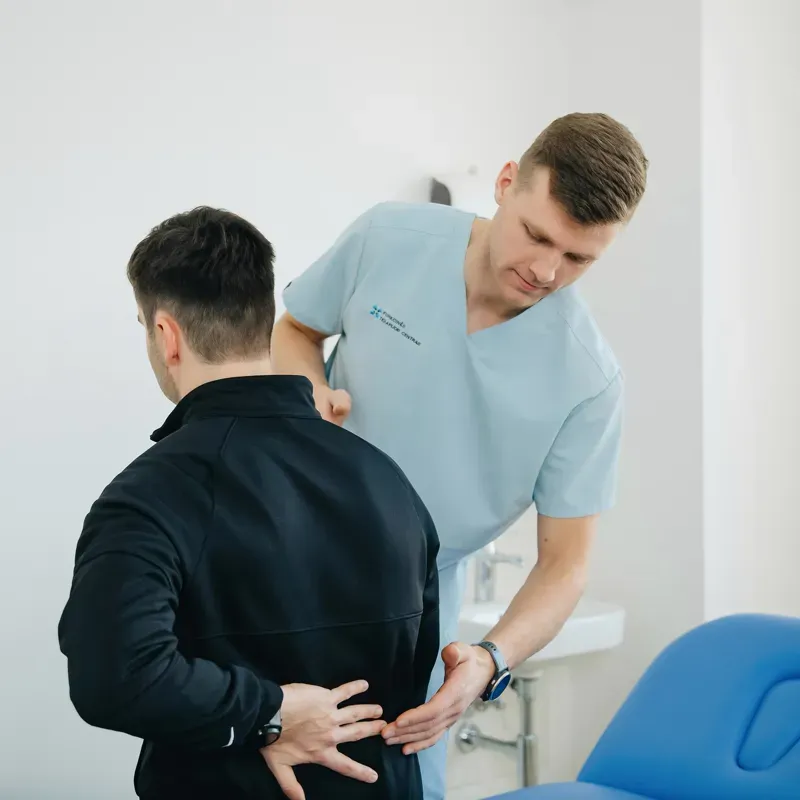
Physiotherapy in Dubai: The Complete Guide
blogPage.moreFromCategory

PRP vs Cortisone Dubai: Which Injection? (2026)
بیشتر بخوانید
PRP Injection for Joints Dubai: From AED 1,500 (2026)
بیشتر بخوانیدPhysiotherapy Dubai: Types, Cost & Guide (2026)
بیشتر بخوانیدPhysiotherapy Cost Dubai: AED 250–500/Session (2026)
بیشتر بخوانید
Arthritis: Physiotherapy Management Guide (2026)
بیشتر بخوانیدCarpal Tunnel: Non-Surgical Treatment Dubai (2026)
بیشتر بخوانید© 2026 Doctors Clinic Diagnostic Center (DCDC), Dubai Healthcare City. Originally published at https://doctorsclinicdubai.ae/blog/neck-pain-physiotherapy-dubai. All rights reserved. Unauthorized reproduction is prohibited.