النقاط الرئيسية
- The actual CBCT scan takes only 20 to 40 seconds, with the entire appointment lasting approximately 10 to 15 minutes from arrival to departure
- A CBCT scan is completely painless — there is no injection, no contrast dye, no sedation, and no recovery time required
- No special preparation is needed before the scan — you can eat, drink, and take your regular medications as usual; you only need to remove metal objects from the head and neck area
- Results are typically available the same day at DCDC, with a detailed radiologist report and 3D image dataset shared digitally with your referring dentist or surgeon
- The scan uses 50 to 100 times less radiation than a conventional medical CT scan, making it one of the safest advanced imaging procedures available
The CBCT scan procedure is one of the fastest, most comfortable, and most informative diagnostic imaging experiences in modern dentistry. A Cone Beam Computed Tomography scan captures a complete three-dimensional image of your teeth, jawbone, nerve pathways, and surrounding facial structures in a single rotation lasting just 20 to 40 seconds. Yet despite how straightforward and painless the procedure is, many patients feel anxious simply because they do not know what to expect. This guide walks you through every step of the CBCT scan process — from the moment you arrive at the imaging center to the moment you receive your results — so you can approach your appointment with complete confidence.
Whether your dentist has referred you for a CBCT scan to plan dental implants, evaluate wisdom teeth, assess orthodontic treatment, or investigate jaw pain, understanding the procedure in advance eliminates uncertainty and helps you prepare. Below, you will learn exactly how a CBCT scan works, what each step of the procedure involves, how long it takes, whether it hurts, what to do before and after the scan, and what the experience is like at Doctors Clinic Diagnostic Center (DCDC) in Dubai Healthcare City.
How Does a CBCT Scan Work?
A CBCT scan works by rotating a compact X-ray source and a flat-panel digital detector around your head in a single arc. During this rotation, the machine captures between 200 and 600 individual two-dimensional projection images from every angle. These raw images are then fed into advanced reconstruction software that converts them into a precise three-dimensional volumetric dataset — essentially a digital replica of your jaw and teeth that can be sliced, rotated, and measured on a computer screen.
The "cone beam" in CBCT refers to the shape of the X-ray beam itself. Unlike a conventional medical CT scanner that uses a narrow, fan-shaped beam and requires multiple rotations, a CBCT machine emits a wide, cone-shaped beam that captures an entire volume of data in a single pass. This cone-beam geometry is the fundamental reason why CBCT is faster (one rotation instead of many), lower in radiation (less total exposure time), and more compact (no tunnel or enclosed space) than traditional CT technology.
"The beauty of CBCT technology is that it gives us a complete 3D map of the patient's anatomy in under 40 seconds, with radiation levels that are a fraction of what a hospital CT scanner delivers," says Dr. Osama Elzamzami, Head of Radiology at DCDC. "For the patient, it feels no different from standing in front of a panoramic X-ray machine — but the diagnostic information we get is exponentially more detailed."
Once the scan is complete, the reconstruction software generates three standard viewing planes: axial slices (horizontal cross-sections from top to bottom), coronal slices (front-to-back cross-sections), and sagittal slices (side-to-side cross-sections). The software can also produce curved panoramic reconstructions that follow the natural arch of the jaw, cross-sectional views at any point along the jaw, and full 3D volume renderings that can be rotated freely on screen. This versatility allows clinicians to examine every tooth, root, nerve canal, bone contour, and sinus wall from any perspective without any overlapping structures.
Step-by-Step CBCT Scan Procedure
Understanding each step of the CBCT scan procedure removes the uncertainty that causes anxiety. The entire process is straightforward, non-invasive, and remarkably quick. Here is exactly what happens from the moment you walk through the door.
Step 1: Arrival and Registration (2-3 Minutes)
When you arrive at the imaging center, you check in at reception and provide your referral letter (if you have one), identification, and insurance details. The receptionist confirms your appointment and directs you to the radiology department. If you are a walk-in patient, the team verifies availability and registers you on the spot. There are no forms to fill out regarding allergies or medical history specific to the scan itself, because CBCT does not involve contrast dye, sedation, or any injected substances.
Step 2: Preparation and Metal Removal (1-2 Minutes)
The radiographer asks you to remove all metal objects from your head and neck area. This includes earrings, necklaces, hairpins, eyeglasses, hearing aids, and removable dental appliances such as dentures, retainers, or aligners. Metal objects create bright white artifacts on the scan that can obscure important anatomical details and reduce diagnostic quality. You do not need to change into a gown or remove clothing. A lead thyroid collar may be placed around your neck to shield your thyroid gland from scatter radiation, depending on the protocol used at the facility.
Step 3: Positioning at the Machine (1-2 Minutes)
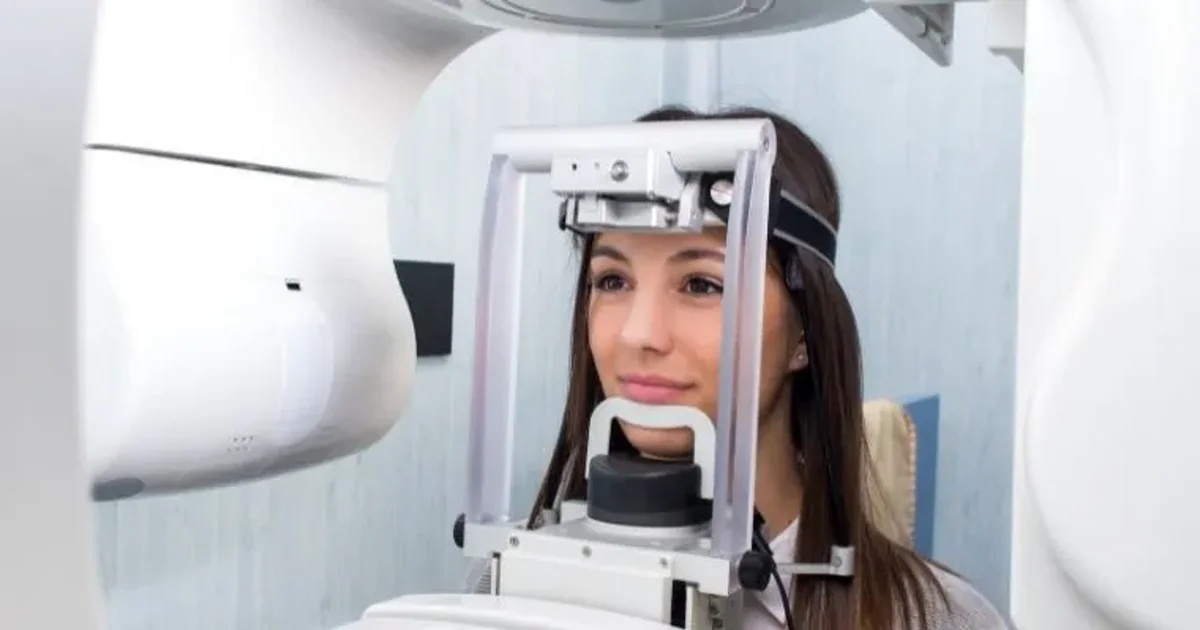
The radiographer guides you to the CBCT machine, where you either stand upright or sit in a chair, depending on the machine design. Your chin rests on a small padded chin rest, and a forehead stabilizer or head strap keeps your head in the correct position. Some machines also use a bite block — a small disposable device that you gently bite down on — to further stabilize your jaw and ensure proper alignment. The radiographer adjusts the height and position of the machine to center the X-ray beam on the area of clinical interest, whether that is a specific quadrant, a single jaw, or the full maxillofacial region.
"We take extra time with positioning because it directly affects image quality," says Dr. Osama Elzamzami, Head of Radiology at DCDC. "A well-positioned patient means a sharper, more diagnostic scan — which ultimately means better treatment planning for the referring clinician."
Step 4: The Scan Itself (20-40 Seconds)
This is the core of the procedure, and it is over before most patients realize it has begun. The radiographer steps behind a protective screen and activates the scan from a control panel. The C-arm of the CBCT machine begins rotating smoothly around your head in a single arc, typically covering 180 to 360 degrees depending on the machine and the clinical indication. You will hear a quiet humming or buzzing sound as the machine rotates — this is completely normal and simply the sound of the X-ray tube and detector moving along their track.
During the rotation, the only thing you need to do is remain perfectly still. Any movement — even a slight swallow or shift of the jaw — can cause motion blur in the reconstructed images. The radiographer will instruct you to keep your tongue pressed against the roof of your mouth, close your lips gently, and breathe normally through your nose. The scan is completely painless. There is no sensation of heat, pressure, vibration, or discomfort of any kind. You do not feel the X-rays passing through your body.
Step 5: Image Reconstruction and Quality Check (3-5 Minutes)
Immediately after the scan, the raw projection data is transferred to the workstation computer, which runs reconstruction algorithms to generate the three-dimensional image dataset. This processing takes approximately two to five minutes. The radiographer reviews the reconstructed images on screen to verify that the scan quality is diagnostic — checking for adequate coverage of the area of interest, sufficient image sharpness, and the absence of motion artifacts or metal scatter that could compromise interpretation. If the scan meets quality standards, you are free to go. In the rare event that the scan quality is not diagnostic (for example, due to patient movement), the radiographer may ask you to repeat the scan, which adds only another 20 to 40 seconds.
Step 6: Radiologist Reporting and Results (Same Day)
After you leave, a consultant radiologist reviews the entire 3D dataset systematically, examining every slice and reconstruction. The radiologist identifies and documents all relevant findings — including bone dimensions, nerve canal positions, pathology, tooth positions, sinus conditions, and any incidental findings — in a detailed written report. At DCDC, this report is typically completed the same day and is shared digitally with your referring dentist, oral surgeon, or orthodontist. The 3D image dataset itself can also be exported in DICOM format for use in implant planning software or orthodontic simulation tools.
| Step | What Happens | Duration |
|---|---|---|
| 1. Arrival & Registration | Check in at reception, provide referral and identification | 2-3 minutes |
| 2. Preparation | Remove metal objects from head and neck area; thyroid collar placed | 1-2 minutes |
| 3. Positioning | Stand or sit at the machine; chin rest, head stabilizer, and bite block adjusted | 1-2 minutes |
| 4. Scan | C-arm rotates around your head; remain still; completely painless | 20-40 seconds |
| 5. Image Processing | Computer reconstructs 3D images; radiographer checks quality | 3-5 minutes |
| 6. Results & Reporting | Consultant radiologist reviews images and prepares detailed report | Same day |
Complete CBCT scan procedure timeline from arrival to results. Total appointment time is approximately 10-15 minutes.
Ready to Book Your CBCT Scan?
At DCDC in Dubai Healthcare City, the entire CBCT scan appointment takes just 10-15 minutes with same-day results. Our experienced radiology team ensures a comfortable, efficient experience from start to finish.
How Long Does a CBCT Scan Take?
The total time for a CBCT scan appointment is approximately 10 to 15 minutes from arrival to departure. The actual scan — the time during which the machine rotates around your head and captures images — lasts only 20 to 40 seconds. The remaining time is spent on registration, preparation (removing metal objects), positioning, and the post-scan quality check.
To put this in perspective, a CBCT scan appointment is shorter than most dental check-ups. Many patients are surprised at how quickly the entire process is completed. There is no waiting period after the scan, no observation time, and no need to stay at the facility. You walk in, the scan is performed, and you walk out — typically within 15 minutes of your arrival time.
The scan duration can vary slightly depending on the field of view (FOV) selected by the radiographer. A small FOV scan targeting a specific region (such as a few teeth for implant planning) may take as little as 15 to 20 seconds. A large FOV scan covering both jaws and the full facial skeleton may take up to 40 seconds. Your referring dentist specifies the required FOV based on the clinical question, and the radiographer programs the machine accordingly. Regardless of the FOV, the scan is always completed in under one minute.
Is a CBCT Scan Painful?
No. A CBCT scan is completely painless. There is no injection, no contrast dye, no needle, no sedation, and no physical sensation during the scan itself. You do not feel the X-rays passing through your body. The machine does not touch you — the C-arm rotates around your head at a comfortable distance without making contact. The only physical sensations you experience are the chin rest supporting your jaw and the gentle pressure of the head stabilizer keeping your head in position.
Unlike some medical imaging procedures such as MRI (which involves lying still in a narrow tube for 20 to 60 minutes) or contrast-enhanced CT (which requires an intravenous injection of contrast dye), a CBCT scan requires nothing more than standing or sitting still for half a minute. There is no enclosed space, no tunnel, and no feeling of confinement — the machine is an open design with the C-arm rotating around your head while you remain in an upright position with a clear view of the room around you.
Patients who are anxious about dental procedures or claustrophobic often find that the CBCT scan is the most comfortable part of their entire dental treatment journey. The procedure is faster than having a dental impression taken, less intrusive than a routine dental cleaning, and involves no discomfort whatsoever.
A Patient's Experience: From Nervousness to Relief
Sarah, a 38-year-old Dubai resident, was referred for a CBCT scan before her dental implant surgery. She had never had any type of CT scan before and was visibly nervous when she arrived at DCDC. "I was imagining lying inside a big machine like you see in the movies," she recalled. "I was worried it would be claustrophobic and that it would take a long time." The radiographer explained each step before beginning, showed her the machine, and reassured her that she would be standing upright the entire time with the room fully visible around her.
The scan took 25 seconds. "I honestly couldn't believe it was over," Sarah said. "The machine went around my head once, and then the radiographer said we were done. I didn't feel anything at all — no pain, no discomfort, nothing. I actually laughed because I had been so nervous for something that turned out to be easier than getting my teeth cleaned." Her results were ready the same afternoon, and her oral surgeon used the 3D images to plan her implant placement with precision. Sarah's experience is typical of what patients report after their first CBCT scan: the anticipation is far worse than the reality.
"We hear this from patients every single day," says Dr. Osama Elzamzami, Head of Radiology at DCDC. "They come in expecting something complicated and uncomfortable, and they leave surprised at how quick and easy it was. That is the beauty of CBCT — maximum diagnostic information with minimal patient burden."
Before Your CBCT Scan: What to Expect
One of the most reassuring aspects of the CBCT scan procedure is that it requires no special preparation. Unlike some medical imaging tests that require fasting, bowel preparation, allergy pre-medication, or the insertion of an intravenous line, a CBCT scan has none of these requirements. Here is what you need to know before your appointment.
What You Can Do Normally
- Eat and drink normally: There are no fasting requirements. You can have breakfast, lunch, coffee, or water at any time before your scan.
- Take your regular medications: Continue all prescribed medications as normal. There are no drug interactions with the scan because no contrast agents or sedatives are used.
- Drive to and from the appointment: You can drive yourself because no sedation is involved. There is no impairment of any kind after the scan.
- Return to normal activities immediately: You can go straight back to work, school, exercise, or any other activity after the scan. There is no recovery period.
What to Bring
- Referral letter: If your dentist or specialist provided a referral or prescription for the scan, bring it with you. This helps the radiographer set the correct scan parameters and field of view.
- Previous imaging: If you have previous dental X-rays, panoramic images, or CBCT scans from another facility, bring them (or have them sent digitally) so the radiologist can compare findings.
- Insurance card and identification: For registration and billing purposes.
What to Avoid
- Wearing metal jewelry on your head and neck: Earrings, necklaces, nose rings, tongue piercings, and hairpins create artifacts on the scan. Leave them at home or be prepared to remove them at the facility.
- Wearing removable dental appliances: Dentures, retainers, aligners, and bite guards should be removed before the scan. Bring a case to store them.
Special Considerations
Pregnancy: As with all X-ray-based imaging, CBCT scans are generally avoided during pregnancy as a precaution, even though the radiation dose is very low and the beam is directed at the head. If you are pregnant or suspect you might be, inform the radiographer before the scan so the team can discuss the clinical necessity with your referring dentist and make an appropriate decision.
Children: CBCT scans can be safely performed on children when clinically justified. Modern machines offer pediatric protocols with reduced radiation settings. Children may need a parent present in the room for reassurance, and the radiographer will take extra time to explain the procedure in simple terms to minimize anxiety. For more on CBCT safety, see our article on what a CBCT scan is and how it works.
After Your CBCT Scan: Results & Next Steps
The post-scan process is just as simple as the scan itself. There is no recovery time, no side effects, and no restrictions on your activities after the procedure. Here is what happens after you step away from the CBCT machine.
Immediate Post-Scan
After the radiographer confirms that the image quality is diagnostic, you are free to leave the facility immediately. You can put your jewelry back on, reinsert your dental appliance, and go about your day without any limitations. There is no observation period, no delayed reaction to worry about, and no post-procedure instructions to follow. The scan has no lasting physical effects whatsoever.
The Radiologist Report
Behind the scenes, the consultant radiologist begins reviewing your 3D images systematically. The radiologist examines every axial, coronal, and sagittal slice, as well as panoramic and cross-sectional reconstructions. The report documents all clinically significant findings, including bone measurements for implant planning, nerve canal positions, the status of tooth roots, sinus conditions, joint health, and any incidental pathology discovered during the review. At DCDC, this report is typically completed the same day as the scan.
How You Receive Your Results
Your results are delivered in two formats. First, a written radiologist report summarizing all findings in clear clinical language that your referring dentist can use for treatment planning. Second, the complete 3D image dataset in DICOM format, which your dentist or surgeon can load into their own imaging software for detailed treatment planning, implant simulation, or orthodontic analysis. At DCDC, both the report and images are shared digitally with your referring clinician via secure electronic transfer, so there is no need for you to carry CDs or printed films between appointments.
Your Follow-Up Appointment
Once your referring dentist or specialist receives the CBCT report and images, they will schedule a follow-up appointment to discuss the findings with you and explain how the 3D images inform your treatment plan. For implant patients, the surgeon will show you exactly where the implant will be placed relative to the bone and nerves. For orthodontic patients, the orthodontist will use the images to refine the treatment approach. For wisdom tooth patients, the surgeon will explain the position of the tooth and the planned extraction technique. The CBCT scan is the diagnostic foundation upon which your entire treatment plan is built.
CBCT Scan Procedure at DCDC Dubai
At Doctors Clinic Diagnostic Center (DCDC) in Dubai Healthcare City, the CBCT scan procedure is designed for maximum patient comfort and diagnostic excellence. DCDC has been providing diagnostic imaging services for over 13 years and performs more than 1,000 diagnostic scans every month, making it one of the most experienced imaging facilities in the UAE.
Advanced CBCT Technology
DCDC uses a modern CBCT system with adjustable fields of view, from small focused scans of individual teeth to full maxillofacial volumes covering both jaws and the entire facial skeleton. The machine operates with optimized dose protocols that minimize radiation exposure while maintaining the high image resolution needed for accurate diagnosis and treatment planning. Pediatric protocols are available for younger patients, ensuring age-appropriate radiation settings.
Experienced Radiology Team
Every CBCT scan at DCDC is performed by trained, experienced radiographers and interpreted by consultant radiologists who specialize in dental and maxillofacial imaging. This dual layer of expertise — skilled acquisition and expert interpretation — ensures that every scan captures the information your clinician needs and that every finding, no matter how subtle, is identified and reported. The radiology team works closely with referring dentists, oral surgeons, and orthodontists across Dubai to provide integrated diagnostic support.
Same-Day Results and Digital Sharing
DCDC prioritizes rapid turnaround because delays in reporting mean delays in treatment. In most cases, the radiologist report and the 3D image dataset are available on the same day as the scan. Digital sharing eliminates the need for patients to physically transport films or discs between the imaging center and the treating clinician, streamlining the workflow and getting you into treatment faster.
Convenient Location and Booking
DCDC is located in Dubai Healthcare City, one of the region's premier medical free zones, with easy access from Oud Metha, Karama, Bur Dubai, Downtown Dubai, and the wider UAE. The center is open six days a week. CBCT scan appointments can be booked by phone, WhatsApp, or through the online booking form. Walk-in patients are also welcomed subject to availability. For pricing details, see our guide on CBCT scan cost in Dubai.
Book Your CBCT Scan at DCDC Today
Experience a fast, painless CBCT scan with same-day results at Doctors Clinic Diagnostic Center in Dubai Healthcare City. Our radiology team is ready to provide the precise 3D imaging your dentist needs.
Or call us at +971 4 435 9991
الأسئلة الشائعة
Final Thoughts
The CBCT scan procedure is one of the simplest, fastest, and most comfortable diagnostic imaging experiences in modern healthcare. In under one minute of actual scanning time, CBCT captures a complete three-dimensional map of your teeth, jawbone, nerves, and surrounding structures — providing your dentist or surgeon with the precise information needed to plan treatment with confidence. There is no pain, no injection, no sedation, no contrast dye, and no recovery time. The entire appointment takes approximately 10 to 15 minutes, and results are typically available the same day.
If your dentist has recommended a CBCT scan, there is nothing to worry about. The procedure is straightforward, the radiation dose is minimal, and the diagnostic value is immense. At Doctors Clinic Diagnostic Center (DCDC) in Dubai Healthcare City, our radiology team performs CBCT scans daily with advanced technology, optimized protocols, and a commitment to making every patient's experience as smooth and efficient as possible. To learn more about CBCT imaging, read our comprehensive guide on what a CBCT scan is, or visit our guide on CBCT scan cost in Dubai for pricing details.
المصادر والمراجع
تمت مراجعة هذا المقال من قبل فريقنا الطبي ويستند إلى المصادر التالية:
- American Dental Association - Dental Radiographic Examinations: Recommendations for Patient Selection and Limiting Radiation Exposure
- European Academy of DentoMaxilloFacial Radiology (EADMFR) - Basic Principles for Use of Dental Cone Beam CT
- RadiologyInfo.org - Cone Beam CT (CBCT)
- International Commission on Radiological Protection (ICRP) - Radiological Protection in Cone Beam CT
يتم مراجعة المحتوى الطبي على هذا الموقع من قبل أطباء مرخصين من هيئة الصحة. اطلع على سياستنا التحريرية لمزيد من المعلومات.

كتبه
Dr. Osama Elzamzami
Diagnostic Radiology
MD, FRCR
Dr. Osama Elzamzami is Head of Radiology at DCDC Dubai Healthcare City, specializing in diagnostic imaging including CBCT, CT, MRI, and ultrasound. He holds an MD and FRCR (Fellowship of the Royal College of Radiologists).