

Book Your Appointment
Verified Patient Reviews of DCDC Diagnostic Center in Dubai
Verified reviews and real patient stories from Dubai Healthcare City
I'm very satisfied with this medical clinic. I had my first pregnancy screening here. It was affordable and very professional. The radiologist was welcoming, kind, and made the experience great.
Aizhan Tokmanbetova
Hurt my knee Friday night and got an MRI appointment Sunday evening (booked Sunday afternoon). Waited about 2 minutes and was done in just over 30 minutes. The team was amazing, friendly and efficient.
Kirsten Evans
Dr. Osama's team was gentle and amazing. After a bad experience elsewhere, my pelvic exam here was much more professional. Great report and very precise.
Mary






PTH Test in Dubai: Parathyroid Hormone and Calcium Metabolism Assessment
Accurate intact PTH measurement for diagnosing hyperparathyroidism, calcium disorders, and bone health evaluation
A PTH test in Dubai measures parathyroid hormone, the master regulator of calcium and phosphate metabolism in the human body. Produced by the four tiny parathyroid glands located behind the thyroid gland in the neck, PTH responds to minute changes in blood calcium concentration within seconds, orchestrating calcium movement between bone, kidney, and intestine to maintain serum calcium within a remarkably narrow physiological range. When PTH levels become chronically elevated or suppressed, the resulting calcium imbalance affects virtually every organ system, from bone density and kidney stone formation to neuromuscular function, cardiovascular health, and cognitive performance. The intact PTH blood test in Dubai, measuring parathyroid hormone alongside simultaneous calcium metabolism testing and vitamin D levels, is the cornerstone of parathyroid disease diagnosis.
The most clinically important PTH disorder is primary hyperparathyroidism, caused in the vast majority of cases by a benign, autonomous parathyroid adenoma that secretes excess PTH independent of normal feedback regulation. Primary hyperparathyroidism is now primarily detected incidentally during routine blood testing when mildly elevated serum calcium is discovered on a metabolic panel — a pattern particularly common in postmenopausal women. Once considered a disease of "bones, stones, groans, and psychic moans," referring to its classical severe manifestations of osteitis fibrosa cystica, kidney stones, gastrointestinal symptoms, and neuropsychiatric effects, primary hyperparathyroidism in the modern era is most commonly asymptomatic or mildly symptomatic, with fatigue, cognitive fog, depression, and osteoporosis as the predominant presentations.
Secondary hyperparathyroidism represents the parathyroid glands appropriately responding to hypocalcaemia by increasing PTH output. The most common cause in the UAE and the wider Middle East is vitamin D deficiency, which reduces intestinal calcium absorption, lowering blood calcium and stimulating compensatory PTH elevation. Chronic kidney disease is another major cause, as failing kidneys cannot convert vitamin D to its active form, hydroxylate phosphate, or maintain calcium balance, driving sustained PTH elevation that accelerates renal osteodystrophy. Distinguishing primary from secondary hyperparathyroidism requires simultaneous measurement of PTH, calcium, 25-hydroxyvitamin D, phosphate, and kidney function.
- Intact PTH AssayMost accurate measurement of biologically active parathyroid hormone
- Calcium Co-testingSimultaneous calcium for accurate PTH-calcium relationship assessment
- Bone Health InsightIdentifies PTH-driven bone loss before fracture risk becomes significant
- Vitamin D IntegrationPTH interpreted alongside 25-OH vitamin D for complete calcium axis evaluation

Dr. Hadi Komshi
Specialist Internal Medicine·Laboratory & Diagnostics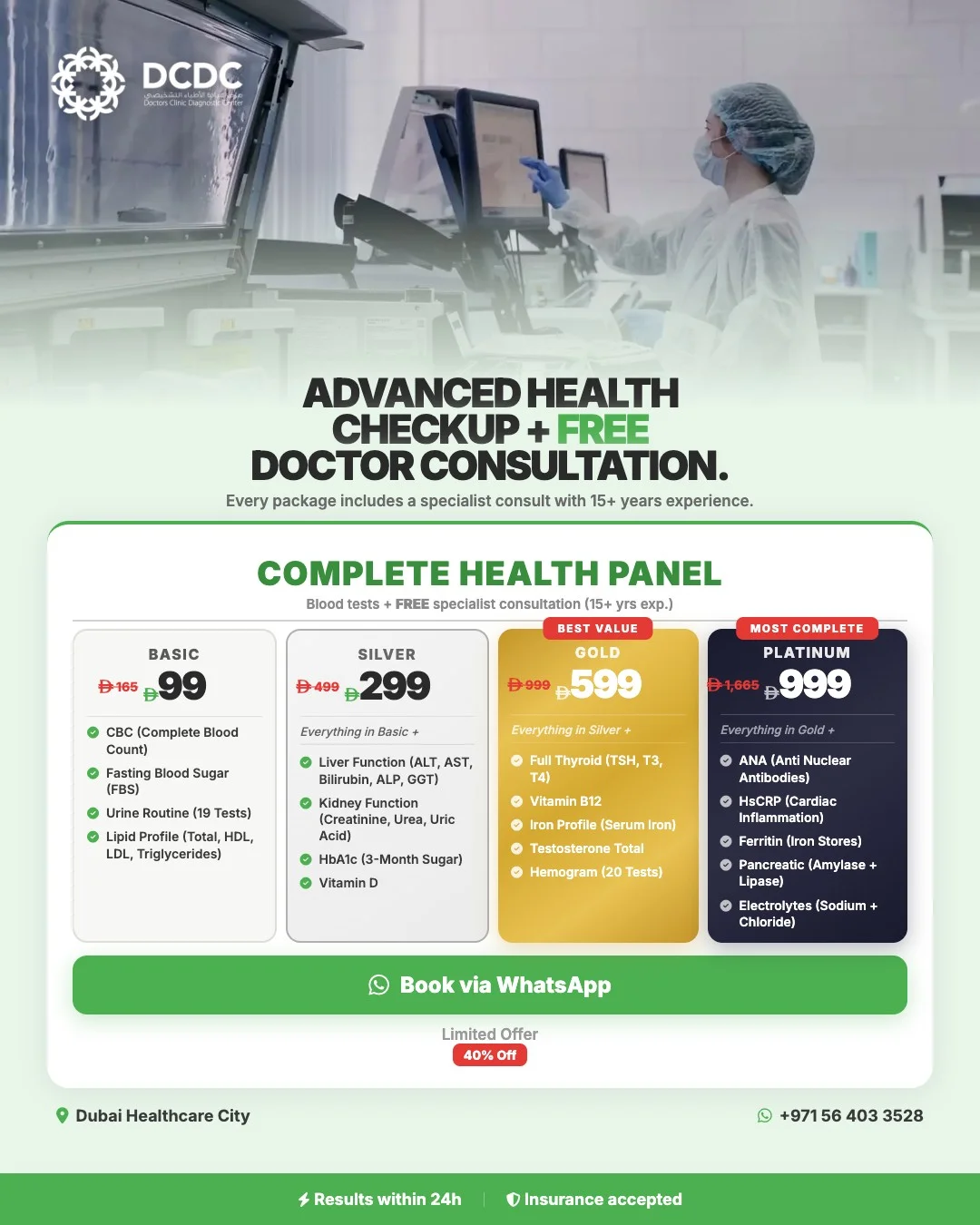
Complete Health Panel
Advanced health checkup with FREE specialist consultation. 4 tiers from basic blood work to full-body screening with 40+ biomarkers.
10–40+ tests included
What's Included
Who is this for?
Anyone wanting a comprehensive baseline health check with specialist consultation
Explore Our Services
Comprehensive pth test (parathyroid hormone) services at DCDC Dubai Healthcare City.
PTH & Calcium Panel
Intact PTH with simultaneous calcium and phosphate for parathyroid assessment.
Vitamin D Test
25-hydroxyvitamin D measurement essential for calcium axis evaluation.
Bone Density Scan (DEXA)
DEXA scan for bone mineral density and osteoporosis assessment.
Health Checkup
Complete wellness assessment including bone and metabolic health markers.
All services performed by DHA-licensed specialists
Who Should Get PTH Test (Parathyroid Hormone)?
PTH testing is indicated for anyone with abnormal calcium levels on routine blood tests, suspected parathyroid disease, bone loss, recurrent kidney stones, or chronic vitamin D deficiency. It is an essential investigation for kidney disease patients and anyone with unexplained fatigue, depression, or cognitive changes with calcium abnormalities.
Elevated serum calcium (hypercalcaemia) detected on routine blood tests
Most CommonLow serum calcium (hypocalcaemia) requiring cause identification
Most CommonRecurrent kidney stones, particularly calcium oxalate or calcium phosphate stones
Osteoporosis or bone density loss disproportionate to age or risk factors
Chronic vitamin D deficiency with persistent elevation despite supplementation
Chronic kidney disease (CKD) requiring renal osteodystrophy monitoring
Unexplained fatigue, bone pain, or muscle weakness with calcium abnormalities
Depression, cognitive fog, or neuropsychiatric symptoms with hypercalcaemia
Post-thyroid surgery monitoring for hypoparathyroidism
Neck mass or suspected parathyroid adenoma on imaging
Malignancy-associated hypercalcaemia requiring PTH suppression confirmation
Family history of multiple endocrine neoplasia (MEN) syndromes
Why Choose DCDC for PTH Testing?
DCDC in Dubai Healthcare City offers intact PTH measurement with simultaneous calcium and vitamin D testing for comprehensive parathyroid and bone health evaluation.

Complete Parathyroid Panel
Our MOHAP-accredited laboratory measures intact PTH alongside calcium, phosphate, and vitamin D to accurately diagnose primary, secondary, and tertiary hyperparathyroidism.
Results Within 24-48 Hours
PTH results are typically available within 24-48 hours, enabling your physician to evaluate parathyroid function and calcium metabolism promptly.
Endocrinology Referral Pathway
Abnormal PTH results are flagged with direct referral to endocrinology or internal medicine for further evaluation and management planning.
Insurance Direct Billing
We accept direct billing with 20+ major insurers including Daman, AXA, MetLife, and Bupa. Walk-ins welcome with no appointment needed.
Your Comfortable Visit
A simple, step-by-step PTH scan process designed for comfort, speed, and accuracy.
Walk In or Book
No fasting needed. Any time of day. Inform the team of current supplements.
Registration
Insurance verification in under 5 minutes. Physician referral requested.
Blood Draw
Single sample for PTH, calcium, phosphate, and vitamin D if ordered together.
Prompt Processing
PTH samples processed rapidly as the hormone degrades at room temperature.
Results
Results within 24-48 hours with clinical interpretation and endocrine follow-up pathway.
PTH Test Cost in Dubai
Insurance coverage available with a physician referral. Direct billing with 20+ insurers. Contact us: +971 54 219 5008
- PTH test: from AED 449.
- No fasting required; tell your doctor about calcium and vitamin D supplements.
- Results typically within 24-48 hours.
- Insurance verification in minutes
- No hidden fees
- Fast response on WhatsApp
Your PTH Test Experience
Simple blood test with no fasting required and rapid results.
Before
During
After
Insurance & Location
MOHAP License: Fully licensed diagnostic center in Dubai Healthcare City








- 20+ insurance providers in Dubaiincluding Daman, AXA, ADNIC, and others
- Pre-authorization supportand direct billing (where applicable)
- Coverage verificationbefore your appointment at our Dubai Healthcare City clinic
- Transparent pricingwith no hidden fees for pth test (parathyroid hormone) services
Visit Us in Dubai Healthcare City
Doctors Clinic Diagnostic Center
Building 64, Block A, Al Razi Medical Complex, Dubai Healthcare City, Dubai, UAE
Near Oud Metha Road · Easy access from Bur Dubai, Downtown Dubai, Business Bay · Free dedicated parking available
Working Hours
Mon-Thu, Sat: 8AM - 10:30PM | Sun: 8:30AM - 10:30PM | Fri: 9AM - 10PM
How Insurance Works at DCDC
Check Coverage
Verify your plan covers PTH Test (Parathyroid Hormone)
Get a Referral
Some insurers require a GP referral — we can guide you
Pre-Authorization
We handle pre-auth directly with your insurer
Direct Billing
No upfront payment — we bill your insurer directly
Co-Pay Only
You only pay any applicable co-pay at the clinic
Dr. Hadi Komshi
Specialist Internal Medicine
MD, Specialist Internal Medicine
Dr. Hadi Komshi is a DHA-licensed Internal Medicine Specialist with extensive experience in managing both acute and chronic medical conditions. With years of clinical practice across inpatient, outpatient, emergency, ICU, and CCU settings, he is known for his accurate diagnoses, comprehensive approach, and dedication to patient-centered care. He has previously led a Hemodialysis Unit and is skilled in interpreting imaging studies and specialized diagnostic tests, ensuring safe, effective, and evidence-based treatment for his patients.
- Acute & chronic disease management
- Diabetes, thyroid disorders & metabolic conditions
- Hypertension & cardiovascular risk assessment
Persian · Arabic · English
The Calcium-PTH Axis: Understanding Parathyroid Physiology
Calcium is not merely a structural component of bone; it is an essential signalling ion that controls muscle contraction, nerve impulse transmission, hormone secretion, blood clotting, and intracellular signalling. Maintaining serum ionised calcium within a narrow range of approximately 1.15 to 1.35 mmol/L is therefore a physiological imperative. The parathyroid calcium-sensing receptor (CaSR), a G-protein coupled receptor on the surface of parathyroid chief cells, monitors ionised calcium concentrations in real time and modulates PTH secretion within seconds. This exquisitely sensitive feedback system means that PTH levels change dynamically throughout the day in response to dietary calcium intake, and mild sustained disruptions to this axis carry significant long-term consequences for bone, kidney, and cardiovascular health.
Laboratory measurement of PTH has evolved significantly. First-generation PTH assays measured fragments including biologically inactive C-terminal fragments that accumulate in kidney disease, causing significant overestimation in renal patients. Second-generation intact PTH assays (iPTH) measure only the full-length 1-84 amino acid molecule alongside larger fragments, offering superior accuracy in most clinical contexts. Third-generation "biointegral" or "whole" PTH assays that measure only the complete 1-84 molecule are available for research and specific clinical situations including intraoperative PTH monitoring during parathyroidectomy, where a greater than 50 percent decline in PTH within 10 minutes of adenoma removal confirms successful surgical cure.
Parathyroid and Calcium Conditions Diagnosed Through PTH Testing
Primary Hyperparathyroidism
Autonomous PTH secretion from a single parathyroid adenoma (85% of cases) causing concurrent elevated calcium and elevated PTH; the most common parathyroid disorder, predominantly affecting postmenopausal women.
Secondary Hyperparathyroidism
Compensatory PTH elevation in response to hypocalcaemia from vitamin D deficiency or chronic kidney disease; elevated PTH with low or normal calcium, correctable by treating the underlying cause.
Tertiary Hyperparathyroidism
Autonomous PTH hypersecretion developing after prolonged secondary hyperparathyroidism, most commonly in advanced renal disease or post-transplant, often requiring surgical management.
Hypoparathyroidism
Insufficient PTH production causing hypocalcaemia and hyperphosphataemia; most commonly post-thyroid surgery, presenting with tetany, perioral tingling, Chvostek and Trousseau signs.
Malignancy-Associated Hypercalcaemia
Suppressed PTH with elevated calcium caused by PTHrP (PTH-related protein) from tumours or bony metastases; confirmed by low PTH distinguishing it from parathyroid disease.
Vitamin D Deficiency with Bone Disease
Low vitamin D causing secondary hyperparathyroidism with bone mineralisation defects (osteomalacia in adults, rickets in children); normalises with adequate vitamin D supplementation.
Renal Osteodystrophy
Bone disease in chronic kidney disease driven by secondary and tertiary hyperparathyroidism, hyperphosphataemia, and vitamin D deficiency; PTH monitoring guides phosphate binder and cinacalcet therapy.
Familial Hypocalciuric Hypercalcaemia (FHH)
Benign CaSR mutation causing mild hypercalcaemia with normal or mildly elevated PTH but low urinary calcium; distinguished from primary hyperparathyroidism by 24-hour urine calcium; no treatment required.
Related Services
Explore other diagnostic and consultation services available at our Dubai Healthcare City clinic.
Frequently Asked Questions
Common questions about PTH Test (Parathyroid Hormone) in Dubai.
The four parathyroid glands are small endocrine organs embedded in or near the posterior thyroid gland, each roughly the size of a grain of rice. Despite their anatomical proximity to the thyroid, they are functionally entirely separate, serving as the primary regulators of calcium and phosphate homeostasis. PTH is released within seconds in response to falling ionised calcium, acting on three target organs: bones (releasing calcium through osteoclast activation), kidneys (increasing calcium reabsorption and reducing phosphate retention, also activating vitamin D), and intestine (indirectly increasing calcium absorption via activated vitamin D). Together these actions rapidly restore serum calcium to normal, after which PTH secretion is suppressed by the rising calcium through a tight negative feedback loop.
Elevated PTH (hyperparathyroidism) is categorised by its cause. Primary hyperparathyroidism occurs when a parathyroid gland becomes autonomous, typically due to a benign adenoma, secreting excess PTH independent of calcium levels. The result is concurrent elevated calcium and elevated PTH. Secondary hyperparathyroidism is an appropriate compensatory response to hypocalcaemia or vitamin D deficiency, with high PTH but low or normal calcium. Tertiary hyperparathyroidism develops in long-standing secondary hyperparathyroidism, particularly in kidney disease, when the glands become autonomously hyperactive despite calcium correction. Each type has different treatment implications.
Low or undetectable PTH (hypoparathyroidism) results in hypocalcaemia because there is insufficient PTH to maintain calcium levels. The most common cause is surgical removal or inadvertent damage to the parathyroid glands during thyroid or neck surgery. Autoimmune destruction, genetic conditions such as DiGeorge syndrome, severe magnesium deficiency (magnesium is required for PTH secretion), and radiation damage are other causes. Low PTH with high calcium suggests the hypercalcaemia is from a non-PTH source, such as malignancy, vitamin D toxicity, or granulomatous disease.
The only curative treatment for primary hyperparathyroidism is surgical parathyroidectomy, removing the causative adenoma or hyperplastic gland. Minimally invasive parathyroidectomy guided by preoperative imaging with technetium-99m sestamibi scan and neck ultrasound achieves cure rates above 95 percent. Surgery is recommended when calcium is significantly elevated, when kidney stones, osteoporosis, or renal impairment are present, or in patients under 50. For those who decline or are unsuitable for surgery, cinacalcet (a calcimimetic drug that reduces PTH secretion) and bisphosphonates to protect bone can manage the condition, with regular monitoring of calcium, PTH, and bone density.
Vitamin D deficiency causes reduced intestinal calcium absorption, lowering blood calcium and triggering compensatory PTH elevation (secondary hyperparathyroidism). This is extremely common in the UAE and Middle East, where sun avoidance due to heat, skin coverage, and indoor lifestyles produce endemic vitamin D deficiency. Chronically elevated PTH due to vitamin D deficiency draws calcium from bones to compensate, contributing to osteoporosis and bone pain. Vitamin D supplementation corrects the deficiency, allowing calcium absorption to improve and PTH to normalise. This is why PTH and 25-OH vitamin D should always be measured together for accurate interpretation.
PTH values are only interpretable in the context of simultaneous calcium. A PTH of 80 pg/mL is normal if calcium is normal but indicates primary hyperparathyroidism if calcium is elevated — because in that situation PTH should be suppressed by the high calcium. Conversely, a PTH of 80 pg/mL with low calcium is an appropriate secondary response. The PTH-calcium relationship (whether they move in the same or opposite direction) is the key diagnostic discriminator. Our laboratory routinely reports PTH alongside calcium and phosphate in the same panel to ensure clinically useful interpretation.
Yes. Primary hyperparathyroidism increases urinary calcium excretion (hypercalciuria) through multiple mechanisms including increased bone calcium release and increased intestinal absorption via activated vitamin D. This elevated urinary calcium promotes calcium oxalate and calcium phosphate kidney stone formation. Approximately 15 to 20 percent of primary hyperparathyroidism patients have or develop kidney stones; conversely, primary hyperparathyroidism should be excluded in any patient presenting with recurrent calcium kidney stones through calcium and PTH measurement. Parathyroidectomy significantly reduces stone recurrence risk.
Chronically elevated PTH, as in primary hyperparathyroidism, stimulates osteoclast-mediated bone resorption to release calcium from the skeleton. This disproportionately affects cortical bone such as the distal radius and hip, while trabecular bone such as the lumbar spine is relatively spared in primary disease. Bone mineral density measured by DXA scan typically shows reduced density at the hip and forearm in primary hyperparathyroidism. After successful parathyroidectomy, bone density improves significantly over the following 1 to 3 years. Interestingly, intermittent low-dose PTH (teriparatide) is used therapeutically as an anabolic bone treatment for osteoporosis, demonstrating the complex site- and dose-dependent effects of PTH on bone.
Key Facts
- Modality
- PTH Test (Parathyroid Hormone)
- Primary Indication
- Abnormal calcium levels, hyperparathyroidism investigation, bone loss assessment, and vitamin D deficiency evaluation
- Duration
- 5-10 minutes for sample collection
- Preparation
- No fasting required; inform doctor of calcium supplements, vitamin D, and relevant medications
- Report Time
- Results typically within 24-48 hours
- Location
- Dubai Healthcare City
- Insurance
- Most major insurance accepted (Daman, AXA, Bupa, etc.)
Medical Review & Oversight
All services are provided under the supervision of licensed medical professionals in our MOHAP-accredited facility.