
Book Your Appointment
Verified Patient Reviews of DCDC Diagnostic Center in Dubai
Verified reviews and real patient stories from Dubai Healthcare City
I'm very satisfied with this medical clinic. I had my first pregnancy screening here. It was affordable and very professional. The radiologist was welcoming, kind, and made the experience great.
Aizhan Tokmanbetova
Hurt my knee Friday night and got an MRI appointment Sunday evening (booked Sunday afternoon). Waited about 2 minutes and was done in just over 30 minutes. The team was amazing, friendly and efficient.
Kirsten Evans
Dr. Osama's team was gentle and amazing. After a bad experience elsewhere, my pelvic exam here was much more professional. Great report and very precise.
Mary





Prolactin Test in Dubai: Fertility and Pituitary Hormone Assessment
Accurate prolactin measurement for diagnosing hyperprolactinemia, pituitary adenoma, menstrual dysfunction, and male infertility
Fertility Insight
Identifies treatable prolactin-driven causes of irregular periods and infertility
Pituitary Assessment
Detects prolactinoma and other pituitary pathology requiring specialist referral
Male & Female
Essential hormonal evaluation for both men and women with reproductive concerns
Treatment-Guided
Results directly guide dopamine agonist therapy with high success rates
A prolactin test in Dubai measures the level of prolactin, a polypeptide hormone produced by lactotroph cells in the anterior pituitary gland, that plays critical roles in reproduction, lactation, and metabolic regulation. While its primary physiological role is the initiation and maintenance of breast milk production after childbirth, abnormally elevated prolactin — a condition known as hyperprolactinemia — is one of the most common hormonal disorders affecting the pituitary, occurring in approximately 0.4 percent of the general population and far more frequently in women presenting with menstrual irregularity, infertility, or galactorrhea (inappropriate milk production). At DCDC in Dubai Healthcare City, we offer prolactin level test and prolactin blood test in Dubai as part of comprehensive hormonal fertility panels, hyperprolactinemia testing, and standalone pituitary function assessment.
The significance of prolactin lies in its inhibitory effect on the hypothalamic-pituitary-gonadal (HPG) axis. Elevated prolactin suppresses the pulsatile release of gonadotropin-releasing hormone (GnRH) from the hypothalamus, which in turn reduces LH and FSH secretion from the pituitary. The downstream consequence is suppression of ovarian function in women, manifesting as irregular or absent periods (oligomenorrhoea or amenorrhoea), failure to ovulate (anovulation), and reduced estrogen production. In men, elevated prolactin suppresses testosterone production and impairs sperm development. This shared HPG axis mechanism explains why hyperprolactinemia is a significant and treatable cause of infertility in both sexes.
Pituitary adenomas, benign tumours of the pituitary gland, are the most common pathological cause of elevated prolactin. Prolactinomas account for approximately 40 percent of all pituitary adenomas and are classified as microprolactinomas (less than 10mm diameter) or macroprolactinomas (10mm or larger). Microprolactinomas are far more common, particularly in women, and typically present with menstrual irregularity, galactorrhea, and infertility. Macroprolactinomas may additionally cause headache, visual field defects from optic chiasm compression, and hormonal deficiencies of other pituitary hormones. However, it is critical to note that many common causes of elevated prolactin are entirely physiological or medication-related, and these must be systematically excluded before pathological investigations are pursued.
Fertility Insight
Identifies treatable prolactin-driven causes of irregular periods and infertility
Pituitary Assessment
Detects prolactinoma and other pituitary pathology requiring specialist referral
Male & Female
Essential hormonal evaluation for both men and women with reproductive concerns
Treatment-Guided
Results directly guide dopamine agonist therapy with high success rates
Prolactin Test in Dubai: Fertility and Pituitary Hormone Assessment
Accurate prolactin measurement for diagnosing hyperprolactinemia, pituitary adenoma, menstrual dysfunction, and male infertility
A prolactin test in Dubai measures the level of prolactin, a polypeptide hormone produced by lactotroph cells in the anterior pituitary gland, that plays critical roles in reproduction, lactation, and metabolic regulation. While its primary physiological role is the initiation and maintenance of breast milk production after childbirth, abnormally elevated prolactin — a condition known as hyperprolactinemia — is one of the most common hormonal disorders affecting the pituitary, occurring in approximately 0.4 percent of the general population and far more frequently in women presenting with menstrual irregularity, infertility, or galactorrhea (inappropriate milk production). At DCDC in Dubai Healthcare City, we offer prolactin level test and prolactin blood test in Dubai as part of comprehensive hormonal fertility panels, hyperprolactinemia testing, and standalone pituitary function assessment.
The significance of prolactin lies in its inhibitory effect on the hypothalamic-pituitary-gonadal (HPG) axis. Elevated prolactin suppresses the pulsatile release of gonadotropin-releasing hormone (GnRH) from the hypothalamus, which in turn reduces LH and FSH secretion from the pituitary. The downstream consequence is suppression of ovarian function in women, manifesting as irregular or absent periods (oligomenorrhoea or amenorrhoea), failure to ovulate (anovulation), and reduced estrogen production. In men, elevated prolactin suppresses testosterone production and impairs sperm development. This shared HPG axis mechanism explains why hyperprolactinemia is a significant and treatable cause of infertility in both sexes.
Pituitary adenomas, benign tumours of the pituitary gland, are the most common pathological cause of elevated prolactin. Prolactinomas account for approximately 40 percent of all pituitary adenomas and are classified as microprolactinomas (less than 10mm diameter) or macroprolactinomas (10mm or larger). Microprolactinomas are far more common, particularly in women, and typically present with menstrual irregularity, galactorrhea, and infertility. Macroprolactinomas may additionally cause headache, visual field defects from optic chiasm compression, and hormonal deficiencies of other pituitary hormones. However, it is critical to note that many common causes of elevated prolactin are entirely physiological or medication-related, and these must be systematically excluded before pathological investigations are pursued.

Dr. Hadi Komshi
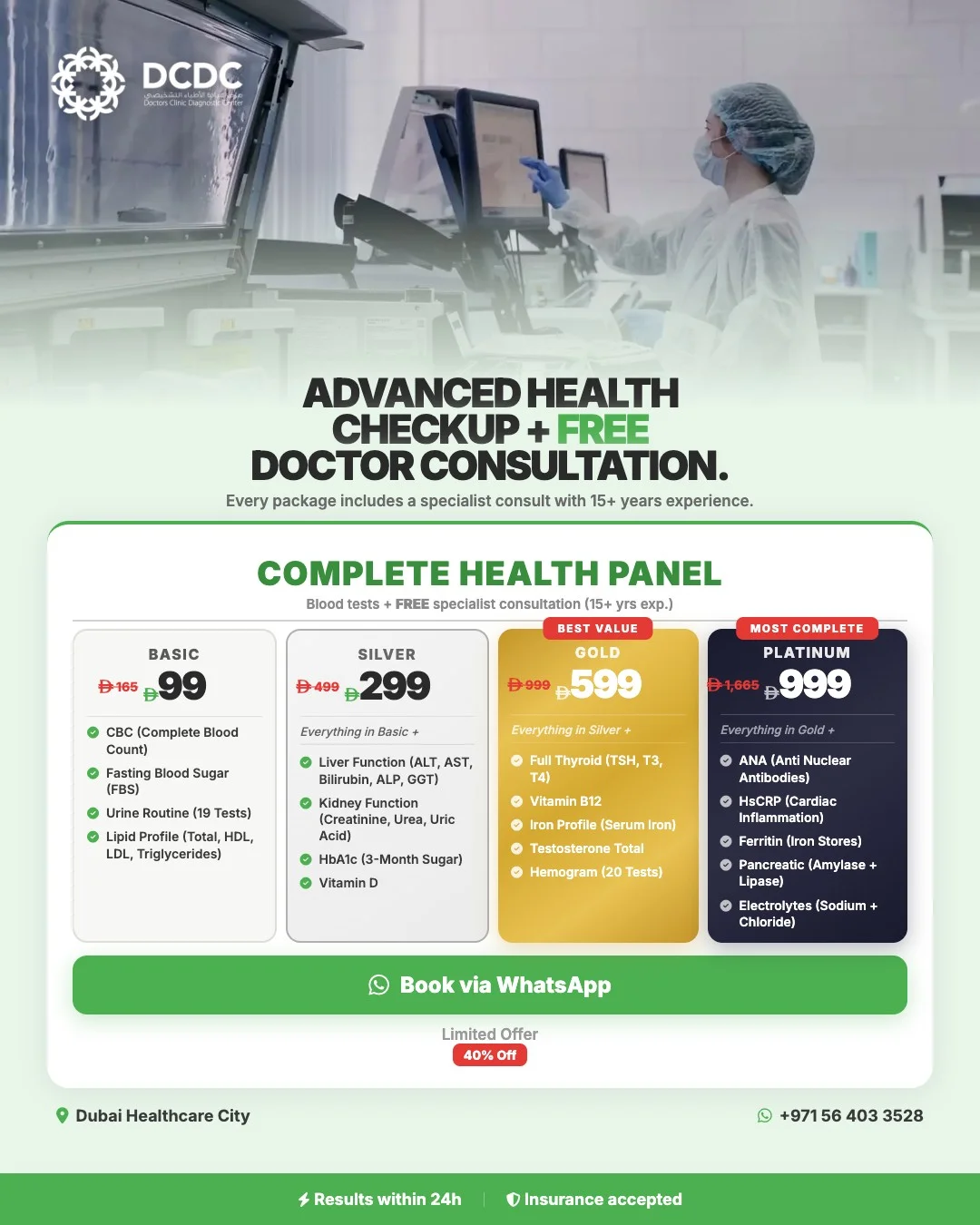
Complete Health Panel
Advanced health checkup with FREE specialist consultation. 4 tiers from basic blood work to full-body screening with 40+ biomarkers.
10–40+ tests included
What's Included
Who is this for?
Anyone wanting a comprehensive baseline health check with specialist consultation
Explore Our Services
Comprehensive prolactin test services at DCDC Dubai Healthcare City.
Serum Prolactin Test
Accurate prolactin measurement with macroprolactin assessment for reliable interpretation.
Female Hormone Panel
FSH, LH, estradiol, progesterone, AMH for comprehensive reproductive assessment.
TSH & Thyroid Tests
Thyroid function testing as hypothyroidism is a common treatable cause of hyperprolactinemia.
PCOS Assessment Panel
Testosterone, DHEA-S, prolactin, and androgen index for PCOS hormonal workup.
Health Checkup
Complete wellness screening including reproductive and pituitary hormones.
All services performed by DHA-licensed specialists
Who Should Get Prolactin Test?
Prolactin testing is essential for women with menstrual irregularity, unexplained infertility, or galactorrhea, and for men with sexual dysfunction, infertility, or unexplained visual changes. It is a key component of PCOS evaluation and pituitary function assessment.
Women with irregular, infrequent, or absent periods (oligomenorrhoea or amenorrhoea)
Women or men with unexplained infertility
Galactorrhea: inappropriate nipple discharge or milk production outside breastfeeding
Women with low libido or vaginal dryness suggesting estrogen deficiency
Men with reduced libido, erectile dysfunction, or gynaecomastia
Men with low testosterone not explained by primary testicular failure
Why Choose DCDC for Prolactin Testing?
DCDC offers accurate prolactin measurement with macroprolactin exclusion to avoid false positives and unnecessary treatment.
Macroprolactin Exclusion Testing
Our laboratory screens for macroprolactin (big-big prolactin), a clinically inactive form that causes false-positive results and leads to unnecessary treatment at other facilities.
Results Within 24-48 Hours
Prolactin results are typically available within 24-48 hours, with standardised morning collection protocols for the most accurate hormone measurement.
Comprehensive Reproductive Panel
Prolactin can be ordered alongside FSH, LH, estradiol, and TSH for a complete reproductive and pituitary hormone workup in a single blood draw.
Insurance Direct Billing
We accept direct billing with 20+ major insurers including Daman, AXA, MetLife, and Bupa. Walk-ins welcome for morning hormone testing.
Your Comfortable Visit
A simple, step-by-step Prolactin scan process designed for comfort, speed, and accuracy.
Prolactin Test Cost in Dubai
Prolactin pricing in Dubai varies by scan type, contrast requirements, and insurance coverage for various test types.
- Pricing varies by scan type and whether contrast is required
- Insurance coverage accepted with referral and verification
- Transparent self-pay rates available with instant quote on request
Insurance verification in minutes • No hidden fees • Fast response on WhatsApp
Patient Guide
Your Prolactin Test Experience
Simple, low-preparation blood test with fast results.
Insurance & Location
Insurance Partners
- •20+ insurance providers in Dubai including Daman, AXA, ADNIC, and others
- •Pre-authorization support and direct billing (where applicable)
- •Coverage verification before your appointment at our Dubai Healthcare City clinic
- •Transparent pricing with no hidden fees for prolactin test services








Visit Us in Dubai Healthcare City
Doctors Clinic Diagnostic Center
Building 64, Block A, Al Razi Medical Complex, Dubai Healthcare City, Dubai, UAE
Near Oud Metha Road · Easy access from Bur Dubai, Downtown Dubai, Business Bay · Free dedicated parking available
Working Hours
Mon-Thu, Sat: 8AM - 10:30PM | Sun: 8:30AM - 10:30PM | Fri: 9AM - 10PM
How Insurance Works at DCDC
Check Coverage
Verify your plan covers Prolactin Test
Get a Referral
Some insurers require a GP referral — we can guide you
Pre-Authorization
We handle pre-auth directly with your insurer
Direct Billing
No upfront payment — we bill your insurer directly
Co-Pay Only
You only pay any applicable co-pay at the clinic
Your Specialist
Dr. Hadi Komshi
Specialist Internal Medicine
MD, Specialist Internal Medicine
Persian · Arabic · English
Patient Guide
Understanding Prolactin and the Reproductive Axis
Prolactin regulation is unique among pituitary hormones in that it is primarily under inhibitory control from the hypothalamus. Dopamine, released from the hypothalamic arcuate nucleus, tonically inhibits prolactin secretion. Any interruption of this dopaminergic inhibition — whether from a stalk-compressing tumour, dopamine-blocking medications, or autonomously secreting prolactinoma cells — results in elevated prolactin. This mechanism explains why antipsychotic drugs that block dopamine receptors are potent prolactin-elevating agents and why dopamine agonists are the first-line treatment for prolactinomas.
The clinical assessment of hyperprolactinemia requires systematic exclusion of the many physiological and pharmacological causes before attributing elevation to pathology. A careful medication history is essential. If medication is excluded and prolactin remains consistently elevated on repeat testing, macroprolactin should be excluded by PEG precipitation. Only after confirming true monomeric prolactin elevation should pituitary MRI be requested. This structured approach avoids unnecessary imaging and treatment in the substantial proportion of patients with physiological or macroprolactinaemic elevation. When pathological hyperprolactinemia is confirmed, treatment with cabergoline is highly effective, with the majority of patients achieving prolactin normalisation and tumour shrinkage within months of commencing therapy.
Conditions Diagnosed Through Prolactin Testing
Microprolactinoma
Benign pituitary adenoma smaller than 10mm causing mildly to moderately elevated prolactin, presenting with menstrual irregularity, galactorrhea, and infertility; treated with cabergoline with excellent outcomes.
Macroprolactinoma
Pituitary adenoma 10mm or larger producing markedly elevated prolactin often exceeding 10,000 mIU/L; may cause headache and visual field defects, typically treated with dopamine agonists before considering surgery.
Hyperprolactinemia-related Amenorrhoea
Prolactin-suppressed GnRH causing loss of menstrual periods through anovulation and estrogen deficiency, a reversible and highly treatable cause of secondary amenorrhoea.
Galactorrhea
Inappropriate nipple discharge occurring outside pregnancy and breastfeeding, caused by elevated prolactin stimulating mammary gland secretion, present in up to 80% of women with prolactinoma.
Hyperprolactinemia-related Male Infertility
Elevated prolactin suppressing testosterone and spermatogenesis in men, causing reduced libido, erectile dysfunction, and oligozoospermia; reversible with dopamine agonist therapy.
Medication-induced Hyperprolactinemia
Dopamine-blocking antipsychotics and antiemetics causing prolactin elevation up to 5,000 mIU/L; requires medication review or switch rather than prolactin-specific treatment.
Related Services
Explore other diagnostic and consultation services available at our Dubai Healthcare City clinic.
Frequently Asked Questions
Common questions about Prolactin Test in Dubai.
Prolactin is a 199 amino acid polypeptide hormone produced by lactotroph cells in the anterior pituitary gland. Its primary role is initiating and maintaining lactation after childbirth, stimulated by oestrogen during pregnancy and nipple stimulation. Outside of pregnancy and breastfeeding, prolactin has significant roles in regulating the reproductive axis by suppressing GnRH pulsatility. The prolactin blood test measures the serum concentration in mIU/L or ng/mL, with normal ranges typically below 500 mIU/L (23 ng/mL) in women and below 450 mIU/L (21 ng/mL) in men outside of pregnancy and breastfeeding. Levels vary between laboratories, so local reference ranges apply.
Causes span physiological, pharmacological, and pathological categories. Physiological elevation occurs with pregnancy, breastfeeding, sleep (prolactin peaks during sleep), stress, exercise, sexual intercourse, and nipple stimulation. Pharmacological causes include antipsychotic medications (dopamine antagonists such as haloperidol, risperidone, metoclopramide, and domperidone are particularly potent prolactin-elevating drugs), antidepressants, opioids, and antihypertensives including verapamil. Pathological causes include prolactinoma (the most common pituitary tumour), other pituitary or hypothalamic masses causing pituitary stalk compression (stalk effect), hypothyroidism (TRH stimulates prolactin), chronic kidney disease, and liver cirrhosis.
The degree of prolactin elevation provides diagnostic guidance. Levels mildly elevated above the upper reference limit, typically below 2,000 to 3,000 mIU/L, may represent physiological variation, medication effects, or macroprolactinaemia (a benign form discussed below). Moderate elevation from 2,000 to 5,000 mIU/L may be seen with microprolactinoma or stalk compression from a non-functioning tumour. Levels consistently above 5,000 mIU/L, and especially above 10,000 mIU/L, are strongly associated with macroprolactinoma. Very high levels exceeding 100,000 mIU/L are diagnostic of macroprolactinoma. MRI of the pituitary with gadolinium contrast is the imaging investigation of choice when a prolactinoma is suspected.
Macroprolactin is prolactin bound to IgG antibodies, forming a large complex that is biologically inactive but detected by standard prolactin immunoassays, causing apparent hyperprolactinemia on blood testing. Macroprolactinaemia is found in 10 to 26 percent of patients with elevated prolactin on standard assay and is usually clinically benign — these patients have no symptoms of true hyperprolactinemia and require no treatment. The distinction is made by polyethylene glycol (PEG) precipitation, which removes the bound complexes, leaving only free biologically active prolactin. A post-PEG recovery below 40 percent confirms macroprolactinaemia. Without this test, macroprolactinaemia may be incorrectly diagnosed as pathological, leading to unnecessary MRI scans and treatments. Our laboratory offers macroprolactin exclusion testing.
Yes. Hypothyroidism is an important and frequently overlooked cause of secondary hyperprolactinemia. Reduced thyroid hormone levels stimulate increased thyrotropin-releasing hormone (TRH) from the hypothalamus, which stimulates not only TSH but also prolactin release from the pituitary. Additionally, prolonged hypothyroidism can cause the pituitary to enlarge with thyrotroph hyperplasia, which may be mistaken for a pituitary adenoma on imaging. Crucially, treating the underlying hypothyroidism with levothyroxine normalises TSH levels, reduces TRH drive, and resolves both the hyperprolactinemia and any pituitary enlargement — without specific prolactin-lowering treatment. This is why TSH should always be measured alongside prolactin.
Treatment depends on the cause and severity. For prolactinoma, dopamine agonists (cabergoline first-line, bromocriptine second-line) are highly effective, normalising prolactin in over 85 percent of cases and shrinking tumour size in the majority of macroprolactinomas, often obviating the need for surgery. Cabergoline is taken twice weekly and is well tolerated. Treatment is typically continued for at least 2 years, after which a trial of withdrawal can be considered if prolactin has normalised and MRI shows no residual tumour. Surgery (transsphenoidal adenomectomy) is reserved for dopamine agonist-resistant or intolerant cases and for decompression of vision-threatening tumours. For medication-induced hyperprolactinemia, switching or reducing the offending drug resolves the elevation.
In men, elevated prolactin suppresses GnRH pulsatility, reducing LH and FSH, which in turn decreases testicular testosterone production and impairs spermatogenesis. The clinical consequences include reduced libido, erectile dysfunction, decreased ejaculate volume, oligozoospermia or azoospermia, and gynaecomastia (breast tissue development from the altered androgen-estrogen ratio). These effects are often gradual and may be attributed to other causes before prolactin is checked. Male hyperprolactinemia is less common than in women and is more frequently caused by macroprolactinoma due to the longer delay before symptoms prompt investigation. Dopamine agonist treatment restores testosterone, improves libido and sexual function, and can restore fertility.
Yes, significantly. Prolactin is a stress-responsive hormone released in response to physical and psychological stress, including the anxiety of venepuncture itself. Exercise raises prolactin acutely for up to 30 to 60 minutes after vigorous activity. Nipple stimulation and sexual activity cause transient prolactin spikes. Sleep is associated with a pronounced nocturnal prolactin surge. To minimise these confounders, morning testing is preferred, ideally with a period of rest in the waiting room before sample collection. Significantly elevated prolactin should be confirmed with at least one repeat measurement under standardised conditions, and macroprolactin exclusion performed before initiating further investigation or treatment.
Key Facts
Medical Review & Oversight
All services are provided under the supervision of licensed medical professionals in our MOHAP-accredited facility.