
Book Your Appointment
Verified Patient Reviews of DCDC Diagnostic Center in Dubai
Verified reviews and real patient stories from Dubai Healthcare City
I'm very satisfied with this medical clinic. I had my first pregnancy screening here. It was affordable and very professional. The radiologist was welcoming, kind, and made the experience great.
Aizhan Tokmanbetova
Hurt my knee Friday night and got an MRI appointment Sunday evening (booked Sunday afternoon). Waited about 2 minutes and was done in just over 30 minutes. The team was amazing, friendly and efficient.
Kirsten Evans
Dr. Osama's team was gentle and amazing. After a bad experience elsewhere, my pelvic exam here was much more professional. Great report and very precise.
Mary



ECG Test in Dubai: 12-Lead Electrocardiogram with Cardiologist Interpretation
Quick, painless heart rhythm assessment with walk-in availability
Quick & Painless
Complete 12-lead ECG in just 5-10 minutes with no preparation required
Walk-Ins Welcome
No appointment needed during clinic hours at our DHCC facility
Cardiologist Read
Every ECG interpreted by a board-certified cardiologist same day
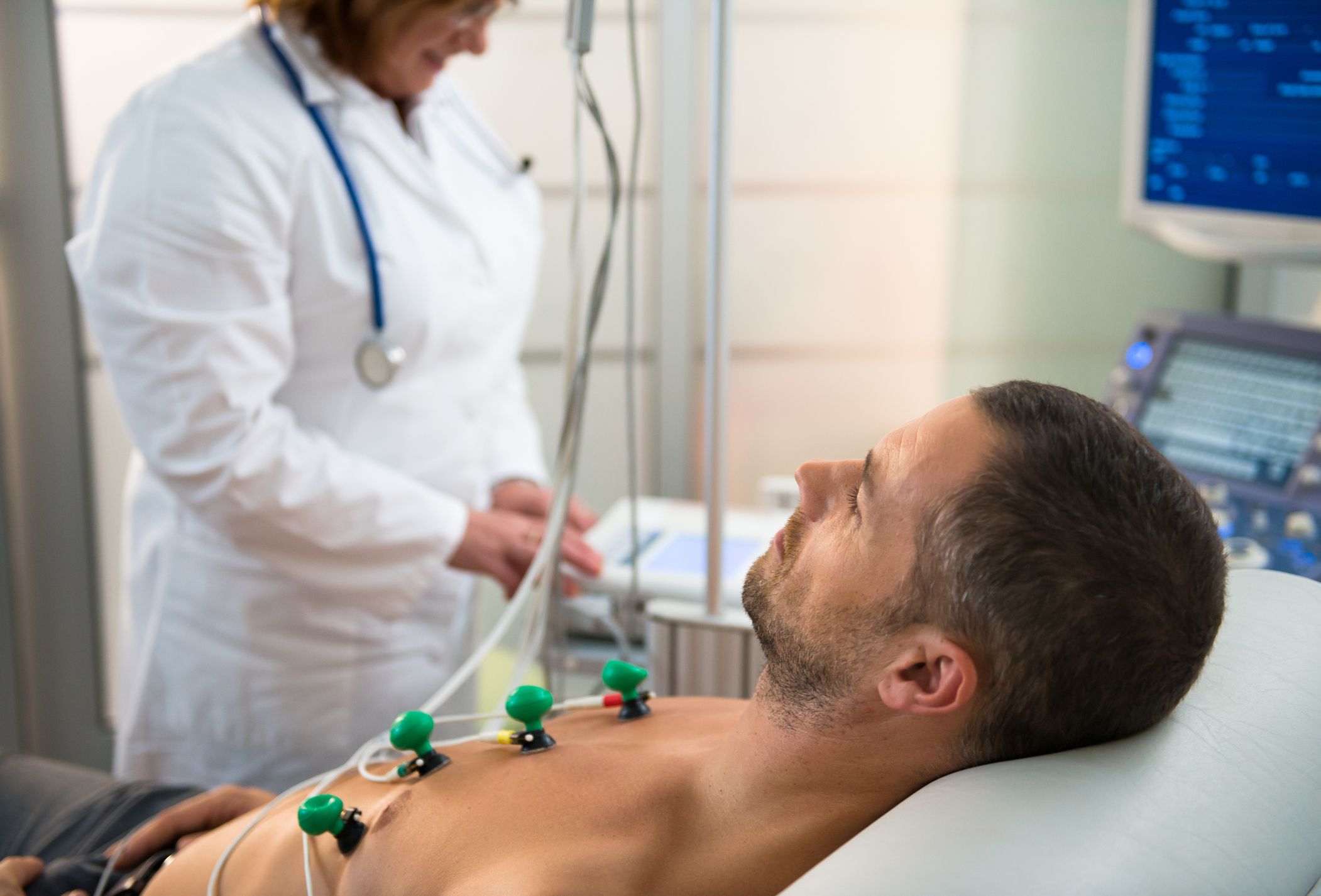
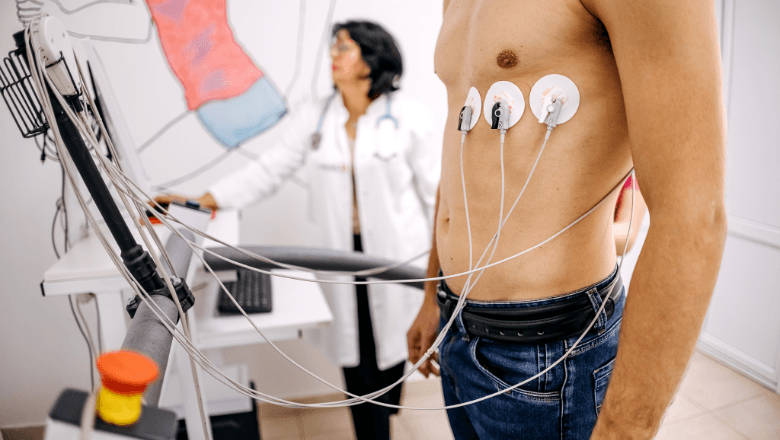
An ECG test in Dubai is one of the simplest and most important heart tests available. It records the electrical activity of your heart through small electrode patches placed on your chest, arms, and legs, producing a tracing that reveals your heart rhythm, rate, and electrical conduction in real time. At DCDC in Dubai Healthcare City, our 12-lead resting ECG takes just 5 to 10 minutes, requires no preparation, and walk-ins are welcome during clinic hours.
Your doctor may recommend an ECG for chest pain, palpitations, dizziness, shortness of breath, or as part of a routine health screening. The 12-lead system captures your heart's electrical activity from multiple angles simultaneously, giving a comprehensive picture of cardiac function. Results are available within minutes, and every ECG at DCDC is interpreted by a cardiologist to ensure nothing is missed.
An ECG can detect arrhythmias such as atrial fibrillation, heart block, bundle branch block, and premature beats. It also identifies signs of previous heart attacks, enlarged heart chambers, electrolyte imbalances, and medication-related cardiac effects. For pre-employment medicals, fitness clearance, and pre-surgical assessments, an ECG provides essential baseline cardiac information.
The electrocardiogram Dubai remains one of the most cost-effective and widely used diagnostic tools in cardiology. For patients searching for an ECG near me, DCDC provides unique information about the electrical conduction system that no other test can replicate. The ECG cost Dubai is competitive and transparent. It is the first-line investigation for any patient presenting with cardiac symptoms, and its role in emergency medicine for rapidly identifying life-threatening conditions like acute myocardial infarction cannot be overstated.
At DCDC, we integrate our electrocardiogram Dubai testing within our comprehensive cardiology services. Whether you are looking for an ECGor need to know the ECG cost Dubai, we provide transparent pricing and same-day service. If your ECG shows any abnormality, our on-site cardiologists can provide immediate consultation, order additional investigations such as echocardiography or Holter monitoring, and initiate treatment without the delays that come from referrals to external facilities. This same-day, all-under-one-roof approach is what patients value about cardiac care at DCDC.
Quick & Painless
Complete 12-lead ECG in just 5-10 minutes with no preparation required
Walk-Ins Welcome
No appointment needed during clinic hours at our DHCC facility
Cardiologist Read
Every ECG interpreted by a board-certified cardiologist same day
ECG Test in Dubai: 12-Lead Electrocardiogram with Cardiologist Interpretation
Quick, painless heart rhythm assessment with walk-in availability
An ECG test in Dubai is one of the simplest and most important heart tests available. It records the electrical activity of your heart through small electrode patches placed on your chest, arms, and legs, producing a tracing that reveals your heart rhythm, rate, and electrical conduction in real time. At DCDC in Dubai Healthcare City, our 12-lead resting ECG takes just 5 to 10 minutes, requires no preparation, and walk-ins are welcome during clinic hours.
Your doctor may recommend an ECG for chest pain, palpitations, dizziness, shortness of breath, or as part of a routine health screening. The 12-lead system captures your heart's electrical activity from multiple angles simultaneously, giving a comprehensive picture of cardiac function. Results are available within minutes, and every ECG at DCDC is interpreted by a cardiologist to ensure nothing is missed.
An ECG can detect arrhythmias such as atrial fibrillation, heart block, bundle branch block, and premature beats. It also identifies signs of previous heart attacks, enlarged heart chambers, electrolyte imbalances, and medication-related cardiac effects. For pre-employment medicals, fitness clearance, and pre-surgical assessments, an ECG provides essential baseline cardiac information.
The electrocardiogram Dubai remains one of the most cost-effective and widely used diagnostic tools in cardiology. For patients searching for an ECG near me, DCDC provides unique information about the electrical conduction system that no other test can replicate. The ECG cost Dubai is competitive and transparent. It is the first-line investigation for any patient presenting with cardiac symptoms, and its role in emergency medicine for rapidly identifying life-threatening conditions like acute myocardial infarction cannot be overstated.
At DCDC, we integrate our electrocardiogram Dubai testing within our comprehensive cardiology services. Whether you are looking for an ECGor need to know the ECG cost Dubai, we provide transparent pricing and same-day service. If your ECG shows any abnormality, our on-site cardiologists can provide immediate consultation, order additional investigations such as echocardiography or Holter monitoring, and initiate treatment without the delays that come from referrals to external facilities. This same-day, all-under-one-roof approach is what patients value about cardiac care at DCDC.

Dr. Shahoo Mazhari
Explore Our Services
Comprehensive ecg test services at DCDC Dubai Healthcare City.

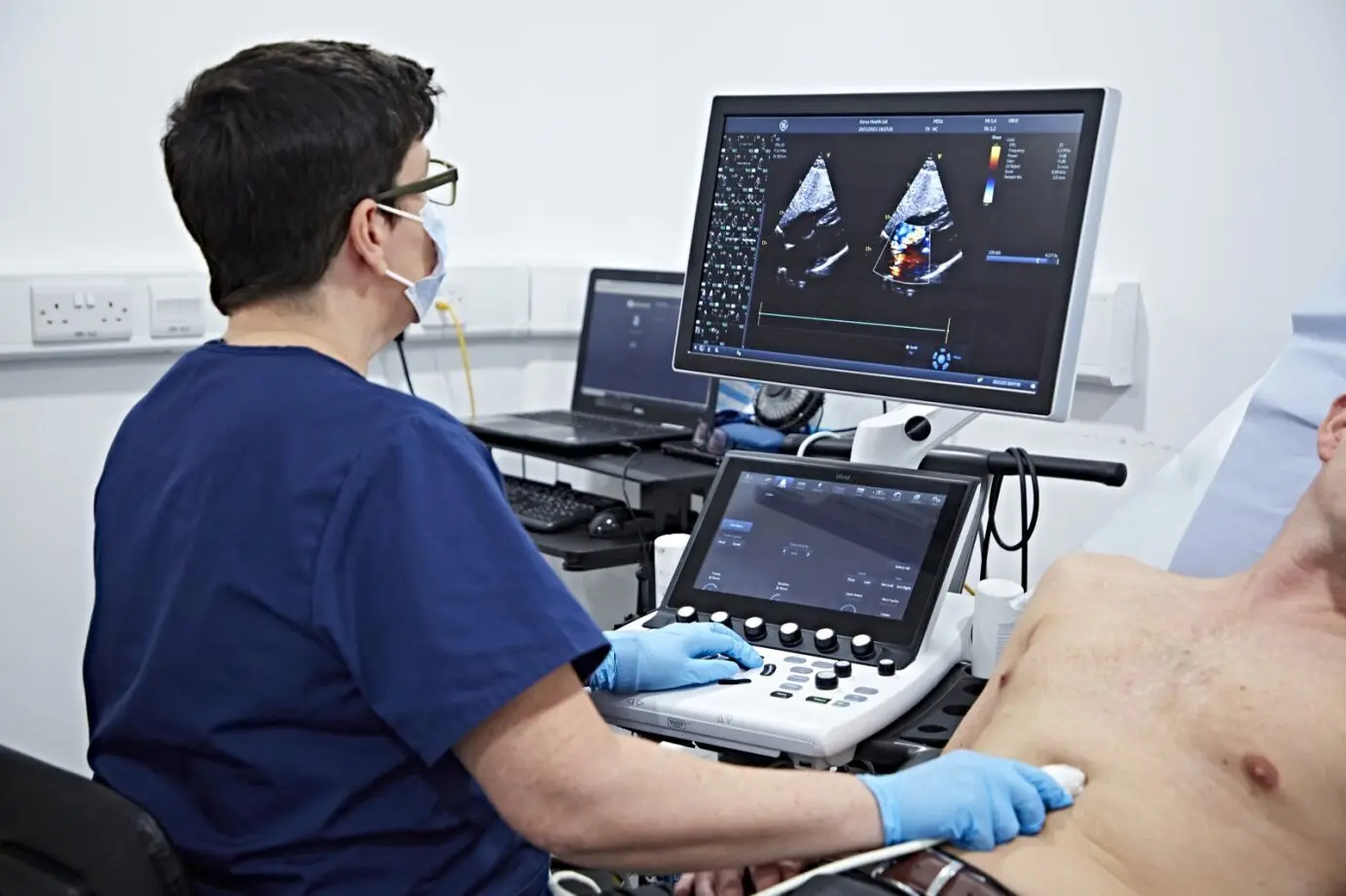
All services performed by DHA-licensed specialists
Who Should Get ECG Test?
An ECG is recommended for anyone experiencing cardiac symptoms or requiring a baseline heart assessment. You should get an ECG if you have:
Chest pain, pressure, or tightness
Palpitations, racing heart, or irregular heartbeat
Shortness of breath or difficulty breathing
Dizziness, lightheadedness, or fainting episodes
Pre-employment or fitness-to-work medical requirements
Pre-surgical cardiac clearance before any procedure
Why Choose DCDC for Your ECG Test?
MOHAP-licensed facility with walk-in ECG availability, cardiologist interpretation, and immediate results in our clinic.
MOHAP Licensed
Accredited medical center in our facility. License NIMY7VY5-240925.
Cardiologist Interpretation
Every ECG reviewed by a board-certified cardiologist for accurate assessment.
Walk-In Available
No appointment needed for ECG during clinic hours. Results in minutes.
Insurance Support
Direct billing with 20+ insurers. We handle pre-authorization for you.
Convenient Location
Building 64, Block A in our center. Free parking on-site.
Integrated Cardiac Care
Echo, stress test, and Holter available on-site if further testing is needed.
Your Comfortable Visit
A simple, step-by-step ECG scan process designed for comfort, speed, and accuracy.
ECG Test Pricing
ECG pricing in Dubai varies by test type and insurance coverage for resting and stress ECG tests.
- Pricing varies by scan type and whether contrast is required
- Insurance coverage accepted with referral and verification
- Transparent self-pay rates available with instant quote on request
Insurance verification in minutes • No hidden fees • Fast response on WhatsApp
Patient Guide
What to Expect During Your ECG Test
A quick, painless test with immediate results.
Insurance & Location
Insurance Partners
- •20+ insurance providers in Dubai including Daman, AXA, ADNIC, and others
- •Pre-authorization support and direct billing (where applicable)
- •Coverage verification before your appointment at our Dubai Healthcare City clinic
- •Transparent pricing with no hidden fees for ecg test services








Visit Us in Dubai Healthcare City
Doctors Clinic Diagnostic Center
Building 64, Block A, Al Razi Medical Complex, Dubai Healthcare City, Dubai, UAE
Near Oud Metha Road · Easy access from Bur Dubai, Downtown Dubai, Business Bay · Free dedicated parking available
Working Hours
Mon-Thu, Sat: 8AM - 10:30PM | Sun: 8:30AM - 10:30PM | Fri: 9AM - 10PM
How Insurance Works at DCDC
Check Coverage
Verify your plan covers ECG Test
Get a Referral
Some insurers require a GP referral — we can guide you
Pre-Authorization
We handle pre-auth directly with your insurer
Direct Billing
No upfront payment — we bill your insurer directly
Co-Pay Only
You only pay any applicable co-pay at the clinic
Check Coverage
Verify your plan covers ECG Test
Get a Referral
Some insurers require a GP referral — we can guide you
Pre-Authorization
We handle pre-auth directly with your insurer
Direct Billing
No upfront payment — we bill your insurer directly
Co-Pay Only
You only pay any applicable co-pay at the clinic
Your Specialist
Dr. Shahoo Mazhari
Consultant Cardiologist
MD, Consultant Cardiologist
Persian · English · Kurdish
Patient Guide
Understanding the ECG: How an Electrocardiogram Works
The electrocardiogram, or ECG, is one of the oldest and most valuable diagnostic tools in medicine, first developed in the early 1900s. It works by detecting the tiny electrical impulses that your heart generates to coordinate each heartbeat. Every time your heart beats, an electrical signal originates in the sinoatrial (SA) node in the right atrium, spreads through the atria causing them to contract, passes through the atrioventricular (AV) node, and then travels through the bundle of His and Purkinje fibres to cause ventricular contraction. The ECG captures this entire sequence as a series of waves known as P, QRS, and T waves.
The standard 12-lead ECG uses 10 electrode patches placed at specific locations on the body to capture the heart's electrical activity from 12 different angles or "leads." Six electrodes are placed across the chest (precordial leads V1 through V6), and four are placed on the limbs (right arm, left arm, right leg as ground, and left leg). The limb electrodes generate six leads (I, II, III, aVR, aVL, aVF) that view the heart in the frontal plane, while the precordial leads view the heart in the horizontal plane. Together, these 12 perspectives create a detailed electrical map of the heart.
Each component of the ECG waveform provides specific diagnostic information. The P wave represents atrial depolarisation and reflects the electrical signal spreading through the atria. The PR interval measures the time taken for the signal to travel from the atria through the AV node to the ventricles. The QRS complex represents ventricular depolarisation, the electrical activation that triggers the main pumping contraction. The ST segment and T wave represent ventricular repolarisation, the electrical recovery phase. Changes in the shape, duration, or amplitude of any of these components can indicate specific cardiac conditions.
While the resting ECG provides a snapshot of your heart at one moment in time, some cardiac conditions only manifest during exercise, stress, or over extended periods. This is why your cardiologist may recommend additional tests such as an exercise stress test ECG, a 24-hour Holter monitor for continuous recording, or an event recorder for intermittent symptoms. At DCDC, all of these extended ECG monitoring options are available on-site, allowing your cardiologist to select the most appropriate test based on your symptoms and the initial resting ECG findings.
Conditions Detected by ECG Testing
Atrial Fibrillation (AFib)
ECG detects the irregular, chaotic electrical activity in the atria that characterises AFib, the most common sustained arrhythmia.
Heart Block
Identifies delays or blocks in the electrical conduction system including first-degree, second-degree, and third-degree heart block.
Myocardial Infarction (Heart Attack)
ST-segment changes, Q waves, and T-wave inversions on ECG indicate current or previous heart muscle damage from blocked coronary arteries.
Bundle Branch Block
Widened QRS complexes reveal conduction delays in the left or right bundle branches, which may indicate underlying heart disease.
Ventricular Hypertrophy
Increased voltage patterns on ECG suggest thickening of the heart muscle walls, often caused by high blood pressure or valve disease.
Supraventricular Tachycardia (SVT)
Episodes of rapid heart rate originating above the ventricles, often presenting as sudden palpitations.
Related Articles
Heart Health Prevention in Dubai
Proactive strategies to protect your cardiovascular health and reduce heart attack risk.
Cardiology Services in Dubai
Comprehensive guide to cardiology services available at DCDC in our clinic.
Stress Test Dubai: Heart Exercise Testing Guide
Complete guide to cardiac stress testing.
Related Services
Explore other diagnostic and consultation services available at our Dubai Healthcare City clinic.
Frequently Asked Questions
Common questions about ECG Test in Dubai.
An ECG, or electrocardiogram, is a simple, non-invasive test that records the electrical activity of your heart. Small electrode patches are placed on your chest, arms, and legs, and they detect the tiny electrical signals that your heart produces with each beat. These signals are displayed as a waveform on paper or screen. The standard 12-lead ECG captures electrical activity from 12 different angles, providing a comprehensive view of your heart's rhythm, rate, and conduction patterns. The test is completely painless and takes only 5 to 10 minutes to complete.
No special preparation is required for an ECG. You can eat, drink, and take your medications as normal before the test. The only recommendations are to avoid heavy exercise for about 30 minutes beforehand, as this can temporarily affect your heart rate and rhythm, and to wear clothing that allows easy access to your chest area. You will need to remove any watches, bracelets, or jewellery from your wrists and ankles, and the electrode areas on your skin should be clean and dry.
No, an ECG is completely painless. The test only records electrical signals from your heart; it does not send any electricity into your body. The electrode patches are small, self-adhesive stickers that are placed gently on your skin. Some patients feel a slight coolness from the conductive gel on the electrodes. When the patches are removed after the test, you may feel a mild tug similar to removing a small bandage. There are no needles, injections, or discomfort of any kind during an ECG.
The entire ECG process takes approximately 5 to 10 minutes from start to finish. This includes preparing your skin, placing the 10 electrode patches in their correct positions, recording the heart tracing for about 10 seconds, and removing the patches afterwards. The actual recording of your heart's electrical activity takes only about 10 seconds. Results are available immediately as a printed tracing, and cardiologist interpretation is provided the same day at DCDC.
An ECG can detect a wide range of cardiac conditions including arrhythmias (irregular heart rhythms such as atrial fibrillation, atrial flutter, and ventricular tachycardia), heart block and conduction delays, signs of a previous heart attack (myocardial infarction), chamber enlargement (atrial or ventricular hypertrophy), electrolyte imbalances affecting the heart (potassium, calcium), pericarditis (inflammation around the heart), effects of cardiac medications, and ischemic changes suggesting reduced blood flow. However, a normal ECG does not rule out all heart conditions, as some problems only appear during exercise or monitoring over 24 hours.
At DCDC, walk-ins are welcome for ECG testing during our regular clinic hours. No appointment is necessary. Simply arrive at our reception in Building 64, Block A, DCDC, and let our team know you need an ECG. The test is quick and we can usually accommodate you with minimal waiting. However, if you want to combine your ECG with a cardiology consultation, booking an appointment in advance ensures you see the cardiologist during the same visit.
An ECG records the electrical activity of your heart and shows rhythm, rate, and conduction patterns. It is quick, taking about 10 seconds of recording time, and uses electrode patches on your skin. An echocardiogram (echo) is an ultrasound of your heart that shows its physical structure, including chamber sizes, wall thickness, valve function, and pumping efficiency. An echo takes 20 to 30 minutes and uses a probe on your chest. The two tests provide different but complementary information. Your cardiologist may order both if a comprehensive cardiac assessment is needed.
For insurance coverage, a physician referral is typically required. However, at DCDC, self-pay patients can walk in without a referral and have an ECG performed the same day. If you need a referral, our on-site general practitioners can assess your symptoms and provide one during the same visit. Many patients combine an ECG with a general health check-up or a cardiology consultation for the most efficient use of their time.
Key Facts
Medical Review & Oversight
All services are provided under the supervision of licensed medical professionals in our MOHAP-accredited facility.