Ключевые выводы
- A complete mammogram appointment takes 15 to 20 minutes from check-in to completion, with the actual imaging lasting only a few minutes
- Four images are taken during a standard screening mammogram: two views of each breast (a top-to-bottom view and an angled side view)
- Breast compression lasts only a few seconds per image and is essential for producing clear, diagnostically accurate images
- Mammogram results are typically available within 1 to 2 business days, with the radiologist's report sent directly to your referring doctor
- DCDC in Dubai Healthcare City provides mammogram screening with advanced digital mammography equipment and experienced radiology specialists
A mammogram procedure is a low-dose X-ray examination of the breast tissue that serves as the primary screening tool for detecting breast cancer at its earliest, most treatable stages. For many women, the prospect of a first mammogram raises questions about what exactly happens during the appointment, whether the compression is painful, how long the process takes, and when results become available. Understanding each step of the mammogram step by step process removes the uncertainty and helps women approach their screening appointment with confidence rather than anxiety.
This guide walks through every stage of a mammogram appointment at Doctors Clinic Diagnostic Center (DCDC) in Dubai Healthcare City, from arrival and check-in through the imaging process itself and on to results and follow-up. Whether you are preparing for your first mammogram or simply want a clear picture of what happens during a mammogram, this article provides the detailed, medically accurate information you need.
What Happens Before Your Mammogram?
Preparation for a mammogram begins before you arrive at the clinic. Scheduling your appointment at the right time in your menstrual cycle can make a meaningful difference in comfort. The American College of Radiology recommends that premenopausal women book their mammogram during the first two weeks of their menstrual cycle (days 1 to 14), when breast tissue tends to be less tender and swollen. This timing reduces discomfort during compression and can also improve image quality because the breast tissue is less dense during this phase.
On the day of your mammogram, avoid applying deodorant, antiperspirant, body powder, cream, or lotion to your underarm area or breasts. These products can contain metallic particles, particularly aluminum in antiperspirants, that appear as white spots on the mammogram images and may be mistaken for calcifications. If you have already applied deodorant before remembering this guideline, the clinic will provide cleansing wipes to remove the product before the scan.
Wearing a two-piece outfit is practical because you will need to undress from the waist up. Avoid wearing necklaces or other jewelry around the neck and chest, as these must be removed before imaging. When you arrive at DCDC, the reception team will ask you to complete a brief questionnaire covering your medical history, breast symptoms, family history of breast cancer, previous surgeries or biopsies, and whether you are breastfeeding or pregnant. This information helps the radiologist interpret your images in the correct clinical context.
If you have had mammograms at another facility, bringing those previous images (or ensuring they are transferred digitally) allows the radiologist to compare your current images with prior studies. Changes over time are often more significant than findings on a single mammogram in isolation, and comparison reduces the likelihood of being called back for additional views of a stable, benign finding.
Step-by-Step Mammogram Procedure
The mammogram procedure follows a standardized sequence that has been refined over decades of clinical practice to ensure consistent, high-quality images while minimizing patient discomfort. Every step serves a specific diagnostic purpose, and understanding what happens at each stage helps demystify the experience.
| Step | What Happens | Duration |
|---|---|---|
| 1. Check-in and registration | You arrive at DCDC, complete registration paperwork, and fill out the breast health questionnaire covering your medical history, symptoms, and family history | 5-7 minutes |
| 2. Changing | You are shown to a private changing area where you undress from the waist up and put on a clinic gown that opens at the front. All jewelry around the neck and chest is removed | 2-3 minutes |
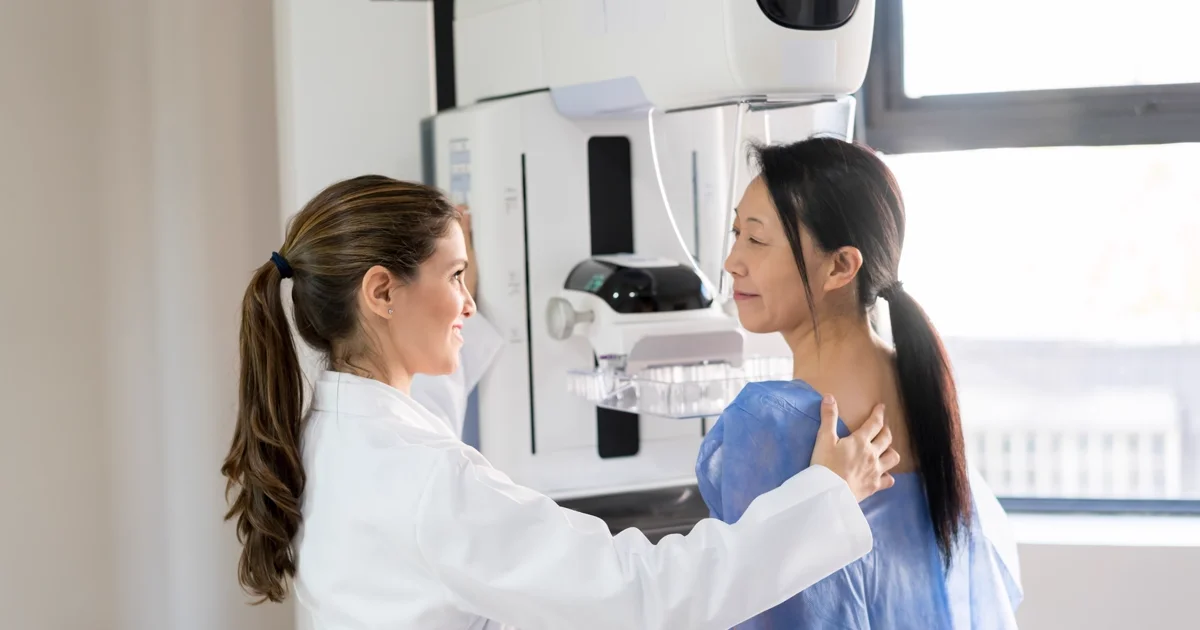
| 3. Positioning | The mammography technologist positions you in front of the mammography machine. One breast at a time is placed on a flat imaging plate (the detector). The technologist carefully adjusts your arm, shoulder, and body position to include as much breast tissue as possible in the image | 1-2 minutes per view |
| 4. Compression | A clear plastic paddle lowers onto the breast and applies firm, even pressure to spread the tissue into a thin, uniform layer. Compression lasts approximately 5 to 10 seconds per image. You may feel pressure or brief discomfort, but it should not be painful | 5-10 seconds per image |
| 5. Imaging | The X-ray is taken while you hold still and hold your breath for a moment. Two views of each breast are captured: a craniocaudal (CC) view from top to bottom and a mediolateral oblique (MLO) view from an angled side position. That means four images total for a standard screening mammogram | 1-2 seconds per exposure |
| 6. Review and release | The technologist reviews the images on screen to verify they are clear, well-positioned, and diagnostically acceptable. If any image is suboptimal, that specific view may be repeated. Once all images pass quality checks, you are free to change back into your clothes and leave | 2-3 minutes |
Overview of each step in a standard screening mammogram appointment at DCDC. Total appointment time is typically 15 to 20 minutes.
"We explain every step to our patients before we begin," says Dr. Osama Elzamzami, Head of Radiology at DCDC. "When a woman understands exactly what is happening and why, the compression feels more manageable and the entire experience becomes far less stressful. Communication between the technologist and the patient is the single most important factor in a positive mammogram experience."
A standard screening mammogram captures four images in total: a craniocaudal (CC) view and a mediolateral oblique (MLO) view of each breast. The CC view is taken from directly above, providing a clear view of the central and inner breast tissue. The MLO view is taken from an angled position, capturing the outer breast tissue and the axillary tail (the portion extending toward the armpit). Together, these two views provide comprehensive coverage from different angles, allowing the radiologist to pinpoint the exact location of any finding.
In women with breast implants, additional images called Eklund views (implant displacement views) are taken. The technologist gently pushes the implant back against the chest wall and pulls the native breast tissue forward so it can be compressed and imaged separately. This ensures the implant does not obscure the tissue. Women with implants should inform the reception team when booking so that additional time can be allocated.
What Does Breast Compression Feel Like?
Breast compression is the aspect of the mammogram procedure that women ask about most frequently, and it is also the part that is most often misrepresented. The reality is that compression causes a sensation of firm pressure and tightness that most women describe as uncomfortable but not painful. The discomfort is brief, lasting only 5 to 10 seconds per image, and it subsides immediately once the compression paddle is released.
Compression serves three essential diagnostic purposes. First, it spreads the overlapping layers of breast tissue apart so that small abnormalities such as masses or calcifications are not hidden behind normal tissue. Second, it creates a uniform thickness across the breast, which produces an even exposure and a sharper, clearer image. Third, it reduces the thickness of tissue that the X-ray beam must pass through, which lowers the radiation dose required to produce a diagnostic image. Without adequate compression, the mammogram images would be blurry, underexposed, and far less capable of detecting early cancers.
The degree of discomfort varies and is influenced by breast density, menstrual cycle timing, caffeine intake, individual pain tolerance, and anxiety level. Women who experience significant tenderness before their period will find compression more comfortable during the first half of their cycle. If you are concerned about discomfort, taking an over-the-counter pain reliever such as paracetamol or ibuprofen 30 to 60 minutes before your appointment can help. Communicate with your technologist throughout the procedure; she can adjust the compression speed and ensure you are as comfortable as possible.
"I always tell patients that the compression is the part that makes the mammogram effective," says Dr. Osama Elzamzami, Head of Radiology at DCDC. "Without proper compression, we simply cannot produce images that are clear enough to detect small tumors. But the good news is that it only lasts a few seconds, and the vast majority of our patients tell us it was much more manageable than they expected."
How Long Does a Mammogram Take?
A screening mammogram appointment at DCDC takes approximately 15 to 20 minutes from the moment you enter the imaging room to the moment you leave. The actual imaging time, meaning the time you spend standing at the mammography machine, is approximately 5 to 10 minutes. Each individual X-ray exposure lasts less than 2 seconds, and the compression for each image is held for approximately 5 to 10 seconds. The remaining time is spent on positioning, adjusting, and reviewing images.
Including check-in, paperwork, and changing time, the total clinic visit is typically 20 to 30 minutes. First-time patients should allow a few extra minutes for completing the health questionnaire. A diagnostic mammogram, which includes additional views for evaluating a specific concern, takes 30 to 45 minutes. For women having a mammogram combined with a breast ultrasound (common for dense breast tissue), the combined appointment also takes approximately 30 to 45 minutes.
Book Your Mammogram at DCDC
At Doctors Clinic Diagnostic Center in Dubai Healthcare City, our radiology team provides expert mammogram screening with advanced digital mammography. Get accurate results, personalized care, and a comfortable experience from an experienced all-female imaging team.
What Happens After the Mammogram?
After the imaging is complete and the technologist has confirmed that all images meet quality standards, you change back into your clothes and are free to leave the clinic. There is no recovery period, no lingering side effects, and no restrictions on your activities. You can return to work, exercise, and carry on with your normal routine immediately. Some women notice very mild breast tenderness for an hour or two after the compression, but this is uncommon and resolves on its own without any treatment.
Your mammogram images are reviewed by a consultant radiologist who examines each image systematically, looking for masses, calcifications (tiny calcium deposits that can indicate early-stage cancer), asymmetric density, and architectural distortion. The radiologist also compares your current images with any previous mammograms to identify changes over time.
At DCDC, mammogram results are typically available within 1 to 2 business days. The radiologist's report uses the standardized BI-RADS (Breast Imaging Reporting and Data System) classification, which assigns a score from 0 to 6 that communicates the findings clearly to your referring physician:
- BI-RADS 0: Additional imaging is needed before a final assessment can be made (such as additional mammogram views or an ultrasound)
- BI-RADS 1: Negative, meaning no abnormalities were found. Continue routine screening
- BI-RADS 2: Benign finding identified (such as a simple cyst or stable calcification). No cause for concern; continue routine screening
- BI-RADS 3: Probably benign finding with a less than 2% chance of malignancy. Short-interval follow-up mammogram recommended in 6 months
- BI-RADS 4: Suspicious abnormality. A biopsy is recommended to determine whether the finding is benign or malignant
- BI-RADS 5: Highly suggestive of malignancy. Biopsy is strongly recommended
- BI-RADS 6: Known biopsy-proven malignancy. Used when a woman with a confirmed breast cancer undergoes imaging to monitor treatment response
Receiving a callback for additional imaging (BI-RADS 0) is common and does not mean cancer has been found. Approximately 10% of screening mammograms result in a callback, and the vast majority lead to benign findings. A callback simply means the radiologist needs a clearer view of a specific area.
Patient Story: A First-Time Mammogram Experience
A 42-year-old Dubai resident had been delaying her first mammogram for over two years due to anxiety about compression and fear of potential findings. Her gynecologist had recommended annual screening starting at age 40, but the unknown kept her from scheduling. When she finally booked at DCDC, the mammography technologist recognized her nervousness and walked her through the entire process before beginning. She explained the purpose of each image, demonstrated the compression paddle, and reassured her that compression would be applied gradually. The imaging session took just under 10 minutes. Afterward, the patient described the compression as "firm but completely manageable" and said her biggest regret was waiting so long.
"Her results came back as BI-RADS 1, completely normal," says Dr. Osama Elzamzami, Head of Radiology at DCDC. "But the most important outcome was that she left with a positive experience and has already booked her next annual screening. Fear of the mammogram procedure is one of the most common reasons women delay screening, and the best way to overcome that fear is to understand exactly what happens and to have a technologist who communicates well."
Diagnostic vs Screening Mammogram: Procedure Differences
A screening mammogram and a diagnostic mammogram use the same technology but differ in purpose, the number of images taken, radiologist involvement, and time required. A screening mammogram is a routine examination for women with no breast symptoms. Its purpose is early detection: finding breast cancer before it causes symptoms. A standard screening mammogram consists of four images (two per breast), takes 15 to 20 minutes, and results are communicated within 1 to 2 business days.
A diagnostic mammogram is performed when there is a specific clinical concern, such as a palpable lump, breast pain, nipple discharge, skin thickening, an abnormality found on a previous screening mammogram, or a personal history of breast cancer. A diagnostic mammogram includes the standard four views plus additional targeted views of the area of concern. These additional views may include:
- Spot compression views: A smaller paddle applies focused compression to a specific area, spreading the tissue and providing a magnified, sharper image of the region of interest
- Magnification views: The breast is positioned closer to the X-ray source and further from the detector, producing an enlarged image that reveals fine details of calcifications or mass margins
- Rolled views: The breast tissue is gently rolled in different directions to separate overlapping structures and determine whether an apparent finding is a true lesion or simply superimposed normal tissue
- Exaggerated CC views: The breast is positioned to include tissue that may have been excluded from the standard CC view, particularly far lateral or far medial tissue
During a diagnostic mammogram, the radiologist is often present or reviews images in real time, directing the technologist to capture additional views as needed. The patient can sometimes receive preliminary feedback before leaving. A diagnostic mammogram is frequently followed by a targeted breast ultrasound if findings require further characterization. In summary, a screening mammogram is a standardized exam (four images, results in 1-2 days), while a diagnostic mammogram is a customized exam tailored to the patient's concern (variable images, radiologist directing the exam, results often same day). Both use the same compression technique and mammography machine.
The Mammogram Experience at DCDC
DCDC (Doctors Clinic Diagnostic Center) in Dubai Healthcare City is a JCI-accredited diagnostic imaging facility that provides mammogram screening and diagnostic breast imaging services using advanced digital mammography technology. The center's approach to mammography prioritizes both diagnostic accuracy and patient comfort, recognizing that a positive screening experience is essential for encouraging women to return for their annual mammograms year after year.
The center uses full-field digital mammography (FFDM) equipment that produces high-resolution images with excellent contrast, particularly in dense breast tissue. Digital images can be electronically adjusted for brightness and contrast after capture, and transmitted to your referring physician electronically. All mammograms are interpreted by consultant radiologists with extensive experience in breast imaging, using the BI-RADS classification system and correlating findings with each patient's clinical history. The mammography technologists are trained in positioning techniques that maximize tissue inclusion and minimize the need for repeat images.
The mammography suite is designed with patient comfort in mind. Private changing areas, warm imaging rooms, and a dedicated female technologist team create an environment where women feel respected and at ease. The technologists communicate clearly throughout the procedure, explaining each step before it happens and checking in with the patient regarding comfort during compression.
Location and Booking
DCDC is located in Dubai Healthcare City, easily accessible from Oud Metha, Karama, Bur Dubai, and Downtown Dubai. Mammogram appointments can be booked by phone, WhatsApp, or through the online booking form. With over 13 years of operation and a reputation for accurate, timely diagnostic imaging, DCDC is a trusted choice for mammogram screening in Dubai.
Schedule Your Annual Mammogram
Early detection saves lives. Book your mammogram screening at DCDC in Dubai Healthcare City and take a proactive step toward your breast health. Our experienced all-female imaging team ensures a comfortable, professional experience.
Or call us at +971 4 435 9999
Часто задаваемые вопросы
Final Thoughts
A mammogram is one of the most important preventive health screenings a woman can undergo, and understanding the procedure step by step transforms it from an intimidating unknown into a straightforward, manageable appointment. The entire process, from check-in through imaging and departure, takes 15 to 20 minutes. Compression lasts only seconds per image and is the essential factor that makes mammogram images diagnostically accurate. Results are available within 1 to 2 business days, giving you and your doctor the information needed to stay ahead of any potential concerns.
At Doctors Clinic Diagnostic Center in Dubai Healthcare City, mammogram screening is performed with advanced digital mammography technology, interpreted by experienced consultant radiologists, and delivered in a patient-centered environment designed to make women feel comfortable and confident. If you are due for your annual mammogram, or if you have never had one and are past the recommended starting age of 40, booking your screening is one of the most impactful decisions you can make for your long-term health. For more information about breast health, explore our guides on what a mammogram is and how to prepare for your mammogram.
Источники и ссылки
Эта статья проверена нашей медицинской командой и ссылается на следующие источники:
- American Cancer Society - Mammogram Basics
- American College of Radiology - Mammography
- RadiologyInfo.org - Mammography
- World Health Organization - Breast Cancer Screening
Медицинский контент на этом сайте проверяется врачами, лицензированными DHA. См. нашу редакционную политику для получения дополнительной информации.

Автор
Dr. Osama Elzamzami
Diagnostic Radiology
MD, FRCR
Dr. Osama Elzamzami is the Head of Radiology at DCDC, specializing in diagnostic imaging including mammography, CT, MRI, and ultrasound at Dubai Healthcare City.