मुख्य बातें
- Swimmer's shoulder affects 40-90% of competitive swimmers at some point in their career, making it the most common swimming injury
- The condition is primarily caused by subacromial impingement from repetitive overhead movement, not acute trauma
- Rotator cuff weakness and scapular dyskinesis (poor shoulder blade movement) are the two most treatable causes
- Stroke technique errors, particularly hand entry position and body rotation, significantly contribute to shoulder load
- A structured dryland exercise programme of 15-20 minutes, 3 times per week, can prevent most cases of swimmer's shoulder
- Recovery typically takes 4-12 weeks with physiotherapy, but training volume modification is essential during treatment
- Complete rest from swimming is rarely necessary; reducing volume and modifying strokes is usually sufficient
You love swimming. It keeps you fit, it is low-impact, and in Dubai it is one of the few sports you can do comfortably year-round. But now your shoulder aches during freestyle, the pain lingers after sessions, and reaching overhead has become uncomfortable. Swimmer's shoulder is the most common injury in the sport, and if left untreated, it can end your swimming career. Our Physiotherapy service at DCDC offers same-day appointments in Dubai Healthcare City.
This guide explains the anatomy behind swimmer's shoulder, helps you understand whether your problem is rotator cuff tendinopathy or subacromial impingement, covers the physiotherapy treatment approach, provides dryland exercises for prevention, and gives clear guidance on modifying your training volume during recovery. It is written for recreational and competitive swimmers in Dubai who want to return to pain-free swimming.



What Is Swimmer's Shoulder and Why Does It Happen?
Swimmer's shoulder is an umbrella term for shoulder pain caused by swimming, most commonly involving subacromial impingement, rotator cuff tendinopathy, or a combination of both. It develops because competitive swimmers perform 1-2 million arm strokes per year, each involving the shoulder moving through a large range of motion under load. The repetitive overhead movement creates cumulative microtrauma to the structures that pass through the subacromial space.
The shoulder is inherently a compromise between mobility and stability. It is the most mobile joint in the body, which allows the range needed for swimming strokes, but this mobility comes at the cost of skeletal stability. The rotator cuff muscles (supraspinatus, infraspinatus, teres minor, subscapularis) and the scapular stabilisers must work continuously to keep the humeral head centred in its socket during swimming. When these muscles fatigue or weaken, impingement occurs.
Is Your Problem Rotator Cuff Tendinopathy or Impingement?
While these conditions often coexist, understanding the distinction helps guide treatment priorities. A clinical assessment by a physiotherapist can differentiate between them, though imaging may be needed for persistent or severe cases.
| Feature | Rotator Cuff Tendinopathy | Subacromial Impingement |
|---|---|---|
| Primary issue | Degenerative changes within the tendon itself | Mechanical pinching of structures in the subacromial space |
| Pain location | Lateral shoulder, may radiate to upper arm | Top/front of shoulder, painful arc between 60-120 degrees |
| Pain pattern | Gradual onset, worsens with load | Sharp pain at specific arm positions, especially overhead |
| Night pain | Common, especially lying on affected side | Less common unless severe |
| Weakness | Progressive weakness in rotation | Pain-limited weakness, true strength may be preserved |
| Key treatment | Progressive loading (eccentric and isometric exercises) | Scapular repositioning, posture correction, manual therapy |
| Recovery time | 8-12 weeks | 4-8 weeks |
Distinguishing rotator cuff tendinopathy from subacromial impingement in swimmers
How Does Swimming Stroke Technique Contribute to Shoulder Pain?
Stroke technique errors are a major contributor to swimmer's shoulder, and correcting them is often as important as rehabilitation exercises. A small technique fault repeated millions of times creates enormous cumulative stress. The following are the most common biomechanical issues identified in swimmers with shoulder pain. For related information, see our guide on Rotator Cuff Exercises: Non-Surgical Treatment.
- Hand entry crossing midline: When the hand enters the water past the centre of the head, the shoulder is forced into internal rotation and adduction, narrowing the subacromial space and increasing impingement risk. The hand should enter in line with the shoulder
- Insufficient body rotation: Poor trunk rotation forces the shoulder to reach further forward and higher, increasing impingement. Aim for 45-60 degrees of rotation to each side during freestyle
- Thumb-first hand entry: Entering with the thumb down internally rotates the shoulder at the point of maximum reach, when the subacromial space is already narrowed. Enter with a flat hand or fingertips first
- Dropped elbow during catch: A straight-arm pull increases the lever arm and load on the shoulder compared to a high-elbow catch. The early vertical forearm (EVF) technique is more shoulder-friendly
- Breathing pattern: Always breathing to one side creates asymmetric shoulder loading. Bilateral breathing (every 3 or 5 strokes) distributes stress more evenly
What Does Physiotherapy Treatment for Swimmer's Shoulder Include?
Physiotherapy for swimmer's shoulder follows a phased approach that addresses pain, restores rotator cuff and scapular function, corrects contributing factors, and progressively returns the swimmer to full training volume. Treatment at our sports rehabilitation clinic typically follows this structure.
| Phase | Duration | Goals | Key Interventions |
|---|---|---|---|
| Phase 1: Pain Management | Weeks 1-2 | Reduce pain and inflammation, maintain fitness | Activity modification, manual therapy, ice, isometric rotator cuff exercises, kick-only swimming |
| Phase 2: Restoration | Weeks 3-6 | Restore rotator cuff strength, scapular control | Progressive external rotation, scapular stabilisation exercises, wall slides, band work |
| Phase 3: Loading | Weeks 6-10 | Build strength endurance, begin stroke modification | Eccentric exercises, prone swimming patterns, modified swimming with technique focus |
| Phase 4: Return to Swimming | Weeks 10-12+ | Full swimming volume with maintained prevention programme | Progressive volume increase (25% per week), technique drills, ongoing dryland maintenance |
Phased physiotherapy approach for swimmer's shoulder rehabilitation
What Dryland Exercises Prevent Swimmer's Shoulder?
Prevention is far more effective than treatment for swimmer's shoulder. The following dryland programme takes 15-20 minutes and should be performed 3 times per week (or as a pre-swim warm-up in abbreviated form). It targets the specific muscle groups that protect the shoulder during swimming.
Rotator Cuff Strengthening
- Sidelying external rotation: 3 sets of 15 reps per side with a light dumbbell (1-3kg). Strengthens infraspinatus and teres minor, the primary external rotators
- Prone Y-T-W raises: 3 sets of 10 in each position. Activates the lower trapezius and rotator cuff in an overhead-relevant position
- Band pull-aparts: 3 sets of 15. Strengthens posterior shoulder and scapular retractors, counterbalancing the internal rotation dominance from swimming
Scapular Stabilisation
- Wall slides: 3 sets of 10. Trains the serratus anterior and lower trapezius to upwardly rotate the scapula, creating space in the subacromial area
- Push-up plus: 3 sets of 10. The "plus" (protraction at the top of the push-up) specifically activates serratus anterior, the key scapular stabiliser for swimmers
- Low row with band: 3 sets of 15. Strengthens middle trapezius and rhomboids, correcting the forward-shoulder posture common in swimmers
Core and Thoracic Mobility
- Thoracic spine rotation: 3 sets of 10 per side (open book or thread-the-needle). Adequate thoracic rotation is essential for body roll and reduces compensatory shoulder stress
- Side plank: 3 sets of 30 seconds per side. Core stability supports body rotation mechanics in the water
- Lat stretch: 3 sets of 30 seconds per side. Tight latissimus dorsi restricts overhead movement and contributes to impingement
How Should You Modify Training Volume During Recovery?
Complete rest from swimming is rarely necessary and often counterproductive. Instead, training volume and intensity should be modified systematically to keep you in the water while the shoulder heals. The key principle is to stay below the pain threshold: swimming should not increase your pain above 2-3 out of 10. You may also find our Physiotherapy After Car Accident Dubai helpful.
- Reduce total volume by 40-60%: If you normally swim 4,000m per session, reduce to 1,600-2,400m initially
- Eliminate painful strokes: Butterfly and backstroke are typically the most aggravating. Switch to freestyle and breaststroke, or use a pull buoy to change loading
- Increase kick work: Kick sets maintain cardiovascular fitness without shoulder loading. Use a kickboard or streamline position
- Reduce paddle use: Paddles increase shoulder torque by 20-30%. Eliminate them during recovery and reintroduce gradually in Phase 4
- Modify sets: Replace high-intensity sprint sets with technique-focused drilling at moderate pace
- Gradual return: Increase swimming volume by no more than 25% per week as symptoms allow. Rushing volume increases is the primary cause of relapse
Shoulder Pain Affecting Your Swimming?
Book a swimming-specific shoulder assessment at DCDC Dubai Healthcare City. Our physiotherapy team will identify the cause, build your recovery programme, and work with you on stroke modifications. Learn more about our physiotherapy services.
When Should Swimmers Seek Imaging or Specialist Referral?
Most cases of swimmer's shoulder respond well to physiotherapy without imaging. However, certain situations warrant further investigation through MRI or orthopedic consultation.
- Pain that has not improved after 6-8 weeks of structured physiotherapy
- Significant weakness that does not respond to rehabilitation (possible rotator cuff tear)
- Catching, clicking, or locking sensations suggesting a labral tear
- History of shoulder dislocation or subluxation
- Night pain that consistently disrupts sleep despite treatment
- Symptoms in swimmers under 18 where growth plate issues should be excluded
DCDC में संबंधित सेवाएं
दुबई हेल्थकेयर सिटी में विशेषज्ञ देखभाल और उन्नत निदान
Physiotherapy
Evidence-based physiotherapy for shoulder pain and swimming injuries
अपॉइंटमेंट बुक करेंSports Rehabilitation
Sport-specific rehabilitation programmes for competitive swimmers
अपॉइंटमेंट बुक करेंOrthopedic Consultation
Specialist assessment for persistent shoulder pain and structural issues
अपॉइंटमेंट बुक करेंFrequently Asked Questions
Swimming Pain-Free: The Long-Term Approach
Swimmer's shoulder is overwhelmingly a preventable and treatable condition. The swimmers who avoid chronic shoulder problems are those who invest in rotator cuff and scapular strengthening, pay attention to stroke technique, and respond to early warning signs rather than training through pain.
If you are currently dealing with swimming shoulder pain, the best investment you can make is a physiotherapy assessment to identify the specific causes and build a rehabilitation plan. Combined with stroke technique review and a maintenance dryland programme, most swimmers return to full training within 8-12 weeks and stay pain-free long-term.
स्रोत एवं संदर्भ
यह लेख हमारी चिकित्सा टीम द्वारा समीक्षित है और निम्नलिखित स्रोतों का संदर्भ देता है:
- British Journal of Sports Medicine - Swimmer's shoulder prevalence and risk factors
- Clinical Journal of Sport Medicine - Subacromial impingement in overhead athletes
- Journal of Orthopaedic & Sports Physical Therapy - Rotator cuff rehabilitation protocols
- American Journal of Sports Medicine - Swimming biomechanics and shoulder injury
- FINA (World Aquatics) - Athlete health and injury prevention
- Dubai Health Authority - Physiotherapy practice guidelines
इस साइट पर चिकित्सा सामग्री DHA-लाइसेंस प्राप्त चिकित्सकों द्वारा समीक्षित है। हमारी देखें संपादकीय नीति अधिक जानकारी के लिए।

लेखक
Dr. Hadi Komshi
Specialist Internal Medicine
MD, DHA-Licensed
Dr. Hadi Komshi is a DHA-licensed Internal Medicine Specialist at Doctors Clinic Diagnostic Center in Dubai Healthcare City, with extensive experience in managing acute and chronic medical conditions including musculoskeletal pain and rehabilitation.
Related Articles
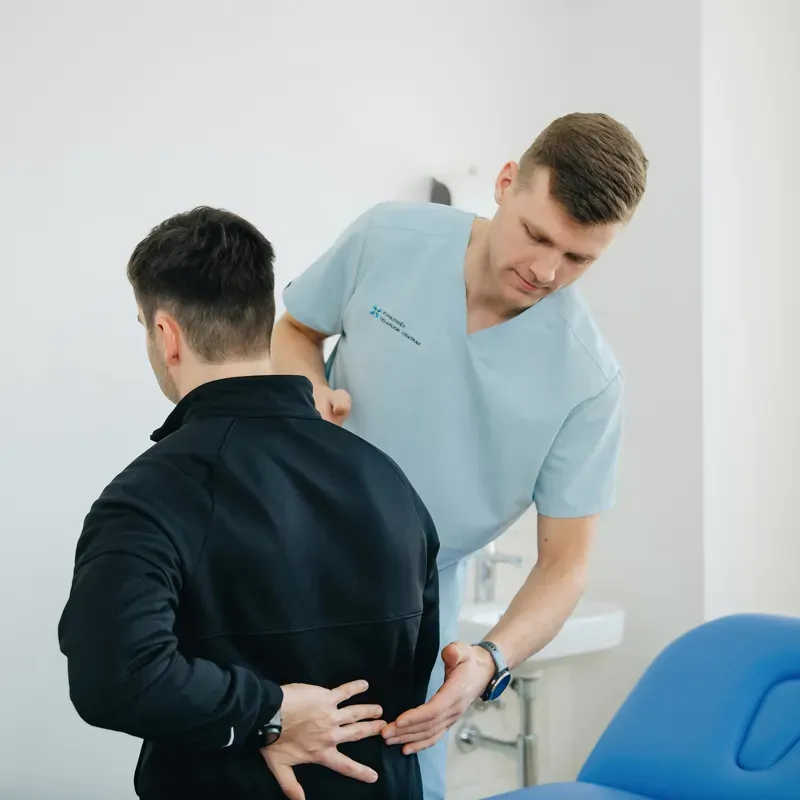
Complete Guide to Physiotherapy in Dubai: Types, Costs & What to Expect

Rotator Cuff Exercises: Physiotherapy Recovery Guide

Sports Physiotherapy in Dubai: Complete Guide
Frozen Shoulder Treatment: A Physiotherapy Approach
More in Physiotherapy
Physiotherapy Packages Dubai: Save 20%+ (2026)
और पढ़ें
Shoulder Pain Dubai: 7 Causes & When to Worry (2026)
और पढ़ें
PRP vs Cortisone Dubai: Which Injection? (2026)
और पढ़ें
PRP Injection for Joints Dubai: From AED 1,500 (2026)
और पढ़ेंPhysiotherapy Cost Dubai: AED 250–500/Session (2026)
और पढ़ेंPhysiotherapy Dubai: Types, Cost & Guide (2026)
और पढ़ें© 2026 Doctors Clinic Diagnostic Center (DCDC), Dubai Healthcare City. Originally published at https://doctorsclinicdubai.ae/blog/swimming-shoulder-injury-physiotherapy. All rights reserved. Unauthorized reproduction is prohibited.