Points cles
- An OPG captures all four wisdom teeth, both jaws, and surrounding structures in a single panoramic image, making it the standard first-line scan for wisdom tooth assessment
- The scan reveals the type of impaction - mesioangular, distoangular, horizontal, or vertical - which directly determines extraction difficulty and surgical approach
- OPG shows the proximity of lower wisdom tooth roots to the inferior alveolar nerve canal, a critical factor in predicting the risk of nerve injury during extraction
- Radiologists use the OPG to identify pathology associated with impacted wisdom teeth, including cysts, bone resorption, and damage to adjacent second molars
- When the OPG shows root-canal superimposition or other high-risk signs, a follow-up CBCT scan provides the three-dimensional detail needed for safe surgical planning
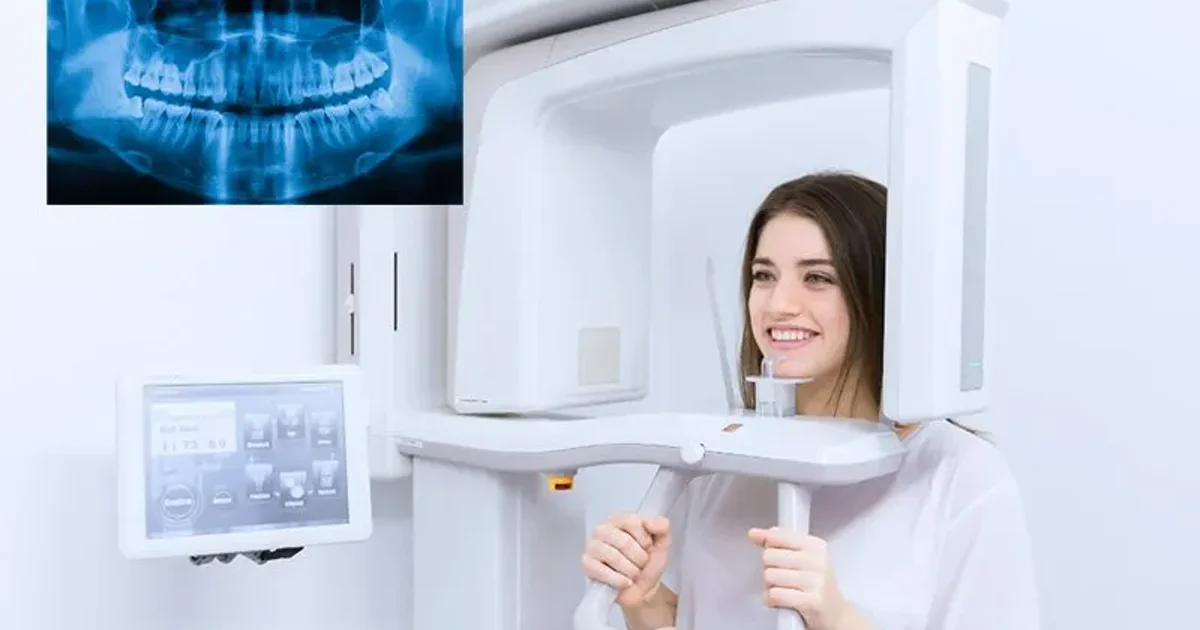
The OPG X-ray (orthopantomogram) is the standard imaging study that dentists and oral surgeons use to evaluate wisdom teeth before deciding whether extraction is necessary. A single panoramic scan lasting under 20 seconds captures all four third molars, the surrounding jawbone, the inferior alveolar nerve canal, and adjacent teeth in one image - providing every piece of information needed for an initial wisdom tooth assessment without placing sensors inside the mouth.
This article explains exactly what an OPG reveals about wisdom teeth, how radiologists classify impaction types, which signs on the scan indicate that removal is needed, and when a CBCT follow-up is required for safe surgical planning. Every section is reviewed by Dr. Osama Elzamzami, Consultant Radiologist at DCDC Dubai Healthcare City.
Why OPG Is the Go-To Scan for Wisdom Teeth
The OPG is the go-to scan for wisdom teeth because it is the only single-image dental X-ray that shows all four third molars, both jaws, the inferior alveolar nerve canals, and the maxillary sinuses simultaneously. No other routine dental imaging study provides this breadth of anatomical coverage in one exposure. Intraoral periapical X-rays, by comparison, capture only two to three teeth per film and cannot show the full length of an impacted wisdom tooth that lies deep within the ramus of the mandible.
For oral surgeons and general dentists, the panoramic view answers three fundamental questions at a glance: Are the wisdom teeth present? Are they impacted? And are they causing or likely to cause problems? The OPG answers all three without any patient discomfort, special preparation, or contrast injection. The scan takes under 20 seconds, uses a very low radiation dose (approximately 10 to 20 microsieverts), and produces a digital image that is available for interpretation within seconds.
International guidelines from the American Association of Oral and Maxillofacial Surgeons (AAOMS) and the Faculty of Dental Surgery of the Royal College of Surgeons of England both recommend the OPG as the first-line imaging modality for third molar assessment. The panoramic radiograph provides sufficient information for the majority of wisdom tooth evaluations, with three-dimensional imaging reserved for cases where the OPG suggests a close relationship between the tooth roots and the nerve canal.
"The OPG is where every wisdom tooth conversation starts," says Dr. Osama Elzamzami, Consultant Radiologist at DCDC. "It gives us the complete picture - the angulation of the tooth, the depth of impaction, the relationship to the nerve, and whether there is any associated pathology. In about 80 percent of cases, the OPG alone provides all the information the surgeon needs to plan the extraction safely."
What OPG Shows About Your Wisdom Teeth
An OPG reveals a comprehensive set of anatomical and pathological details about each wisdom tooth that together form the basis of the clinical decision to extract or monitor. Understanding what the scan shows helps patients appreciate why their dentist or surgeon may recommend a particular course of action.
The key findings visible on an OPG wisdom tooth assessment include:
- Presence or absence of wisdom teeth: The OPG confirms whether all four third molars are present, whether any are congenitally missing (agenesis), or whether supernumerary (extra) teeth exist in the third molar region. Approximately 5 to 37 percent of people are missing one or more wisdom teeth.
- Stage of root development: In younger patients (ages 16 to 25), the OPG shows whether the wisdom tooth roots are still forming or have reached full maturity. Teeth with incomplete root formation are generally easier and safer to extract because the roots are shorter and the surrounding bone is less dense.
- Angulation and direction of eruption: The scan clearly shows whether each wisdom tooth is growing vertically (upright), tilted toward the adjacent molar (mesioangular), tilted away from the adjacent molar (distoangular), or lying completely on its side (horizontal). Angulation is the single most important factor in classifying impaction type.
- Depth of impaction: The OPG reveals how deep the wisdom tooth sits relative to the occlusal plane (biting surface) of the second molar. Teeth that are partially erupted through the gum carry a high risk of infection, while deeply impacted teeth that are fully covered by bone require a more involved surgical approach.
- Relationship to the inferior alveolar nerve canal: In the lower jaw, the OPG shows the mandibular canal - the bony tunnel that houses the inferior alveolar nerve - and its proximity to the wisdom tooth roots. When the roots appear to touch, overlap, or cross the canal on the OPG, the risk of nerve injury during extraction increases and further imaging may be needed.
- Relationship to the maxillary sinus: For upper wisdom teeth, the OPG shows how close the roots are to the floor of the maxillary sinus. If the roots project into the sinus, the surgeon must take precautions to avoid creating an oroantral communication (a hole between the mouth and the sinus) during extraction.
- Condition of the adjacent second molar: The OPG reveals whether the impacted wisdom tooth is causing resorption (erosion) of the second molar root, a cavity on the back surface of the second molar, or bone loss between the two teeth. These findings often tip the decision toward extraction to protect the adjacent tooth.
- Associated pathology: The scan identifies cysts (particularly dentigerous cysts that form around the crown of an unerupted tooth), tumors, and infections in the bone surrounding the wisdom tooth. Any radiolucent (dark) area larger than a normal dental follicle around an unerupted tooth warrants further investigation.
Taken together, these findings allow the oral surgeon to classify the impaction, estimate surgical difficulty, predict potential complications, and choose the safest extraction technique - all from a single painless scan.
Types of Wisdom Tooth Impaction on OPG
Wisdom tooth impaction is classified based on the angulation of the tooth relative to the long axis of the adjacent second molar. The OPG is the primary imaging tool used to determine impaction type because it shows the full length and orientation of the third molar in relation to the surrounding anatomy. The four recognized impaction types, each with distinct OPG characteristics and surgical implications, are described below.
Mesioangular Impaction
Mesioangular impaction is the most common type, accounting for approximately 40 to 45 percent of all impacted lower wisdom teeth. On the OPG, the tooth appears tilted forward toward the second molar, with its crown pointing mesially (toward the front of the mouth). The crown often presses against the distal root or crown of the second molar. Mesioangular impactions are generally considered the easiest to extract surgically because the path of removal follows the natural direction of the tilt.
Vertical Impaction
Vertical impaction is the second most common type. On the OPG, the wisdom tooth appears upright and parallel to the adjacent second molar but has failed to erupt fully through the gum. The tooth is in the correct orientation for eruption but is blocked by insufficient space in the jaw or by the second molar itself. Vertical impactions sometimes erupt on their own over time, particularly in patients under 25, so monitoring with serial OPGs may be recommended before deciding on extraction.
Horizontal Impaction
Horizontal impaction is less common but is the most surgically challenging type. On the OPG, the wisdom tooth lies completely on its side, with its long axis perpendicular to the second molar. The crown typically points directly into the roots of the adjacent tooth. Horizontal impactions frequently cause resorption of the second molar root and are almost always recommended for extraction. Surgical removal requires bone removal and often sectioning (cutting) the tooth into pieces for delivery.
Distoangular Impaction
Distoangular impaction is the least common type but is considered the most difficult to extract in the lower jaw. On the OPG, the tooth is tilted backward (distally), with its crown pointing toward the ramus (the vertical part of the jawbone behind the molars). Because the path of removal is against the natural tilt of the tooth and toward the dense bone of the ramus, extraction often requires significant bone removal and careful surgical technique.
| Wisdom Tooth Position | OPG Appearance | Frequency | Extraction Difficulty | Key OPG Finding |
|---|---|---|---|---|
| Mesioangular | Tilted forward toward second molar | 40-45% | Moderate | Crown pressing on distal surface of second molar; assess for caries on adjacent tooth |
| Vertical | Upright but unerupted or partially erupted | 25-30% | Moderate to difficult | Tooth in correct axis but blocked; check follicle size for cyst development |
| Horizontal | Lying on its side, perpendicular to second molar | 10-15% | Difficult | Crown directed into second molar roots; assess for root resorption |
| Distoangular | Tilted backward toward ramus | 5-10% | Most difficult (lower jaw) | Crown pointing into ramus; limited access for extraction path |
| Buccal/Lingual (transverse) | Tooth displaced toward cheek or tongue | Rare | Variable | OPG may underestimate displacement; CBCT often needed |
Classification of wisdom tooth impaction types based on OPG findings. Mesioangular impaction is the most common, while distoangular is the most surgically challenging in the mandible.
In addition to angulation, oral surgeons use the OPG to classify the depth of impaction using the Pell and Gregory classification, which grades the tooth based on its vertical position relative to the second molar (Class A, B, or C) and the space available between the second molar and the ramus (Class I, II, or III). Together, the angulation and depth classification predict the surgical difficulty and guide the choice of extraction technique.
OPG Signs That Wisdom Teeth Need Removal
Not every impacted wisdom tooth needs to be removed. Many asymptomatic, fully impacted third molars can be safely monitored with periodic OPG imaging. However, there are specific radiographic signs on the OPG that indicate extraction is necessary to prevent complications or protect adjacent teeth. Radiologists and oral surgeons look for the following findings when deciding whether wisdom teeth should be removed.
- Pericoronitis (recurrent infection): When the OPG shows a partially erupted wisdom tooth with a pocket of space between the crown and the overlying gum, this is a setup for pericoronitis - a painful infection of the soft tissue around the tooth. Patients who have experienced two or more episodes of pericoronitis are typically advised to have the tooth extracted.
- Caries on the wisdom tooth or second molar: The OPG may reveal a cavity on the wisdom tooth itself or, more critically, on the distal surface of the adjacent second molar caused by food trapping between the two teeth. Removing the wisdom tooth eliminates the trap and prevents further decay of the more valuable second molar.
- Root resorption of the second molar: When the crown of a horizontally or mesioangularly impacted wisdom tooth presses against the root of the second molar, it can cause external root resorption visible on the OPG as a blunting or irregularity of the second molar root. This is a serious finding that warrants prompt extraction.
- Dentigerous cyst formation: A dentigerous cyst develops from the dental follicle surrounding the crown of an unerupted tooth. On the OPG, it appears as a well-defined dark (radiolucent) area surrounding the crown that is larger than 2.5 millimeters. If left untreated, the cyst can expand, weaken the jawbone, and damage adjacent teeth.
- Bone loss (periodontal defect): The OPG may show vertical or angular bone loss on the distal surface of the second molar caused by the adjacent impacted wisdom tooth. This periodontal defect can compromise the long-term prognosis of the second molar if the wisdom tooth is not removed.
- Orthodontic interference: In patients undergoing or planning orthodontic treatment, the OPG may show wisdom teeth that are likely to interfere with tooth alignment or cause relapse after braces are removed. Extraction before or during orthodontic treatment is often recommended in these cases.
- Pathologic widening of the follicular space: Even without a fully developed cyst, an enlarged follicular space (greater than 3 to 4 millimeters) around an unerupted wisdom tooth on the OPG is considered abnormal and may warrant extraction or biopsy to rule out early cystic or neoplastic change.
A 22-year-old patient visited DCDC complaining of recurring swelling and pain behind the lower left molars. The clinical examination showed partially erupted soft tissue, but the full extent of the problem was not visible in the mouth. An OPG scan immediately revealed a mesioangularly impacted lower left wisdom tooth with a large radiolucent area around its crown consistent with a dentigerous cyst, and early root resorption of the adjacent second molar. "The OPG changed the urgency of this case entirely," explains Dr. Osama Elzamzami. "What looked like simple pericoronitis clinically turned out to be a cyst that had already started damaging the neighboring tooth. The patient was referred for extraction within the week, and the second molar was saved."
OPG Wisdom Teeth Assessment at DCDC Dubai
Get a digital OPG scan for wisdom tooth evaluation at Doctors Clinic Diagnostic Center in Dubai Healthcare City. Same-day radiologist reporting. Walk-ins welcome.
No referral required for self-pay patients
Limitations of OPG for Wisdom Teeth
While the OPG is an indispensable screening tool, it has inherent limitations that clinicians must account for when planning wisdom tooth extractions. Understanding these limitations helps patients appreciate why their surgeon may recommend additional imaging in certain situations.
- Two-dimensional image of a three-dimensional structure: The OPG compresses all anatomical layers into a single flat image. This means that structures in front of and behind the wisdom tooth are superimposed on one another, making it impossible to determine the exact buccal-lingual (cheek-to-tongue) relationship between the tooth roots and the nerve canal.
- Magnification and distortion: OPG images are magnified by approximately 20 to 30 percent compared to actual anatomy, and the degree of magnification varies across different regions of the image. Measurements taken directly from the OPG (such as root length or distance to the nerve) are approximations, not precise values.
- Superimposition of the nerve canal on roots: When the inferior alveolar nerve canal appears to overlap or cross through the wisdom tooth roots on the OPG, this does not necessarily mean the nerve is in direct contact with the tooth. The canal may pass in front of, behind, or between the roots in three-dimensional space. The OPG cannot distinguish these relationships.
- Limited soft tissue detail: The OPG shows bone and teeth well but provides minimal information about soft tissue structures. Conditions such as soft tissue swelling, abscess extent, or the relationship of the lingual nerve to the wisdom tooth cannot be assessed on the OPG.
- Ghost images and artifacts: The tomographic technique can produce ghost images (faint duplicates of dense structures such as the opposite jaw or the cervical spine) that may overlap with the area of interest and obscure details. Metal restorations, earrings, or piercings that are not removed before the scan also create streak artifacts.
Despite these limitations, the OPG remains the recommended first-line imaging study for wisdom teeth because it provides the best balance of diagnostic information, patient comfort, radiation dose, and cost. The limitations become clinically significant only in a subset of cases where the OPG suggests a high-risk relationship between the tooth and the nerve, and in these cases, a CBCT scan resolves the ambiguity.
When CBCT Is Needed After OPG
A CBCT scan (cone-beam computed tomography) is a three-dimensional imaging study that produces cross-sectional and volumetric images of the jaws, providing the spatial detail that the two-dimensional OPG cannot. CBCT is not needed for every wisdom tooth case, but there are specific OPG findings that trigger the recommendation for a follow-up CBCT before extraction.
The recognized radiographic signs on OPG that indicate the need for CBCT include:
- Darkening of the root at the canal crossing: When the wisdom tooth root becomes noticeably darker (more radiolucent) where it overlaps the inferior alveolar canal on the OPG, this suggests the canal may be grooving into or passing through the root. CBCT confirms the exact relationship.
- Interruption or narrowing of the white canal line: The inferior alveolar canal appears as two parallel white (radiopaque) lines on the OPG. If these lines disappear, narrow, or deviate where they meet the wisdom tooth, it suggests direct contact between the tooth and the nerve. This is one of the most reliable OPG predictors of nerve proximity.
- Deflection of the root: If the wisdom tooth root appears to bend or deflect where it meets the canal, this may indicate the root has grown around the nerve. CBCT shows whether the canal passes through a groove in the root, between bifurcated roots, or alongside the root.
- Narrowing of the canal: The canal may appear compressed or constricted at the level of the wisdom tooth on the OPG, suggesting the tooth is physically displacing the nerve. CBCT quantifies the degree of compression and shows the direction of displacement.
- Diversion of the canal: If the canal changes course (deviates inferiorly or buccally) at the level of the wisdom tooth, this is a strong indicator of an intimate relationship between the tooth and the nerve that warrants three-dimensional assessment.
- Superimposition of the root apex on the canal: When the tip of the wisdom tooth root sits directly on or within the canal outline on the OPG, the two-dimensional image cannot determine whether the nerve passes buccal to, lingual to, or directly through the root. CBCT resolves this critical question.
When one or more of these signs are present on the OPG, the CBCT scan provides cross-sectional images that show exactly where the nerve canal sits in relation to the wisdom tooth roots - information that the surgeon uses to modify the extraction technique, choose an alternative approach (such as coronectomy instead of full extraction), or counsel the patient about the specific risk of temporary or permanent nerve numbness.
"I always tell patients that the OPG is the screening test and the CBCT is the confirmation test," says Dr. Osama Elzamzami. "If the OPG shows a clear separation between the wisdom tooth and the nerve canal, there is no need for CBCT - the surgeon can proceed with confidence. But when the OPG raises a red flag, the CBCT gives us the three-dimensional road map that makes the surgery safer. At DCDC, we can do both scans on the same visit, so there is no delay in getting the full picture."
Wisdom Teeth Assessment at DCDC Dubai
Doctors Clinic Diagnostic Center (DCDC) in Dubai Healthcare City offers complete wisdom tooth imaging assessment, from initial OPG screening to CBCT follow-up when needed, with same-day consultant radiologist reporting and seamless referral to oral surgery specialists.
What patients receive at DCDC for wisdom tooth assessment:
- Digital OPG scan: A high-resolution panoramic X-ray using the latest digital equipment, producing sharper images at lower radiation doses than older film-based systems. The image is available for review within seconds of the scan.
- CBCT scan (when indicated): If the OPG reveals signs of nerve proximity or other high-risk features, a CBCT scan can be performed on the same visit without the need for a separate appointment or referral to another facility.
- Consultant radiologist reporting: Every OPG and CBCT scan at DCDC is interpreted and reported by a consultant radiologist specializing in dental and maxillofacial imaging - not by a technician or general practitioner. The report includes a detailed description of each wisdom tooth, the impaction classification, nerve relationship assessment, and any associated pathology.
- Same-day results: Reports are typically completed the same day. In urgent cases, a verbal preliminary report can be communicated to the referring dentist or oral surgeon within minutes of the scan.
- Walk-in availability: No appointment is strictly required for self-pay patients. DCDC accepts walk-ins throughout clinic hours, making it easy to get scanned at your convenience. Insurance patients may need a referral from their dentist to activate coverage.
- Direct referral coordination: DCDC can share imaging and reports directly with the patient's oral surgeon or dentist, streamlining the pathway from diagnosis to treatment.
Whether you have been referred by your dentist for a pre-extraction assessment, you are experiencing wisdom tooth pain and want answers, or you simply need a baseline OPG to check on your third molars, DCDC provides a complete, efficient imaging pathway in one location.
Book Your Wisdom Teeth OPG Today
Walk in or book ahead for a digital OPG X-ray at DCDC Dubai Healthcare City. Same-day results from a consultant radiologist. CBCT available on-site if needed. Call or WhatsApp to schedule.
Questions frequentes
Final Thoughts
The OPG X-ray is the cornerstone of wisdom tooth assessment, providing a complete panoramic view of all four third molars, their relationship to the inferior alveolar nerve, and any associated pathology in a single painless scan lasting under 20 seconds. For the majority of patients, the OPG alone gives the oral surgeon everything needed to plan a safe extraction. When the scan reveals high-risk signs such as root-canal superimposition, a follow-up CBCT provides the three-dimensional confirmation that makes surgery safer.
If you are experiencing wisdom tooth pain, your dentist has recommended a wisdom tooth evaluation, or you want a proactive assessment of your third molars, Doctors Clinic Diagnostic Center in Dubai Healthcare City offers digital OPG and CBCT scans with same-day consultant radiologist reporting. Walk-ins are welcome, and no referral is needed for self-pay patients. Learn more about our OPG X-ray services or contact us to book your scan today.
Sources et references
Cet article a ete revise par notre equipe medicale et fait reference aux sources suivantes :
- American Association of Oral and Maxillofacial Surgeons - White Paper on Third Molar Data
- Faculty of Dental Surgery, Royal College of Surgeons of England - Guidelines for the Management of Third Molars
- Rood JP, Shehab BAAN. The radiological prediction of inferior alveolar nerve injury during third molar surgery. British Journal of Oral and Maxillofacial Surgery, 1990;28(1):20-25
- Sedaghatfar M, August MA, Dodson TB. Panoramic radiographic findings as predictors of inferior alveolar nerve exposure following third molar extraction. Journal of Oral and Maxillofacial Surgery, 2005;63(1):3-7
Le contenu medical de ce site est revise par des medecins agrees DHA. Voir notre politique editoriale pour plus d'informations.

Redige par
Dr. Osama Elzamzami
Diagnostic Radiology
MD, FRCR
Dr. Osama Elzamzami is a Consultant Radiologist specializing in diagnostic imaging including X-ray, CT, MRI, OPG, CBCT, and ultrasound at DCDC Dubai Healthcare City. With extensive experience in dental and maxillofacial radiology, he provides expert reporting for panoramic and cone-beam imaging studies.