Wichtigste Erkenntnisse
- Dental fillings repair small to moderate cavities and preserve more natural tooth structure, while crowns cover the entire visible tooth to restore badly damaged or weakened teeth.
- Composite fillings at DCDC Dubai start from AED 150; dental crowns (Zirconia, E-max, Feldspathic) start from AED 1,250.
- A filling is typically sufficient when less than one-third of the tooth's biting surface is affected; once damage exceeds 50%, a crown is usually recommended.
- Crowns are almost always necessary after root canal treatment on molars because the treated tooth becomes brittle and prone to fracture without full coverage.
- Modern composite fillings are shade-matched to your natural teeth and can last 7-15 years; high-quality zirconia or E-max crowns last 15-25 years with proper care.
- DCDC uses digital impression technology for crowns, eliminating uncomfortable putty molds, and offers same-day composite filling placement with advanced shade-matching.
If your dentist has found decay, a crack, or structural damage in your tooth, the next question is usually: do I need a dental filling or a dental crown? Both are proven restorations, but they solve very different problems. Choosing the wrong one can mean unnecessary cost, repeated treatment, or even tooth loss. This guide compares fillings and crowns side by side so you can walk into your Dubai dental appointment with confidence.
At Doctors Clinic Diagnostic Center (DCDC) in Dubai Healthcare City, our dental team places hundreds of fillings and crowns every month. Below, we break down exactly when each restoration is the right call, what drives the cost difference, and what the latest clinical evidence says about longevity and outcomes.
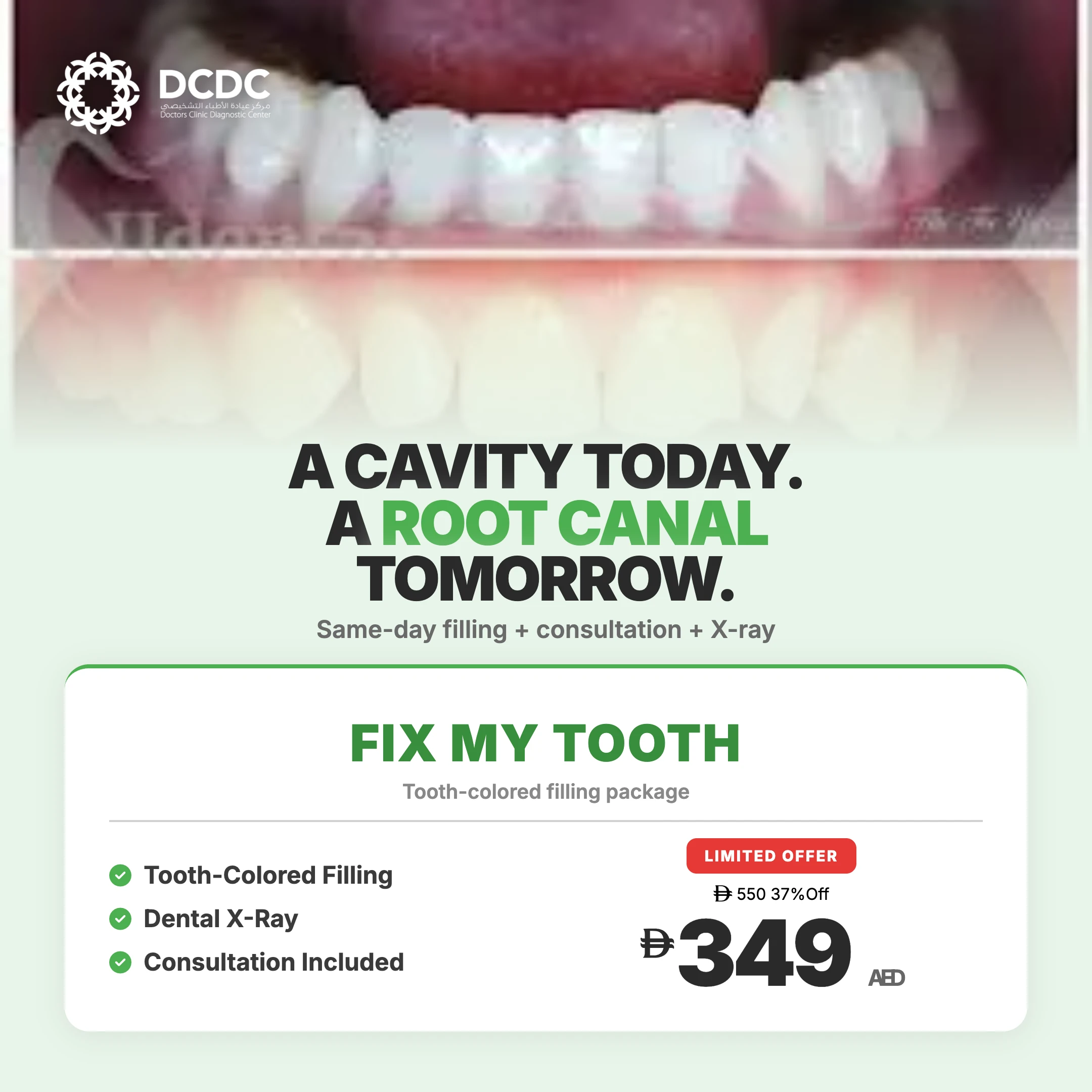

Tooth Filling vs Crown: How to Choose the Right Restoration
The decision between a filling and a crown comes down to three factors: how much healthy tooth structure remains, where the tooth sits in your mouth, and what forces the restoration will face. A filling plugs a hole; a crown replaces the entire outer shell. Both options use biocompatible, tooth-colored materials in modern dentistry, but they are engineered for fundamentally different levels of damage.
Think of it this way: if your tooth were a wall with a small nail hole, a filling is the spackle and paint. If half the wall is crumbling, a crown is the new panel that goes over the entire surface. Understanding that distinction is the first step toward making the right choice for your oral health and your budget.
"The most common mistake I see is patients who delay getting a crown when one is needed, hoping a filling will hold," says Dr. Chadi El Masry, Cosmetic and Restorative Dentist at DCDC. "A large filling in a weakened tooth can fracture under chewing pressure, and what was a straightforward crown case can become an extraction."
What Is a Dental Filling?
A dental filling is a direct restoration placed inside a tooth to repair a cavity or minor structural defect. The dentist removes the decayed or damaged portion, cleans the cavity, and fills it with a restorative material that bonds to the remaining tooth structure. In modern practice at DCDC Dubai, we use composite resin (tooth-colored) fillings almost exclusively because they bond chemically to enamel and dentin, require less tooth removal than amalgam, and are virtually invisible.
Types of Filling Materials
- Composite resin: Tooth-colored, bonds directly to tooth structure, preserves maximum healthy enamel. Used for front and back teeth. This is the standard material at DCDC.
- Glass ionomer: Releases fluoride to help prevent recurrent decay. Often used for fillings near the gum line or in pediatric dentistry.
- Amalgam (silver): Durable but conspicuous. Rarely used in Dubai today due to aesthetic concerns and mercury content.
- Ceramic/porcelain inlay: Lab-fabricated filling for larger cavities. More durable than composite but more expensive. Technically an indirect restoration.
How a Composite Filling Is Placed
At DCDC, same-day composite filling placement typically takes 30-45 minutes per tooth. After numbing the area with local anesthesia, the dentist removes decay with a handpiece, disinfects the cavity, applies a bonding agent, layers composite resin in increments, and cures each layer with a blue LED light. The filling is then shaped and polished to match your bite. You can eat and drink normally within a few hours.
What Is a Dental Crown?
A dental crown (sometimes called a "cap") is an indirect restoration that covers the entire visible portion of a tooth above the gum line. It restores the tooth's shape, strength, size, and appearance. Crowns are fabricated in a dental laboratory from a digital or physical impression of your prepared tooth, then cemented permanently in place at a second appointment.
Crown Materials Available at DCDC
- Zirconia: Extremely strong, tooth-colored ceramic. Ideal for back teeth (molars and premolars) where chewing forces are greatest. Highly resistant to chipping.
- E-max (lithium disilicate): Premium pressed ceramic with excellent translucency. Best aesthetic result for front teeth and premolars. Combines strength with a lifelike appearance.
- Feldspathic porcelain: Layered porcelain offering the most natural appearance. Used for front teeth where aesthetics are the top priority.
- Porcelain-fused-to-metal (PFM): Metal substructure with porcelain overlay. Durable but can show a dark line at the gum margin over time. Less commonly requested today.
The Crown Placement Process
Crown placement at DCDC requires two visits spaced 1-2 weeks apart. At the first visit (the prep appointment), the dentist reshapes the tooth by removing about 1.5-2 mm of structure on all sides, takes a digital impression using an intraoral scanner (no messy putty), selects the shade, and fits a temporary crown to protect the tooth. The digital scan is sent to the laboratory. At the second visit, the temporary crown is removed, the permanent crown is tried in, adjusted for fit and bite, and cemented with dental adhesive.
Filling vs Crown: Side-by-Side Comparison
The table below summarizes the key clinical and practical differences between dental fillings and dental crowns. Use it as a quick reference when discussing options with your dentist in Dubai.
| Feature | Dental Filling | Dental Crown |
|---|---|---|
| What it does | Fills a cavity or small defect inside the tooth | Caps and encases the entire visible tooth |
| Best for | Small to moderate decay (less than 1/3 of tooth surface) | Extensive decay, fractures, post-root-canal, cosmetic reshaping |
| Tooth structure removed | Minimal (only decayed portion) | Significant (1.5-2 mm reduced on all sides) |
| Material | Composite resin, glass ionomer | Zirconia, E-max, feldspathic porcelain, PFM |
| Appointments needed | 1 visit (30-45 minutes) | 2 visits over 1-2 weeks |
| Longevity | 7-15 years | 15-25 years |
| Aesthetics | Excellent shade match for small restorations | Excellent full-tooth makeover; ideal for visible teeth |
| Strength added | Restores lost structure but does not reinforce | Splints and strengthens the entire tooth |
| Cost at DCDC (from) | AED 150 | AED 1,250 |
| Reversibility | Partially reversible (filling can be replaced) | Irreversible (tooth is permanently reshaped) |
Comparison based on clinical guidelines and DCDC treatment protocols. Individual cases may vary.
When a Filling Is the Better Choice
A filling is generally the right restoration when enough healthy tooth structure remains to support it. Dentists evaluate this by looking at the size of the cavity relative to the overall tooth and the location of the damage.
Clinical Scenarios Favoring a Filling
- Small to moderate cavities: When decay affects less than one-third of the tooth's biting surface, a composite filling provides a durable, conservative repair.
- Early interproximal (between-teeth) decay: Cavities caught early on X-rays that have not undermined the cusps of the tooth.
- Chipped front teeth: Minor chips on incisors or canines can be beautifully repaired with composite bonding, which is essentially a filling shaped to restore the tooth's contour.
- Replacing old amalgam fillings: If a small amalgam filling is failing but the surrounding tooth is intact, a composite replacement is appropriate.
- Cervical (gum-line) erosion: Wear or acid erosion at the gum line is repaired with glass ionomer or composite fillings to prevent sensitivity and further damage.
- First-time decay in children and teens: Conservative fillings preserve developing tooth structure and are easily replaced if needed as the patient grows.
For a detailed breakdown of filling types, materials, and what drives cost, see our dedicated guide: Dental Fillings Cost Dubai: From AED 150.
When You Need a Crown Instead
A crown becomes necessary when the remaining tooth structure is too weak to support a filling, or when the tooth needs full-coverage protection to prevent fracture. Placing a filling in a situation that calls for a crown is a short-term fix that often leads to a worse outcome.
Clinical Scenarios Requiring a Crown
- Large cavities (more than 50% of tooth surface): When decay has destroyed more than half the biting surface, a filling cannot distribute chewing forces safely. A crown is needed to hold the tooth together.
- Cracked or fractured teeth: A crown bands the tooth and prevents the crack from propagating into the root, which would make the tooth unrestorable.
- After root canal treatment: Root-canal-treated teeth lose their blood supply and become brittle. A crown provides the full-coverage protection needed to prevent fracture, especially on molars.
- Severe wear from grinding (bruxism): Patients who clench or grind may wear teeth down significantly. Crowns rebuild the lost tooth height and protect against further wear.
- Failed large fillings: When a big filling breaks or develops recurrent decay around its margins, the remaining tooth is usually too compromised for another filling.
- Cosmetic transformation: Crowns can reshape teeth that are severely discolored, misshapen, or poorly aligned when veneers alone would not provide enough coverage.
- Dental implant restoration: An implant post requires a crown to serve as the visible, functional replacement tooth.
For complete information on crown types, lab fabrication, and pricing at DCDC, read: Dental Crown Cost Dubai: From AED 800.
Crown After Root Canal: Why It Matters
One of the most common clinical questions patients ask is whether they really need a crown after a root canal. The short answer for back teeth is almost always yes. Research published in the Journal of Endodontics shows that root-canal-treated molars without crown coverage are six times more likely to fracture than those with crowns.
During root canal therapy, the infected nerve tissue and blood supply are removed from inside the tooth. This saves the tooth from extraction but leaves it structurally weaker and more prone to drying out and cracking over time. A crown acts as a protective helmet, distributing bite forces evenly across the entire surface.
When a Crown May Not Be Needed After Root Canal
- Front teeth (incisors and canines): These teeth bear much less biting force. If the tooth retains most of its structure, a composite filling to seal the access hole may suffice, though a crown still offers better long-term protection.
- Premolars with minimal damage: In select cases where the cavity was small and cusps are intact, a large composite or onlay may be appropriate.
"I always discuss crown placement at the root canal consultation, not after," explains Dr. Chadi El Masry. "Patients should budget for both the root canal (from AED 800 at DCDC) and the crown (from AED 1,250) because together they give the tooth the best chance of lasting decades."
At DCDC, root canal treatment starts from AED 800 depending on the tooth and number of canals. When combined with a crown, the total investment typically ranges from AED 2,050 to AED 3,500. We coordinate the root canal and crown appointments to minimize visits and ensure seamless treatment.
Filling vs Crown Cost in Dubai
Cost is a major factor for patients deciding between a filling and a crown. Below is a pricing comparison for common dental restorations at DCDC Dubai Healthcare City and across Dubai clinics generally. All DCDC prices are starting rates; final cost depends on tooth location, material choice, and case complexity.
| Treatment | DCDC Starting Price | Dubai Average Range | Notes |
|---|---|---|---|
| Composite filling (1 surface) | AED 150 | AED 150 - 500 | Same-day placement, tooth-colored, most common |
| Composite filling (2-3 surfaces) | AED 250 | AED 300 - 800 | Larger cavities involving multiple tooth surfaces |
| Glass ionomer filling | AED 150 | AED 150 - 400 | Fluoride-releasing, often used near gum line |
| Porcelain inlay/onlay | AED 800 | AED 800 - 2,000 | Lab-made, for mid-size cavities too large for direct filling |
| Zirconia crown | AED 1,250 | AED 1,200 - 3,500 | Strongest option, ideal for molars |
| E-max crown | AED 1,250 | AED 1,500 - 4,000 | Best aesthetics, ideal for front teeth and premolars |
| Feldspathic porcelain crown | AED 1,250 | AED 1,500 - 3,500 | Most natural-looking, hand-layered ceramic |
| PFM crown | AED 1,000 | AED 800 - 2,500 | Metal core with porcelain; less requested today |
| Root canal (anterior tooth) | AED 800 | AED 800 - 2,000 | Often paired with crown placement afterward |
| Root canal (molar) | AED 1,200 | AED 1,200 - 3,500 | Multiple canals; crown strongly recommended after |
| Dental cleaning | AED 200 | AED 200 - 500 | Preventive care to reduce need for restorations |
Prices at DCDC are starting rates as of July 2026. Insurance direct billing available with 20+ partners.
DCDC offers direct billing with 20+ insurance partners, which significantly reduces out-of-pocket costs for many patients. Our patient coordinators verify coverage before treatment so there are no surprises. Dental fillings are covered under most comprehensive insurance plans in Dubai, while crown coverage varies by policy.
Need a Filling or Crown? Get Expert Advice at DCDC
Our dental team evaluates every case individually to recommend the most conservative, cost-effective restoration. Book a consultation with cosmetic fillings or dental crown specialists at DCDC Dubai Healthcare City. Same-day filling appointments available.
Book a Dental Consultation
How Long Do Fillings and Crowns Last?
Longevity is one of the biggest differences between fillings and crowns, and it directly affects the long-term value of your investment. However, how long either restoration lasts depends heavily on the material used, the size and location of the restoration, your oral hygiene, and whether you grind your teeth.
Filling Lifespan by Material
- Composite resin: 7-15 years. Smaller fillings on low-stress teeth last longer. Front-tooth bonding may need touch-ups sooner due to staining.
- Glass ionomer: 5-7 years. Softer material, best suited for low-stress areas. Releases fluoride, which is a clinical advantage.
- Amalgam: 10-15 years. Very durable but rarely placed today due to aesthetics. Existing amalgams may still be functioning decades later.
- Porcelain inlay/onlay: 10-20 years. Lab-fabricated, stronger than direct composite for larger restorations.
Crown Lifespan by Material
- Zirconia: 15-25+ years. Extremely fracture-resistant. May outlast the tooth itself with good oral hygiene.
- E-max: 15-20 years. Excellent durability with superior aesthetics.
- Feldspathic porcelain: 10-15 years. Beautiful but slightly more prone to chipping than zirconia.
- PFM: 10-20 years. Metal core is strong, but the porcelain layer can chip, and dark margins may appear at the gum line.
A well-placed filling may cost AED 150-300 but need replacement in 10 years, costing you AED 300-600 over 20 years. A crown costs AED 1,250+ up front but can last 20+ years without replacement. For teeth with significant damage, the crown is often the more economical choice over a patient's lifetime.
If you are weighing the full lifecycle of a restoration, consider exploring the long-term implications in our detailed post: Root Canal vs Tooth Extraction Dubai, which discusses when saving a tooth with a root canal and crown outperforms extraction and implant.
What to Expect at DCDC for Dental Restorations
Doctors Clinic Diagnostic Center is located in Building 64, Block A, Al Razi Medical Complex, Dubai Healthcare City. Our dental department has 6+ specialists covering general, cosmetic, restorative, orthodontic, and surgical dentistry. Here is what a typical filling or crown visit looks like.
Your Filling Appointment (Single Visit)
- Check-in and insurance verification: Our front-desk team verifies your insurance coverage on the spot with 20+ direct-billing partners. Free parking is available.
- Digital X-ray and examination: Your dentist takes a periapical or bitewing X-ray to assess the extent of decay and confirm that a filling is appropriate.
- Shade matching: Using composite shade guides under calibrated lighting, the dentist selects a resin color that matches your natural teeth exactly.
- Numbing and preparation: Local anesthesia is administered. The decayed portion is removed with a high-speed handpiece, and the cavity is cleaned and disinfected.
- Layered placement and curing: Composite resin is applied in thin layers, each cured with a blue LED light for 20-40 seconds. This incremental technique minimizes shrinkage and ensures a strong bond.
- Bite check and polish: The filling is shaped to match your natural bite, then polished to a smooth, stain-resistant finish. Total chair time: approximately 30-45 minutes.
Your Crown Journey (Two Visits)
- Visit 1 - Preparation (60-90 minutes): After examination and X-rays, the dentist numbs the tooth and reshapes it by removing approximately 1.5-2 mm of structure on all sides. A digital impression is captured using an intraoral scanner, eliminating the need for uncomfortable putty molds. A temporary crown is fabricated and cemented to protect the prepared tooth while the lab crafts your permanent restoration.
- Lab fabrication (1-2 weeks): Your digital scan is sent to a partnered dental laboratory. Technicians use CAD/CAM technology to mill or press your crown from the selected material (zirconia, E-max, or feldspathic porcelain). Custom shade and translucency are matched to your adjacent teeth.
- Visit 2 - Cementation (30-45 minutes): The temporary crown is removed. The permanent crown is tried in and evaluated for fit, color, and bite accuracy. Once approved, it is cemented with high-strength dental adhesive. Minor adjustments are made chair-side.
DCDC is open Saturday through Thursday from 8 AM to 10 PM and Friday from 9 AM to 9 PM, making it easy to schedule dental appointments around work or school. Our MOHAP-licensed facility maintains the highest sterilization and infection-control standards, and our 4.8/5 Google rating from 1,000+ reviews reflects a 98% patient satisfaction rate.

Cosmetic and Restorative Dentistry
Dr. Chadi El Masry is a Cosmetic and Restorative Dentist at Doctors Clinic Diagnostic Center (DCDC) in Dubai Healthcare City. A Hollywood Smile specialist, Dr. Chadi combines advanced cosmetic techniques with evidence-based restorative dentistry to deliver natural-looking fillings and precision-crafted crowns.
Filling or Crown: Decision Guide for Patients
Still unsure which restoration you need? Use this decision framework. Answer the questions below and see which path applies to your situation. This is a general guide, and your dentist will confirm the recommendation after a clinical exam and X-rays.
Choose a Filling If...
- The cavity is small to moderate (less than one-third of the biting surface).
- The tooth has not had a root canal.
- The surrounding cusps and walls of the tooth are intact and strong.
- The tooth is not a heavily loaded molar in a patient who grinds their teeth.
- You want a same-day, single-visit solution.
- Budget is a priority and the clinical situation permits a filling.
Choose a Crown If...
- More than 50% of the tooth's structure is damaged or missing.
- The tooth has undergone root canal treatment (especially molars).
- There is a visible crack or fracture in the tooth.
- A previous large filling has failed or developed recurrent decay.
- You have bruxism (teeth grinding) and need reinforced protection.
- The tooth is an implant that needs a prosthetic top.
- You want a long-term restoration (15-25+ years) for a heavily damaged tooth.
The grey zone: When damage falls between 33% and 50% of the tooth surface, either a large filling, an inlay/onlay, or a crown could work. This is where your dentist's clinical judgment and experience matter most. At DCDC, Dr. Chadi El Masry and the dental team use magnification loupes and digital X-rays to assess borderline cases accurately. The goal is always to recommend the most conservative option that will last.
Common Myths About Fillings and Crowns
Misinformation about dental restorations is widespread. Here are the most common myths we hear at DCDC, along with what the evidence actually shows.
Myth 1: Crowns Are Only for Old People
Fact: Crowns are prescribed based on the condition of the tooth, not the age of the patient. A 25-year-old with a cracked molar needs a crown just as much as a 65-year-old. In fact, placing a crown early on a damaged tooth can prevent the need for extraction and implant later.
Myth 2: A Crown Means the Tooth Is Fake
Fact: A crown covers your natural tooth root and remaining structure. The root is still alive (unless a root canal was done), and the tooth remains anchored in your jawbone. Modern zirconia and E-max crowns are virtually indistinguishable from natural teeth.
Myth 3: White Fillings Are Weak
Fact: Today's composite resins have advanced dramatically. Contemporary nano-hybrid composites used at DCDC have compressive strength approaching that of natural enamel. Studies in the Journal of Dental Research confirm that modern composites in properly sized cavities perform comparably to amalgam over 10+ years.
Myth 4: Fillings Last Forever
Fact: No dental restoration is permanent. Composite fillings typically last 7-15 years, and even amalgam fillings eventually degrade. Regular dental check-ups at DCDC (cleanings from AED 200, including oral cancer screening) allow your dentist to monitor restorations and catch failures early.
Myth 5: You Can Always Upgrade a Filling to a Crown Later
Fact: Sometimes, but not always. If a large filling fractures and takes a cusp of the tooth with it, the tooth may become unrestorable. In those cases, the only options are extraction and replacement with a bridge or implant, which is far more expensive and invasive than a crown would have been.
Myth 6: Dental Crowns Cause Sensitivity Permanently
Fact: Some sensitivity to hot and cold is normal for 1-2 weeks after crown preparation. This usually resolves as the tooth adapts. Persistent sensitivity beyond a month should be evaluated, as it may indicate a high bite or the need for root canal treatment. At DCDC, Dr. Chadi El Masry checks the bite meticulously during cementation to minimize post-operative sensitivity.
DCDC Dental Department: Fillings & Crowns in Dubai Healthcare City
With 6+ dental specialists, digital impression technology, and 4.8/5 Google rating from 1,000+ reviews, DCDC provides comprehensive restorative dentistry in Dubai Healthcare City. Same-day filling appointments and 1-2 week crown delivery. Open Saturday-Thursday 8AM-10PM, Friday 9AM-9PM.
WhatsApp Us Now
Verwandte Leistungen im DCDC
Fachkundige Betreuung und moderne Diagnostik in Dubai Healthcare City
Frequently Asked Questions
Final Thoughts
Choosing between a dental filling and a crown is not about preference; it is about matching the restoration to the level of damage. A small cavity deserves a conservative filling. A badly broken or root-canal-treated tooth needs the full protection of a crown. Getting the right restoration the first time saves you time, money, and discomfort down the road.
The best way to determine which option is right for you is a clinical examination with digital X-rays. At DCDC, we believe in transparent communication: we show you the X-ray, explain the damage, outline all viable options with clear pricing, and let you make an informed decision. There is no pressure to choose a more expensive treatment when a simpler one will do.
To book a dental consultation at Doctors Clinic Diagnostic Center in Dubai Healthcare City, call us, WhatsApp us, or book online. With composite fillings from AED 150 and crowns from AED 1,250, expert care from Dr. Chadi El Masry, and direct insurance billing with 20+ partners, restoring your smile has never been more accessible.
Quellen und Referenzen
Dieser Artikel wurde von unserem medizinischen Team überprüft und bezieht sich auf folgende Quellen:
- American Dental Association - Dental Filling Options
- Journal of Endodontics - Survival of Root Canal Treated Teeth With and Without Crown Restoration
- Journal of Dental Research - Longevity of Posterior Composite Restorations
- British Dental Journal - Clinical Performance of Ceramic and Zirconia Crowns
- World Health Organization - Oral Health Fact Sheet
- UAE Ministry of Health and Prevention (MOHAP) - Dental Health Guidelines
Medizinische Inhalte auf dieser Website werden von DHA-lizenzierten Ärzten überprüft. Siehe unsere redaktionelle Richtlinien für weitere Informationen.
Verfasst von
Dr. Chadi El Masry
Cosmetic & Restorative Dentist
DDS
Dr. Chadi El Masry is a Cosmetic and Restorative Dentist at Doctors Clinic Diagnostic Center (DCDC) in Dubai Healthcare City.
Related Articles
Dental Fillings Cost Dubai: From AED 150

Dental Crown Cost Dubai: From AED 800
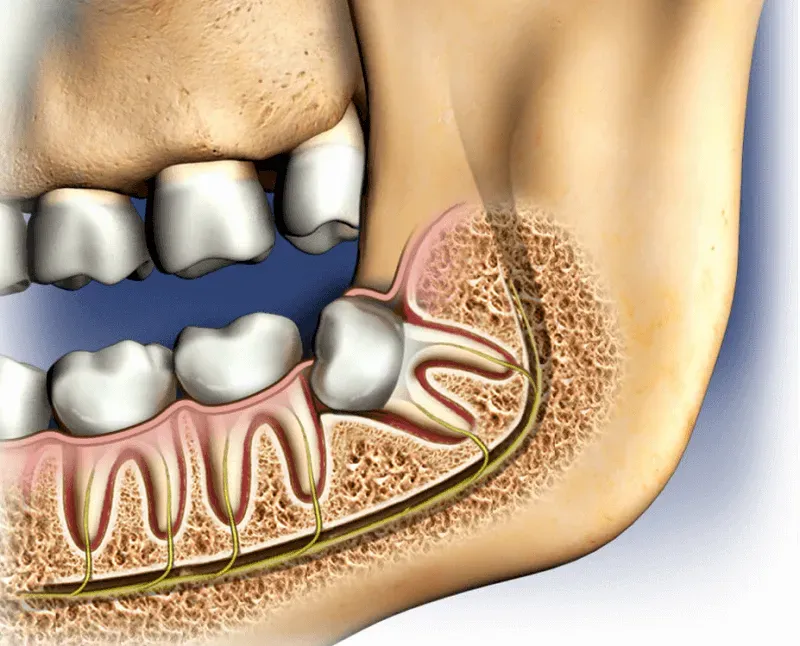
Root Canal vs Tooth Extraction Dubai
Dental Crowns vs Veneers Dubai: Guide
Toothache Dubai: Causes & When to See a Dentist
More in Dental
Dental Crowns vs Veneers Dubai: Guide (2026)
Weiterlesen
Dentures vs Dental Implants Dubai (2026)
Weiterlesen
Dental Veneers Cost Dubai: From AED 500 (2026)
WeiterlesenRoot Canal vs Tooth Extraction Dubai (2026)
WeiterlesenDental Inlays & Onlays Dubai: Cost Guide (2026)
WeiterlesenDentures Cost Dubai: Types & Prices (2026)
Weiterlesen© 2026 Doctors Clinic Diagnostic Center (DCDC), Dubai Healthcare City. Originally published at https://doctorsclinicdubai.ae/blog/tooth-filling-vs-crown-dubai. All rights reserved. Unauthorized reproduction is prohibited.