النقاط الرئيسية
- Mammography is the gold standard for routine breast cancer screening and is the only imaging test proven to reduce breast cancer mortality in large population studies
- Breast ultrasound is a radiation-free supplemental tool that is particularly valuable for evaluating dense breast tissue, where mammograms may miss small lesions
- Mammograms use low-dose X-rays to detect calcifications, architectural distortions, and masses, while ultrasound uses high-frequency sound waves to distinguish solid lumps from fluid-filled cysts
- Neither test fully replaces the other; the most thorough approach for women with dense breasts or elevated risk factors is to use mammography and ultrasound together
- DCDC in Dubai Healthcare City offers both digital mammography and breast ultrasound with same-day reporting by experienced radiology specialists
Choosing between a breast ultrasound vs mammogram is one of the most common questions women face when discussing breast health with their doctor. Both are safe, well-established imaging tests, yet they work in fundamentally different ways and serve different clinical purposes. A mammogram uses low-dose X-rays to create detailed images of breast tissue and remains the primary screening tool recommended by every major health authority for the early detection of breast cancer. A breast ultrasound uses high-frequency sound waves to produce real-time images and is most often used as a supplemental test to evaluate a specific lump, characterize an abnormality found on mammography, or provide additional screening for women with dense breast tissue.
This guide provides a thorough, evidence-based comparison of breast ultrasound and mammogram, explains how each test works, identifies the clinical scenarios where one is preferred over the other, clarifies whether ultrasound can replace mammography, and outlines how both tests are used together for comprehensive breast evaluation at Doctors Clinic Diagnostic Center (DCDC) in Dubai Healthcare City.
Breast Ultrasound vs Mammogram: Overview
The debate around breast ultrasound vs mammogram often stems from a misunderstanding of what each test is designed to do. A mammogram is a screening tool, meaning it is used on women who have no symptoms, with the goal of detecting cancer at its earliest and most treatable stage. A breast ultrasound is primarily a diagnostic and supplemental tool, used to investigate a specific clinical concern such as a palpable lump, nipple discharge, or an abnormality identified on a mammogram. While there is overlap between the two, they are complementary rather than interchangeable.
Mammography has been the cornerstone of breast cancer screening programs worldwide for over four decades. Multiple large-scale randomized controlled trials have demonstrated that regular mammographic screening reduces breast cancer mortality by 20 to 40 percent in women aged 40 to 74. No other single imaging modality has achieved this level of evidence for mortality reduction. Breast ultrasound, while extremely useful for characterizing lesions and evaluating dense tissue, has not been shown in randomized trials to independently reduce breast cancer deaths when used as the sole screening method.
"Understanding the distinct roles of mammography and ultrasound is essential for making informed decisions about breast health," explains Dr. Osama Elzamzami, Specialist in Diagnostic Radiology at DCDC. "Mammography remains the foundation of screening, but ultrasound adds a critical layer of information, particularly for women with dense breast tissue where mammograms alone may not tell the full story."
| Feature | Mammogram | Breast Ultrasound |
|---|---|---|
| Technology | Low-dose X-rays | High-frequency sound waves |
| Radiation | Yes (very low dose, ~0.4 mSv) | None |
| Primary role | Screening and early detection | Diagnostic and supplemental screening |
| Best age to start | Age 40 (annual screening recommended) | Any age (as clinically indicated) |
| Sensitivity in fatty breasts | High (approximately 85-90%) | Moderate |
| Sensitivity in dense breasts | Reduced (approximately 50-70%) | High (detects additional 2-4 cancers per 1,000) |
| Detects calcifications | Excellent | Limited |
| Distinguishes cyst from solid mass | Limited | Excellent (near 100% accuracy) |
| Procedure time | 10-20 minutes | 15-30 minutes |
| Cost range (Dubai) | AED 400-1,200 | AED 300-800 |
| Best for | Routine screening, calcification detection, baseline imaging | Dense breasts, lump evaluation, cyst characterization, pregnancy |
Comparison of mammogram and breast ultrasound across key clinical and practical factors.
How Each Test Works
How a Mammogram Works
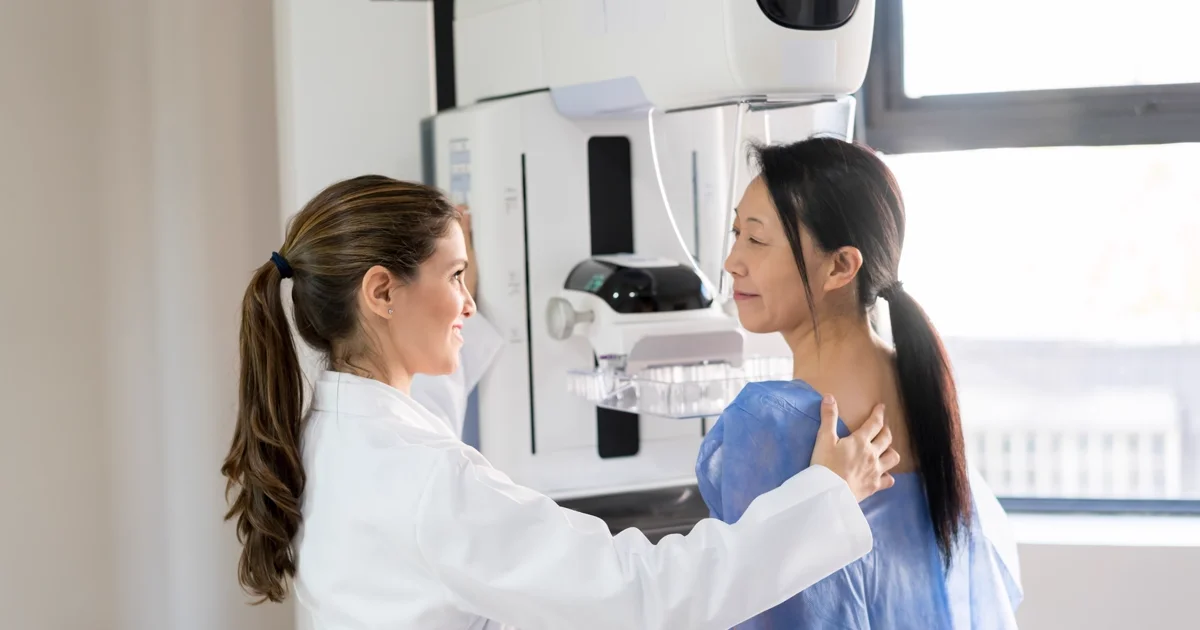
A mammogram works by compressing the breast between two flat plates and passing a low-dose X-ray beam through the tissue. The X-rays are absorbed differently by fat, fibroglandular tissue, and abnormal growths, creating a contrast image that the radiologist interprets for signs of cancer. Modern digital mammography (also called full-field digital mammography or FFDM) captures images electronically, allowing the radiologist to adjust brightness, contrast, and zoom to examine suspicious areas in detail.
During a standard screening mammogram, two views of each breast are taken: a top-to-bottom view (craniocaudal or CC) and an angled side view (mediolateral oblique or MLO). The compression, while briefly uncomfortable, is essential because it spreads the breast tissue apart, reduces overlapping structures, improves image sharpness, and lowers the radiation dose required. The entire procedure takes approximately 10 to 20 minutes from start to finish, with the actual compression lasting only a few seconds per image.
The radiation dose from a screening mammogram is very low, approximately 0.4 millisieverts (mSv) for a standard two-view bilateral study. This is roughly equivalent to seven weeks of natural background radiation and is well within the safety limits established by the International Commission on Radiological Protection. Mammography is the only breast imaging modality that reliably detects microcalcifications, tiny calcium deposits that can be the earliest visible sign of ductal carcinoma in situ (DCIS) or invasive breast cancer, often appearing years before a lump can be felt.
How a Breast Ultrasound Works
A breast ultrasound works by placing a small handheld device called a transducer against the skin of the breast. The transducer emits high-frequency sound waves (typically 7 to 18 megahertz) that travel through the breast tissue and bounce back when they encounter boundaries between different tissue types. The returning echoes are converted into real-time images on a monitor, allowing the radiologist or sonographer to examine the internal structure of the breast without any radiation exposure.
Before the scan, a water-based gel is applied to the breast to ensure good contact between the transducer and the skin and to eliminate air gaps that would interfere with sound wave transmission. The sonographer systematically scans the entire breast in overlapping sweeps, paying particular attention to any area of clinical concern such as a palpable lump or a region flagged on a mammogram. The examination typically takes 15 to 30 minutes, depending on breast size and the complexity of the findings.
Ultrasound excels at distinguishing between solid masses (which may require biopsy) and fluid-filled cysts (which are almost always benign). This distinction, known as tissue characterization, is one of the most important clinical applications of breast ultrasound. A simple cyst appears as a well-defined, anechoic (completely black) structure on ultrasound with sharp posterior acoustic enhancement, providing near-100 percent accuracy in classification and typically eliminating the need for invasive biopsy. Ultrasound is also the imaging modality of choice for guiding needle biopsies and aspirations because it provides continuous, real-time visualization of the needle as it enters the breast.
For a complete overview of ultrasound technology and its applications beyond breast imaging, see our guide on what is an ultrasound scan.
When to Choose Mammogram
A mammogram is the appropriate first-choice imaging test in several well-defined clinical scenarios. The decision to recommend mammography is supported by decades of evidence from large randomized controlled trials and is endorsed by every major medical and radiological society worldwide.
Routine Annual Screening
Mammography is recommended as the primary screening test for breast cancer in women beginning at age 40. The American College of Radiology (ACR) and the Society of Breast Imaging (SBI) recommend annual mammographic screening starting at age 40 for women at average risk, while the U.S. Preventive Services Task Force (USPSTF) updated its recommendation in 2024 to begin biennial screening at age 40. Regardless of the specific interval, all major guidelines agree that mammography is the only imaging modality with sufficient evidence to serve as the primary screening tool for breast cancer.
Detection of Microcalcifications
Mammography is uniquely capable of detecting microcalcifications, which are tiny deposits of calcium within the breast tissue that can indicate the earliest stages of breast cancer, particularly ductal carcinoma in situ (DCIS). These calcifications are often too small to be felt during a physical examination and are generally invisible on ultrasound. Detecting DCIS through mammographic calcification screening allows treatment before the cancer becomes invasive, significantly improving survival outcomes. Approximately 25 to 30 percent of mammographically detected breast cancers present as calcifications alone, without an associated mass.
Baseline Breast Assessment
A baseline mammogram performed at age 35 to 40 provides a reference point that radiologists use to compare with future screening mammograms. This comparison is critical because subtle changes in breast tissue architecture over time can signal early cancer development. Without a baseline study for comparison, the radiologist must interpret the mammogram in isolation, which can result in higher recall rates (false positives) or, conversely, missed early changes.
Post-Treatment Surveillance
Women who have been treated for breast cancer require ongoing surveillance mammography to monitor for cancer recurrence or new primary cancers in either breast. Post-treatment surveillance protocols typically include annual mammography of the treated breast and the contralateral breast, beginning six months to one year after completion of radiation therapy. Mammography remains the standard of care for this surveillance because it provides consistent, reproducible imaging that can be directly compared year over year.
To learn more about the mammogram procedure itself, including preparation and what to expect, read our comprehensive guide on what is a mammogram.
When to Choose Breast Ultrasound
Breast ultrasound is the preferred imaging modality in specific clinical situations where its unique characteristics, particularly the absence of radiation and the ability to characterize tissue in real time, provide a distinct advantage over mammography.
Evaluating a Palpable Lump
When a woman or her doctor discovers a palpable breast lump, ultrasound is typically the first imaging step for women under 30 and a critical complementary step for women over 30 (who will also receive a mammogram). Ultrasound can rapidly determine whether the lump is a simple cyst (benign, no further action needed), a complex cyst (may need aspiration or follow-up), or a solid mass (may require biopsy). This real-time tissue characterization guides the next clinical decision within the same appointment.
Supplemental Screening for Dense Breasts
Breast density is classified into four categories on mammography, ranging from almost entirely fatty (category A) to extremely dense (category D). Approximately 40 to 50 percent of women have heterogeneously dense or extremely dense breast tissue (categories C and D). Dense tissue appears white on mammograms, and because cancers also appear white, dense breast tissue can mask tumors, reducing mammographic sensitivity from approximately 85 percent in fatty breasts to as low as 50 percent in extremely dense breasts.
Supplemental breast ultrasound screening in women with dense breasts has been shown to detect an additional 2 to 4 cancers per 1,000 women that were occult (hidden) on mammography alone. The ACRIN 6666 trial, a landmark multi-center study, demonstrated that adding a single screening ultrasound to mammography increased cancer detection by 55 percent in women with dense breasts and at least one additional risk factor. For an in-depth discussion of this topic, see our article on dense breast tissue screening.
Breast Imaging During Pregnancy and Lactation
Ultrasound is the first-line imaging modality for evaluating breast concerns during pregnancy and breastfeeding. Because it uses sound waves rather than ionizing radiation, ultrasound poses no risk to the developing fetus. The hormonal changes of pregnancy and lactation cause significant breast tissue changes that make mammographic interpretation more difficult, further favoring ultrasound as the initial imaging choice in this population. If a suspicious solid mass is identified on ultrasound during pregnancy, mammography can still be safely performed with abdominal shielding if additional diagnostic information is needed.
Young Women Under 30
For women under the age of 30 presenting with a breast concern such as a lump or pain, ultrasound is the recommended initial imaging study. Young women generally have dense breast tissue that limits mammographic sensitivity, and the low incidence of breast cancer in this age group means the diagnostic yield of mammography is minimal. Ultrasound provides excellent visualization of the dense glandular tissue typical of younger breasts and avoids any radiation exposure. Mammography may be added if the ultrasound reveals a suspicious solid mass that warrants further characterization.
Guiding Biopsies and Interventions
When a biopsy is needed to sample a suspicious breast lesion, ultrasound guidance is the preferred technique whenever the lesion is visible on ultrasound. The radiologist can watch the biopsy needle in real time as it approaches and enters the target, ensuring accurate sampling. Ultrasound-guided core needle biopsy is faster, more comfortable, and less expensive than stereotactic (mammogram-guided) biopsy, and it avoids additional radiation exposure. At DCDC, ultrasound-guided biopsies are performed by experienced radiologists using state-of-the-art equipment, with results typically available within a few working days.
Book a Breast Screening Consultation
Not sure whether you need a mammogram, breast ultrasound scan, or both? Our radiology team at DCDC in Dubai Healthcare City can help determine the right screening plan based on your age, breast density, and risk factors.
Can Breast Ultrasound Replace Mammogram?
No, breast ultrasound cannot replace mammography as a primary screening tool for breast cancer. This is one of the most important points in the breast ultrasound vs mammogram discussion, and it is supported by strong consensus among radiological and oncological societies worldwide, including the American College of Radiology, the European Society of Breast Imaging, and the World Health Organization.
The fundamental limitation of breast ultrasound as a standalone screening tool is its inability to reliably detect microcalcifications, which represent approximately 25 to 30 percent of mammographically detected cancers. DCIS, the earliest and most curable form of breast cancer, frequently presents as microcalcifications without a visible mass. If ultrasound were used alone, these early cancers would be missed, potentially allowing them to progress to invasive disease before detection.
Additionally, breast ultrasound has a higher false-positive rate compared to mammography when used as a screening tool. The ACRIN 6666 trial found that supplemental ultrasound screening resulted in a positive predictive value of only 8.9 percent for biopsy recommendation, meaning that more than 90 percent of biopsies prompted by ultrasound findings turned out to be benign. While mammography also produces false positives, its positive predictive value for biopsy is substantially higher at approximately 25 to 40 percent.
"I often hear patients ask whether they can skip the mammogram and just get an ultrasound because there is no radiation," says Dr. Osama Elzamzami. "I understand the concern, but the evidence is clear: mammography detects cancers that ultrasound misses, particularly early-stage calcification-based cancers. The radiation dose from a mammogram is extremely low and the screening benefit far outweighs this minimal exposure. The best approach for most women is to get both tests, not to substitute one for the other."
Ultrasound does have a clear advantage over mammography in specific contexts, particularly for distinguishing cysts from solid masses, evaluating women under 30, imaging during pregnancy, and supplementing mammography in women with dense breasts. However, these advantages make ultrasound an excellent complement to mammography, not a replacement for it.
Using Both Tests Together
The most comprehensive approach to breast imaging is to use mammography and ultrasound together, leveraging the strengths of each modality to compensate for the limitations of the other. This combined approach is particularly important for women at elevated risk of breast cancer or those with dense breast tissue, where using a single modality may leave diagnostic gaps.
The Combined Screening Protocol
In a combined screening protocol, the mammogram is performed first to establish the structural baseline, identify any calcifications, and assess breast density. If the mammogram reveals an area of concern, a targeted breast ultrasound is immediately performed to further evaluate the finding. If the mammogram is normal but the breast tissue is classified as dense (ACR categories C or D), a whole-breast screening ultrasound may be performed to search for cancers hidden within the dense tissue. This stepwise approach maximizes cancer detection while minimizing unnecessary biopsies.
Patient Story: Why Both Tests Mattered
A 48-year-old woman living in Dubai came to DCDC for her annual screening mammogram. She had no symptoms, no family history of breast cancer, and felt healthy. The mammogram was reported as normal with no suspicious masses or calcifications, but the radiologist noted that her breast tissue was extremely dense (ACR category D). Based on the dense tissue classification and following evidence-based supplemental screening guidelines, Dr. Elzamzami recommended an additional breast ultrasound.
The ultrasound revealed a small, 9-millimeter solid mass in the left breast that was completely invisible on the mammogram because the surrounding dense tissue had the same X-ray density as the tumor. An ultrasound-guided core needle biopsy was performed the same week, and pathology confirmed an early-stage invasive ductal carcinoma. Because the cancer was detected at a small size and before it had spread to the lymph nodes, the patient was treated with a lumpectomy and a short course of radiation therapy and had an excellent prognosis.
"This case is a powerful illustration of why we need both tools," reflects Dr. Osama Elzamzami. "The mammogram was essential because it confirmed there were no calcifications and established the breast density category that triggered the supplemental ultrasound recommendation. The ultrasound then found the cancer that the mammogram could not show. Neither test alone would have given us the complete picture."
Who Should Get Both Tests?
- Women with dense breast tissue (ACR categories C or D): Dense tissue reduces mammographic sensitivity, and supplemental ultrasound can detect additional cancers hidden within the dense tissue
- Women with a personal history of breast cancer: Post-treatment surveillance benefits from the complementary information provided by both modalities
- Women with a strong family history: First-degree relatives of breast cancer patients have a 2-fold increased lifetime risk, and combined screening improves early detection
- Women with a palpable lump and a normal mammogram: A negative mammogram does not exclude breast cancer, and ultrasound should always be performed to evaluate a clinically palpable concern
- Women recalled from screening for further assessment: When a mammographic abnormality requires additional evaluation, targeted ultrasound is the standard next step in the diagnostic workup
Breast Imaging at DCDC Dubai
Doctors Clinic Diagnostic Center (DCDC) in Dubai Healthcare City provides a comprehensive breast imaging service that includes both digital mammography and high-resolution breast ultrasound, along with ultrasound-guided biopsies and interventional procedures. The center is equipped with modern digital mammography systems that deliver high-quality images at the lowest achievable radiation dose, and high-frequency ultrasound units with dedicated breast transducers that provide exceptional resolution for detecting small lesions.
Experienced Radiology Team
All breast imaging studies at DCDC are performed by qualified radiographers and interpreted by consultant radiologists with extensive experience in breast imaging. The radiologists follow standardized reporting using the BI-RADS (Breast Imaging Reporting and Data System) classification, ensuring that every mammogram and ultrasound report includes a clear assessment category and a specific management recommendation. This structured approach eliminates ambiguity and gives referring physicians and patients a clear path forward.
Same-Day Combined Screening
At DCDC, patients who require both a mammogram and a breast ultrasound can have both tests performed during a single visit. The mammogram is performed first, and if a supplemental ultrasound is indicated based on the mammographic findings or breast density, it can be done immediately without the need for a separate appointment. In most cases, the radiologist reviews the images and provides a verbal preliminary result on the same day, with the formal written report available within 24 hours.
Location and Booking
DCDC is located in Dubai Healthcare City, accessible from Downtown Dubai, Oud Metha, Karama, Bur Dubai, and the wider UAE. Breast imaging appointments can be booked by phone, WhatsApp, or through the online booking form. No referral is required for screening mammography, although a physician referral is recommended for diagnostic studies to ensure the radiologist has the clinical context needed to provide the most relevant interpretation.
Schedule Your Breast Screening at DCDC
DCDC in Dubai Healthcare City offers digital mammography and breast ultrasound with experienced radiology specialists. Whether you need a routine screening mammogram, a supplemental ultrasound for dense breasts, or a diagnostic workup for a breast concern, our team provides accurate imaging with same-day results.
Or call us directly to discuss your breast screening needs
الأسئلة الشائعة
Final Thoughts
The question of breast ultrasound vs mammogram does not have a one-size-fits-all answer, but the evidence is clear on the fundamental principles. Mammography is the proven, irreplaceable foundation of breast cancer screening, capable of detecting calcification-based early cancers that no other modality can reliably identify. Breast ultrasound is a powerful complementary tool that adds significant diagnostic value in specific scenarios, particularly for women with dense breast tissue, palpable lumps, or clinical situations where radiation avoidance is preferred. The two tests are most effective when used together, with mammography providing the structural screening baseline and ultrasound filling in the gaps where mammographic sensitivity is limited.
At Doctors Clinic Diagnostic Center (DCDC) in Dubai Healthcare City, both digital mammography and breast ultrasound are available with same-day reporting by experienced radiology specialists. Whether you are due for your annual screening mammogram, have been advised to add supplemental ultrasound for dense breasts, or need a diagnostic workup for a breast concern, DCDC provides the imaging expertise and equipment to support your breast health. To schedule an appointment, visit our contact page or reach out via WhatsApp.
المصادر والمراجع
تمت مراجعة هذا المقال من قبل فريقنا الطبي ويستند إلى المصادر التالية:
- American College of Radiology - ACR Appropriateness Criteria: Breast Cancer Screening
- Berg WA et al. - Combined Screening With Ultrasound and Mammography vs Mammography Alone in Women at Elevated Risk of Breast Cancer (ACRIN 6666)
- U.S. Preventive Services Task Force - Screening for Breast Cancer: Recommendation Statement (2024 Update)
- RadiologyInfo.org - Mammography
- European Society of Breast Imaging - Dense Breast Screening Recommendations
يتم مراجعة المحتوى الطبي على هذا الموقع من قبل أطباء مرخصين من هيئة الصحة. اطلع على سياستنا التحريرية لمزيد من المعلومات.

كتبه
Dr. Osama Elzamzami
Diagnostic Radiology
MD, FRCR
Dr. Osama Elzamzami is a Specialist in Diagnostic Radiology at DCDC Dubai Healthcare City, with expertise in breast imaging, mammography, ultrasound, CT, and MRI interpretation.